
Acitretin 10 & 25 Pharmc Capsule
PDF Leaflet Revision Date: 24 October 2023
Clinical Summary
Quick overview from the medicine insert
Indication
Severe psoriasis and keratinization disorders.
Dosage (summary)
Initial: 25-30 mg daily; Maintenance: 25-50 mg daily, max 75 mg.
Special Populations
- Renal impairment
- Hepatic impairment
Pregnancy & Breastfeeding
Highly teratogenic; contraindicated in pregnancy and breastfeeding.
Key Drug Interactions
- Alcohol
- Methotrexate
- Tetracyclines
Contraindications
- Pregnancy
- Lactation
- Hypersensitivity
- Severe liver/kidney impairment
Common side effects
- Headache
- Dry mouth
- Alopecia
- Arthralgia
Counselling Points
- Use effective contraception
- Avoid alcohol
- Monitor for mood changes
Serious warnings
- Teratogenic risk
- Monitor liver function
- Increased intracranial pressure
Important Disclaimer
The Acitretin 10 & 25 Pharmc Capsule professional information leaflet below is the property of Pharmacorp and is provided on Medinsert exactly as issued, with no.. alterations or editorial changes. We make every effort to keep content current by updating documents as soon as new versions become available. Medinsert serves as a trusted access point for healthcare professionals, but does not replace official sources or clinical judgement. For more details, please read our full disclaimer. read more>>
 Healthcare Professionals Only
This content is for registered healthcare professionals
Sign in or create a free account to read the full package insert.
Free for HPCSA-registered professionals. Powered by Medinsert.
Clinical Particulars
Section 4 of the official insert — extracted exactly as issued, no alterations
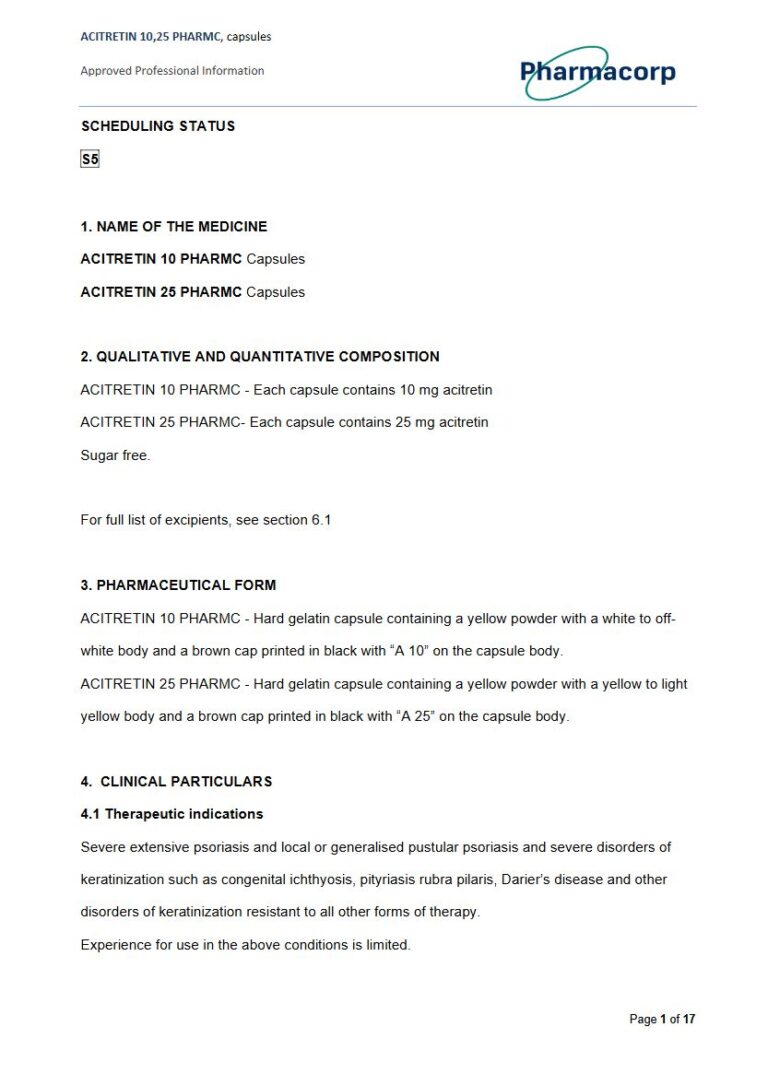
4.1 Therapeutic indications
Severe extensive psoriasis and local or generalised pustular psoriasis and severe disorders of keratinization such as congenital ichthyosis, pityriasis rubra pilaris, Darieru2019s disease and other disorders of keratinization resistant to all other forms of therapy. Experience for use in the above conditions is limited.
The quantity of a prescription should only cover treatment for one month to ensure regular monitoring.
4.2 Posology and method of administration
Posology
Adults
Because there are differences in the absorption and rate of metabolism of acitretin, the dosage must be individually adjusted. The capsules should be taken preferably once daily with a meal, or with some milk. The following will serve as guidelines:
The initial daily dose 25 mg (1 capsule; 25 mg) or 30 mg (3 capsules; 10 mg) for about two to four weeks may give satisfactory therapeutic results.
The maintenance dose Must be based on clinical efficacy and tolerability. In general, a daily dosage of 25 - 50 mg taken for a further six to eight weeks, achieves optimal therapeutic results. It may be necessary in some cases to increase the dose up to a maximum of 75 mg per day (3 capsules; 25 mg). Therapy can be terminated in patients with psoriasis whose lesions have resolved sufficiently. Relapses should be treated as described above.
In disorders of keratinization A continuous maintenance is mostly needed with the dose at the lowest possible level. This may be less than 20 mg/day and should not exceed 50 mg daily.
Combined treatment When ACITRETIN PHARMC is used in combination with other types of therapy, it may be possible, depending on the patient's individual response, to reduce the dosage of ACITRETIN PHARMC. Standard topical treatments except keratolytics which should be stopped, can generally be continued, and do not interfere with ACITRETIN PHARMC.
Method of administration For oral use only.
4.3 Contraindications
Pregnancy and lactation: ACITRETIN PHARMC is highly teratogenic and must not be used by females who are pregnant or who intend becoming pregnant. ACITRETIN PHARMC is contraindicated in all women of childbearing potential unless the following precautions are strictly observed:
- Before therapy with ACITRETIN PHARMC is instituted, patients of childbearing potential must be examined for pregnancy and told clearly and in detail by the medical practitioner about the precautions to be taken, the risks involved, and the possible consequences should pregnancy occur during the course of treatment or within three years of discontinuing therapy.
- Having excluded pregnancy, any woman of childbearing potential must practise effective contraception for at least one month before treatment, during the treatment period and for at least three years following its cessation.
- The same effective and uninterrupted contraceptive measure must be taken every time therapy is repeated, independently of the intervening period and must be continued for three years afterwards.
- Should pregnancy occur, in spite of these precautions, during treatment with ACITRETIN PHARMC or up to three years after its discontinuation, there is a high risk of severe malformation of the foetus (e.g., exencephaly).
- The woman is reliable and capable of understanding the risks, of complying with effective contraceptive measures and confirms that she has understood the warnings.
- Therapy should not begin until the second or third day of the next normal menstrual period.
- A negative pregnancy test result must be obtained within two weeks before commencement of treatment. (It is advisable to perform additional pregnancy tests at monthly intervals during therapy.)
- Women of childbearing potential must not receive blood from patients treated with ACITRETIN PHARMC. ACITRETIN PHARMC must not be given to nursing mothers.
u2022 Hypersensitivity to acitretin or to any of the inactive excipients (see section 6.1)
u2022 ACITRETIN PHARMC is also contraindicated in patients with severely impaired liver and kidney functions and in patients with chronic abnormally elevated blood lipid values.
u2022 The effect of microdosed progesterone preparations or u201cminipillsu201d may be diminished by interaction with acitretin and should not be used.
u2022 Hypervitaminosis A.
u2022 Children less than 18 years of age or until bone development is complete.
u2022 Treatment for longer than 12 months, as limited safety and efficacy data are available.
u2022 Since both acitretin, as contained in ACITRETIN PHARMC, and tetracyclines can cause increased intracranial pressure, their combined use is contraindicated. Supplementary treatment with antibiotics such as tetracyclines is therefore contraindicated (see section 4.5).
u2022 An increased risk of hepatitis has been reported following the concomitant use of methotrexate and etretinate. Consequently, the concomitant use of methotrexate and ACITRETIN PHARMC is contraindicated (see section 4.5).
4.4 Special warnings and precautions for use
The following musculo-skeletal changes have been reported after long-term systemic retinoid treatment: hyperostosis, including vertebral hyperostosis and bridging of vertebral bodies; exostoses; extra-skeletal calcifications, including soft tissue calcifications; calcification of the anterior spinal ligament and calcification of tendons and ligaments especially ankles, knees and pelvis; periosteal thickening; disk narrowing; cortical bone resorption; osteoporosis; thinning of bones; fractures; premature epiphyseal closure and painless muscle stiffness.
Less frequently, severe skin reactions, including erythema multiforme and toxic epidermal necrolysis may occur.
Less frequently, patients may experience photosensitivity reactions.
Transient and usually reversible elevation of transaminases and alkaline phosphatases have been observed. Elevation of serum triglycerides and serum cholesterol has occurred, especially in high-risk patients (disturbances of lipid metabolism, diabetes, obesity, alcoholism). An associated risk of atherogenesis cannot be ruled out if these disturbances persist.
Hepatic function should be monitored before and every one to two weeks for the first two months after starting treatment with ACITRETIN PHARMC and then every three months during treatment. If pathological values for hepatic function are found, monitoring should be repeated at weekly intervals. If they fail to return to normal or if they deteriorate, ACITRETIN PHARMC must be withdrawn. It is then advisable to continue monitoring hepatic function for at least three months.
Serum cholesterol and serum triglycerides (fasting values) must be monitored in high-risk patients (disturbances of lipid metabolism, diabetes, obesity, alcoholism) and in long-term treatment.
In diabetics, retinoids can either improve or worsen glucose tolerance. Blood-sugar levels should be checked more frequently than usual in the early stages of treatment.
Benign intracranial hypertension has been reported with ACITRETIN PHARMC. Since tetracyclines can also cause an increase in intracranial pressure, their combination with ACITRETIN PHARMC is contraindicated (see section 4.3).
In adults receiving long-term treatment, appropriate examinations should periodically be performed in view of possible ossification abnormalities. In the event of ossification disorders, ACITRETIN PHARMC should be discontinued.
Any patient complaining of atypical musculo-skeletal symptoms during treatment with ACITRETIN PHARMC should be promptly and fully investigated to exclude acitretin induced bone changes or extra-skeletal calcification.
The effects of UV light are enhanced, therefore excessive exposure to sunlight and the unsupervised use of sunlamps should be avoided. Patients should not donate blood either during or for at least three years following discontinuation of ACITRETIN PHARMC.
ACITRETIN PHARMC is contraindicated in pregnant women and women of childbearing potential (see section 4.3).
4.5 Interactions with other medicines and other forms of interaction
Alcoholic beverages must not be ingested during treatment with ACITRETIN PHARMC by women of childbearing age as etretinate can be formed with concurrent ingestion of acitretin and ethanol. Etretinate formation from acitretin is enhanced by the ingestion of alcoholic beverages. Alcoholic beverages should also be avoided for 2 months after cessation of acitretin therapy.
Concomitant administration of vitamin A and other retinoids must be avoided because hypervitaminosis A could arise.
In investigations on the effect of acitretin, as contained in ACITRETIN PHARMC, on the protein binding of anticoagulants of the coumarin type (warfarin), no interaction was detected.
In concurrent treatment with phenytoin, it must be remembered that acitretin partially reduces the protein binding of phenytoin.
Further interactions between acitretin and other substances e.g., digoxin, cimetidine, combined oestrogen/progesterone oral contraceptives, have not been observed so far. The effect of microdosed progesterone preparations or u201cminipillsu201d may be diminished by interaction with acitretin and should not be used.
An increased risk of hepatitis has been reported following concomitant use of methotrexate and ACITRETIN PHARMC. Combined use of these medicines is contraindicated (see section 4.3).
ACITRETIN PHARMC should not be used during pregnancy and lactation (see section 4.3).
4.6 Fertility, pregnancy, and lactation
Women of childbearing potential
Acitretin is highly teratogenic. Its use is contraindicated in women who might become pregnant during or within 3 years of the termination of treatment. The risk of giving birth to a deformed child is extremely high if acitretin is taken before or during pregnancy, no matter for how long or at what dosage.
Acitretin is therefore contraindicated in every woman of childbearing potential unless each of the following conditions is met:
- The patient is suffering from a severe disorder of keratinisation which is resistant to standard therapies.
- The patient can be relied on to understand and follow the physician's instructions.
- The patient is capable of taking the stipulated contraceptive measures reliably and without fail.
- It is absolutely essential that every woman of childbearing potential who is to undergo treatment with acitretin uses effective contraception (preferably 2 complementary methods) without interruption for four weeks before, during and for 3 years after the discontinuation of treatment with acitretin. The patient should be instructed to immediately contact a doctor in case of suspected pregnancy.
- Even female patients who normally do not practice contraception because of a history of infertility should be advised to do so, while taking acitretin.
- Therapy should not commence until the second or third day of the next normal menstrual period.
- At the start of therapy, a negative pregnancy test result (minimum sensitivity of 25 mIU/mL) must be obtained up to three days before the first dose is given. During therapy, pregnancy tests should be arranged at 28-day intervals. A negative pregnancy test not older than 3 days is mandatory before prescription is made at these visits.
- After stopping therapy, pregnancy tests should be performed at 1-3 monthly intervals for a period of 3 years after the last dose is given.
- Before therapy with acitretin is instituted, the healthcare professional must give patients of childbearing potential detailed information about the precautions to be taken, the risk of very severe foetal malformation, and the possible consequences if pregnancy occurs during treatment with acitretin or within 3 years of discontinuing therapy.
Should pregnancy occur, despite these precautions, there is a high risk of severe malformation of the foetus (e.g., cranio facial defects, cardiac and vascular or CNS malformations, skeletal and thymic defects) and the incidence of spontaneous abortion is increased. This risk applies especially during treatment with acitretin and 2 months after treatment. For up to 3 years after acitretin discontinuation, the risk is lower (particularly in women who have not consumed alcohol) but cannot be entirely excluded due to possible formation of etretinate. Therefore, before instituting acitretin the treating healthcare professional must explain clearly and in detail what precautions must be taken. This should include the risks involved and the possible consequences of pregnancy occurring during acitretin treatment or in the 3 years following its cessation.
Women of childbearing age must not consume alcohol (in drinks, food or medicines) during treatment with acitretin and for 2 months after cessation of acitretin therapy (see section 4.4, 4.5 and 5.2).
Pregnancy ACITRETIN PHARMC is contraindicated in pregnant woman (see section 4.3).
Breastfeeding ACITRETIN PHARMC is contraindicated in breastfeeding women (see section 4.3).
Fertility No data available.
4.7 Effects on ability to drive and use machines
Decreased night vision has been reported with ACITRETIN PHARMC therapy. Patients should be advised of this potential problem and warned to be cautious when driving or operating any vehicle at night. Visual problems should be carefully monitored (see section 4.8).
4.8 Undesirable effects
a. Summary of the safety profile
The frequency of adverse reactions listed below is defined using the following convention: frequent; less frequent or frequency unknown (cannot be estimated from the available data).
b. Tabulated summary of adverse reactions
Me dDRA system organ class Frequency Adve rse reactions
Infections an d infestations Frequency unknown Vulvo - vaginitis du e to Candida albicans
Immune system disorders Frequency unknown Hypersensitivity
Nervous system disorders Frequent Headache Less frequent Dizziness, peripheral neuropathy, benign intracranial hypertension
Eye disorders Frequent Drying of and inflammation of mucous membranes (e.g., conjunctivitis, xerophthalmia) Less frequent Blurred vision, night blindness, ulcerative keratitis
Ear and labyrinth disorders Frequency unknown Impaired hearing, tinnitus
Vascular disorders Frequency unknown Flushing, Capillary Leak Syndrome/Retinoic Acid Syndrome
Respiratory, thoracic and mediastinal disorders Frequent Drying of and inflammation of mucous membranes (e.g., epistaxis and rhinitis) Frequency unknown Dysphonia
Gastrointestinal disorders Frequent Dry mouth, thirst, stomatitis, gastrointestinal disorders (e.g., abdominal pain, diarrhoea, nausea, vomiting) Less frequent Gingivitis Frequency unknown Dysgeusia, rectal haemorrhage
Hepato-biliary disorders Less frequent Hepatitis, jaundice
Skin and subcutaneous tissue disorders Frequent Cheilitis, pruritus, alopecia, skin exfoliation (all over the body, particularly on the palms and soles), skin fragility, sticky skin, dermatitis, abnormal hair texture, brittle nails, paronychia, erythema Less frequent Rhagades, bullous dermatitis, photosensitivity reaction Frequency unknown Pyogenic granuloma, madarosis, dryness of the skin may be associated with scaling, thinning, erythema (especially of the face), hair thinning and frank alopecia, granulomatous lesions, sweating, rhagades of the corner of the mouth, madarosis, angioedema, urticaria, exfoliative dermatitis
Musculoskeletal and connective tissue disorders Frequent Arthralgia, myalgia Less frequent Bone pain, exostosis (maintenance treatment may result in progression of existing spinal hyperostosis, in appearance of new hyperostotic lesions and in extra-skeletal calcification, as has been observed in long-term systemic treatment with retinoids)
General disorders and administration site conditions Frequent Peripheral oedema Frequency unknown Malaise, drowsiness
Investigations Frequent Liver function test abnormal (transient, usually reversible elevation of transaminases and alkaline phosphatises), abnormal lipids (during treatment with high doses of acitretin, reversible elevation of serum triglycerides and serum cholesterol has occurred, especially in high-risk patients and during long-term treatment. An associated risk of atherogenesis cannot be ruled out if these conditions persist)
4.9 Overdose
In the event of acute overdosage, ACITRETIN PHARMC must be withdrawn at once. Further treatment is supportive and symptomatic.
