
Actemra Sc 162 mg Injection
Clinical Summary
Quick overview from the medicine insert
Indication
Treatment of moderate to severe rheumatoid arthritis in adults, systemic juvenile idiopathic arthritis in children aged 2 years and older, and giant cell arteritis.
Dosage (summary)
The recommended dose for adults with rheumatoid arthritis is 8 mg/kg administered as an intravenous infusion every 4 weeks. For subcutaneous administration, the recommended dose is 162 mg once every week or every other week depending on the indication.
Onset of Action / Duration
Onset of action may vary; clinical improvement can be observed within 2 to 4 weeks after initiation of therapy.
Special Populations
- Elderly patients
- Patients with renal impairment
- Patients with hepatic impairment
- Patients with a history of serious infections
Pregnancy & Breastfeeding
Use during pregnancy only if the potential benefit justifies the potential risk to the fetus. Caution is advised when administering to breastfeeding mothers.
Key Drug Interactions
- Live vaccines may be less effective when administered concurrently.
- Caution with concomitant use of immunosuppressants.
- May interact with anticoagulants and increase the risk of bleeding.
Contraindications
- Active infections
- Severe hypersensitivity to tocilizumab or any component of the formulation
- Severe hepatic impairment
Common side effects
- Increased risk of infections
- Headache
- Elevated liver enzymes
- Gastrointestinal perforations
- Injection site reactions
Counselling Points
- Advise patients to report any signs of infection immediately.
- Inform patients about potential side effects and the importance of regular monitoring.
- Instruct patients on proper injection technique if self-administering.
- Discuss the importance of adherence to follow-up appointments for monitoring.
Serious warnings
- Monitor for signs of serious infections during treatment.
- Caution in patients with a history of tuberculosis.
- Regular blood tests are recommended to monitor liver function and blood cell counts.
Important Disclaimer
The Actemra Sc 162 mg Injection professional information leaflet below is the property of Roche and is provided on Medinsert exactly as issued, with no.. alterations or editorial changes. We make every effort to keep content current by updating documents as soon as new versions become available. Medinsert serves as a trusted access point for healthcare professionals, but does not replace official sources or clinical judgement. For more details, please read our full disclaimer. read more>>
 Healthcare Professionals Only
This content is for registered healthcare professionals
Sign in or create a free account to read the full package insert.
Free for HPCSA-registered professionals. Powered by Medinsert.
Clinical Particulars
Section 4 of the official insert — extracted exactly as issued, no alterations
4.1 Therapeutic indication
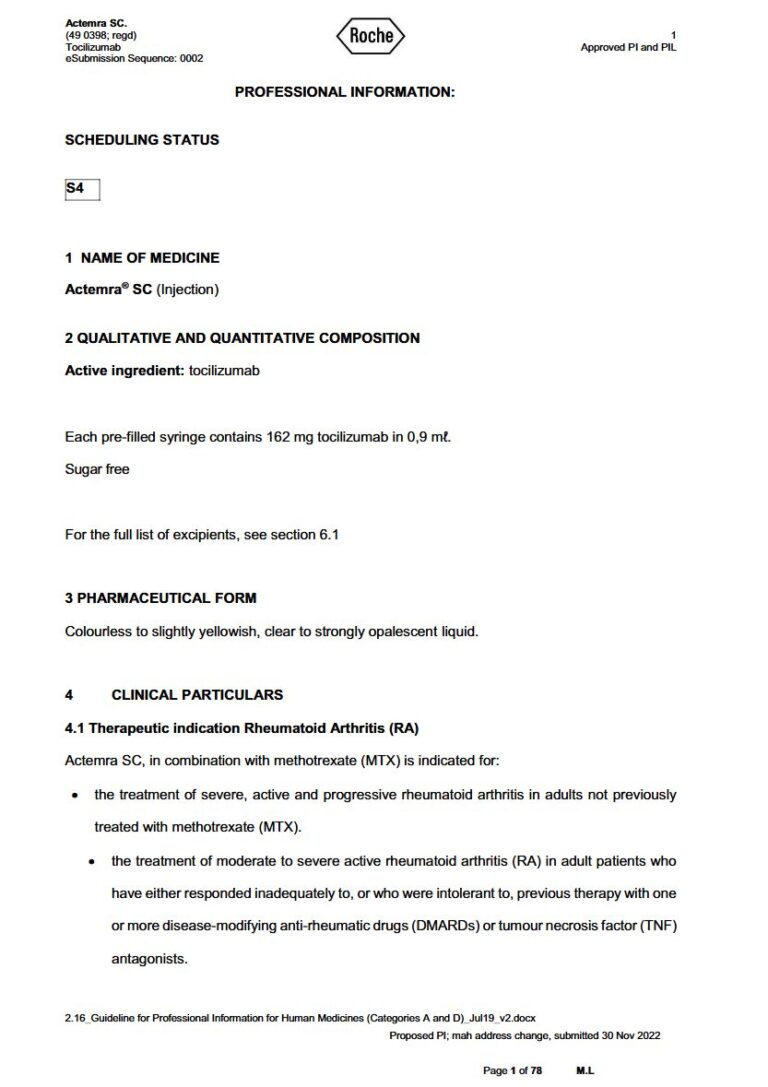
Rheumatoid Arthritis (RA) Actemra SC, in combination with methotrexate (MTX) is indicated for:
- the treatment of severe, active and progressive rheumatoid arthritis in adults not previously treated with methotrexate (MTX).
- the treatment of moderate to severe active rheumatoid arthritis (RA) in adult patients who have either responded inadequately to, or who were intolerant to, previous therapy with one or more disease-modifying anti-rheumatic drugs (DMARDs) or tumour necrosis factor (TNF) antagonists.
In these patients, Actemra SC can be given as monotherapy in case of intolerance to MTX or where continued treatment with MTX is inappropriate. Actemra SC has been shown to reduce the rate of progression of joint damage as measured by modified total Sharp-Genant radiographic score and to improve physical function when given in combination with MTX.
Giant Cell Arteritis (GCA) Actemra SC is indicated for the treatment of giant cell arteritis (GCA) in adult patients.
Polyarticular Juvenile Idiopathic Arthritis (pJIA) Actemra SC, in combination with MTX, is indicated for the treatment of polyarticular juvenile idiopathic arthritis (pJIA; rheumatoid factor positive or negative and extended oligoarthritis) in patients 2 years of age and older. Actemra SC can be given alone in patients intolerant to MTX or where the treatment response with MTX is inadequate. Efficacy and safety of Actemra SC in children with a condition other than pJIA has not been established. Children below the age of two years have not been studied.
Systemic Juvenile Idiopathic Arthritis (sJIA) Subcutaneous Formulation Actemra is indicated for the treatment of active systemic juvenile idiopathic arthritis in patients 1 year of age and older. Actemra SC can be given alone or in combination with MTX.
4.2 Posology and method of administration
Method of Administration Treatment should be initiated by medical practitioners experienced in the diagnosis and treatment of RA. Actemra SC is administered with a single-use pre-filled syringe (PFS) with a needle safety device (NSD). The first few injections should be performed under the supervision of a qualified healthcare professional. The recommended injection sites (abdomen, thigh and upper arm) should be rotated and injections should never be given into moles, scars, or other areas where the skin is tender, bruised, red, hard or not intact. Patients transitioning from Actemra IV therapy to SC administration should administer the first SC dose at the time of the next scheduled IV dose under the supervision of a qualified healthcare professional. Actemra SC formulation is not intended for intravenous administration. Assess suitability of patient or parent/guardian for SC home use and instruct patients or parent/guardian to inform a healthcare professional if they experience any symptoms of allergic reaction. Patients should seek immediate medical attention if they develop symptoms of serious allergic reactions (see WARNINGS AND SPECIAL PRECAUTIONS and SIDE EFFECTS).
Subcutaneous dosing regimen Rheumatoid Arthritis (RA) The recommended dose of Actemra SC for adult patients is 162 mg given once every week as a subcutaneous injection. Actemra SC can be used alone or in combination with MTX and/or other DMARDs.
Giant Cell Arteritis (GCA) The recommended dose of Actemra SC for adult patients with GCA is 162 mg given once every week as a subcutaneous injection, in combination with a tapering course of glucocorticoids. A dose of 162 mg given once every other week as a subcutaneous injection in combination with a tapering course of glucosteroids may be prescribed on clinical considerations. Actemra SC can be used alone following discontinuation of glucocorticoids. In the event of patients experiencing a relapse of GCA during the course of Actemra SC therapy, the treating medical practitioner should consider re-introducing and/or escalating the dose of concomitant glucocorticoids (or restarting glucocorticoid therapy if it has been discontinued) according to best medical judgement/treatment guidelines.
Dose Modifications recommendations for RA and GCA See WARNINGS AND SPECIAL PRECAUTIONS.
- Liver enzyme abnormalities
- Low absolute neutrophil count (ANC) [31] In patients not previously treated with Actemra SC, initiation is not recommended in patients with an absolute neutrophil count (ANC) below 2 x 10 9 /u2113. Laboratory value (cells x 10 9 /u2113) Action ANC > 1 Maintain dose. Laboratary Value Action > 1 to 3x ULN Dose modify concomitant DMARDs (RA) or immunomodulatory agents (GCA) if appropriate. For patients on subcutaneous Actemra SC with persistent increases in this range, reduce Actemra SC injection frequency to every other week or interrupt Actemra SC until ALT/AST have normalized. Restart with weekly injection or injection every other week, as clinically appropriate. > 3 to 5x ULN Interrupt Actemra SC dosing until 1 to 3x ULN For persistent increases > 3x ULN (confirmed by repeat testing, see section 2.4.4), discontinue Actemra SC > 5x ULN Discontinue Actemra SC
- ANC 0,5 to 1 Interrupt Actemra SC dosing. When ANC increases > 1 x 10 9 /u2113 resume Actemra SC injection every other week and increase frequency to every week, as clinically appropriate.
- ANC < 0,5 Discontinue Actemra SC.
Low platelet count Laboratory value (cells x 10 3 /u03bcu2113) Action 50 to 100 Interrupt Actemra SC dosing. When platelet count is > 100 x 10 3 /u03bcu2113 resume Actemra SC injection every other week and increase frequency to every week, as clinically appropriate. < 50 Discontinue Actemra SC.
Polyarticular Juvenile Idiopathic Arthritis (pJIA) A change in dose should only be based on a consistent change in the patientu2019s body weight over time. Actemra SC can be used alone or in combination with MTX. The recommended dose of Actemra SC for patients with pJIA is:
- 162 mg once every three weeks for patients below 30 kg,
- 162 mg once every two weeks for patients u2265 30 kg
Dose Modification Recommendations for pJIA: Dose reduction of Actemra SC has not been studied in the pJIA or sJIA population. Dose interruptions of Actemra SC for laboratory abnormalities are recommended in patients with pJIA or sJIA and are similar to what is outlined above for patients with RA and GCA (also see WARNINGS AND SPECIAL PRECAUTIONS). If appropriate, concomitant methotrexate and/or other medications should be dose modified or stopped and Actemra SC dosing interrupted until the clinical situation has been evaluated. In pJIA or sJIA the decision to discontinue Actemra SC for a laboratory abnormality should be based upon the medical assessment of the individual patient. After proper training in injection technique, patients may self-inject Actemra SC if their doctor determines that it is appropriate and if the patient agrees to medical follow-up as necessary. The total content (0,9 mu2113) of the pre-filled syringe should be administered as a subcutaneous injection. The pre-filled syringe should not be shaken. Comprehensive instructions for the administration of Actemra SC by the patient, using the pre-filled syringe, are given in the Patient Information Leaflet.
RA and GCA Missed dose If a patient misses a SC weekly injection of Actemra SC within 7 days of the scheduled dose, he/she should be instructed to administer the missed dose on the next scheduled day. If a patient misses a SC once every other week injection of Actemra SC within 7 days of the scheduled dose, he/she should be instructed to administer the dose immediately and the next dose on the next scheduled day.
Special dosing instructions Children The safety and efficacy of Actemra SC in children with conditions other than pJIA have not been established. Children below the age of two years have not been studied. The safety and efficacy in patients aged less than 2 years in sJIA or less than 1 year with in sJIA have not been established.
Elderly patients No dose adjustment is required in patients aged 65 years and older.
Renal impairment No dose adjustment is required in patients with mild or moderate renal impairment. Actemra SC has not been studied in patients with severe renal impairment (see Pharmacokinetic Properties). Renal function should be monitored closely in these patients.
Hepatic Impairment Actemra SC has not been studied in patients with hepatic impairment, and safety in patients with hepatic impairment has not been established. Therefore, no dose recommendations can be made.
Systemic Juvenile Idiopathic Arthritis (sJIA) A change in dose should only be based on a consistent change in the patientu2019s body weight over time. Actemra SC can be used alone or in combination with MTX. The recommended dose of Actemra SC for patients with sJIA is:
- 162 mg once every two weeks for patients below 30 kg,
- 162 mg once every week for patients u2265 30 kg
Patients between 1 year and 2 years of age must have a minimum body weight of 10 kg when receiving 162 mg SC tocilizumab Dose Modification Recommendations for sJIA Dose reduction of Actemra SC has not been studied in the sJIA population. Dose interruptions of Actemra SC for laboratory abnormalities are recommended in patients with sJIA and are similar to what is outlined above for patients with RA and GCA (also see WARNINGS AND SPECIAL PRECAUTIONS). If appropriate, concomitant methotrexate and/or other medications should be dose modified or stopped and Actemra SC dosing interrupted until the clinical situation has been evaluated. In sJIA, the decision to discontinue Actemra SC for a laboratory abnormality should be based upon the medical assessment of the individual patient.
4.3 Contraindications
- Actemra SC is contraindicated in patients with a known hypersensitivity to tocilizumab or to any of the excipients.
- Active, severe infections (see WARNINGS AND SPECIAL PRECAUTIONS).
- Active hepatic disease/hepatitis or a recent history of hepatic disease/hepatitis
- Impairment of hepatic/liver function (ALT and/or or AST) increases to u22655x ULN before or during treatment.
- Active or chronic hepatitis B
- Concomitant use with other hepatotoxic medicines except methotrexate as approved under indications
4.4 Special warnings and precautions for use
Infections Serious and sometimes fatal infections have been reported in patients receiving Actemra SC (see SIDE EFFECTS). Actemra SC treatment should not be initiated in patients with active infections. Administration of Actemra SC should be interrupted if a patient develops a serious infection until the infection is controlled (see CONTRAINDICATIONS and SIDE EFFECTS). Medical practitioners should exercise caution when considering the use of Actemra SC in patients with a history of recurring or chronic infections or with underlying conditions (e.g. diverticulitis, diabetes) which may predispose patients to infections. Vigilance for the timeous detection of serious infection is recommended for patients receiving immunosuppressive medicines such as Actemra SC as signs and symptoms of acute inflammation may be lessened, due to suppression of the acute phase reactants. The effects of Actemra SC on C-reactive protein (CRP), neutrophils and signs and symptoms of infection should be considered when evaluating a patient for a potential infection. Patients (which include younger children who may be less able to communicate their symptoms) and parents/guardians of minors, should be instructed to contact their medical practitioner immediately when any symptoms suggesting infection appear, in order to assure rapid evaluation and appropriate treatment.
Tuberculosis All patients should be screened for active or latent tuberculosis (TB) infection prior to starting Actemra SC therapy. Patients with active or latent TB should be treated with standard anti-mycobacterial therapy before initiating Actemra SC.
Risks of tuberculosis disease
- An increased risk of tuberculosis (including disseminated and extra-pulmonary presentations) has been observed in patients treated with TNF-u03b1 inhibitors and similar immune-modulatory medicines.
- Tuberculosis in these patients may be due to reactivation of latent tuberculosis infection or due to new infections.
- Prophylactic treatment of a latent tuberculosis infection should be initiated prior to starting treatment with Actemra SC.
- Patients may become infected with tuberculosis during the course of therapy with Actemra SC and physicians should continue to monitor the patient for signs and symptoms of tuberculosis, including patients who have tested negative for latent tuberculosis at the start of therapy. Treatment of tuberculosis should follow current national guidelines.
Complications of diverticulitis Events of diverticular perforations have been reported with Actemra SC in patients treated with Actemra SC (see SIDE EFFECTS). Actemra SC should be used with caution in patients with previous history of intestinal ulceration or diverticulitis. Patients presenting with symptoms potentially indicative of complicated diverticulitis, such as abdominal pain, haemorrhage and/or unexplained change in bowel habits with fever should be evaluated promptly for early identification of diverticulitis which can be associated with gastrointestinal perforation.
Hypersensitivity reactions Serious hypersensitivity reactions, including anaphylaxis have been reported in association with Actemra SC. Such reactions may be more severe, and potentially fatal in patients who have experienced hypersensitivity reactions during previous administrations even if they have received premedication with steroids and antihistamines (see SIDE EFFECTS). Appropriate treatment should be available for immediate use in the event of an anaphylactic reaction during administration of Actemra SC. If an anaphylactic reaction or other serious hypersensitivity/serious administration related reaction occurs, administration of Actemra SC should be stopped immediately and Actemra SC should be permanently discontinued (see DOSAGE AND DIRECTIONS FOR USE).
Active hepatic disease and hepatic impairment Treatment with Actemra SC, particularly when administered concomitantly with MTX, may be associated with elevations in hepatic transaminases (see SIDE EFFECTS). Therefore, caution should be exercised when considering treatment of patients with active hepatic disease or hepatic impairment, as the safety of Actemra SC in these patients has not been adequately studied (see DOSAGE AND DIRECTIONS FOR USE: Special Dosage Instructions).
Hepatotoxicity Mild and moderate elevations of hepatic transaminases have been observed with Actemra SC treatment (see SIDE EFFECTS). An increased frequency of these elevations was observed when potentially hepatotoxic medicines (e.g. MTX) were used in combination with Actemra SC. Serious medicine-induced liver injury, including acute liver failure, hepatitis and jaundice, have been observed with Actemra SC (see SIDE EFFECTS, Post Marketing). Serious hepatic injury occurred between 2 weeks to more than 5 years after initiation of Actemra SC. Cases of liver failure resulting in liver transplantation have been reported. Caution should be exercised when considering initiation of Actemra SC treatment in patients with elevated alanine aminotransferase (ALT) or aspartate aminotransferase (AST) above 1,5x upper limit of normal (ULN). In patients with baseline ALT or AST above 5x ULN, treatment is not recommended. In RA, pJIA and GCA, ALT and AST should be monitored every 4 to 8 weeks for the first six months of treatment followed by every 12 weeks thereafter. For recommended dose modifications, including Actemra SC discontinuation based on transaminases levels see DOSAGE AND DIRECTIONS FOR USE.
Neutropenia Treatment with Actemra SC was associated with neutropenia. Caution should be exercised when considering initiation of Actemra SC treatment in patients with a low absolute neutrophil count (ANC) below 2 x 10 9 /u2113. In patients with an ANC below 0,5 x 10 9 /u2113, treatment is not recommended. Severe neutropenia may be associated with an increased risk of serious infections, although there has been no clear association between decreases in neutrophils and the occurrence of serious infections in clinical trials with Actemra SC to date. Neutrophils should be monitored in RA and GCA 4 to 8 weeks after start of therapy and thereafter according to good clinical practice. For recommended dose modifications based on ANC counts see DOSAGE AND DIRECTIONS FOR USE. In pJIA and sJIA, neutrophils should be monitored at the time of the second administration and thereafter according to good clinical practice. For recommended dose modifications based on ANC counts see DOSAGE AND DIRECTIONS FOR USE.
Thrombocytopenia Treatment with Actemra SC was associated with a reduction in platelet counts. Treatment-related reduction in platelets was not associated with serious bleeding events in clinical trials (see SIDE EFFECTS). Caution should be exercised when considering initiation of Actemra SC treatment in patients with a platelet count below 100 x 10 3 /u03bcu2113. In patients with a platelet count below 50 x 10 3 /u03bcu2113, treatment is not recommended. In RA and GCA, platelets should be monitored 4 to 8 weeks after start of therapy and thereafter according to good clinical practice. For recommended dose modifications based on ANC and platelet counts see DOSAGE AND DIRECTIONS FOR USE. In pJIA and sJIA, platelets should be monitored at the time of the second administration and thereafter according to good clinical practice (see DOSAGE AND DIRECTIONS FOR USE).
Lipid parameters Elevations of lipid parameters including total cholesterol, low-density lipoprotein (LDL), high-density lipoprotein (HDL) and triglycerides were observed in patients treated with Actemra SC (see SIDE EFFECTS). Assessment of lipid parameters should be performed in patients treated with Actemra SC, 4 to 8 weeks following initiation of Actemra SC therapy. Patients should be managed according to local clinical guidelines for management of hyperlipidaemia. The long-term effect of the raised lipids is still unknown.
Systemic Juvenile Idiopathic Arthritis Macrophage activation syndrome (MAS) MAS is a serious life-threatening disorder that may develop in patients with sJIA. In clinical trials, tocilizumab has not been studied in patients during an episode of active MAS.
Demyelinating disorders Medical practitioners should be vigilant for symptoms potentially indicative of new-onset central demyelinating disorders. The potential for central demyelination with Actemra SC is currently unknown.
Malignancy The risk of malignancy is increased in patients with RA. Immunomodulatory medicines, such as Actemra SC may increase the risk of malignancy.
Vaccinations Live and live attenuated vaccines should not be given concurrently with Actemra SC as clinical safety has not been established. No data are available on the secondary transmission of infection from persons receiving live vaccines to patients receiving Actemra SC. In a randomised open-label study, adult RA patients treated with Actemra SC and methotrexate (MTX) were able to mount an effective response to both the 23-valent pneumococcal polysaccharide and tetanus toxoid vaccines which was comparable to the response seen in patients on MTX only. It is recommended that all patients, particularly paediatric or elderly patients, be brought up to date with all immunisations in agreement with current immunisation guidelines prior to initiating Actemra SC therapy. The interval between live vaccinations and initiation of Actemra SC therapy should be in accordance with current vaccination guidelines regarding immunosuppressive medicines.
Viral Reactivation Viral reactivation (e.g. hepatitis B virus) has been reported with biologic therapies for RA. In clinical studies with Actemra SC, patients who screened positive for hepatitis were excluded.
Cardiovascular risk RA patients have an increased risk for cardiovascular disorders and should have risk factors (e.g. hypertension, hyperlipidaemia) managed as part of usual standard of care
Transition from IV to SC therapy Patients transitioning from Actemra IV therapy to SC administration should administer the first SC dose at the time of the next scheduled IV dose under the supervision of a qualified healthcare professional. Actemra SC formulation is not intended for intravenous administration. Medical practitioners should assess suitability of patient or parent/guardian for SC home use and instruct patients or parent/guardian to inform a healthcare professional if they experience symptoms of allergic reaction before administering the next dose. Patients should seek immediate medical attention if developing symptoms of serious allergic reactions (see DOSAGE AND DIRECTIONS FOR USE).
4.5 Interaction with other medicines and other forms of interaction
Infections Interaction studies were only performed as per treatment of tocilizumab using the IV formulation. Concomitant administration of a single dose of 10 mg/kg tocilizumab with 10 - 25 mg MTX once weekly had no clinically significant effect on MTX exposure. Population pharmacokinetic analysis did not detect any effect of MTX, non-steroidal anti-inflammatory drugs and corticosteroids on tocilizumab clearance in RA patients. In GCA patients, no effect on cumulative corticosteroid dose on Actemra SC exposure was observed. The expression of hepatic CYP450 enzymes is suppressed by the cytokines, such as IL-6, that stimulate chronic inflammation. Thus, CYP450 may be reversed when potent cytokine-inhibitory therapy, such as tocilizumab, is introduced.
In vitro studies with cultured human hepatocytes demonstrated that IL-6 caused a reduction in CYP1A2, CYP2C9, CYP2C19, and CYP3A4 enzyme expression. Tocilizumab normalises expression of these enzymes. The effect of tocilizumab on CYP enzymes (except CYP2C19 and CYP2D6) is clinically relevant for CYP450 substrates with a narrow therapeutic index, and/or where the dose is individually adjusted. In a study in RA patients, levels of simvastatin (CYP3A4) were decreased by 57 % one week following a single dose of tocilizumab, to the level similar or slightly higher than those observed in healthy subjects. When starting or stopping therapy with tocilizumab, patients taking medicines which are individually adjusted and are metabolised via CYP450 3A4, 1A2, 2C9 or 2C19 (e.g. atorvastatin, calcium channel blockers, theophylline, warfarin, phenytoin, ciclosporin or benzodiazepines) should be monitored as doses may need to be adjusted to maintain therapeutic effect. Given its long elimination half-life (t u00bd ), the effect of tocilizumab on CYP450 enzyme activity may persist for several weeks after stopping therapy.
Combination with TNF antagonists There is no experience with the use of tocilizumab in combination with TNF antagonists or other biological treatments for RA patients. Actemra SC is not recommended for use with other biological agents.
4.6 Fertility, pregnancy and lactation
Pregnancy A study in animals has shown an increased risk of spontaneous abortion/embryo-foetal death at a high dose. There are no adequate data from the use of Actemra in pregnant women.
Breastfeeding/Lactation It is unknown whether Actemra SC is excreted in human breast milk. The excretion of Actemra SC in milk has not been studied in animals. Breastfeeding should be discontinued during treatment with Actemra SC.
Fertility No available data suggest an effect on fertility under treatment of Actemra
4.7 Effects on ability to drive and use machines.
No studies on the effects on the ability to drive and use machines have been performed. However, given that dizziness has been commonly reported, patients who experience this adverse reaction should be advised not to drive or use machines until the dizziness has resolved.
4.8 Undesirable effects
Clinical Trials The safety profile in this section comes from 4 510 patients exposed to Actemra IV and SC in clinical trials; the majority of these patients were participating in RA studies (n= 4 009), while the remaining experience comes from pJIA (n=240), sJIA (n=112), and GCA (n=149) studies. The safety profile of Actemra across these indications remains similar and undifferentiated. ADRs are listed according to clinical importance to the patient. Frequencies are defined as very common (u22651/10), common (u22651/100 to < 1/10) or uncommon (u2265 1/1000 to < 1/100), rare (u2265 1/10 000, < 1/1 000), very rare (< 1/10 000), including isolated reports.
Table 3: Summary of ADRs occurring in patients treated with Actemra
| System Organ Class | Very Common | Common | Uncommon |
|---|---|---|---|
| Infections and infestations | Upper respiratory tract infections | Cellulitis, pneumonia, oral herpes simplex, herpes zoster | Diverticulitis |
| Gastrointestinal disorders | Abdominal pain, mouth ulceration, gastritis | Stomatitis, gastric ulcer | |
| Skin and subcutaneous tissue disorders | Rash, pruritus, urticaria | ||
| Nervous system disorders | Headache, dizziness | ||
| Investigations | Increased hepatic transaminases, increased weight, increased total billirubin | ||
| Vascular disorders | Hypertension | ||
| Blood and lymphatic system disorders | Leucopenia, neutropenia | ||
| Metabolism and nutrition disorders | Hypercholesterolaemia | Hypertriglyceridaemia | |
| General disorders and administration site conditions | Injection site reactions, including erythema, pruritus, pain, haematoma | Peripheral oedema, hypersensitivity reactions | |
| Respiratory, thoracic and mediastinal disorders | Cough, dyspnoea | ||
| Eye disorders | Conjunctivitis | ||
| Renal disorders | Nephrolithiasis | ||
| Endocrine disorders | Hypothyroidism |
Rheumatoid Arthritis (RA): Patients treated with subcutaneous Actemra SC The safety of subcutaneous Actemra SC in RA was studied in a double-blind, controlled, multicentre study clinical trial, SC-I. The study compared the efficacy and safety of Actemra SC 162 mg administered every week versus 8 mg/kg IV in subjects with adult RA. All patients in the study received background non-biologic DMARD(s). The safety and immunogenicity observed for Actemra SC was consistent with the known safety profile of IV tocilizumab and no new or unexpected adverse drug reactions were observed, see Table 3. A higher frequency of injection site reactions were observed in the SC arms compared with placebo SC injections in the IV arms.
RA: Immunogenicity A total of 625 patients treated with Actemra SC 162 mg weekly were tested for anti-tocilizumab antibodies in a 6-month controlled period. Five patients (0,8 %) developed positive anti-tocilizumab antibodies; of these, all developed neutralising anti-tocilizumab antibodies. A total of 1 454 Actemra SC all exposure patients have been tested for anti-tocilizumab antibodies, thirteen patients (0,9 %) developed positive anti tocilizumab antibodies, and of these 12 patients (0,8 %) developed neutralising anti-tocilizumab antibodies. No correlation of antibody development to clinical response or adverse events was observed.
Giant Cell Arteritis The safety of subcutaneous Actemra has been studied in one Phase III study (WA28119) with 251 GCA patients. The total patient years duration in the Actemra SC all exposure population was 138,5 patient years during the 12-month double blind, placebo-controlled phase of the study. The overall safety profile observed in the Actemra SC treatment groups was consistent with the known safety profile of Actemra (see Table 3).
GCA: Infections The rate of infection/serious infection events was balanced between the Actemra SC weekly group (200,2/9,7 events per 100 patient years) versus placebo plus 26 weeks prednisone taper (156,0/4,2 events per 100 patient years) and placebo plus 52 weeks taper (210,2/12,5 events per 100 patient years) groups.
Polyarticular Juvenile Idiopathic Arthritis The safety profile of Actemra SC and IV was studied in 240 paediatric patients with pJIA. In Study WA19977, 188 patients (2 to 17 years of age) were treated with Actemra IV and in Study WA28117, 52 patients (1 to 17 years of age) were treated with Actemra SC. The total patient exposure to Actemra in the pJIA all exposure population was 184,4 patient years for Actemra IV and 50,4 patient years for Actemra SC. In general, the safety profile observed in patients with pJIA was consistent with the known safety profile of Actemra with the exception of injection site reactions (ISRs), see Table 3. A higher frequency of ISRs was experienced by pJIA patients following Actemra SC injections compared to adult RA patients.
pJIA: Infections Infections are the most commonly observed events in pJIA. The rate of infections in the pJIA Actemra IV all exposure population was 163,7 per 100 patient years. The most common events observed were nasopharyngitis and upper respiratory tract infections. The rate of serious infections was numerically higher in patients weighing below 30 kg treated with 10 mg/kg tocilizumab (12,2 per 100 patient years) compared to patients weighing u2265 30 kg, treated with 8 mg/kg Actemra IV (4,0 per 100 patient years). The incidence of infections leading to dose interruptions was also numerically higher in patients weighing below 30 kg treated with 10 mg/kg Actemra IV (21,4 %) compared to patients weighing u2265 30 kg, treated with 8 mg/kg Actemra IV (7,6 %). The rate of infection in pJIA patients treated with SC tocilizumab was comparable with pJIA patients treated with Actemra IV.
pJIA: Injection Site Reactions (ISRs) A total of 28,8 % (15/52) pJIA patients experienced ISRs to Actemra SC. These ISRs occurred in 44 % of patients u2265 30 kg compared to 14,8 % of patients below 30 kg. The most common ISRs were injection site erythema, swelling, haematoma, pain and pruritis. All ISRs reported were non-serious Grade 1 events, and none of the ISRs required patient withdrawal from treatment or dose interruption.
pJIA: Immunogenicity Positive neutralising anti-tocilizumab antibodies have been detected in clinical studies. However, no clear association between antibody development and clinical response or adverse events was observed.
Systemic Juvenile Idiopathic Arthritis The safety profile of Actemra SC in sJIA was studied in 163 paediatric patients. In Study WA18221 (12-week trial and long term extension), 112 patients (2 to 17 years of age) were treated with Actemra IV and in Study WA28118 (52-week trial), 51 patients (1 to 17 years of age) were treated with SC Actemra SC. In general, the adverse drug reactions in patients with sJIA were similar in type to those seen in RA patients (see SIDE EFFECTS).
sJIA Infections In the 12 week controlled trial (Study WA18221), the rate of all infections in the IV tocilizumab group was 344.7 and 11.5 per 100 patient-years and 287.0 per 100 patient-years in the placebo group. In the open label extension study the overall rate of infections remained similar and remained stable at 11.3 at 306.6 per 100 patient-years. Reported serious infections were similar to those seen in RA patients with the addition of varicella and otitis media. The rate of infection in sJIA patients treated with SC tocilizumab was comparable to sJIA patients treated with IV tocilizumab.
sJIA: Injection Site Reactions (ISRs) In Study WA28118, a total of 41.2% (21/51) sJIA patients experienced ISRs to Actemra SC. The most common ISRs were erythema, pruritus, pain, and swelling at the injection site. The majority of ISRs reported were Grade 1 events and all ISRs reported were non-serious and none of the ISRs required patient withdrawal from treatment or dose interruption.
sJIA: Immunogenicity In Study WA18221, all 112 patients were tested for anti-tocilizumab antibodies at baseline. Two patients developed positive anti-tocilizumab antibodies with one of these patients having a hypersensitivity reaction leading to withdrawal [56]. In Study WA28118, 46 of the 51 (90.2%) patients tested for anti-tocilizumab antibodies at baseline had at least one post-baseline screening assay result. No patient developed positive anti-tocilizumab antibodies post-baseline.
Haematological abnormalities Neutrophils There was no clear relationship between decreases in neutrophils below 1 x 10 9 /u2113 and the occurrence of serious infections in any of the indications.
Rheumatoid Arthritis (RA) SC administration During routine laboratory monitoring in the Actemra SC 6-month controlled period of clinical trial SC-1, a decrease in neutrophil count below 1 x 10 9 /u2113 occurred in 2,9 % of patients on Actemra SC 162 mg weekly.
Giant Cell Arteritis (GCA) During routine laboratory monitoring in the tocilizumab 12-month double blind, placebo-controlled phase of study WA28119, a decrease in neutrophil count below 1 x 10 9 /u2113 occurred in 4 % of patients in the Actemra SC weekly group. This was not observed in either of the placebo plus prednisone taper groups.
Polyarticular Juvenile Idiopathic Arthritis (pJIA) During routine laboratory monitoring in the Actemra IV all exposure population, a decrease in neutrophil count below 1 u00d7 10 9 /u2113 occurred in 3,7 % of patients treated with Actemra IV and 15,4 % of patients treated with Actemra SC.
Systemic Juvenile Idiopathic Arthritis During routine laboratory monitoring in the 12-week controlled trial (Study WA18221), a decrease in neutrophil counts below 1 u00d7 109/L occurred in 7% of patients in the Actemra IV group, and in none in the placebo group. In the open-label extension study (WA18221), decreases in neutrophil counts below 1 x 10⁹/L, occurred in 15% of the Actemra IV group. In the 52-week open-label trial (Study WA28118), neutrophil count decrease below 1 u00d7 109/L occurred in 23.5% of patients treated with Actemra SC.
4.9 Overdose
Clinical experience There are limited data available on overdose with Actemra SC. One case of accidental overdose was reported in which a patient with multiple myeloma received a single dose of 40 mg/kg IV. No adverse reactions were observed. No serious adverse reactions were observed in healthy volunteers who received a single dose up to 28 mg/kg, although dose limiting neutropenia was observed. Treatment is palliative and supportive.
