
Avastin 100 mg & 400 mg Solution
PDF Leaflet Revision Date: 19 April 2022
Clinical Summary
Quick overview from the medicine insert
Indication
Treatment of various cancers including colorectal, breast, lung, renal, ovarian, cervical, and glioblastoma.
Dosage (summary)
5-15 mg/kg IV every 2-3 weeks depending on cancer type.
Special Populations
- Elderly
- Renal impairment
- Hepatic impairment
Pregnancy & Breastfeeding
Contraindicated in pregnancy; avoid breastfeeding during treatment and for 6 months after.
Key Drug Interactions
- Sunitinib
- Chemotherapy agents
Contraindications
- Hypersensitivity to bevacizumab
- Pregnancy
- Breastfeeding
- Concomitant use with sunitinib
Common side effects
- Hypertension
- Fatigue
- Diarrhoea
- Abdominal pain
Counselling Points
- Monitor blood pressure
- Report signs of bleeding
- Discuss fertility preservation options
Serious warnings
- Gastrointestinal perforations
- Wound healing complications
- Hypertension
- Arterial thromboembolism
Important Disclaimer
The Avastin 100 mg & 400 mg Solution professional information leaflet below is the property of Roche and is provided on Medinsert exactly as issued, with no.. alterations or editorial changes. We make every effort to keep content current by updating documents as soon as new versions become available. Medinsert serves as a trusted access point for healthcare professionals, but does not replace official sources or clinical judgement. For more details, please read our full disclaimer. read more>>
 Healthcare Professionals Only
This content is for registered healthcare professionals
Sign in or create a free account to read the full package insert.
Free for HPCSA-registered professionals. Powered by Medinsert.
Clinical Particulars
Section 4 of the official insert — extracted exactly as issued, no alterations
4.1 Therapeutic Indications
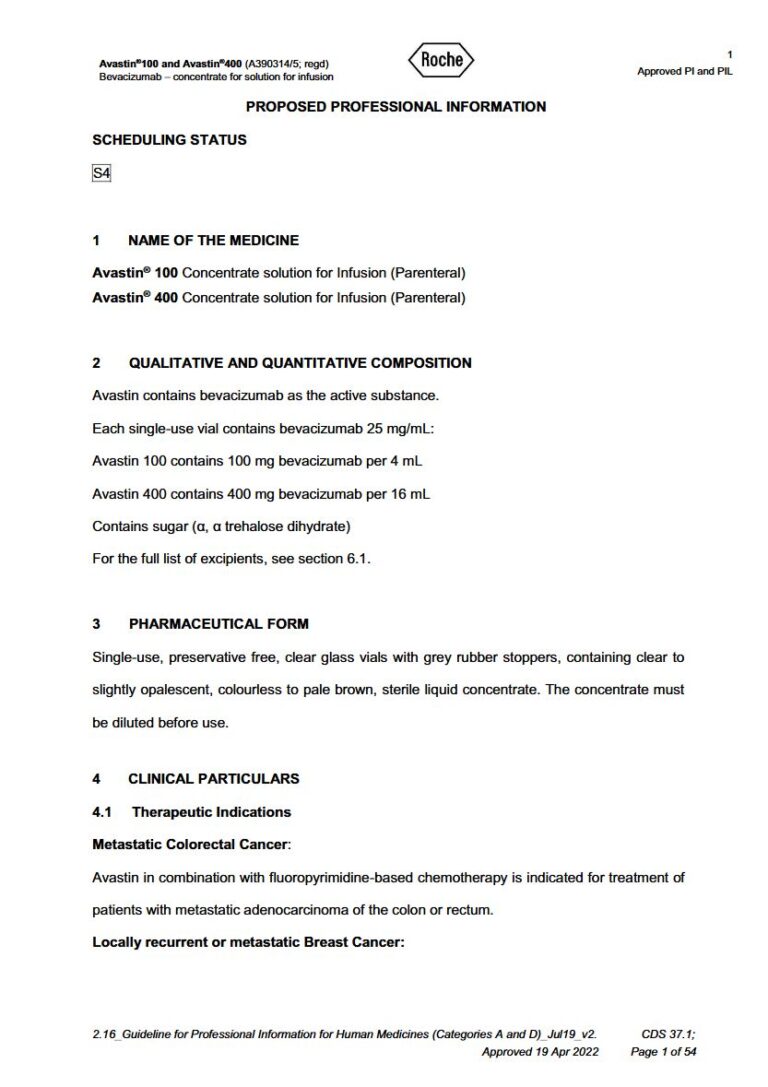
Metastatic Colorectal Cancer : Avastin in combination with fluoropyrimidine-based chemotherapy is indicated for treatment of patients with metastatic adenocarcinoma of the colon or rectum.
Locally recurrent or metastatic Breast Cancer: Avastin in combination with paclitaxel is indicated for first-line treatment of patients with locally recurrent or metastatic adenocarcinoma of the breast. Avastin in combination with capecitabine, is indicated for first-line treatment of adult patients with metastatic adenocarcinoma of the breast in whom treatment with other chemotherapy options including taxanes or anthracyclines is not considered appropriate. Patients who have received taxane and anthracycline-containing regimens in the adjuvant setting within the last 12 months should be excluded from treatment with Avastin in combination with capecitabine.
Advanced, metastatic or recurrent adenocarcinoma of the lung: Avastin, in addition to platinum-based chemotherapy, is indicated for first-line treatment of patients with unresectable advanced, metastatic or recurrent adenocarcinoma of the lung. Avastin, in combination with erlotinib, is indicated for first-line treatment of patients with unresectable advanced, metastatic or recurrent non-squamous non-small cell lung cancer with Epidermal Growth Factor Receptor (EGFR) activating mutations.
Advanced and/or metastatic Renal Cell Cancer (mRCC): Avastin in combination with interferon alfa-2a is indicated for first-line treatment of patients with advanced and/or metastatic renal cell cancer.
Epithelial Ovarian, Fallopian Tube and Primary Peritoneal Cancer: Avastin, in combination with carboplatin and paclitaxel is indicated for the first-line treatment of epithelial ovarian, fallopian tube, or primary peritoneal cancer. Avastin, in combination with carboplatin and gemcitabine or in combination with carboplatin and paclitaxel is indicated for the treatment of patients with recurrent, platinum-sensitive, epithelial ovarian, fallopian tube, or primary peritoneal cancer. Avastin in combination with paclitaxel, topotecan or pegylated liposomal doxorubicin is indicated for the treatment of patients with recurrent, platinum-resistant epithelial ovarian, fallopian tube, or primary peritoneal cancer who received no more than two prior chemotherapy regimens.
Cervical Cancer: Avastin in combination with paclitaxel and cisplatin or paclitaxel and topotecan is indicated for the treatment of persistent, recurrent, or metastatic carcinoma of the cervix.
Malignant Glioma (WHO Grade IV) - Glioblastoma: Avastin in combination with radiotherapy and temozolomide is indicated for the treatment of adult patients with newly diagnosed glioblastoma. Avastin, as a single agent, or in combination with irinotecan, is indicated for the treatment of patients with glioblastoma after relapse or disease progression.
4.2 Posology and method of administration
General instructions: Avastin must be prepared and administered under the supervision of a healthcare professional experienced in the use of antineoplastic medicines. It is recommended that Avastin be continued until progression of the underlying disease. Parenteral medicines should be inspected visually for particulate matter and discolouration prior to administration. Discard any unused portion left in the vial, as the product contains no preservatives. The safety and efficacy of alternating or switching between Avastin and products that are biosimilar but not deemed interchangeable have not been established. Therefore, the benefit-risk of alternating or switching need to be carefully considered.
The initial Avastin dose should be delivered over 90 minutes as an intravenous infusion. If the first infusion is well tolerated, the second infusion may be administered over 60 minutes. If the 60-minute infusion is well tolerated, all subsequent infusions may be administered over 30 minutes. The initial dose of Avastin should be administered following chemotherapy; all subsequent doses can be given before or after chemotherapy. Dose reduction of Avastin for side effects is not recommended. If indicated, Avastin should either be discontinued or temporarily suspended, see sections 4.4 and 4.8. It is recommended that Avastin treatment be continued until progression of the underlying disease. Withdraw the necessary amount of Avastin and dilute to the required administration volume with 0,9 % sodium chloride solution. The concentration of the final bevacizumab solution should be kept within the range of 1,4 - 16,5 mg/mL. For recommendations on the storage of Avastin before and after dilution, please refer to section 6.4.
Incompatibilities: see section 6.2. Avastin infusions should not be administered or mixed with glucose solutions. Do not administer as an intravenous push or bolus.
Metastatic Colorectal Cancer (mCRC): The recommended dose of Avastin, administered as an intravenous infusion, is as follows:
- First-line treatment: 5 mg/kg of body weight given once every 2 weeks or 7,5 mg/kg of body weight given once every 3 weeks
- Second-line treatment: 5 mg/kg or 10 mg/kg of body weight given once every 2 weeks or 7,5 mg/kg or 15 mg/kg of body weight given once every 3 weeks
Metastatic Breast Cancer (mBC): The recommended dose of Avastin is 10 mg/kg of body weight given once every 2 weeks or 15 mg/kg of body weight given once every 3 weeks as an intravenous infusion.
Adenocarcinoma of the lung: First-line treatment of Non-Small Cell Lung Cancer (NSCLC) in combination with platinum-based chemotherapy. Avastin is administered in addition to platinum-based chemotherapy for up to 6 cycles of treatment followed by Avastin as a single agent until disease progression. The recommended dose of Avastin when used in addition to cisplatin-based chemotherapy is 7,5 mg/kg of body weight given once every 3 weeks as an intravenous infusion. The recommended dose of Avastin when used in addition to carboplatin-based chemotherapy is 15 mg/kg of body weight given once every 3 weeks as an intravenous infusion.
First-line treatment of NSCLC with EGFR activating mutations in combination with erlotinib: The recommended dose of Avastin when used in addition to erlotinib is 15 mg/kg of body weight given once every 3 weeks as an intravenous infusion. It is recommended that the treatment with Avastin in addition to erlotinib is continued until disease progression. Please refer to the full professional information for erlotinib patient selection and dosage.
Advanced and/or metastatic Renal Cell Cancer (mRCC): The recommended dose of Avastin is 10 mg/kg of body weight given once every 2 weeks as an intravenous infusion.
Malignant Glioma (WHO Grade IV) - Glioblastoma: The recommended dose of Avastin, administered as an intravenous infusion, is as follows:
- Newly diagnosed glioblastoma: Avastin (10 mg/kg of body weight given once every 2 weeks) is administered in combination with temozolomide and radiotherapy for 6 weeks. Following a 4 week treatment break, Avastin (10 mg/kg of body weight given once every 2 weeks) is re-initiated in combination with temozolomide for up to 6 cycles of 4 week duration. After administration of up to 6 cycles of combined Avastin and temozolomide, Avastin (15 mg/kg of body weight given once every 3 weeks) is continued as a single agent until disease progression.
- Treatment of recurrent disease: 10 mg/kg of body weight given once every 2 weeks or 15 mg/kg of body weight given once every 3 weeks.
Epithelial Ovarian, Fallopian Tube and Primary Peritoneal Cancer: First-line treatment: Avastin is administered in addition to carboplatin and paclitaxel for up to 6 cycles of treatment followed by continued use of Avastin as single agent for 15 months or until disease progression, whichever occurs earlier. The recommended dose of Avastin is 15 mg/kg of body weight given once every 3 weeks as an intravenous infusion.
Treatment of recurrent disease: Platinum sensitive: Avastin is administered in combination with carboplatin and gemcitabine for six cycles and up to 10 cycles followed by continued use of Avastin as single agent until disease progression. The recommended dose of Avastin is 15 mg/kg of body weight given once every 3 weeks as an intravenous infusion when administered in combination with Carboplatin and paclitaxel for 6 cycles and up to 8 cycles followed by continued use of Avastin as a single agent until disease progression. Alternatively, 15 mg/kg every 3 weeks when administrated in combination with carboplatin and gemcitabine for 6 cycles and up to 10 cycles followed by continued use of Avastin as single agent until disease progression.
Platinum resistant: 10 mg/kg body weight given once every 2 weeks when administered in combination with one of the following agents u2013 paclitaxel, topotecan (given weekly) or pegylated liposomal doxorubicin. Alternatively, 15 mg/kg every 3 weeks when administered in combination with topotecan given on days 1-5, every 3 weeks. It is recommended that treatment be continued until disease progression.
Cervical Cancer: Avastin is administered in combination with one of the following chemotherapy regimens: paclitaxel and cisplatin or paclitaxel and topotecan. The recommended dose of Avastin is 15 mg/kg of body weight given once every 3 weeks as an intravenous infusion. It is recommended that treatment be continued until disease progression.
Special dosage instructions: Analyses of demographic data suggest that no dose adjustments are necessary for age or sex. Paediatric use: The safety and efficacy of Avastin in children and adolescents (< 18 years) have not been established (see section 4.4). Elderly use: No dose adjustment for Avastin is required in patients u2265 65 years of age. Renal impairment: The safety and efficacy of Avastin have not been studied in patients with renal impairment. Hepatic impairment: The safety and efficacy of Avastin have not been studied in patients with hepatic impairment.
4.3 Contraindications
Avastin is contraindicated in patients with known hypersensitivity to:
- Bevacizumab or any components of the product.
- Chinese hamster ovary cell products or other recombinant human or humanised antibodies.
- Avastin must not be used during pregnancy. Women must not breastfeed during Avastin treatment and for at least six months after the last dose of Avastin (see section 4.6).
- Concomitant use with sunitinib (see section 4.5).
- Intravitreal use.
4.4 Special warnings and precautions for use
Gastro-intestinal perforations and Fistulae: Patients with metastatic carcinoma of the colon or rectum may be at increased risk for the development of gastro-intestinal perforation and gallbladder perforation when treated with Avastin and chemotherapy. Therefore, caution should be exercised when treating these patients with Avastin. Avastin should be permanently discontinued in patients who develop gastro-intestinal perforation. Patients treated for persistent, recurrent, or metastatic cervical cancer with Avastin are at increased risk of fistulae between the vagina and any part of the GI tract (GI-vaginal fistulae) (see section 4.8).
Wound healing complications: Avastin may adversely affect the wound healing process. Serious wound healing complications with a fatal outcome have been reported. Avastin therapy should not be initiated for at least 28 days following major surgery or until the surgical wound is fully healed. In patients who experience wound healing complications during Avastin treatment, Avastin should be withheld until the wound is fully healed. Avastin therapy should be withheld for elective surgery. Necrotising fasciitis including fatal cases, has been reported in patients treated with Avastin; usually secondary to wound healing complications, gastrointestinal perforation or fistula formation. Avastin therapy should be discontinued in patients who develop necrotising fasciitis and appropriate treatment should be promptly initiated.
Non-GI Fistulae: Patients are at increased risk for the development of fistulae when treated with Avastin. Permanently discontinue Avastin in patients with TE (tracheoesophageal) fistula or any grade 4 fistula. Limited information is available on the continued use of Avastin in patients with other fistulae. In cases of internal fistula not arising in the GI tract, discontinuation of Avastin should be considered.
Hypertension: An increased incidence of all grades of hypertension was observed in patients treated with Avastin. Clinical safety data suggest that the incidence of hypertension is likely to be dose-dependent. Pre-existing hypertension should be adequately controlled before starting Avastin treatment. There is no information on the effect of Avastin in patients with uncontrolled hypertension at the time of initiating Avastin therapy. Monitoring of blood pressure is essential during Avastin therapy. In most cases hypertension was controlled adequately using standard antihypertensive treatment appropriate for the individual situation of the affected patient. The use of diuretics to manage hypertension is not advised in patients who receive a cisplatin-based chemotherapy regimen. Avastin should be permanently discontinued, if medically significant hypertension cannot be adequately controlled with antihypertensive therapy, or if the patient develops hypertensive crisis or hypertensive encephalopathy.
Posterior Reversible Encephalopathy Syndrome (PRES): There have been reports of Avastin-treated patients developing signs and symptoms that are consistent with Posterior Reversible Encephalopathy Syndrome (PRES), a rare neurologic disorder, which can present with the following signs and symptoms among others: seizures, headache, altered mental status, visual disturbance, or cortical blindness, with or without associated hypertension. A diagnosis of PRES requires confirmation by brain imaging, preferably magnetic resonance imaging (MRI). In patients developing PRES, treatment of specific symptoms including control of hypertension is recommended along with discontinuation of Avastin. The safety of reinitiating Avastin therapy in patients previously experiencing PRES is not known.
Proteinuria: Patients with a history of hypertension may be at increased risk for the development of proteinuria when treated with Avastin. There is evidence suggesting that Grade 1 proteinuria may be related to Avastin dose. Monitoring of proteinuria by dipstick urinalysis is recommended prior to starting and during Avastin therapy. Grade 4 proteinuria (nephrotic syndrome) was seen in up to 1,4 % of patients treated with Avastin. Avastin should be permanently discontinued in patients who develop Grade 4 proteinuria (nephrotic syndrome).
Arterial thromboembolism: In five clinical trials, the incidence of arterial thromboembolism events including cerebrovascular accidents (CVA), transient ischaemic attack (TIA) and myocardial infarction (MI) was higher in patients receiving Avastin in combination with chemotherapy compared to those who received chemotherapy alone. Avastin should be permanently discontinued in patients who develop arterial thromboembolic events. A history of arterial thromboembolic events, or age greater than 65, was associated with an increased risk of arterial thromboembolic events during Avastin therapy. Patients receiving Avastin plus chemotherapy with a history of arterial thromboembolism and age greater than 65 years have a higher risk. Diabetes mellitus patients are particularly liable to develop arterial thromboembolism. Caution should be taken when treating these patients with Avastin.
Venous thromboembolism: Patients are at risk of developing venous thromboembolic events, including pulmonary embolism under Avastin treatment. Patients treated for persistent, recurrent, or metastatic cervical cancer with Avastin are at increased risk of venous thromboembolic events (see section 4.8). Avastin should be discontinued in patients with life-threatening (Grade 4) venous thromboembolic events, including pulmonary embolism. Patients with thromboembolic events u2264 Grade 3 need to be closely monitored.
Haemorrhage: The risk of CNS haemorrhage in patients with CNS metastases receiving Avastin could not be fully evaluated, as these patients were excluded from clinical trials. Patients with metastatic cancer of the colon or rectum have an increased risk of tumour-associated haemorrhage. Avastin should be permanently discontinued in patients who experience Grade 3 or 4 bleeding during Avastin therapy. Patients should be monitored for signs and symptoms of CNS bleeding, and Avastin treatment discontinued in case of intracranial bleeding. There is no information on the safety profile of Avastin in patients with congenital bleeding diathesis, acquired coagulopathy or in patients receiving full dose of anticoagulants for the treatment of thromboembolism prior to starting Avastin treatment, as such patients were excluded from clinical trials. Therefore, caution should be exercised before initiating Avastin therapy in these patients. However, patients who developed venous thrombosis while receiving Avastin therapy did not appear to have an increased rate of Grade 3 or above bleeding when treated with full dose of warfarin and Avastin, concomitantly.
Pulmonary Haemorrhage/Haemoptysis: Patients with adenocarcinoma of the lung treated with Avastin are at risk for serious, and in some cases fatal, pulmonary haemorrhage/haemoptysis (see section 4.8, Haemorrhage). Patients with recent pulmonary haemorrhage/haemoptysis (> 2,5 mL red blood) should not be treated with Avastin.
Congestive Heart Failure (CHF)/Cardiomyopathy: Prior anthracyclines exposure and/or prior radiation to the chest wall may be possible risk factors for the development of CHF. Caution should be exercised before initiating Avastin therapy in patients with these risk factors. Caution should be exercised when treating patients with clinically significant cardiovascular disease such as pre-existing coronary artery disease, or congestive heart failure with Avastin (see section 4.8).
Neutropenia: Increased rates of severe neutropenia, febrile neutropenia, or infection with severe neutropenia (including some fatalities) have been observed in patients treated with some myelotoxic chemotherapy regimens plus Avastin in comparison to chemotherapy alone.
Ovarian Failure / Fertility: Avastin may impair female fertility. Therefore fertility preservation strategies should be discussed with women of child-bearing potential prior to starting treatment with Avastin (see sections 4.4, 4.6 and 4.8).
Paediatric use: Avastin is not approved for use in patients under the age of 18 years. The safety and efficacy of Avastin in this population have not been established. Addition of Avastin to standard of care did not demonstrate clinical benefit in paediatric patients in two phase II clinical trials: one in paediatric high grade glioma and one in paediatric metastatic rhabdomyosarcoma or non-rhabdomyosarcoma soft tissue sarcoma. In published reports, cases of osteonecrosis at sites other than the jaw have been observed in patients under the age of 18 years exposed to Avastin. In order to improve traceability of biological medicines, the trade name and the batch number of the administered product should be clearly recorded (or stated) in the patient file.
4.5 Interaction with other medicines and other forms of interaction
Combination use of Avastin and sunitinib malate: In two clinical studies of metastatic renal cell carcinoma, microangiopathic haemolytic anaemia (MAHA) was reported in 7 of 19 patients treated with Avastin (10 mg/kg every two weeks) and sunitinib malate (50 mg daily) in combination. MAHA is a haemolytic disorder which can present with red cell fragmentation, anaemia, and thrombocytopenia. In addition, hypertension (including hypertensive crisis), elevated creatinine, and neurological symptoms were observed in some of these patients. All of these findings were reversible upon discontinuation of Avastin and sunitinib malate.
Effect of antineoplastic agents on Avastin pharmacokinetics: No clinically relevant interaction of co-administered chemotherapy on Avastin pharmacokinetics was observed based on the results of population pharmacokinetic analyses. There was no difference in clearance of Avastin in patients treated with single-agent Avastin compared to patients receiving Avastin in combination with interferon alpha 2a, erlotinib or chemotherapies (IFL, 5-FU-LV, carboplatin-paclitaxel, capecitabine, doxorubicin or cisplatin-gemcitabine).
Effect of Avastin on the pharmacokinetics of other antineoplastic agents: No clinically relevant interaction of Avastin was observed on the pharmacokinetics of co-administered interferon alpha 2a, erlotinib (and its active metabolite OSI-420), or the chemotherapies irinotecan (and its active metabolite SN38), capecitabine, oxaliplatin (as determined by measurement of free and total platinum), and cisplatin. Conclusions on the impact of Avastin on gemcitabine pharmacokinetics cannot be drawn.
Radiotherapy: The safety and efficacy of concomitant administration of radiotherapy and Avastin was evaluated in a study of 921 patients with newly diagnosed glioblastoma. No new adverse events associated with Avastin were reported in this study. The safety and efficacy of concomitant administration of radiotherapy and Avastin has not been established in other indications.
4.6 Fertility, pregnancy and lactation
Pregnancy: Avastin is contraindicated during pregnancy (see section 4.3). Avastin has been shown to be embryotoxic and teratogenic when administered to rabbits. Angiogenesis has been shown to be critically important to foetal development. The inhibition of angiogenesis following administration of Avastin could result in an adverse outcome of pregnancy. IgGs are known to cross the placental barrier, and Avastin may inhibit angiogenesis in the foetus.
In the post-marketing setting, cases of foetal abnormalities in women treated with Avastin alone or in combination with known embryotoxic chemotherapeutics have been observed (see section 4.8). Avastin may impair female fertility. Women of child-bearing potential should be advised of fertility preservation strategies prior to starting treatment with Avastin.
Contraception: In women with childbearing potential, appropriate contraceptive measures must be used during Avastin therapy and for at least six months following the last dose of Avastin.
Lactation: As maternal IgG is excreted in milk and Avastin could harm infant growth and development, women must discontinue breastfeeding during Avastin therapy and not breastfeed for at least six months following the last dose of Avastin (see section 4.3).
Fertility: Repeat dose safety studies in animals have shown that Avastin may have an adverse effect on female fertility (see u201cOvarian failure/fertilityu201d under sections 4.4 and 4.8). A sub-study with 295 premenopausal women has shown a higher incidence (32/82 patients) of new cases of ovarian failure in the Avastin group compared to the control group (2/78 patients). After discontinuation of Avastin treatment, ovarian function recovered in the majority of patients (25/29). Long term effects of the treatment with Avastin on fertility are unknown. Ovarian failure was defined as the presence of all of the following for females who were premenopausal at randomisation: a negative serum u03b2-HCG pregnancy test, u2265 3 months of amenorrhea, and serum follicle-stimulating hormone (FSH) of u2265 30 MIU/mL.
4.7 Effects on ability to drive and use machines
There is evidence that Avastin treatment may result in an increase in adverse events that might lead to impairment of the ability to drive or operate machinery or impairment of mental ability.
4.8 Undesirable effects
a. Summary of the safety profile: The overall safety profile of Avastin is based on data from approximately 5 500 patients with various malignancies, predominantly treated with Avastin in combination with chemotherapy in clinical trials (see section 4.4 as well). The most serious side effects were:
- Gastro-intestinal perforations.
- Haemorrhage, including pulmonary haemorrhage/haemoptysis, which is more common in non-small cell lung cancer patients.
- Arterial thromboembolism.
The most frequently observed side effects across clinical trials in patients receiving Avastin were hypertension, fatigue or asthenia, diarrhoea and abdominal pain. Analyses of the clinical safety data suggest that the occurrence of hypertension and proteinuria with Avastin therapy are likely to be dose-dependent.
b. Tabulated summary of adverse drug reactions from clinical trials: Table 1 lists side effects associated with the use of Avastin in combination with different chemotherapy regimens in multiple indications by MedDRA system organ class. The corresponding frequency category for each adverse drug reaction is based on the following convention: very common (u22651/10); common (u22651/100 to <1/10); uncommon (u22651/1,000 to <1/100); rare (u22651/10,000 to <1/1,000); very rare (<1/10,000). These reactions had occurred either with at least a 2 % difference compared to the control arm (NCI-CTC [common toxicity criteria] Grade 3-5 reactions) or with at least a 10 % difference compared to the control arm (NCI-CTC Grade 1-5 reactions), in at least one of the major clinical trials. Side effects are added to the appropriate category in the table below according to the highest incidence seen in any of the major clinical trials. Within each frequency grouping side effects are presented in the order of decreasing seriousness. Some of the side effects are reactions commonly seen with chemotherapy, however, Avastin may exacerbate these reactions when combined with chemotherapeutic agents. Examples include palmar-plantar erythrodysaesthesia syndrome with pegylated liposomal doxorubicin or capecitabine, peripheral sensory neuropathy with paclitaxel or oxaliplatin, nail disorders or alopecia with paclitaxel, and paronychia with erlotinib.
Table 1: Very Common and Common Side effects
System Organ Class (SOC) NCI-CTC Grade 3 - 5 Reactions ( u00b3 2 % difference between the study arms in at least one clinical trial) All Grade Reactions ( u00b3 10 % difference between the study arms in at least one clinical trial)
Very common
Common
Very common
Infections and infestations
- Sepsis
- Abscess
- Cellulitis
- Infection
- Paronychia
Blood and the lymphatic systems disorders
- Febrile neutropenia
- Leucopenia
- Thrombocytopenia
- Neutropenia
- Anaemia
- Lymphopenia
Metabolism and nutrition disorders
- Dehydration
- Hyponatraemia
- Anorexia
- Hypomagnesaemia
- Hyponatraemia
Nervous system disorders
- Peripheral sensory neuropathy
- Cerebrovascular accident
- Syncope
- Somnolence
- Headache
- Dysgeusia
- Headache
- Dysarthria
Eye disorders
- Eye disorder
- Increased lacrimation
Cardiac disorders
- Cardiac failure congestive
- Supraventricular tachycardia
Vascular disorders
- Hypertension
- Thromboembolism (arterial)
- Deep vein thrombosis
- Haemorrhage
- Hypertension
Respiratory, thoracic and mediastinal disorders
- Pulmonary embolism
- Dyspnoea
- Hypoxia
- Epistaxis
- Dyspnoea
- Epistaxis
- Rhinitis
- Cough
Gastro-intestinal disorders
- Diarrhoea
- Nausea
- Vomiting
- Abdominal pain
- Intestinal perforation
- Ileus
- Intestinal obstruction
- Recto-vaginal fistulae**
- Gastro-intestinal disorder
- Stomatitis
- Proctalgia
- Constipation
- Stomatitis
- Rectal haemorrhage
- Diarrhoea
Endocrine disorders
- Ovarian failure**
Skin and subcutaneous tissue disorders
- Palmar-plantar erythrodysaesthesia syndrome
- Exfoliative dermatitis
- Dry skin
- Skin discolouration
Musculoskeletal, connective tissue and bone disorders
- Muscular weakness
- Myalgia
- Arthralgia
- Back pain
- Arthralgia
Renal and urinary disorders
- Proteinuria
- Urinary Tract Infection
- Proteinuria
General disorders and administration site conditions
- Asthaenia
- Fatigue
- Pain
- Lethargy
- Mucosal inflammation
- Pyrexia
- Asthaenia
- Pain
- Mucosal inflammation
Reproductive System and Breast
- Pelvic pain
Investigations
- Decreased weight
** Based on a substudy from AVF3077s (NSABP C-08) with 295 patients. ** Recto-vaginal fistulae are the most common fistulae in the GI-vaginal fistula category.
Table 2: Side effects reported in the post-marketing setting
System Organ Class (SOC) Reactions
Congenital, familial and genetic disorders: Cases of foetal abnormalities in women treated with Avastin alone or in combination with known embryotoxic chemotherapeutics have been observed (see section 4.5).
Immune system disorders: Hypersensitivity reactions and infusion reactions: with the following possible co-manifestations: dyspnoea/difficulty breathing, flushing/redness/rash, hypotension or hypertension, oxygen desaturation, chest pain, rigors and nausea/vomiting. (See also hypersensitivity, infusion reactions below).
Nervous system disorders: Hypertensive encephalopathy. Posterior Reversible Encephalopathy Syndrome (PRES) (see section 4.4).
Vascular disorders: Renal thrombotic microangiopathy, clinically manifested as proteinuria. (For further information on proteinuria see section 4.4)
Respiratory, thoracic and mediastinal disorders: Nasal septum perforation Pulmonary hypertension Dysphonia
Gastrointestinal disorders: Gastrointestinal ulcer
Hepatobiliary disorders: Gallbladder perforation
4.9 Overdose
The highest dose tested (20 mg/kg of body weight, intravenous every 2 weeks) was associated with severe migraine in several patients. The side effects profile will be exaggerated and aggravated. Treatment is symptomatic and supportive.
