
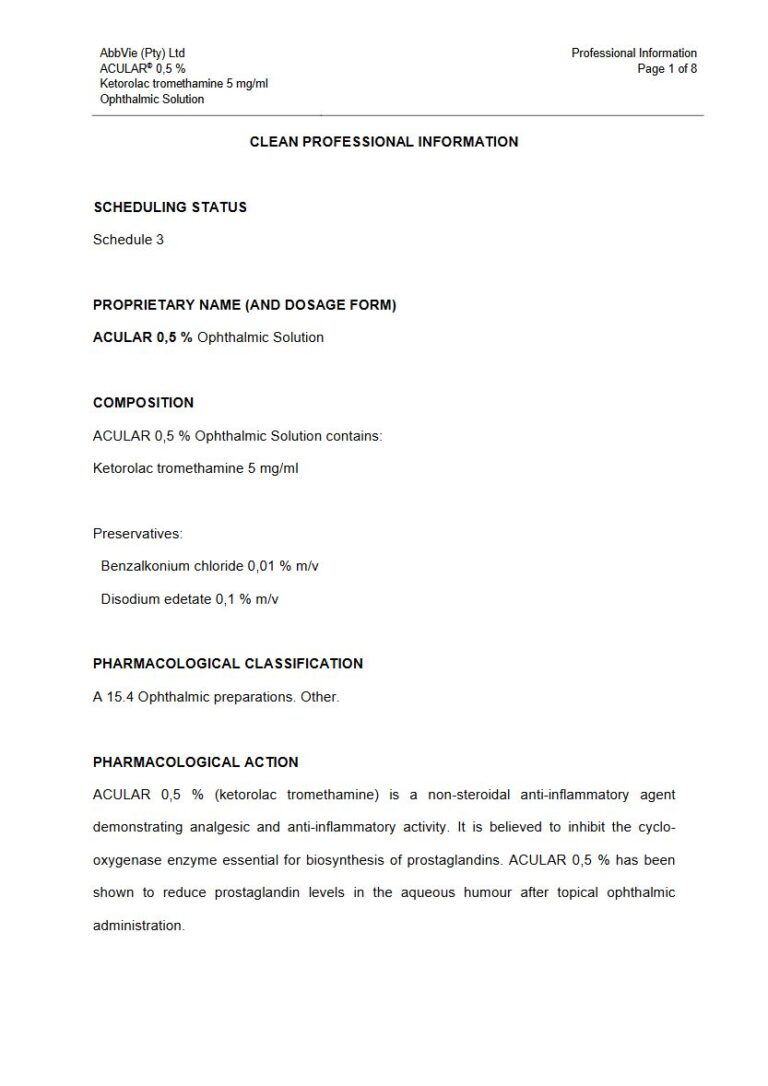
Acular 0.5% Ophthalmic Solution
Clinical Summary
Quick overview from the medicine insert
Indication
Management of pain and inflammation in ocular surgery and allergic conjunctivitis.
Dosage (summary)
Instill 1 drop into the affected eye(s) 4 times daily, starting 24 hours before surgery and continuing for up to 2 weeks postoperatively.
Onset of Action / Duration
Onset of action is typically within 30 minutes, with a duration of effect lasting up to 4-6 hours.
Special Populations
- Elderly patients may require dose adjustment.
- Patients with renal impairment should use with caution.
Pregnancy & Breastfeeding
Use during pregnancy only if clearly needed. Caution is advised during lactation as it is not known if Ketorolac is excreted in human milk.
Key Drug Interactions
- Increased risk of bleeding when used with anticoagulants.
- May enhance the effects of other non-steroidal anti-inflammatory drugs (NSAIDs).
Contraindications
- Hypersensitivity to Ketorolac or any component of the formulation.
- Active or history of peptic ulcer disease.
- Severe renal impairment.
Common side effects
- Burning or stinging sensation upon instillation.
- Redness of the eye.
- Allergic reactions including itching and swelling.
Counselling Points
- Instruct patients to avoid touching the dropper tip to any surface, including the eye.
- Advise patients to report any signs of severe eye irritation or allergic reactions.
- Inform patients to wash hands before and after using the eye drops.
Serious warnings
- Prolonged use may increase the risk of corneal damage.
- Use with caution in patients with a history of asthma or allergic reactions.
Important Disclaimer
The Acular 0.5% Ophthalmic Solution professional information leaflet below is the property of AbbVie and is provided on Medinsert exactly as issued, with no.. alterations or editorial changes. We make every effort to keep content current by updating documents as soon as new versions become available. Medinsert serves as a trusted access point for healthcare professionals, but does not replace official sources or clinical judgement. For more details, please read our full disclaimer. read more>>
 Healthcare Professionals Only
This content is for registered healthcare professionals
Sign in or create a free account to read the full package insert.
Free for HPCSA-registered professionals. Powered by Medinsert.
Clinical Particulars
Section 4 of the official insert — extracted exactly as issued, no alterations
4.1 Therapeutic indications
ACULAR 0,5 % is indicated for the relief of inflammation following ocular surgery.
4.2 Posology and method of administration
One drop instilled into the eye three times daily starting 24 hours before surgery and continuing post-operatively.
4.3 Contraindications
ACULAR 0,5 % is contra-indicated in patients hypersensitive to any component of the medicine. The potential exists for cross-sensitivity to acetylsalicylic acid, phenyl acetic derivatives and other non-steroidal anti-inflammatory drugs. ACULAR 0,5 % is contra-indicated in individuals who have previously exhibited sensitivities to the components. Safety and effectiveness in children have not been established. Safety of use in pregnant women has not been established (see PREGNANCY AND LACTATION). ACULAR 0,5 % is not recommended for nursing mothers. Ketorolac tromethamine is secreted in human milk after systemic administration (see PREGNANCY AND LACTATION). ACULAR 0,5 % should not be used while wearing soft contact lenses.
4.4 Special warnings and precautions for use
ACULAR 0,5 % contains the preservative benzalkonium chloride, which may be absorbed by soft contact lenses. Contact lenses should be removed prior to instillation of ACULAR 0,5 % and may be reinserted 15 minutes following administration. As the possibility of adverse effects on the corneal permeability and danger of disruption of the corneal epithelium with prolonged or repeated usage of benzalkonium chloride preserved preparations cannot be excluded, regular ophthalmological examination is required. Caution should be exercised in the use of benzalkonium chloride preserved topical medication over an extended period in patients with extensive ocular surface disease. There have been post-marketing reports of bronchospasm or exacerbation of asthma in patients, who have either a known hypersensitivity to aspirin/NSAIDS or a past medical history of asthma associated with the use of ACULAR 0,5 %, which may be contributory. With ACULAR 0,5 %, there exists the potential for increased bleeding time due to interference with thrombocyte aggregation. There have been reports that ocularly applied NSAIDs may cause increased bleeding of ocular tissues (including hyphaemas) in conjunction with surgery. It is recommended that ACULAR 0,5 % be used with caution in patients with known bleeding tendencies or who are receiving other medication which may prolong bleeding time and in patients with known history of peptic ulceration. In common with other anti-inflammatory medicines, ACULAR 0,5 % may mask the usual signs of infection.
General: ACULAR 0,5 % may slow or delay healing. Use of ACULAR 0,5 % may result in keratitis. In such patients, continued use of ACULAR 0,5 % may result in epithelial breakdown, corneal thinning, corneal erosion, corneal ulceration or corneal perforation. These events may lead to blindness. Patients with evidence of corneal epithelial breakdown should immediately discontinue use of ACULAR 0,5 % and should be closely monitored for corneal health. ACULAR 0,5 % should be used with caution in patients with complicated ocular surgeries, corneal denervation, corneal epithelial defects, diabetes mellitus, ocular surface diseases (e.g. dry eye syndrome), rheumatoid arthritis, or repeat ocular surgeries within a short period of time, as they may be at increased risk for corneal adverse events which may become sight threatening. Post-marketing experience with topical NSAIDs, such as ACULAR 0,5 %, also suggest that use more than 24 hours prior to surgery or use beyond 14 days post-surgery may increase patient risk for the occurrence and severity of corneal adverse events.
4.5 Interactions with other medicines
ACULAR 0,5 % has been safely administered with systemic and ophthalmic medications such as antibiotics, sedatives, beta blockers, carbonic anhydrase inhibitors, miotics, mydriatics, cycloplegics and corticosteroids.
4.6 Fertility, pregnancy and lactation
Pregnancy: Safety and efficacy in human pregnancy have not been established.
Lactation: Ketorolac tromethamine, the active ingredient in ACULAR 0,5 %, is secreted in human milk after systemic administration. Therefore, mothers using ACULAR 0,5 % should not be breastfeeding their infants.
4.7 Effects on ability to drive and use machines
Upon instillation, patients may experience transient blurred vision which may impair the ability to drive or use machinery. If affected, patients should not drive or use machinery until their vision has cleared.
4.8 Undesirable effects
The most frequent side effects reported with the use of ACULAR 0,5 % are stinging and burning on instillation. Blurring and/or diminished vision have been reported with the use of ACULAR 0,5 %. The use of ACULAR 0,5% while wearing soft (hydrophilic) contact lenses is not recommended. The events below are classified according to their incidence in clinical trials. The frequency of adverse reactions is given as follows: Very common (u22651/10); Common (u22651/100, <1/10); Uncommon (u22651/1 000, <1/100); Rare (u22651/10 000, <1/1 000); Very rare (<1/10 000); not known (cannot be estimated from the available data).
Eye disorders: Common: Iritis, keratic precipitates, hem retinal, cystoid macular oedema, eye burning, eye pruritus, eye trauma, increased intraocular pressure.
Immune system disorders: Common: Hypersensitivity.
Nervous system disorders: Common: Headache.
None of the typical adverse reactions reported with the systemic non-steroidal anti-inflammatory agents have been observed at the doses used in topical ophthalmic therapy.
Post-marketing experience: The following adverse reactions have been identified during post-marketing use of ACULAR 0,5 %. Because these reactions are reported voluntarily from a population of uncertain size, it is not always possible to reliably estimate their frequency or establish a causal relationship to ACULAR 0,5 %. Eye disorders: Eye irritation, eyelid oedema, eye oedema, ocular hyperaemia, conjunctival hyperaemia, eye swelling, eye pain, eye pruritus and ulcerative keratitis. There have been post-marketing reports of bronchospasm or exacerbation of asthma in patients, who have either a known hypersensitivity to aspirin/NSAIDS or a past medical history of asthma associated with the use of ACULAR 0,5 %, which may be contributory.
4.9 Overdose
In the event of topical overdose, wash the eye with water. If accidentally ingested, drink fluids to dilute. Treatment is symptomatic and supportive.
