
Akurit Kid 75/50 Oral Dispersible Tablets
Clinical Summary
Quick overview from the medicine insert
Indication
Treatment of tuberculosis (TB) in combination with other antitubercular agents.
Dosage (summary)
The usual adult dosage is 10 mg/kg of Rifampicin and 5 mg/kg of Isoniazid, administered once daily. Dosage may vary based on clinical response and specific patient factors.
Onset of Action / Duration
Rifampicin: onset within hours; peak effect in 2-4 hours. Isoniazid: onset within 1-2 hours; peak effect in 1-2 hours.
Special Populations
- Hepatically impaired patients
- Renally impaired patients
- Elderly patients
- Pediatric patients
Pregnancy & Breastfeeding
Use with caution during pregnancy; benefits must outweigh risks. Isoniazid is excreted in breast milk; monitor infant for side effects.
Key Drug Interactions
- May reduce the effectiveness of oral contraceptives.
- Increased risk of hepatotoxicity with alcohol.
- May interact with anticoagulants, anticonvulsants, and other medications metabolized by the liver.
Contraindications
- Hypersensitivity to Rifampicin or Isoniazid.
- Active liver disease or severe hepatic impairment.
- History of acute liver injury related to isoniazid.
Common side effects
- Hepatotoxicity
- Gastrointestinal disturbances (nausea, vomiting)
- Peripheral neuropathy
- Rash
- Flu-like symptoms
Counselling Points
- Take medication exactly as prescribed.
- Report any signs of liver dysfunction (jaundice, dark urine, persistent nausea).
- Avoid alcohol during treatment.
- Inform healthcare provider of all medications being taken.
Serious warnings
- Monitor liver function tests regularly.
- Risk of drug interactions; review all concurrent medications.
- May cause discoloration of bodily fluids (urine, sweat, tears).
Important Disclaimer
The Akurit Kid 75/50 Oral Dispersible Tablets professional information leaflet below is the property of Pharma Dynamics and is provided on Medinsert exactly as issued, with no.. alterations or editorial changes. We make every effort to keep content current by updating documents as soon as new versions become available. Medinsert serves as a trusted access point for healthcare professionals, but does not replace official sources or clinical judgement. For more details, please read our full disclaimer. read more>>
 Healthcare Professionals Only
This content is for registered healthcare professionals
Sign in or create a free account to read the full package insert.
Free for HPCSA-registered professionals. Powered by Medinsert.
Clinical Particulars
Section 4 of the official insert — extracted exactly as issued, no alterations
4.1 Therapeutic indications
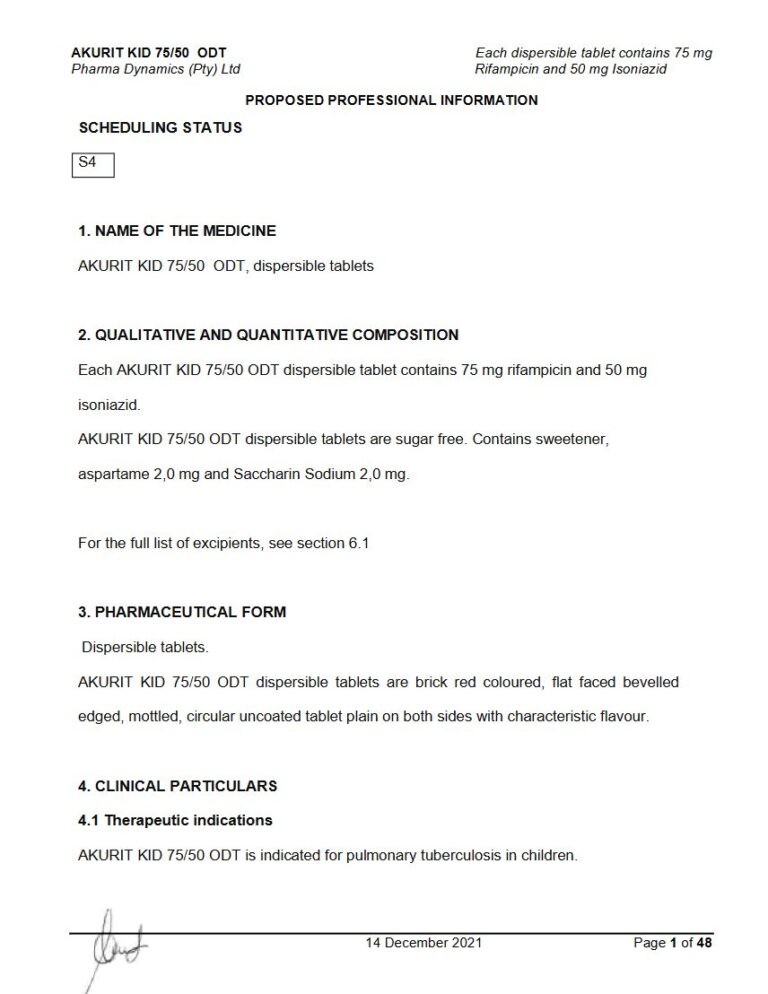
AKURIT KID 75/50 ODT is indicated for pulmonary tuberculosis in children.
4.2 Posology and method of administration
Posology
AKURIT KID 75/50 ODT is recommended in the continuation phase of the treatment of pulmonary tuberculosis. During this phase AKURIT KID 75/50 ODT should be administered on a continuous daily basis. The total dosage requirement is as follows:
Daily Maximum daily dose
- Rifampicin 15 mg/kg (10 to 20) 600 mg
- Isoniazid 10 mg/kg (7 to 15) 300 mg
The daily dosage is calculated from the recommended daily requirement given above and to closely regulate dosage according to body mass.
Table 1: Dosage calculation
Number of dispersible tablets For infants/children with body mass (kg)
- 1 dispersible tablet 4 - 7
- 2 dispersible tablets 8 - 11
- 3 dispersible tablets 12 - 15
- 4 dispersible tablets 16 - 24
Adult dosages recommended 25 +
Method of administration
The dispersible tablets can either be dispersed in as little as 5 mL of water, or chewed, and should preferably be taken on an empty stomach as a single dosage, orally. AKURIT KID 75/50 ODT should be taken at least 1 hour before aluminium containing antacids are used (see section 4.5). For missed doses, the missing dose can be taken as soon as possible, and then take the next dose at its regular time. However, if the next dose is due within 6 hours, do not take the missed dose. Wait and take the next dose at the regular time. A double dose should not be taken to make up for a forgotten tablet.
4.3 Contraindications
- Hypersensitivity or a history of hypersensitivity to rifampicin, other rifampicins, isoniazid or to any of the ingredients of AKURIT KID 75/50 ODT
- The presence of jaundice or in patients with hepatic impairment
- In patients with moderate to severe renal or hepatic impairment, diabetes mellitus, chronic alcoholism, a history of gout, patients suffering from convulsive disorders and porphyria
- Concomitant use of AKURIT KID 75/50 ODT and nevirapine is contraindicated (see section 4.5)
- When given concurrently with the combination of saquinavir/ritonavir (see section 4.5)
- Pregnancy and lactation (see section 4.6).
4.4 Special warnings and precautions for use
Rifampicin: Hepatic impairment
Patients with impaired liver function should not be given AKURIT KID 75/50 ODT. Should AKURIT KID 75/50 ODT be the only treatment option in these patients, careful monitoring of liver function, especially serum glutamic pyruvic transaminase ALT and serum glutamic oxaloacetic transaminase AST, should be carried out prior to therapy and repeated every two to four weeks during therapy. If signs of hepatocellular damage occur, AKURIT KID 75/50 ODT should be withdrawn (see section 4.3). A report showing a moderate rise in bilirubin and/or transaminase level in itself is not an indication for interruption of treatment. This decision should rather be made after repeating the tests, noting trends in the levels and considering them in conjunction with the patientu2019s clinical condition. Liver function should be checked before and during treatment with AKURIT KID 75/50 ODT and special care should be taken in alcoholic patients or those with pre-existing liver disease should AKURIT KID 75/50 ODT be the only treatment option (see section 4.3). Dosage adjustment is necessary where there is evidence of hepatic function impairment and treatment may need to be changed where there is more serious liver toxicity. Blood counts should be monitored during prolonged treatment and in patients with hepatic disorders. (see section 4.3).
Discoloration of bodily fluids
Patients should be advised that discolouration of the urine, faeces, saliva, sputum, sweat and tears may occur. Patients should be further advised that soft contact lenses may be permanently stained.
Other
If other serious complications arise e.g. renal failure or haemolytic anaemia (see haematological toxicity), AKURIT KID 75/50 ODT should be stopped and never restarted. Rifampicin has enzyme induction properties that can enhance the metabolism of endogenous substrates including adrenal hormones, thyroid hormones and vitamin D. Because of the possibility of immunological reactions including anaphylaxis occurring with intermittent therapy (less than 2 to 3 times per week) patients should be closely monitored. Patients should be cautioned against interruption of dosage regimens since these reactions may occur.
Hypersensitivity
Rifampicin may cause a hypersensitivity syndrome including u2018flu-likeu2019 symptoms and/or organ manifestation. The risk is higher in intermittent therapy or if treatment is resumed after discontinuation. If severe, acute signs of rifampicin hypersensitivity do appear (e.g. thrombocytopenia, purpura, haemolytic anaemia, dyspnoea, shock or acute renal failure). AKURIT KID 75/50 ODT dispersible tablets should immediately be discontinued. Such patients should not be re-challenged with rifampicin. If rifampicin therapy is temporarily discontinued, rifampicin should be restarted carefully at a reduced dose, and with close monitoring. In this situation, AKURIT KID 75/50 ODT dispersible tablets should not be used.
Haematological toxicity
Since rifampicin treatment has been associated with haemolytic anaemia, leukopenia and thrombocytopenia, full blood count should be monitored regularly throughout therapy with AKURIT KID 75/50 ODT dispersible tablets. In case of severe haematological disturbances AKURIT KID 75/50 ODT dispersible tablets must be discontinued.
4.5 Interactions with other medicines
Rifampicin
The concomitant use of AKURIT KID 75/50 ODT and nevirapine is contraindicated (see section 4.3). When AKURIT KID 75/50 ODT is given concomitantly with the combination of saquinavir/ritonavir, the potential for hepatotoxicity is increased. Therefore, concomitant use of AKURIT KID 75/50 ODT with saquinavir/ritonavir is contraindicated (see section 4.3). Halogenated inhalation anaesthetics, when given concomitantly with rifampicin has been reported to increase the hepatotoxicity of both rifampicin and isoniazid. Ketoconazole has been reported to diminish the serum concentrations of both medicines when given concomitantly. Rifampicin is a very potent inducer of the hepatic and intestinal cytochrome P-450 enzyme system, as well as of glucuronidation and the P-glycoprotein transport system. Administration of rifampicin with medicines that undergo biotransformation through these metabolic pathways is likely to accelerate elimination of co-administered medicines. These effects approach their maximum after about 10 days of treatment, and gradually return to normal within 2 or more weeks after discontinuation. This must be considered when co-treating with other medicines. To maintain optimum therapeutic blood levels, dosages of medicines metabolised by these enzymes may require adjustment when starting or stopping the concomitant administration of AKURIT KID 75/50 ODT dispersible tablets. As rifampicin has liver-enzyme inducing properties and may reduce the activity of azathioprine, chloramphenicol, cimetidine, clofibrate, corticosteroids, warfarin, ciclosporin, dapsone, diazepam, doxycycline, fluconazole, haloperidol, hexobarbitone, itraconazole, ketoconazole, methadone, oral hypoglycaemic medicines, phenytoin, quinine, sulphasalazine, thyroid hormones, theophylline, zidovudine, and several cardiovascular medicines including beta-adrenoceptor blocking medicines, digoxin, and antidysrhythmic medicines such as disopyramide, lorcainide, mexiletine, propafenone, quinidine, tocainide, and verapamil and other calcium-channel blocking medicines, oral contraceptives, narcotics, analgesics and barbiturates. Thus, it may be necessary to adjust the dosage of these medicines if they are given concurrently with AKURIT KID 75/50 ODT.
Oral contraceptives
Patients using oral contraceptives should be advised to change to non-hormonal methods of birth control during therapy with AKURIT KID 75/50 ODT.
Minerals
Magnesium trisilicate, aluminium hydroxide or sodium bicarbonate reduce the bioavailability of AKURIT KID 75/50 ODT.
Alcohol
Concurrent daily consumption of alcohol may increase the risk of rifampicin-induced hepatotoxicity and increased the metabolism of rifampicin. Dosage adjustments of rifampicin may be necessary, and patients should be monitored closely for signs of hepatotoxicity.
Corticosteroids
Concurrent use with rifampicin may enhance the metabolism of corticosteroids in Addisonu2019s disease and induce an Addisonian crisis (see section 4.5).
Laboratory monitoring
Full blood count and liver function should be monitored prior to and at regular intervals during treatment with AKURIT KID 75/50 ODT dispersible tablets.
Aspartame
Aspartame is a source of phenylalanine. It may be harmful if you have phenylketonuria (PKU), a rare genetic disorder in which phenylalanine builds up because the body cannot remove it properly.
4.6 Fertility, pregnancy and lactation
Pregnancy
Safety during pregnancy has not been established.
Breastfeeding
Safety during lactation has not been established. Rifampicin and isoniazid cross the placenta, and both are excreted in breastmilk.
4.7 Effects on ability to drive and use machines
AKURIT KID 75/50 ODT may cause dizziness, impaired concentration, and/or drowsiness. Patients should be instructed that if they experience these symptoms, they should avoid potentially hazardous tasks such as driving or operating machinery.
4.8 Undesirable effects
Summary of the safety profile
The most important adverse reactions of rifampicin are hepatotoxicity, particularly cholestatic reactions, and skin reactions. Rifampicin may cause subclinical, unconjugated hyperbilirubinemia or jaundice without hepatocellular damage, but occasionally causes hepatocellular injury. It can also potentiate the hepatotoxicity of the other anti-tuberculosis medications.
The most important adverse reactions of isoniazid are peripheral and central neurotoxic effects, and hepatotoxicity. Severe and sometimes fatal hepatitis due to isoniazid therapy has been reported. Most cases have occurred within the first three months of therapy, but hepatotoxicity may also develop after a longer duration of treatment.
Tabulated list of adverse effects
Side effects for AKURIT KID 75/50 ODT dispersible tablets :
System Organ Class Frequency Side effects
- Blood and lymphatic system disorders Frequency unknown Anaemia (haemolytic, sideroblastic, or aplastic), thrombocytopenia, leukopenia, neutropenia with eosinophilia, agranulocytosis
- Immune system disorders Frequency unknown Allergic reactions with skin manifestations, pruritus, fever, leukopenia, anaphylaxis, allergic pneumonitis, vasculitis, lymphadenopathy, rheumatic syndrome, lupusu2013like syndrome, hypotension, shock
- Metabolism and nutrition disorders Less frequent Frequency unknown Aggravated porphyria Hyperglycaemia, metabolic acidosis, pellagra
- Psychiatric disorders Less frequent Frequency unknown Memory impairment, toxic psychosis Confusion, disorientation, hallucination
- Nervous system disorders Frequent Less frequent Frequency unknown Peripheral neuropathy, usually preceded by paraesthesia of feet and hands Headache, lethargy, ataxia, difficulties concentrating, dizziness, seizures, toxic encephalopathy Tremor, vertigo, insomnia, hyperreflexia, cerebral haemorrhage
- Eye disorders Frequent Less frequent Frequency unknown Ocular redness, permanent discolouration of soft contact lenses Exudative conjunctivitis Optic atrophy or neuritis
- Gastrointestinal disorders Frequent Less frequent Frequency unknown Diarrhoea, abdominal pain, nausea, anorexia, vomiting Erosive gastritis, pseudomembranous colitis, pancreatitis Dry mouth, flatulence, constipation
- Hepato-biliary disorders Frequent Less frequent Transient increases of serum transaminases Increases of serum bilirubin and alkaline phosphatases, hepatitis
- Skin and subcutaneous tissue disorders Frequent Less frequent Frequency unknown Erythema, exanthema, pruritus with or without rash, urticaria Photosensitivity reaction, exfoliative dermatitis, pemphigoid reactions, purpura Lyellu2019s Syndrome, Stevens- Johnson Syndrome
- Musculoskeletal, connective tissue and bone disorders Frequency unknown Arthralgia, myalgia
- Renal and urinary disorders Less frequent Frequency unknown Acute renal failure, interstitial nephritis Urinary retention
- Reproductive system and breast disorders Frequent Disturbances of the menstrual cycle
- General disorders and administrative site conditions Frequent Flushing, reddish discolouration of body fluids and u2013secretions, such as urine, sputum, tears, saliva and sweat, decrease in blood pressure, shock
Side effects for Rifampicin:
System Organ Class Frequency Side effects
- Blood and lymphatic system disorders Less frequent Blood dyscrasias, unusual bleeding or bruising, thrombocytopenia, purpura, haemolysis, eosinophilia, leukopenia, haemolytic anaemia Disseminated intravascular coagulation, eosinophilia, agranulocytosis, haemolytic anaemia, decreased haemoglobin
- Immune system disorders Frequency unknown Anaphylaxis and shock.
- Nervous system disorders Less frequent Confusion, drowsiness, headache, ataxia, dizziness, peripheral neuropathy and generalised numbness.
- Eye disorders Less frequent Blurred vision, eye irritation.
- Ear and labyrinth disorders Less frequent Transient hearing loss
- Respiratory, thoracic and mediastinal disorders Frequency unknown Pulmonary fibrosis, pneumonitis, shortness of breath and wheezing
- Gastrointestinal disorders Frequent Less frequent Frequency unknown Nausea, vomiting, anorexia, diarrhoea and epigastric distress Pseudomembranous colitis. Ulcerative colitis, gastrointestinal bleeding.
- Hepato-biliary disorders Less frequent Hepatitis (which may be fatal), hepatitis prodromal symptoms which include loss of appetite, nausea or vomiting, unusual tiredness or weakness. A rise in serum transaminase levels
- Skin and subcutaneous tissue disorders Frequent Less frequent Cutaneous reactions, which typically consist of flushing and itching, with or without a rash More serious hypersensitivity cutaneous reactions, toxic epidermal necrolysis, exfoliative dermatitis, erythema multiforme including Stevens-Johnson syndrome and vasculitis, drug reaction with eosinophilia and system symptoms (DRESS).
- Musculoskeletal, connective tissue and bone disorders Frequent Muscle weakness and myopathy
- Renal and urinary disorders Less frequent Interstitial nephritis, renal failure.
- Reproductive system and breast disorders Frequent Disturbances of the menstrual cycle, reduction of effectiveness of oral contraceptives
- General disorders and administrative site conditions Frequent Less frequent Frequency unknown Reddish-orange to reddish-brown discolouration of the urine, faeces, saliva, sputum, sweat and tears. Soft contact lenses may be permanently stained Intermittent, interrupted or repeated treatment of rifampicin may increase the chance of a patient developing flu syndrome, a febrile reaction with influenza-like symptoms, fungal overgrowth i.e. sore mouth or tongue Oedema
Side effects for Isoniazid:
System Organ Class Frequency Side effects
- Blood and lymphatic system disorders Less frequent Various haematological disturbances including eosinophilia, agranulocytosis, thrombocytopenia and various anaemias
- Immune system disorders Less frequent Hypersensitivity reactions including various skin eruptions, fever, lymphadenopathy and vasculitis, lupus-like reactions
- Metabolism and nutrition disorders Less frequent Hyperglycaemia, metabolic acidosis
- Psychiatric disorders Less frequent Psychotic reactions (characterised by delusions, hallucinations and confusion), memory impairment
- Nervous system disorders Frequent Less frequent Peripheral neuropathy Polyneuritis associated with paraesthesia, muscle weakness, loss of tendon reflexes, convulsions, increase in frequency of fits in epileptic patients, ataxia
- Eye disorders Less frequent Optic neuritis (blurred vision or loss of vision, with or without eye pain)
- Ear and labyrinth disorders Less frequent Vertigo
- Gastrointestinal disorders Frequent Diarrhoea, nausea and vomiting, stomach pain, constipation, dry mouth, pancreatitis
- Hepato-biliary disorders Frequent Hepatitis (sometimes fatal), hepatitis prodromal symptoms (loss of appetite, nausea or vomiting, unusual tiredness or weakness). Transient increases in liver enzymes
- Skin and subcutaneous tissue disorders Less frequent Frequency unknown Skin reactions, pellagra, acne, Stevens-Johnsons syndrome, exfoliative dermatitis Alopecia, urticaria
- Musculoskeletal and connective tissue disorders Frequency unknown Rheumatic syndrome, hyperreflexia
- Renal and urinary disorders Less frequent Urinary retention
- Reproductive system and breast disorders Less frequent Gynecomastia
Reporting of suspected adverse reactions
Reporting suspected adverse reactions after authorisation of the medicine is important. It allows continued monitoring of the benefit/risk balance of the medicine. Healthcare professionals are asked to report any suspected adverse reactions to SAHPRA via the u201c6.04 Adverse Drug Reaction Reporting Formu201d, found online under SAHPRAu2019s publications: https://www.sahpra.org.za/Publications/Index/8
4.9 Overdose
Signs and symptoms:
Rifampicin: Acute overdosage with rifampicin has produced a characteristic bright-red discolouration of the skin and mucous membranes, sometimes referred to as u201cthe red-man syndromeu201d, mental obtundation, periorbital or facial oedema and generalised pruritus.
Isoniazid: Symptoms are more likely to be related to isoniazid. These include hyperglycaemia and metabolic acidosis, slurred speech, convulsions, coma, hallucinations, respiratory distress, central nervous system depression; fatalities can occur.
Management of overdose:
In cases of overdosage with AKURIT KID 75/50 ODT activated charcoal slurry into the stomach may help absorb any remaining medicine from the gastrointestinal tract. Antiemetic medication may be required to control severe nausea and vomiting. Intensive supportive measures should be instituted, and individual symptoms treated as they arise. Further treatment is symptomatic and supportive. If acute overdose is suspected, even in asymptomatic patients, the administration of intravenous pyridoxine (vitamin B6) should be considered. In patients with seizures not controlled with pyridoxine, anticonvulsant therapy should be administered. Sodium bicarbonate should be given to control metabolic acidosis. Haemodialysis is advised for refractory cases: if this is not available, peritoneal dialysis can be used along with forced diuresis.
