
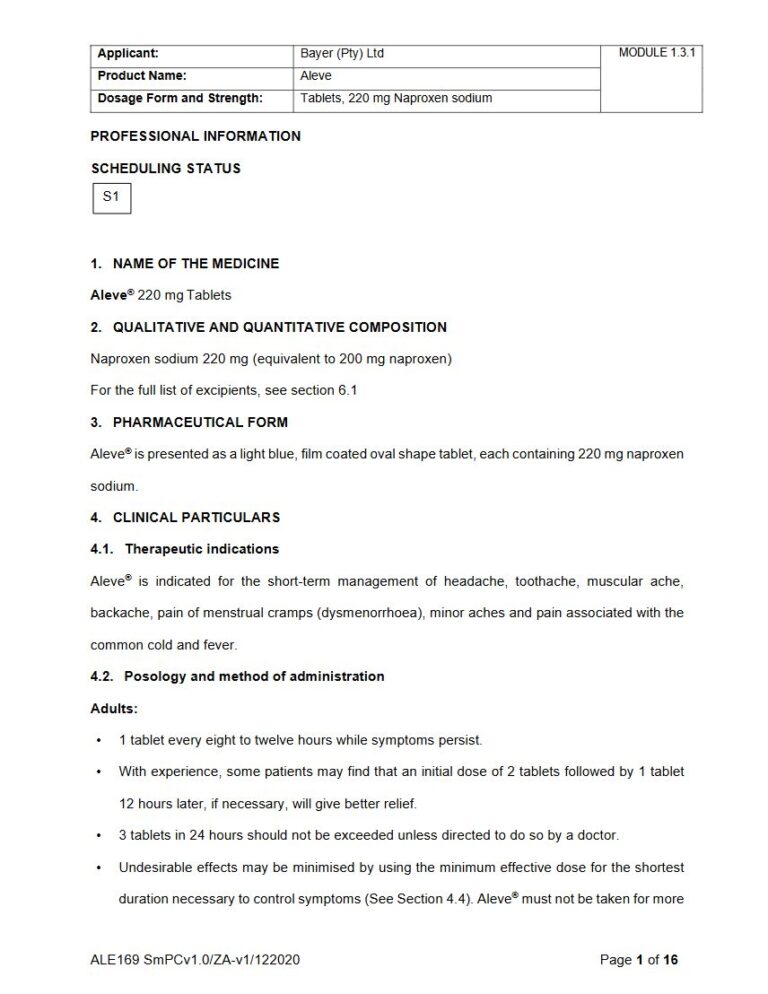
Aleve 220 mg Tablets
Clinical Summary
Quick overview from the medicine insert
Indication
Relief of mild to moderate pain, including headache, dental pain, menstrual cramps, muscle aches, and pain from arthritis.
Dosage (summary)
The recommended dose for adults is 220 mg every 8 to 12 hours as needed. Do not exceed 660 mg in a 24-hour period.
Onset of Action / Duration
Pain relief typically begins within 30 minutes to 1 hour after administration.
Special Populations
- Elderly patients may require dose adjustments due to increased risk of adverse effects.
- Patients with renal impairment should use with caution and may require dose adjustments.
- Patients with hepatic impairment should use with caution.
Pregnancy & Breastfeeding
Naproxen should be avoided during the third trimester of pregnancy due to the risk of premature closure of the ductus arteriosus. It is excreted in breast milk; caution is advised when administered to nursing mothers.
Key Drug Interactions
- Increased risk of gastrointestinal bleeding when used with other NSAIDs, anticoagulants, or corticosteroids.
- May reduce the antihypertensive effect of ACE inhibitors and diuretics.
- May increase plasma concentrations of lithium.
Contraindications
- Hypersensitivity to naproxen or any of its components.
- Active peptic ulcer disease.
- History of gastrointestinal bleeding or ulceration related to NSAID therapy.
- Severe renal impairment.
Common side effects
- Gastrointestinal upset, including nausea, vomiting, and dyspepsia.
- Headache.
- Dizziness.
- Rash.
- Increased risk of cardiovascular events with long-term use.
Counselling Points
- Take with food or milk to reduce gastrointestinal irritation.
- Do not exceed the recommended dose.
- Report any signs of gastrointestinal bleeding, such as black or bloody stools, to a healthcare provider.
- Avoid alcohol while taking this medication to reduce the risk of gastrointestinal side effects.
Serious warnings
- Use with caution in patients with a history of cardiovascular disease.
- Monitor for signs of gastrointestinal bleeding, especially in elderly patients.
- Discontinue use if signs of an allergic reaction occur, such as rash, itching, or difficulty breathing.
Important Disclaimer
The Aleve 220 mg Tablets professional information leaflet below is the property of Bayer and is provided on Medinsert exactly as issued, with no.. alterations or editorial changes. We make every effort to keep content current by updating documents as soon as new versions become available. Medinsert serves as a trusted access point for healthcare professionals, but does not replace official sources or clinical judgement. For more details, please read our full disclaimer. read more>>
 Healthcare Professionals Only
This content is for registered healthcare professionals
Sign in or create a free account to read the full package insert.
Free for HPCSA-registered professionals. Powered by Medinsert.
Clinical Particulars
Section 4 of the official insert — extracted exactly as issued, no alterations
4.1. Therapeutic indications
Aleve u00ae is indicated for the short-term management of headache, toothache, muscular ache, backache, pain of menstrual cramps (dysmenorrhoea), minor aches and pain associated with the common cold and fever.
4.2. Posology and method of administration
Adults:
- 1 tablet every eight to twelve hours while symptoms persist.
- With experience, some patients may find that an initial dose of 2 tablets followed by 1 tablet 12 hours later, if necessary, will give better relief.
- 3 tablets in 24 hours should not be exceeded unless directed to do so by a doctor.
- Undesirable effects may be minimised by using the minimum effective dose for the shortest duration necessary to control symptoms (See Section 4.4).
Aleve u00ae must not be taken for more than ten days, unless under the direction of a doctor. If pain or fever persists or if symptoms change, a doctor should be consulted.
Elderly (65 and over):
- No more than 2 tablets per day, unless directed to do so by a doctor.
Children:
- Do not give this medicine to children under 12 years, except under the advice and supervision of a doctor.
Dose in Severe Renal, Hepatic or cardiac Impairment:
- In patients with severe, renal, hepatic and/ or cardiac impairment dose reduction may be necessary.
Method of administration
Each dose should be taken orally with a glass of water and can be taken fasting or with meals. Absorption may be delayed with meals.
4.3. Contraindications
- Known hypersensitivity to naproxen or any other ingredient in the medicine
- History of asthma, urticaria or allergic-type reactions after taking aspirin or other non-steroidal anti-inflammatory drugs (NSAIDs).
- History of gastrointestinal bleeding or perforation related to previous NSAID therapy.
- Active, or a history of, recurrent peptic ulcer or haemorrhage (two or more distinct episodes of proven ulceration or bleeding).
- Severe heart failure.
- Aleve u00ae is contraindicated in pregnant or nursing mothers.
4.4. Special warnings and precautions for use
Pain of gastrointestinal origin is not an indication for Aleve u00ae.
General Warnings:
The use of Aleve u00ae with concomitant NSAIDs including cyclooxygenase-2 selective inhibitors should be avoided. Undesirable effects may be minimised by using the lowest effective dose for the shortest duration necessary to control symptoms (see gastrointestinal and cardiovascular risks below).
Precautions for Elderly Patients:
Although total plasma concentrations of naproxen are unchanged, the unbound plasma fraction of naproxen is increased in the elderly. Caution is advised and lower doses might be required. For the effects of reduced elimination in the elderly refer to the section u2013 Use in patients with impaired renal function.
Use in patients with impaired renal function:
As naproxen is eliminated to a large extent (95%) by urinary excretion via glomerular filtration it should be used with great caution in patients with impaired renal function and the monitoring of serum creatinine and /or creatinine clearance is advised in these patients. Certain patients, specifically those where renal blood flow is compromised, such as in extracellular volume depletion, cirrhosis of the liver, sodium restriction, congestive heart failure and pre-existing renal disease, should have renal function assessed before and during Aleve u00ae therapy. Elderly patients in whom impaired renal function may be expected could also fall within this category. A reduction in daily dosage is recommended to avoid the possibility of excessive accumulation of naproxen metabolites in these patients.
Gastrointestinal bleeding, ulceration and perforation:
Gastrointestinal bleeding, ulceration or perforation, which can be fatal, has been reported with all NSAIDs at any time during treatment, with or without warning symptoms or a previous history of serious gastrointestinal events. The risk of gastrointestinal bleeding, ulceration or perforation is higher with increasing NSAID doses, in patients with a history of ulcer, particularly if complicated with haemorrhage or perforation (See section 4.3), and in the elderly. These patients should commence treatment on the lowest dose available. Combination therapy with protective agents (e.g. misoprostol or proton pump inhibitors) should be considered for these patients, and also for patients requiring concomitant low dose aspirin, or other drugs likely to increase gastrointestinal risk (See section 4.5). Patients with a history of gastrointestinal toxicity, particularly when elderly, should report any unusual abdominal symptoms (especially gastrointestinal bleeding) particularly in the initial stages of treatment. Caution should be advised in patients receiving concomitant medications which could increase the risk of ulceration or bleeding, such as oral corticosteroids, anticoagulants such as warfarin, selective serotonin-reuptake inhibitors or anti-platelet agents such as aspirin (See section 4.5). When gastrointestinal bleeding or ulceration occurs in patients receiving Aleve u00ae, the treatment should be withdrawn. NSAIDs should be given with care to patients with a history of gastrointestinal disease (ulcerative colitis, Crohnu2019s disease) as their condition may be exacerbated (See section 4.8).
Sodium/fluid retention in cardiovascular conditions and peripheral oedema:
Caution (discussion with doctor or pharmacist) is required prior to starting treatment in patients with a history of hypertension and/or heart failure as fluid retention, hypertension and oedema have been reported in association with NSAID therapy.
Cardiovascular and cerebrovascular effects:
Clinical trial and epidemiological data suggest that use of coxibs and some NSAIDs (particularly at high doses and in long term treatment) may be associated with a small increased risk of arterial thrombotic events (for example myocardial infarction or stroke). Although data suggest that the use of naproxen (1000 mg daily) may be associated with a lower risk, some risk cannot be excluded. There are insufficient data regarding the effects of low dose Aleve u00ae (220 mg u2013 660 mg daily) to draw firm conclusions on possible thrombotic risks. Aleve u00ae may attenuate acetylsalicylic acidu2019s antiplatelet effect. Patients should talk to their doctor if they are on an acetylsalicylic acid regimen and plan to take Aleve u00ae. (See section 4.5)
Skin reactions:
Serious skin reactions, some of them fatal, including exfoliative dermatitis, Stevenu2019s-Johnson syndrome, and toxic epidermal necrolysis, have been reported very rarely in association with the use of NSAIDs (See section 4.8). Patients appear to be at highest risk of these reactions early in the course of therapy. Aleve u00ae should be discontinued at the first appearance of skin rash, mucosal lesions, or any other sign of hypersensitivity.
Anaphylactic (anaphylactoid) reactions:
Hypersensitivity reactions, including anaphylactic (anaphylactoid) reactions may occur both in patients with and without a history of hypersensitivity on exposure to aspirin, other non-steroidal anti-inflammatory drugs or naproxen-containing products. They may also occur in individuals with a history of angioedema, bronchospastic reactivity (e.g. asthma), rhinitis, nasal polyps, allergic disease, chronic respiratory disease or aspirin sensitivity. This also applies to patients exhibiting allergic reactions (e.g. cutaneous reactions, itching urticaria) to naproxen or other NSAIDs. Anaphylactoid reactions, like anaphylaxis, may have a fatal outcome.
Hepatic effects:
Severe hepatic reactions, including jaundice and hepatitis (some cases of hepatitis have been fatal), have been reported with Aleve u00ae as with other non-steroidal anti-inflammatory drugs. Cross reactivity has been reported.
Precautions related to fertility:
There is some evidence that drugs which inhibit cyclooxygenase / prostaglandin synthesis may cause impairment of female fertility by an effect on ovulation. This is reversible on withdrawal of treatment.
Patients with medical history
Subjects with the following additional medical history should be under adequate and careful supervision of their doctor when taking Aleve u00ae:
- Those taking any other analgesic
- Those taking steroids
- Those with coagulation disturbances or who take medicines that influence haemostasis
- Those on intensive diuretic therapy
- Those with severe renal, hepatic, or cardiac impairment
4.5. Interaction with other medicines
Cyclosporine: Cyclosporine concentrations may increase, increasing the risk for nephrotoxicity.
Lithium: Lithium levels may increase, which could induce nausea, polydipsia, polyuria, tremor, confusion.
Methotrexate used at doses of 15 mg/week or more: Elevated concentration of methotrexate, increasing the risk for toxicity to this substance.
Non-steroidal anti-inflammatory drugs (NSAIDs) including aspirin: Increased risk of ulcers and gastrointestinal bleeding. (See section 4.4).
Low-dose aspirin: Aleve u00ae may attenuate the irreversible platelet inhibition induced by acetylsalicylic acid. Clinical pharmacodynamic data suggest that concurrent (same day) Aleve u00ae usage for more than one day consecutively inhibits the effect of low-dose acetylsalicylic acid on platelet activity and this inhibition may persist for up to several days after stopping Aleve u00ae therapy. The clinical relevance of this interaction is not known. Treatment with Aleve u00ae in patients with increased cardiovascular risk may limit the cardiovascular protection of acetylsalicylic Acid. (See section 4.4).
Anticoagulants: NSAIDs may enhance the effects of anti-coagulants, such as warfarin (See section 4.4). Anticoagulants and other drugs influencing haemostasis add to the risk of bleeding and require careful monitoring.
Anti-platelet agents and selective serotonin reuptake inhibitors (SSRIs): Increased risk of gastrointestinal bleeding (See section 4.4).
Corticosteroids: Increased risk of gastro-intestinal ulceration or bleeding (See section 4.4).
Diuretics and antihypertensive drugs including ACE Inhibitors: The diuretic and antihypertensive efficacy, particularly in patients with pre-existing nephropathy, may be reduced.
During short term use of Aleve u00ae interactions of clinical significance do not seem to be relevant for the following medications:
- Antacids
- Antidiabetic agents
- Hydantoins
- Probenecid
- Zidovudine
Drug u2013 Food Interaction
The absorption of Aleve u00ae may be delayed with a meal.
Interference with Laboratory Testing
Aleve u00ae has been claimed to interfere with the urinary analyses of 17-ketogenic steroids and 5-hydroxy indoleacetic acid (5 HIAA).
4.6. Fertility, pregnancy and lactation
Pregnancy
As with other drugs of this type, Aleve u00ae produces a delay in parturition in animals and also affects the human foetal cardiovascular system (closure of the ductus arteriosus). Therefore, Aleve u00ae should not be used unless clearly needed and directed to do so by a doctor. The use of Aleve u00ae in pregnancy requires cautious balancing of the possible benefits against potential risk to the mother and foetus, especially during the first and third trimester.
Breastfeeding
Naproxen has been found in the milk of lactating mothers. The use of Aleve u00ae should therefore be avoided in women who are breast-feeding.
4.7. Effects on the ability to drive and use machines
No studies on the effect on the ability to drive and use machines have been performed. However, undesirable effects such as drowsiness, dizziness, vertigo, insomnia have been observed with the use of Aleve u00ae. Patients should be cautioned to see how they react before driving or operating machinery.
4.8. Undesirable effects
Cardiac disorders
Oedema, hypertension, and cardiac failure, have been reported in association with NSAID treatment. Clinical trial and epidemiological data suggest that use of coxibs and some NSAIDs (particularly at high doses and in long term treatment) may be associated with a small increased risk of arterial thrombotic events (for example myocardial infarction or stroke) (See section 4.4).
Gastrointestinal disorders
The most commonly observed adverse events are gastrointestinal in nature. Peptic ulcers, perforation or gastrointestinal bleeding, sometimes fatal, particularly in the elderly, may occur. (See section 4.4). Nausea, vomiting, diarrhoea, flatulence, constipation, dyspepsia, abdominal pain, melena, hematemesis, ulcerative stomatitis, exacerbation of colitis and Crohnu2019s disease (See section 4.4) have been reported following administration. Less frequently, gastritis has been observed.
Skin and subcutaneous tissue disorders
Bullous reactions including Stevens-Johnson syndrome and toxic epidermal necrolysis (very rare). Aleve u00ae causes transient, dose-dependent modestly increased bleeding times. However, these values often do not exceed the upper limit of the reference range.
Tabulation of SIDE EFFECTS
The following adverse drug reactions have been observed for Aleve u00ae, including those with prescription dosing.
System organ class Frequency Effects
Immune System disorders Very rare < 0.01% and isolated reports Anaphylaxis/ anaphylactoid reactions including shock with fatal outcome
Blood and the lymphatic system disorders Very rare < 0.01% and isolated reports haematopoietic disturbances (leucopoenia, thrombocytopenia, agranulocytosis, aplastic anaemia, eosinophilia, haemolytic anaemia)
Psychiatric disorders Very rare < 0.01% and isolated reports psychiatric disorders, depression, dream abnormalities, inability to concentrate
Nervous system disorders Common = 1% - < 10% dizziness, headache, light-headedness
Uncommon = 0.1 % - < 1 % drowsiness, insomnia somnolence
Very rare < 0.01% and isolated reports aseptic meningitis, cognitive dysfunction, convulsions
Eye disorders Very rare < 0.01% and isolated reports visual disturbance , corneal opacity, papillitis, retrobulbar optic neuritis, papilledema
Ear & labyrinth disorders Uncommon = 0.1 % - < 1 % Vertigo
Very rare < 0.01% and isolated reports hearing impairment, tinnitus, hearing disturbances
Cardiac disorders Very rare < 0.01% and isolated reports congestive heart failure, hypertension, pulmonary oedema, palpitations
Vascular disorders Very rare < 0.01% and isolated reports vasculitis
Respiratory, Thoracic and Mediastinal disorders Very rare < 0.01% and isolated reports dyspnoea, asthma, eosinophilic pneumonitis
Gastro-intestinal disorders Common = 1% - < 10% dyspepsia, nausea, heartburn, abdominal pain
Uncommon = 0.1 % - < 1 % diarrhoea, constipation, vomiting
Rare = 0.01% - < 0.1% peptic ulcers without or with bleeding or perforation, gastrointestinal bleeding, hematemesis, melena
Very rare < 0.01% and isolated reports pancreatitis, colitis, aphthous ulcers, stomatitis, esophagitis, intestinal ulcerations
Hepatobiliary disorders Very rare < 0.01% and isolated reports hepatitis, (including fatal cases), jaundice, icterus
Uncommon = 0.1 % - < 1 % exanthema (rash), pruritus, urticaria
Skin & Subcutaneous Tissue disorders Rare = 0.01% - < 0.1% angioneurotic oedema
Very rare < 0.01% and isolated reports alopecia (usually reversible), photosensitivity, porphyria, exudative erythema multiforme, bullous reactions including Stevenu2019s-Johnson syndrome and toxic epidermal necrolysis, erythema nodosum, fixed drug eruption, lichen planus, pustular reaction, skin rashes, Systemic Lupus Erythematosus, photosensitivity reactions including porphyria cutanea tarda (u201cpseudoporphyriau201d) or epidermolysis bullosa, ecchymoses, purpura, sweating
Renal & Urinary disorders Rare = 0.01% - < 0.1% renal impairment
Very rare < 0.01% and isolated reports interstitial nephritis, renal papillary necrosis, nephrotic syndrome, renal failure, renal disease haematuria, proteinuria
Congenital Very rare < 0.01% and isolated reports Closure of ductus arteriosus
Reproductive system and breast disorders Very rare < 0.01% and isolated reports female: infertility
General disorders Rare = 0.01% - < 0.1% peripheral oedema, particular in patients with hypertension or kidney failure, pyrexia (including chills and fever)
Very rare < 0.01% and isolated reports oedema, thirst, malaise
Investigations Very rare < 0.01% and isolated reports raised serum creatinine, abnormal liver function test, hyperkalemia
Reporting of suspected adverse reactions
Health care providers are asked to report any suspected adverse reactions to SAHPRA via the u201c6.04 Adverse Drug Reactions Reporting Formu201d, found under SAHPRAu2019s publications: Https://www.sahpra.org.za/Publications/Index/8.
4.9. Overdose
Significant overdosage of the drug may be characterised by dizziness, drowsiness, epigastric pain, abdominal discomfort, heartburn, indigestion, nausea and vomiting, transient alterations in liver function, hypoprothrombinaemia, renal dysfunction, metabolic acidosis, apnea, or disorientation. Because Aleve u00ae tablets may be rapidly absorbed, high and early blood levels should be anticipated. A few patients have experienced convulsions, but it is not clear these were naproxen related or not. Some cases with acute, reversible renal failure have been described. It is not known what dose of the drug would be life threatening. Should a patient ingest a large quantity of Aleve u00ae tablets the stomach may be emptied and usual supportive measures like administration of activated charcoal employed. Haemodialysis does not decrease the plasma concentration of naproxen because of the high degree of its protein binding. There is no specific antidote.
