
Alunbrigtm Tablets
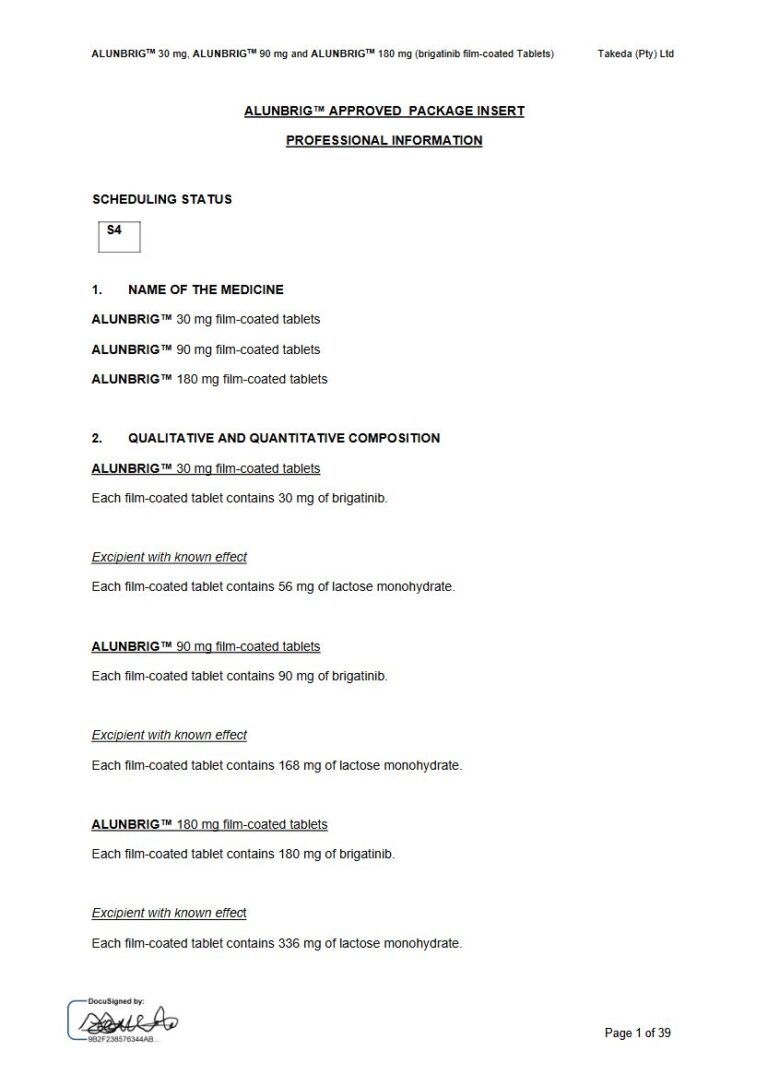
PDF Leaflet Revision Date: 17 February 2022
Clinical Summary
Quick overview from the medicine insert
Indication
Monotherapy for ALK-positive advanced NSCLC in adults.
Dosage (summary)
Starting dose: 90 mg once daily for 7 days, then 180 mg once daily.
Special Populations
- Elderly
- Hepatic impairment
- Renal impairment
Pregnancy & Breastfeeding
Contraindicated in pregnancy; breastfeeding should be discontinued during treatment.
Key Drug Interactions
- Strong CYP3A inhibitors
- Strong CYP3A inducers
- Grapefruit juice
Contraindications
- Hypersensitivity
- Pregnancy
Common side effects
- Increased AST
- Increased CPK
- Hyperglycaemia
- Diarrhoea
- Fatigue
Counselling Points
- Monitor for respiratory symptoms
- Avoid grapefruit
- Use contraception during treatment
Serious warnings
- Pulmonary adverse reactions
- Hypertension
- Bradycardia
- Visual disturbances
Important Disclaimer
The Alunbrigtm Tablets professional information leaflet below is the property of Takeda and is provided on Medinsert exactly as issued, with no.. alterations or editorial changes. We make every effort to keep content current by updating documents as soon as new versions become available. Medinsert serves as a trusted access point for healthcare professionals, but does not replace official sources or clinical judgement. For more details, please read our full disclaimer. read more>>
 Healthcare Professionals Only
This content is for registered healthcare professionals
Sign in or create a free account to read the full package insert.
Free for HPCSA-registered professionals. Powered by Medinsert.
Clinical Particulars
Section 4 of the official insert — extracted exactly as issued, no alterations
4.1 Therapeutic indications
ALUNBRIGu2122 is indicated as monotherapy for the treatment of adult patients with anaplastic lymphoma kinase (ALK) positive advanced non-small cell lung cancer (NSCLC) of the adenocarcinoma cell type previously not treated with an ALK inhibitor. ALUNBRIGu2122 is indicated as monotherapy for the treatment of adult patients with anaplastic lymphoma kinase (ALK) positive advanced non-small cell lung cancer (NSCLC) of the adenocarcinoma cell type, who have progressed on or are intolerant to crizotinib.
4.2 Posology and method of administration
Treatment with ALUNBRIGu2122 should be initiated and supervised by a medical practitioner experienced in the use of anticancer medicines. ALK-positive NSCLC status should be known prior to initiation of ALUNBRIGu2122 therapy. A validated ALK assay is necessary for the selection of ALK-positive NSCLC patients (see section 5.1).
Assessment for ALK-positive NSCLC should be performed by laboratories with demonstrated proficiency in the specific technology being utilised.
Posology
The recommended starting dose of ALUNBRIGu2122 is 90 mg once daily for the first 7 days, then 180 mg once daily. If ALUNBRIGu2122 is interrupted for 14 days or longer for reasons other than adverse reactions, treatment should be resumed at 90 mg once daily for 7 days before increasing to the previously tolerated dose. If a dose is missed or vomiting occurs after taking a dose, an additional dose should not be administered and the next dose should be taken at the scheduled time. Treatment should continue as long as clinical benefit is observed.
Dose adjustments
Dosing interruption and/or dose reduction may be required based on individual safety and tolerability. ALUNBRIGu2122 dose modification levels are summarised in Table 1.
Table 1: Recommended ALUNBRIGu2122 dose reduction levels
Dose Dose reduction levels
First Second Third
90 mg once daily (first 7 days) reduce to 60 mg once daily permanently discontinue not applicable
180 mg once daily reduce to 120 mg once daily reduce to 90 mg once daily reduce to 60 mg once daily
ALUNBRIGu2122 should be permanently discontinued if patient is unable to tolerate the 60 mg once daily dose.
Recommendations for dose modifications of ALUNBRIGu2122 for the management of adverse reactions are summarised in Table 2.
4.3 Contraindications
Hypersensitivity to the active substance or to any of the excipients listed in section 6.1. Pregnancy and lactation (see section 4.6).
4.4 Special warnings and precautions for use
Pulmonary adverse reactions
Severe, life-threatening, and fatal pulmonary adverse reactions, including those with features consistent with ILD/pneumonitis, can occur in patients treated with ALUNBRIGu2122 (see section 4.8). Most pulmonary adverse reactions were observed within the first 7 days of treatment. Grade 1 - 2 pulmonary adverse reactions resolved with interruption of treatment or dose modification. Increased age and shorter interval (less than 7 days) between the last dose of crizotinib and the first dose of ALUNBRIGu2122 were independently associated with an increased rate of these pulmonary adverse reactions. These factors should be considered when initiating treatment with ALUNBRIGu2122. Patients with a history of ILD or drug-induced pneumonitis were excluded from the pivotal trial. Some patients experienced pneumonitis later in treatment with ALUNBRIGu2122. Patients should be monitored for new or worsening respiratory symptoms (e.g., dyspnoea, cough, etc.), particularly in the first week of treatment. Evidence of pneumonitis in any patient with worsening respiratory symptoms should be promptly investigated. If pneumonitis is suspected, the dose of ALUNBRIGu2122 should be withheld, and the patient evaluated for other causes of symptoms (e.g., pulmonary embolism, tumour progression, and infectious pneumonia). The dose should be modified accordingly (see section 4.2).
Hypertension
Hypertension has occurred in patients treated with ALUNBRIGu2122 (see section 4.8). Blood pressure should be monitored regularly during treatment with ALUNBRIGu2122. Hypertension should be treated according to standard guidelines to control blood pressure. Heart rate should be monitored more frequently in patients if concomitant use of a medicine known to cause bradycardia cannot be avoided. For severe hypertension (u2265 Grade 3), ALUNBRIGu2122 should be withheld until hypertension has recovered to Grade 1 or to baseline. The dose should be modified accordingly (see section 4.2).
Bradycardia
Bradycardia has occurred in patients treated with ALUNBRIGu2122 (see section 4.8). Caution should be exercised when administering ALUNBRIGu2122 in combination with other medicines known to cause bradycardia. Heart rate and blood pressure should be monitored regularly. If symptomatic bradycardia occurs, treatment with ALUNBRIGu2122 should be withheld and concomitant medicines known to cause bradycardia should be evaluated. Upon recovery, the dose should be modified accordingly (see section 4.2). In case of life-threatening bradycardia, if no contributing concomitant medicines is identified or in case of recurrence, treatment with ALUNBRIGu2122 should be discontinued (see section 4.2).
Visual disturbance
Visual disturbance adverse reactions have occurred in patients treated with ALUNBRIGu2122 (see section 4.8). Patients should be advised to report any visual symptoms. For new or worsening severe visual symptoms, an ophthalmologic evaluation and dose reduction should be considered (see section 4.2).
Creatine phosphokinase (CPK) elevation
Elevations of CPK have occurred in patients treated with ALUNBRIGu2122 (see section 4.8). Patients should be advised to report any unexplained muscle pain, tenderness, or weakness. CPK levels should be monitored regularly during ALUNBRIGu2122 treatment. Based on the severity of the CPK elevation, and or if associated with muscle pain or weakness, treatment with ALUNBRIGu2122 should be withheld, and the dose modified accordingly (see section 4.2).
Elevations of pancreatic enzymes
Elevations of amylase and lipase have occurred in patients treated with ALUNBRIGu2122 (see section 4.8). Lipase and amylase should be monitored regularly during treatment with ALUNBRIGu2122. Based on the severity of the laboratory abnormalities, treatment with ALUNBRIGu2122 should be withheld, and the dose modified accordingly (see section 4.2).
Hepatotoxicity
Elevations of hepatic enzymes (aspartate aminotransferase, alanine aminotransferase) and bilirubin have occurred in patients treated with ALUNBRIGu2122 (see section 4.8). Liver function, including AST, ALT and total bilirubin should be assessed prior to the initiation of ALUNBRIGu2122 and then every 2 weeks during the first 3 months of treatment. Thereafter, monitoring should be performed periodically. Based on the severity of the laboratory abnormalities, treatment should be withheld, and the dose modified accordingly (see section 4.2).
Hyperglycaemia
Elevations of serum glucose have occurred in patients treated with ALUNBRIGu2122. Fasting serum glucose should be assessed prior to initiation of ALUNBRIGu2122 and monitored periodically thereafter. Antihyperglycaemic treatment should be initiated or optimised as needed. If adequate hyperglycaemic control cannot be achieved with optimal medical management, ALUNBRIGu2122 should be withheld until adequate hyperglycaemic control is achieved; upon recovery reducing the dose as described in Table 1 may be considered or ALUNBRIGu2122 may be permanently discontinued.
4.5 Interactions with other medicines
The concomitant use of ALUNBRIGu2122 with strong CYP3A inhibitors should be avoided. If concomitant use of strong CYP3A inhibitors cannot be avoided, the dose of ALUNBRIGu2122 should be reduced from 180 mg to 90 mg, or from 90 mg to 60 mg. After discontinuation of a strong CYP3A inhibitor, ALUNBRIGu2122 should be resumed at the dose that was tolerated prior to the initiation of the strong CYP3A inhibitor. The concomitant use of ALUNBRIGu2122 with strong and moderate CYP3A inducers should be avoided (see section 4.5). Vaccinations with live attenuated vaccines are not advised for patients taking ALUNBRIGu2122.
4.6 Fertility, pregnancy and lactation
ALUNBRIGu2122 is contraindicated during pregnancy (see section 4.3). Women of childbearing age being treated with ALUNBRIGu2122 should be advised not to become pregnant and men being treated with ALUNBRIGu2122 should be advised not to father a child during treatment. Women of reproductive potential should use effective non-hormonal contraception during treatment with ALUNBRIGu2122 and for at least 4 months following the final dose. Men with female partners of reproductive potential should use effective contraception during treatment and for at least 3 months after the last dose of ALUNBRIGu2122. ALUNBRIGu2122 may cause foetal harm when administered to a pregnant woman. Studies in animals have shown reproductive toxicity (see section 5.3). There are no clinical data on the use of ALUNBRIGu2122 in pregnant women. ALUNBRIGu2122 should not be used during pregnancy. If ALUNBRIGu2122 is used during pregnancy, or if the patient becomes pregnant while taking this medicine, the patient should be apprised of the potential hazard to a foetus. Breast-feeding should be stopped during treatment with ALUNBRIGu2122. No human data on the effect of ALUNBRIGu2122 on fertility are available. Based on repeat-dose toxicity studies in male animals, ALUNBRIGu2122 may cause reduced fertility in males (see section 5.3).
4.7 Effects on ability to drive and use machines
Caution should be exercised when driving or operating machines as patients may experience visual disturbance, dizziness, or fatigue while taking ALUNBRIGu2122.
4.8 Undesirable effects
Summary of the safety profile The adverse reactions described in this section were identified three clinical trials with limited patient numbers, 222 (ALTA trial), 275 (ALTA 1L) and 25 (Study 101). The most common adverse reactions (u2265 25 %) reported in patients treated with Alunbrig at the recommended dosing regimen were increased AST, increased CPK, hyperglycaemia, increased lipase, hyperinsulinaemia, diarrhoea, increased ALT, increased amylase, anaemia, nausea, fatigue, hypophosphataemia, decreased lymphocyte count, cough, increased alkaline phosphatase, rash, increased APTT, myalgia, headache, hypertension, decreased white blood cell count, dyspnoea, and vomiting. The most common serious adverse reactions (u2265 2 %) reported in patients treated with Alunbrig at the recommended dosing regimen other than events related to neoplasm progression were pneumonia, pneumonitis, dyspnoea and pyrexia. The data described below reflect exposure to Alunbrig at the recommended dosing regimen in three clinical trials: a Phase 3 trial (ALTA 1L) in patients with advanced ALK positive NSCLC previously not treated with an ALK inhibitor (N = 136), a Phase 2 trial (ALTA) in patients treated with Alunbrig with ALK positive NSCLC who previously progressed on crizotinib (N = 110), and a phase 1/2 dose escalation/expansion trial in patients with advanced malignancies (N = 28). Across these studies, the median duration of exposure in patients receiving Alunbrig at the recommended dosing regimen was 21.8 months. Adverse reactions reported are presented in Table 3 and are listed by system organ class, preferred term and frequency. Frequency categories are very common (u2265 1/10), common (u2265 1/100 to < 1/10) and uncommon (u2265 1/1,000 to < 1/100). Within each frequency grouping, undesirable effects are presented in order of frequency.
4.9 Overdose
There is no specific antidote for overdose with ALUNBRIGu2122. In the event of an overdose, monitor the patient for adverse reactions (see section 4.8) and provide appropriate supportive care.
