
Replagal 3,5 mg/ 3,5 ml Concentrate for solution for infusion
PDF Leaflet Revision Date: 24 July 2024
Clinical Summary
Quick overview from the medicine insert
Indication
Long-term enzyme replacement therapy for Fabry disease.
Dosage (summary)
0.2 mg/kg body weight every other week by IV infusion over 40 minutes.
Special Populations
- Elderly (65+ years)
- Hepatic impairment
- Renal impairment
Pregnancy & Breastfeeding
Limited data show no adverse effects in pregnancy; caution advised during breastfeeding.
Key Drug Interactions
- Chloroquine
- Amiodarone
- Gentamicin
Contraindications
- Hypersensitivity to agalsidase alfa or excipients
Common side effects
- Headache
- Nausea
- Fatigue
- Rigors
- Flushing
Counselling Points
- Monitor for infusion-related reactions.
- Record product name and batch number for traceability.
- Consider pre-treatment with antihistamines or corticosteroids.
Serious warnings
- Idiosyncratic infusion-related reactions
- Severe allergic reactions
Important Disclaimer
The Replagal 3,5 mg/ 3,5 ml Concentrate for solution for infusion professional information leaflet below is the property of Takeda and is provided on Medinsert exactly as issued, with no.. alterations or editorial changes. We make every effort to keep content current by updating documents as soon as new versions become available. Medinsert serves as a trusted access point for healthcare professionals, but does not replace official sources or clinical judgement. For more details, please read our full disclaimer. read more>>
 Healthcare Professionals Only
This content is for registered healthcare professionals
Sign in or create a free account to read the full package insert.
Free for HPCSA-registered professionals. Powered by Medinsert.
Clinical Particulars
Section 4 of the official insert — extracted exactly as issued, no alterations
4.1 Therapeutic Indications
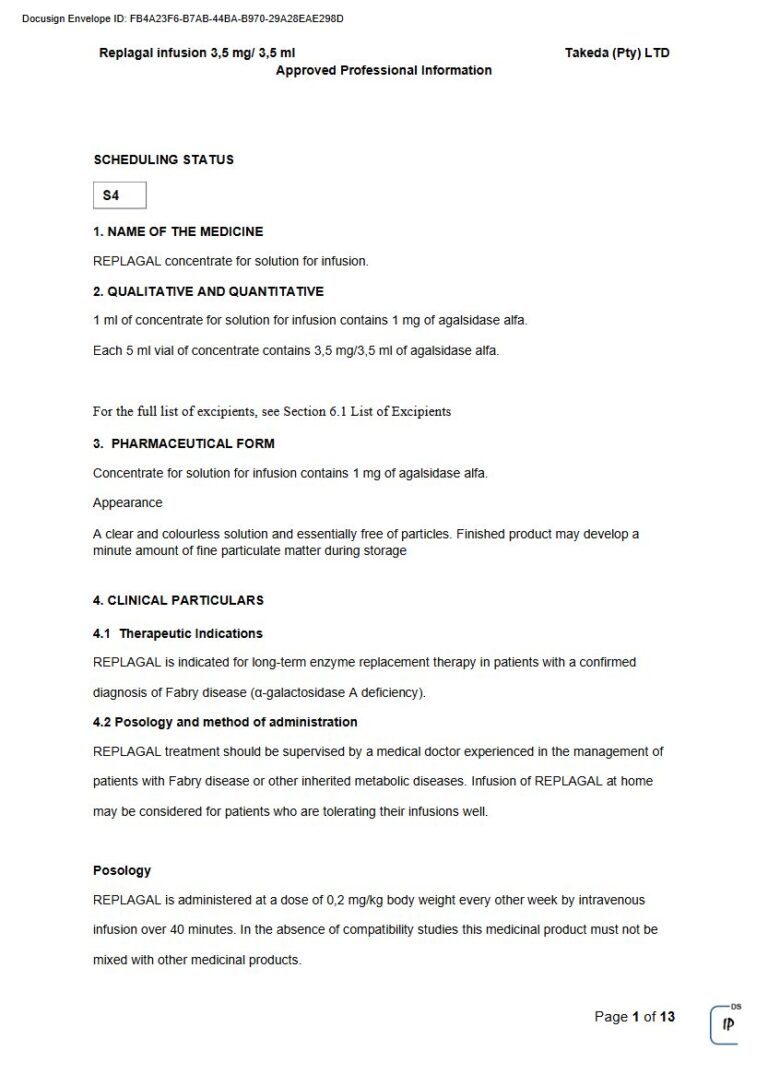
REPLAGAL is indicated for long-term enzyme replacement therapy in patients with a confirmed diagnosis of Fabry disease (u03b1 -galactosidase A deficiency).
4.2 Posology and method of administration
REPLAGAL treatment should be supervised by a medical doctor experienced in the management of patients with Fabry disease or other inherited metabolic diseases. Infusion of REPLAGAL at home may be considered for patients who are tolerating their infusions well.
Posology
REPLAGAL is administered at a dose of 0,2 mg/kg body weight every other week by intravenous infusion over 40 minutes. In the absence of compatibility studies this medicinal product must not be mixed with other medicinal products.
Special populations
Patients 65 years and above
Studies in patients over the age of 65 years have not been performed and no dosage regimen can presently be recommended in these patients as safety and efficacy have not yet been established.
Patients with hepatic impairment
No studies have been performed in patients with hepatic impairment.
Patients with renal impairment
No dose adjustment is necessary in patients with renal impairment. The presence of extensive renal damage (eGFR <60ml/min) may limit the renal response to enzyme replacement therapy. Limited data are available in patients on dialysis or post-kidney transplantation, no dose-adjustment is recommended.
Paediatric population
The experience in children is limited. Studies in children (0-6 years) have not been performed and no dosage regimen can presently be recommended in the patients as safety and efficacy have not yet been established. Limited clinical data in children (7-18 years) do not permit to recommend an optimal dosage regimen presently (see section u2018Pharmacokinetic Propertiesu2019). Because no unexpected safety issues were encountered in the 6-month study with REPLAGAL administered at 0,2 mg/kg in this population, this dosage regimen is suggested for children between 7u2013 18 years of age.
Method of administration
- Calculate the dose and number of REPLAGAL vials needed.
- Dilute the total volume of REPLAGAL concentrate required in 100 ml of 9 mg/ml (0,9 %) sodium chloride solution for infusion. Care must be taken to ensure the sterility of the prepared solutions since REPLAGAL does not contain any preservative or bacteriostatic agent; aseptic technique must be observed. Once diluted, the solution should be mixed gently but not shaken.
- The solution should be inspected visually for particulate matter and discolouration prior to administration.
- Administer the infusion solution over a period of 40 minutes using an intravenous line with an integral filter. Since no preservative is present, it is recommended that administration is started as soon as possible.
- Do not infuse REPLAGAL concomitantly in the same intravenous line with other agents.
- For single use only. Any unused product or waste material should be disposed of in accordance with local requirements.
4.3 Contraindications
Hypersensitivity to the active substance or any of the excipients.
4.4 Special warnings and precautions for use
Traceability
In order to improve the traceability of biological medicines, the name and batch number of the administered product should be clearly recorded.
Idiosyncratic infusion-related reactions
13,7 % of patients treated with REPLAGAL in clinical trials have experienced idiosyncratic infusion-related reactions. Overall, the percentage of infusion-related reactions was significantly lower in females than in males. The most common symptoms reported have been rigors, headache, nausea, pyrexia, flushing and fatigue. Serious infusion reactions have been reported uncommonly; symptoms reported include pyrexia, rigors, tachycardia, urticaria, nausea/vomiting, angioneurotic oedema with throat tightness, stridor and swollen tongue.
The onset of infusion-related reactions has generally occurred within the first 2-4 months after initiation of treatment with REPLAGAL although later onset (after 1 year) has been reported as well. These effects usually decrease with time. If any acute infusion reactions occur, medical attention must be sought immediately and appropriate actions instituted. The infusion can be temporarily interrupted (5 to 10 minutes) until symptoms subside and the infusion may then be restarted. Mild and transient effects may not require medical treatment or discontinuation of the infusion. In addition, oral or intravenous pre-treatment with antihistamines and/or corticosteroids, from 1 to 24 hours prior to infusion may prevent subsequent reactions in those cases where symptomatic treatment was required.
Allergic-type hypersensitivity reactions
Allergic-type hypersensitivity reactions may occur. If severe allergic or anaphylactic-type reactions occur, the administration of REPLAGAL should be discontinued immediately and appropriate treatment initiated. The current medical standards for emergency treatment are to be observed.
IgG antibodies to the protein
Patients may develop IgG antibodies to the protein. A low titre IgG antibody response has been observed in approximately 24 % of the male patients treated with REPLAGAL. Based on limited data this percentage has been found to be lower (7 %) in the male paediatric population. These IgG antibodies appeared to develop following approximately 3-12 months of treatment. After 12 to 54 months of therapy, 17 % of REPLAGAL treated patients were still antibody positive whereas 7 % showed evidence for the development of immunologic tolerance, based on the disappearance of IgG antibodies over time. The remaining 76 % remained antibody negative throughout. No IgE antibodies have been detected in any patient receiving REPLAGAL.
Patients with renal impairment
The presence of extensive renal damage may limit the renal response to enzyme replacement therapy, possibly due to underlying irreversible pathological changes. In such cases, the loss of renal function remains within the expected range of the natural progression of disease.
Sodium
This medicine contains 14.2 mg sodium per vial, equivalent to 0.7 % of the WHO recommended maximum daily intake of 2 g sodium for an adult.
4.5 Interaction with other medicines and other forms of interaction
REPLAGAL should not be co-administered with chloroquine, amiodarone, or gentamicin since these substances have the potential to inhibit intra-cellular u03b1 -galactosidase activity. As u03b1 -galactosidase A is itself an enzyme, it would be an unlikely candidate for cytochrome P450 mediated interactions. In clinical studies, neuropathic pain medicinal products (such as carbamazepine, phenytoin and gabapentin) were administered concurrently to most patients without any evidence of interaction.
Incompatibilities:
In the absence of compatibility studies this medicinal product must not be mixed with other medicinal products.
4.6 Fertility, pregnancy and lactation
Very limited clinical data on pregnancies exposed to REPLAGAL (n=4) have shown no adverse effects on the mother and newborn child. It is not known whether REPLAGAL is excreted in human milk. Caution should be exercised when prescribing to pregnant or breast-feeding women.
4.7 Effects on ability to drive and use machines
REPLAGAL has no or negligible influence on the ability to drive and use machines.
4.8 Undesirable Effects
Summary of safety profile
The most commonly reported adverse reactions were infusion associated reactions, which occurred in 13.7 % of adult patients treated with Replagal in clinical trials. Most undesirable effects were mild to moderate in severity.
Tabulated list of adverse reactions
Table 1 lists adverse reactions reported for the 344 patients treated with Replagal in clinical trials, including 21 patients with history of end stage renal disease, 30 paediatric patients (u226418 years of age) and 17 female patients, and from post-marketing spontaneous reports. Information is presented by system organ class and frequency (very common u22651/10; common u22651/100 to <1/10; uncommon u22651/1,000 to <1/100). The adverse reactions categorized as incidence u201cnot known (cannot be estimated from the available data)u201d are derived from post-marketing spontaneous reports. Within each frequency grouping, undesirable effects are presented in order of decreasing seriousness. The occurrence of an event in a single patient is defined as uncommon in view of the number of patients treated. A single patient could be affected by several adverse reactions.
The following adverse reactions have been identified for agalsidase alfa:
Table 1
System organ class
Adverse reaction
Very common
Common
Uncommon
Not known
Metabolism and nutrition disorders
peripheral oedema
Nervous system disorders
headache, dizziness, neuropathic pain, tremor, hypoesthesia, paraesthesia
dysgeusia, hypersomnia, parosmia
Eye disorders
lacrimation increased
corneal reflex decreased
Ear and labyrinth disorders
tinnitus
tinnitus aggravated
Cardiac disorders
palpitations
tachycardia, atrial fibrillation
Tachyarrhythmia
myocardial ischaemia, heart failure, ventricular extrasystoles
Vascular disorders
hypertension, hypotension, flushing
Respiratory, thoracic and mediastinal disorders
dyspnoea, cough, nasopharyngitis, pharyngitis
hoarseness, throat tightness, rhinorrhoea
oxygen saturation decreased
Throat secretion increased
Gastrointestinal disorders
vomiting, nausea, abdominal pain, diarrhoea
abdominal discomfort
Skin and subcutaneous tissue disorders
rash
Urticaria, erythema, pruritus, acne, hyperhidrosis
angioneurotic oedema, livedo reticularis
Musculoskeletal, connective tissue and bone disorders
arthralgia, pain in limb, myalgia, back pain
musculoskeletal discomfort, peripheral swelling, joint swelling
sensation of heaviness
Immune system disorders
hypersensitivity
anaphylactic reaction
General disorders and administration site conditions
chest pain, rigors, pyrexia, pain, asthenia, fatigue
chest tightness, fatigue aggravated, feeling hot, feeling cold, influenza like illness, discomfort, malaise
injection site rash
See also section 4.4.
Description of selected adverse reactions
Infusion related reactions reported in the post marketing setting (also see section 4.4) may include cardiac events such as cardiac arrhythmias (atrial fibrillation, ventricular extrasystoles, tachyarrhythmia), myocardial ischemia, and heart failure in patients with Fabry disease involving the heart structures. The most common infusion related reactions were mild and include rigors, pyrexia, flushing, headache, nausea, dyspnoea, tremor and pruritus. Infusion-related symptoms may also include dizziness, hyperhidrosis, hypotension, cough, vomiting and fatigue. Hypersensitivity, including anaphylaxis, has been reported.
Side effects reported in patients with history of end-stage renal disease were similar to those reported in the general patient population. Side effects reported in the paediatric population (children and adolescents) were, in general, similar to those reported in adults. However, infusion-related reactions and pain exacerbation occurred more frequently. The most frequent were mild infusion-related reactions that mainly included rigors, pyrexia, flushing, headache, nausea, and dyspnoea.
Reporting of suspected adverse reactions
Reporting suspected adverse reactions after authorisation of the medicine is important. It allows continued monitoring of the benefit/risk balance of the medicine. Health care providers are asked to report any suspected adverse reactions to SAHPRA via the u201c6.04 Adverse Drug Reactions Reporting Formu201d, found online under SAHPRAu2019s publications: https://www.sahpra.org.za/Publications/Index/8
4.9 Overdose
No case of overdose has been reported. Treatment is symptomatic and supportive.
