
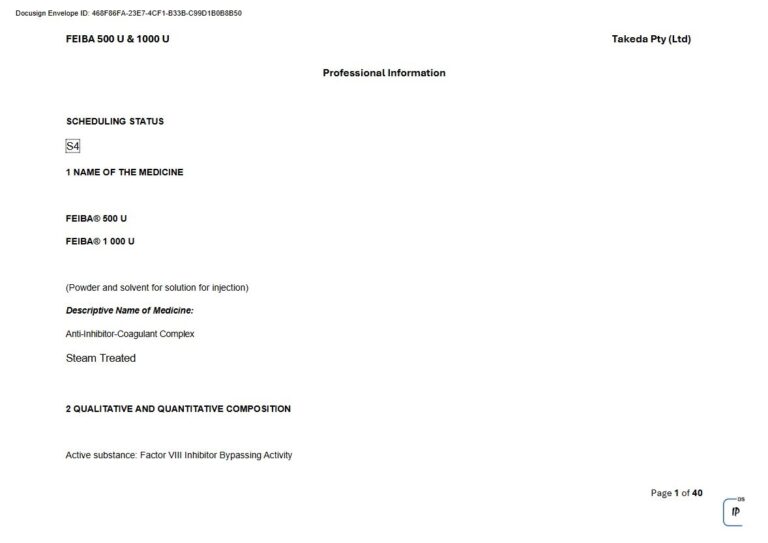
Feiba Solution
PDF Leaflet Revision Date: 26 February 2026
Clinical Summary
Quick overview from the medicine insert
Indication
Treatment and prevention of bleeding in patients with haemophilia A or B with inhibitors.
Dosage (summary)
50-100 U/kg bodyweight, max 200 U/kg/day; adjust based on bleeding severity.
Special Populations
- Elderly
- Paediatric population
Pregnancy & Breastfeeding
Safety not established; increased risk of thrombosis in pregnancy.
Key Drug Interactions
- Antifibrinolytics
- Recombinant Factor VIIa
- Emicizumab
Contraindications
- Hypersensitivity
- DIC
- Acute thrombosis or embolism
Common side effects
- Hypersensitivity reactions
- Thrombosis
- Headache
- Nausea
Counselling Points
- Monitor for signs of hypersensitivity
- Do not exceed recommended doses
- Inform about potential thromboembolic risks
Serious warnings
- Risk of thromboembolic events
- Monitor for DIC
- Allergic reactions
Important Disclaimer
The Feiba Solution professional information leaflet below is the property of Takeda and is provided on Medinsert exactly as issued, with no.. alterations or editorial changes. We make every effort to keep content current by updating documents as soon as new versions become available. Medinsert serves as a trusted access point for healthcare professionals, but does not replace official sources or clinical judgement. For more details, please read our full disclaimer. read more>>
 Healthcare Professionals Only
This content is for registered healthcare professionals
Sign in or create a free account to read the full package insert.
Free for HPCSA-registered professionals. Powered by Medinsert.
Clinical Particulars
Section 4 of the official insert — extracted exactly as issued, no alterations
4.1 Therapeutic indications
FEIBA is indicated for therapy and prophylaxis of haemorrhage and to cover surgical interventions in:
- Haemophilia A patients with F VIII inhibitor
- Haemophilia B patients with F IX inhibitor
FEIBA may be used in combination with Factor VIII concentrate for a continual long-term therapy to achieve an elimination of the factor VIII inhibitor or at least a reduction of the titre (BRACKMANN et al., 1981). In addition, the successful use of FEIBA was described in a few non-haemophiliacs with acquired inhibitors to factors VIII, XI and XII as well as in a patient with von Willebrand's disease with an inhibitor.
4.2 Posology and method of administration
Posology
Treatment should be initiated and supervised by a medical doctor experienced in the management of haemophilia. Since a single dose of FEIBA contains considerably less F VIII coagulant antigen than Factor VIII concentrate, FEIBA is the treatment of choice in high responder patients, even if the current inhibitor titre is low. As a general guideline a dose of 50 to 100 units of FEIBA per kg bodyweight is recommended, however, not exceeding a daily dose of 200 U/kg bodyweight unless the severity of bleeding warrants and justifies the use of higher doses. See section 4.4. Dosage is independent of the patient's inhibitor titre. Since the response to treatment may differ from patient to patient the dosage recommendations are only guidelines.
Paediatric population
The experience in children under 6 years of age is limited; the same dose regimen as in adults should be adapted to the childu2019s clinical condition.
Dosage Guidelines for Treatment of Patients with Inhibitors
Inhibitor titre (BU*/ml) Response to F VIII treatment
- Minor to moderate Bleeding
- Severe to life-threatening bleeding, surgery
10 low responder high responder low responder high responder low responder high responder F VIII or FEIBA FEIBA F VIII or FEIBA FEIBA FEIBA FEIBA F VIII or FEIBA FEIBA FEIBA FEIBA FEIBA FEIBA
*1 Bethesda Unit is defined as that amount of antibody that will inhibit 50 % of the F VIII activity of fresh average human plasma after incubation for 2 hours at 37 u2103.
1. Spontaneous Bleeding
Joint, Muscle and Soft Tissue Haemorrhage
For minor to moderate bleedings a dose of 50 - 75 U/kg bodyweight is recommended at 12 - hour intervals. Treatment should be continued until clear signs of clinical improvement appear, such as relief of pain, reduction of swelling or mobilisation of the joint. For major muscle and soft tissue haemorrhage, such as retroperitoneal bleeding, doses of 100 U/kg bodyweight at 12 - hour intervals are recommended.
Mucous Membrane Bleeding
A dose of 50 U/kg bodyweight is recommended to be given at 6 - hour intervals under careful monitoring of the patient (visible bleeding site, repeated measurements of the patient's haematocrit). Again, if haemorrhage does not stop, the dose may be increased to 100 U/kg bodyweight taking care not to exceed the maximum daily dose of 200 U/kg bodyweight.
Other Severe Haemorrhages
Severe haemorrhages, such as CNS bleedings have been effectively treated with doses of 100 U/kg bodyweight at 12 - hour intervals. In individual cases FEIBA may be given at intervals of 6 hours until clear clinical improvement is achieved. (Do not exceed the maximum daily dose).
2. Surgery
In surgical interventions, an initial dose of 100 U/kg body weight may be administered preoperatively, and a further dose of 50 u2013 100 U/kg body weight may be administered after 6 u2013 12 hours. As a postoperative maintenance dose, 50 u2013 100 U/kg body weight may be administered at 6 u2013 12 - hour intervals; dosage, dosage intervals and duration of the peri - and postoperative therapy are guided by the surgical intervention, the patientu2019s general condition and the clinical efficacy in each individual case. (The maximum daily dose of 200 U/kg body weight must not be exceeded!)
3. Prophylaxis in haemophilia A patients with inhibitors
Prophylaxis of bleeding in patients with a high inhibitor titer and frequent haemorrhages after failed immune tolerance induction (ITI) or when an ITI is not considered: A dose of 70 u2013 100 U / kg body weight every other day is recommended. If necessary, the dose may be increased to 100 U/kg body weight per day or it may be decreased gradually.
Prophylaxis of bleeding in patients with a high inhibitor titer during an immune tolerance induction (ITI): FEIBA may be administered concomitantly with factor VIII administration, in a dosage range of 50 u2013 100 U/kg body weight, twice per day, until the factor VIII inhibitor titer has decreased to < 2 B.U.*
4) Use of FEIBA in special patient groups
See Section 5.1 for information in relation to haemophilia B patients with factor IX inhibitor. In combination with factor VIII concentrate, FEIBA was also used for long term therapy to achieve complete and permanent elimination of the factor VIII inhibitor.
Monitoring
In case of inadequate response to treatment with the medicine, it is recommended that a platelet count be performed because a sufficient number of functionally intact platelets is considered to be necessary for the efficacy of the medicine.
Coagulation tests such as the whole blood clotting time (WBCT), the thrombelastogramme (TEG, r - value), and the aPTT usually show only a minor shortening and need not correlate with clinical improvement. For this reason, these tests can only be used for monitoring of FEIBA therapy to a very limited extent. Due to the complex mechanism of action, no direct monitoring of active ingredients is available.
Method of administration
FEIBA: 500 U / 20 ml & 500 U / 10 ml FEIBA: 1000 U / 20 ml FEIBA must be administered as an intravenous injection or infusion. The rate of administration should ensure the comfort of the patient and should not exceed a maximum of 2 U / kg body weight per minute. FEIBA: 500 U / 5 ml & 1000 U / 10ml FEIBA should be infused at an infusion rate of 2 U/kg body weight per minute. In patients who have tolerated the infusion rate of 2 U / kg body weight per minute well, in subsequent infusions the rate may be increased up to a maximum of 10 U / kg body weight per minute. See section 5.1. For instructions on reconstitution of the medicinal product before administration, see section 6.6.
4.3 Contraindications
FEIBA must not be used in the following situations if therapeutic alternatives to FEIBA are available:
- Hypersensitivity to the medicine
- Disseminated intravascular coagulation (DIC)
- Acute thrombosis or embolism (including myocardial infarction)
4.4 Special warnings and precautions for use
Allergic - Type Hypersensitivity Reactions
FEIBA can precipitate allergic - type hypersensitivity reactions that have included, urticaria, angioedema, gastrointestinal manifestations, bronchospasm, and hypotension; these reactions can be severe and can be systemic (e.g., anaphylaxis with urticaria and angioedema, bronchospasm, and circulatory shock). Other infusion reactions, such as chills, pyrexia, and hypertension have also been reported. At the first sign or symptom of an infusion/hypersensitivity reaction, FEIBA administration should be stopped and medical care initiated as appropriate. Patients should be informed of the early signs of hypersensitivity reactions, for example erythema, skin rash, generalized urticaria, pruritus, breathing difficulties/dyspnoea, tightness of the chest, general indisposition, dizziness and drop in blood pressure up to allergic shock.
When considering re-exposure to FEIBA in patients with known or suspected hypersensitivity to the medicine, the expected benefit and the risk of re-exposure must be carefully weighed, taking into account the known or suspected type of the patient's hypersensitivity (allergic or nonallergic), including potential remedial and/or preventative therapy or alternative therapeutic medicines. (See section 4.8).
Thromboembolic Events
Thromboembolic events, including disseminated intravascular coagulation (DIC), venous thrombosis, pulmonary embolism, myocardial infarction, and stroke, have occurred in the course of treatment with FEIBA. Some of these events occurred with doses above 200 U/kg/day or in patients with other risk factors (including DIC, advanced atherosclerotic disease, crush injury or septicaemia) for thromboembolic events. Concomitant treatment with recombinant Factor VIIa may increase the risk of developing a thromboembolic event. The risk of thrombotic and thromboembolic events may be increased with high doses of FEIBA. The possible presence of such risk factors should always be considered in patients with congenital and acquired haemophilia. FEIBA should be used with particular caution in patients at risk of DIC, arterial or venous thrombosis. (See contraindications).
Thrombotic microangiopathy (TMA) has not been reported in FEIBA clinical studies. Cases of TMAs were reported in an emicizumab clinical trial where subjects received FEIBA as part of a treatment regimen for breakthrough bleeding. The safety and efficacy of FEIBA for breakthrough bleeding in patients receiving emicizumab has not been established. Therefore, benefit-risk evaluation of FEIBA to be administered to emicizumab exposed patients is required and patients must be closely monitored by their medical doctor (see also section 4.5).
At the first signs or symptoms of thromboembolic events, the infusion should be stopped immediately and appropriate diagnostic and therapeutic measures initiated.
A single dose of 100 U/kg body weight and a daily dose of 200 U/kg body weight should not be exceeded unless the severity of bleeding warrants and justifies the use of higher doses. When used to stop bleeding, the medicine should be given only for as long as absolutely necessary to achieve the therapeutic goal.
Thrombotic and Thromboembolic Complications
In the following situations, FEIBA is to be applied only if no reaction to treatment with suitable blood coagulation factor concentrates can be expected u2013 e.g. in case of a high inhibitor titer and a life-threatening haemorrhage or risk of bleeding (e.g. post-traumatically or postoperatively):
- Disseminated intravascular coagulation (DIC): laboratory findings and/or clinical symptoms.
- Liver damage: Due to the delayed clearance of activated coagulation factors, patients with impaired liver function are at increased risk of developing DIC.
- Coronary heart disease, acute thrombosis and/or embolism.
Patients who receive FEIBA should be monitored for the development of DIC, acute coronary ischemia, and signs and symptoms of other thrombotic or thromboembolic events. At the first signs or symptoms of thrombotic and thromboembolic events, the infusion should be stopped immediately and appropriate diagnostic and therapeutic measures initiated.
Monitoring of Therapy
Single doses of 100 units per kg bodyweight of FEIBA and daily doses of 200 units per kg bodyweight of FEIBA should not be exceeded. Patients given single doses of 100 units FEIBA per kg bodyweight or more should be monitored for the development of Disseminated Intravascular Coagulation and/or symptoms of acute coronary ischaemia and for symptoms of other thrombotic or thromboembolic events. High doses of FEIBA should be given only as long as absolutely necessary to stop bleeding. In case of changes in blood pressure, pulse rate, respiratory distress, chest pain and cough, the infusion should be stopped promptly and appropriate diagnostic and therapeutic measures are to be initiated.
Laboratory indications of Disseminated Intravascular Coagulation are decreased fibrinogen, decreased platelet count, and/or presence of fibrin/fibrinogen degradation products (FDP). Other indications of Disseminated Intravascular Coagulation include significantly prolonged thrombin time, prothrombin time, or aPTT. In patients with inhibitor haemophilia or with acquired inhibitors to factors VIII, IX and/or XI, the aPTT is prolonged by the underlying disease. Patients with inhibitor haemophilia or non-haemophilic patients with acquired inhibitors against factors VIII, IX or XII may have both a bleeding tendency and an increased risk of thrombosis at the same time.
Measures to prevent transmission of infectious medicines
Standard measures to prevent infections resulting from the use of medicines prepared from human blood or plasma include selection of donors, screening of individual donations and plasma pools for specific markers of infection and the inclusion of effective manufacturing steps for the inactivation/removal of viruses. Despite this, when medicines prepared from human blood or plasma are administered, the possibility of transmitting infective medicines cannot be totally excluded. This also applies to unknown or emerging viruses and other pathogens.
The measures taken are considered effective for enveloped viruses such as HIV, HBV, and HCV and for the nonenveloped virus HAV. The measures taken may be of limited value against nonenveloped viruses such as parvovirus B19. Parvovirus B19 infection may be serious for pregnant women (foetal infection) and for individuals with immunodeficiency or increased erythropoiesis (e.g., haemolytic anaemia). Appropriate vaccination (against hepatitis A and B) should be considered for patients in regular/repeated receipt of plasma-derived products including FEIBA.
Discordant Response to Bypassing Medicines
Due to patient-specific factors the response to a bypassing medicine can vary, and in a given bleeding situation patients experiencing insufficient response to one medicine may respond to another medicine. In case of insufficient response to one bypassing medicine, use of another medicine should be considered.
Anamnestic Responses
Administration of FEIBA to patients with inhibitors may result in an initial u201canamnesticu201d rise in inhibitor levels. Upon continued administration of FEIBA, inhibitors may decrease over time.
Interference with Laboratory Tests
After administration of high doses of FEIBA, the transitory rise of passively transferred Hepatitis B surface antibodies may result in misleading interpretation of positive results in serological testing.
FEIBA contains blood group isohemagglutinins (anti - A and anti - B). Passive transmission of antibodies to erythrocyte antigens, e.g., A, B, D, may interfere with some serological tests for red cell antibodies, such as antiglobulin test (Coombs test).
Laboratory tests and clinical efficacy
In vitro tests, such as aPTT, whole blood coagulation time (WBCT) and thromboelastograms (TEG) as proof of efficacy do not have to correlate with the clinical picture. Therefore, attempts to normalize these values by increasing the dose of FEIBA cannot be successful, and are even to be strongly rejected because of the possible risk of triggering a DIC through overdosing.
Significance of the thrombocyte count
If the response to treatment with FEIBA is inadequate, conducting a thrombocyte count is recommended since a sufficient number of functionally intact thrombocytes is necessary for the efficacy of FEIBA.
Prophylactic use in haemophilia B patients with inhibitors
Due to the rarity of the disease, only limited clinical data is available for the prophylaxis of bleeding in haemophilia B patients (see section 5.1, literature case reports, n = 46, and clinical data in prophylaxis study 090701, n = 1, and PASS - EU - 006, n = 1)
Elderly
There are only limited clinical trial data with the use of FEIBA in elderly patients.
Paediatric population
Case reports and limited clinical trial data suggest that FEIBA can be used in children younger than 6 years of age.
Excipient related considerations
FEIBA 500 U contains approximately 40 mg sodium per vial, equivalent to 2% of the WHO recommended maximum daily intake of 2 g sodium for an adult. FEIBA 1 000 U contains approximately 80 mg sodium per vial, equivalent to 4% of the WHO recommended maximum daily intake of 2 g sodium for an adult. The recording of the medicine name and batch number is strongly recommended following each administration of this medicine in order to be able to identify the batch of medicine received.
4.5 Interaction with other medicinal products and other forms of interaction
As for any blood coagulation factor concentrate, FEIBA should not be mixed with other medicines before administration as this might impair the efficacy and safety of the product. It is advisable to rinse a common venous access with isotonic saline prior to and after infusion of FEIBA. No adequate and well-controlled studies of the combined or sequential use of FEIBA and recombinant Factor VIIa, antifibrinolytics, or emicizumab have been conducted.
The possibility of thromboembolic events should be considered when systemic antifibrinolytics such as tranexamic acid and aminocaproic acid are used during treatment with FEIBA. Therefore, antifibrinolytics and FEIBA should be administered at least 6 to 12 hours apart. In cases of concomitant rFVIIa use, according to available in vitro data and clinical observations a potential medicine interaction may occur (potentially resulting in adverse events such as a thromboembolic event). During two emicizumab clinical trials, 23 participants receiving emicizumab prophylaxis also received FEIBA for the management of 78 breakthrough bleeds. 59 of the 78 bleeds were managed with an average daily dose u2264 100 U/kg/day for u2264 2 days without TMA complications. 19 of the 78 bleeds were managed with > 100 U/kg/day for > 1 day with TMA complication occurring in 3 patients (of whom 2 patients also received rFVIIa for the same bleeding event) (see section 4.4).
4.6 Fertility, pregnancy and lactation
The safety of FEIBA for use in pregnant or breastfeeding women has not been established.
Pregnancy
There are no adequate data from the use of FEIBA in pregnant women. The pregnancy confers an increased risk of thrombosis, and several complications of pregnancy that are associated with an increased risk of DIC.
Breastfeeding
There are no adequate data from the use of FEIBA in breastfeeding women. The coagulation factors are large protein molecules; therefore, the amount in breast milk is likely to be very low. However, as no data is available, medical doctors should balance the potential risks and only prescribe FEIBA if clearly needed, taking into consideration that pregnancy and the postpartum period confer an increased risk of thromboembolic events.
Fertility
No animal reproduction studies have been conducted with FEIBA, and the effects of FEIBA on fertility have not been established in controlled clinical trials. See section 4.4 for information on parvovirus B19 infection.
4.7 Effects on ability to drive and use machines
No effects on the ability to drive and use machines have been observed.
4.8 Undesirable effects
FEIBA can precipitate allergic - type hypersensitivity reactions that have included urticaria, angioedema, gastrointestinal manifestations, bronchospasm, and a drop in blood pressure; these reactions can be severe and can be systemic (e.g., anaphylaxis with urticaria and angioedema, bronchospasm, and circulatory shock). (See section 4.4). The adverse reactions presented in this section have been reported from post marketing surveillance as well as studies with FEIBA for the treatment of bleeding episodes in paediatric and adult patients with haemophilia A or B and inhibitors to factors VIII or IX. One study also enrolled acquired haemophilia patients with factor VIII inhibitors (2 of 49 patients).
The adverse reactions from a third study comparing prophylaxis with on-demand treatment have been added.
Frequency categories are defined according to the following convention: very common u2265 1/10 common u2265 1/100 to < 1/10 uncommon u2265 1/1 000 to < 1/100 rare u2265 1/10 000 to < 1/1 000 very rare < 1/10 000 unknown cannot be estimated from the available data
System Organ Class (SOC) Preferred current MedDRA Term Frequency Category*
BLOOD AND LYMPHATIC SYSTEM DISORDERS Increase of inhibitor titer (anamnestic response) a Disseminated intravascular coagulation (DIC) d Unknown Unknown
IMMUNE SYSTEM DISORDERS Hypersensitivity c Urticaria Anaphylactic reaction d Common Unknown Unknown
NERVOUS SYSTEM DISORDERS Somnolence Dizziness b Dysgeusia Headache c Paresthesia d Hypaesthesia Thrombotic stroke d Unknown Common Unknown Common Unknown Unknown Unknown
Cardiac disorders Cardiac infarction d Tachycardia d Unknown Unknown
VASCULAR DISORDERS Hypotension Thrombosis d Venous thrombosis d Arterial thrombosis d Embolism (thromboembolic complications) Hypertension d Flushing d Common Unknown Unknown Unknown Unknown Unknown Unknown
RESPIRATORY, THORACIC, AND MEDIASTINAL DISORDERS Dyspnea Pulmonary embolism d Bronchospasm d Wheezing d Cough d Unknown Unknown Unknown Unknown Unknown
GASTROINTESTINAL DISORDERS Nausea Vomiting d Diarrhea d Abdominal discomfort b Unknown Unknown Unknown Unknown
SKIN AND SUBCUTANEOUS Rash c Sensation of numbness in the face Common Unknown
Angioedema d Urticaria d Pruritus d Unknown Unknown Unknown
GENERAL DISORDERS AND ADMINISTRATION SITE CONDITIONS Chills Pyrexia Chest pain Chest discomfort Pain at the injection site d Malaise d Feeling hot d Unknown Unknown Unknown Unknown Unknown Unknown Unknown
INVESTIGATIONS Hepatitis B surface antibody positive c Drop in blood pressure Fibrin D - dimer increased Common Unknown Unknown
*A precise estimate of the rate of these adverse reactions is not possible from the available data. a Increase of inhibitor titre (anamnestic response) [not a MedDRA PT] is the rise of previously existing inhibitor titres occurring after the administration of FEIBA. (See section 4.4) b ADR reported in the original and prophylaxis studies. Frequency shown is from the prophylaxis study only. c ADR reported in the prophylaxis study. Frequency shown is from the prophylaxis study. d The following adverse reactions have been reported in the post-marketing experience, listed by MedDRA System Organ Class (SOC)
Class Reactions
Other symptoms of hypersensitivity reactions to plasma-derived products include lethargy and restlessness. Reporting of suspected adverse reactions
Reporting suspected adverse reactions after authorisation of the medicine is important. It allows continued monitoring of the benefit/risk balance of the medicine. Health care providers are asked to report any suspected adverse reactions to SAHPRA via the Med Safety APP (Medsafety X SAHPRA) and eReporting platform (who - umc.org) found on SAHPRA website. Additionally, suspected adverse reactions can be reported to [email protected] or on the 24 hours contact number: 082 525 3040
4.9 Overdose
The risk of thrombotic and thromboembolic events (including DIC, myocardial infarction, venous thrombosis, and pulmonary embolism) may be increased with high doses of FEIBA. Some of the reported thromboembolic events have occurred with doses above 200 U/kg or with patients with other risk factors for thromboembolic events. If signs or symptoms of thromboembolic events are observed, the infusion should be stopped immediately and appropriate diagnostic and therapeutic measures initiated (See section 4.4)
