
Aminophylline 250mg Fresenius Injection
PDF Leaflet Revision Date: 22 June 2022
Clinical Summary
Quick overview from the medicine insert
Indication
Second line treatment of acute and chronic bronchial obstruction.
Dosage (summary)
Loading: 6 mg/kg lean body mass IV; Maintenance: 0.4-0.5 mg/kg/hour for non-smokers.
Special Populations
- Elderly
- Hepatic impairment
- Renal impairment
- Congestive cardiac failure
Pregnancy & Breastfeeding
Safety not established; monitor neonates for apnoea and irritability.
Key Drug Interactions
- Fluvoxamine may increase theophylline levels.
- Smoking increases theophylline clearance.
- Cimetidine may raise theophylline levels.
Contraindications
- Hypersensitivity to aminophylline or xanthines.
- Porphyria.
- Active gastritis or peptic ulcer disease.
Common side effects
- Nausea
- Vomiting
- Headache
- Tachycardia
- Dizziness
Counselling Points
- Avoid rapid IV injection.
- Monitor for signs of toxicity.
- Do not alter dose without consulting a doctor.
Serious warnings
- Narrow therapeutic index; monitor serum levels.
- Risk of CNS and cardiovascular side effects.
Important Disclaimer
The Aminophylline 250mg Fresenius Injection professional information leaflet below is the property of Fresenius Kabi Manufacturing Sa and is provided on Medinsert exactly as issued, with no.. alterations or editorial changes. We make every effort to keep content current by updating documents as soon as new versions become available. Medinsert serves as a trusted access point for healthcare professionals, but does not replace official sources or clinical judgement. For more details, please read our full disclaimer. read more>>
 Healthcare Professionals Only
This content is for registered healthcare professionals
Sign in or create a free account to read the full package insert.
Free for HPCSA-registered professionals. Powered by Medinsert.
Clinical Particulars
Section 4 of the official insert — extracted exactly as issued, no alterations
4.1 Therapeutic indications
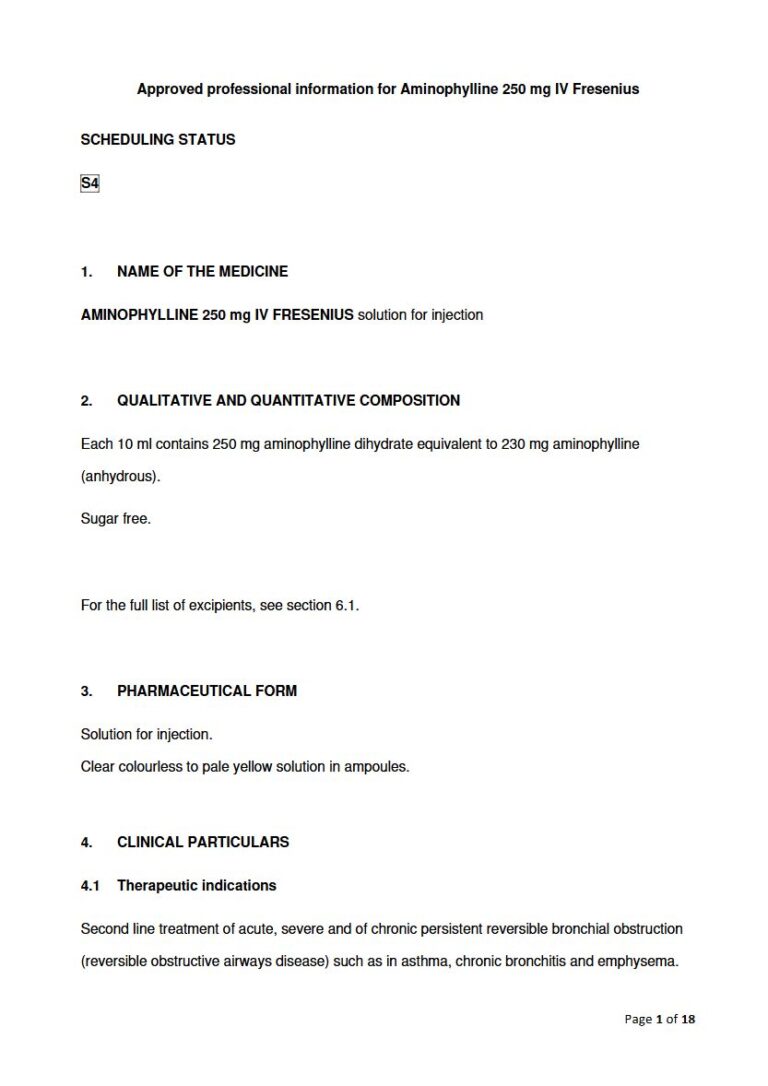
Second line treatment of acute, severe and of chronic persistent reversible bronchial obstruction (reversible obstructive airways disease) such as in asthma, chronic bronchitis and emphysema.
May be used when primary medicines cannot be administered due to inability to use metered dose inhaler and unavailability of mobilised primary medicines. May also be used in addition to primary medicines, if an adequate response has not been obtained with the primary medicines.
4.2 Posology and method of administration
Aminophylline 1,27 g is equivalent to 1 g anhydrous theophylline. Serum levels are measured as theophylline. Dosages should be adjusted individually using serum theophylline levels where possible. Monitoring of serum theophylline levels is highly recommended. There is great variation between patients in the dosage required to achieve a therapeutic blood level because of variable rates of elimination. Dosages must be individualised, based on both symptomatic response and improvement in pulmonary function. Dosages should be adjusted on the basis of peak serum theophylline concentration measurements in order to achieve a dose that will provide maximum potential benefit with minimal risk of adverse effects. Increases in the dose of theophylline should not be made in response to an acute exacerbation of symptoms in chronic lung disease since theophylline provides little added benefit to inhaled beta 2 -selective antagonists and systemic corticosteroids in this circumstance and increases the risk of adverse effects. Therapeutic serum levels of theophylline associated with optimal likelihood of benefit and minimal risk of toxicity, are considered to be between 55 and 110 u03bcmol/l (10 u2013 20 u03bcg/ml). Levels above 100 u03bcmol/l (20 u03bcg/ml) may produce toxic effects. Theophylline does not distribute into fatty tissues. The dosage should be calculated on the basis of lean body mass.
WARNING - Reduce the dosage at any signs of intolerance. Whenever a patient receiving AMINOPHYLLINE 250 mg IV FRESENIUS develops nausea or vomiting, particularly repeated vomiting or other signs and symptoms consistent with theophylline toxicity (even if another cause is suspected), it is advisable that additional doses of AMINOPHYLLINE 250 mg IV FRESENIUS are withheld and serum theophylline concentration be measured immediately.
Adult intravenous: Given over 20 u2013 30 minutes diluted in normal saline. Loading dose: For those NOT currently receiving theophylline preparations: Equivalent of 6 mg/kg lean body mass as a single dose. For those currently receiving theophylline preparations: Loading dose is based on the principle that working from the initial serum theophylline concentration, each 0,5 mg/kg lean body mass will result in a 1,0 u03bcg/ml increase in serum theophylline concentration. Where serum theophylline concentration cannot be measured: Patients currently receiving a non-sustained-release theophylline medicine can receive 2,5 mg/kg or 300 mg per day for the first three days then 400 mg/day, and after three more days 600 mg/day with due caution to avoid toxicity. Doses should be given in 3 u2013 4 divided doses 6 u2013 8 hours apart. Patients who have received sustained-release theophylline preparation during the preceding 12 hours should not be given a loading dose. Maintenance doses should be instituted. Maintenance dose: Adult non-smokers: 0,4 u2013 0,5 mg/kg/hour Adult smokers: 0,7 u2013 0,8 mg/kg/hour Elderly, cor pulmonale: 0,3 mg/kg/hour Congestive cardiac failure, hepatic disease: 0,1 u2013 0,2 mg/kg/hour. NB: Extreme caution should be exercised when converting intravenous therapy to oral administration of theophylline preparations as overlapping doses may lead to inadvertent toxicity.
Immediate release oral formulations can usually be used interchangeably but many brands of extended release theophylline products have clinically important differences in extent and rate of absorption. Children intravenous: Loading dose: For those NOT currently receiving theophylline preparations: equivalent of 4 u2013 6 mg/kg lean body mass as a single dose. Where serum theophylline concentration cannot be measured, patients currently receiving theophylline medicine can receive 1,5 u2013 2,5 mg/kg. Intramuscular injections are not recommended as they are painful and absorption erratic. Intramuscular use should be limited to situations where vascular access is not possible.
4.3 Contraindications
- Hypersensitivity to aminophylline dihydrate, or to any of the excipients listed in section 6.1.
- Hypersensitivity to any xanthines, such as theophyllines, caffeine or theobromine.
- Porphyria.
- Active gastritis or active peptic ulcer disease.
4.4 Special warnings and precautions for use
AMINOPHYLLINE 250 mg IV FRESENIUS should not be administered concurrently with ephedrine. AMINOPHYLLINE 250 mg IV FRESENIUS should not be administered concurrently with other xanthine medications.
Intravenous injections of AMINOPHYLLINE 250 mg IV FRESENIUS must be administered very slowly to prevent dangerous CNS and cardiovascular side effects resulting from the direct stimulant effect. Aminophylline has a narrow therapeutic index and serum levels should be monitored regularly, particularly during initiation of therapy. The patient should be instructed to seek medical advice whenever nausea, vomiting, persistent headache or rapid heartbeat occurs during treatment with AMINOPHYLLINE 250 mg IV FRESENIUS, even if another cause is suspected.
Paediatrics: Children are particularly susceptible to the effects of theophylline and care is required when administering aminophylline to children. Use with extreme caution in neonates and young children as reduced clearance, resulting in increases in the serum theophylline concentrations and serum half-life, increases the potential for toxicity. Hyperglycaemia has been reported in preterm infants. Do not administer repeated doses if the heart rate exceeds 180 beats/min. There have been reports of seizures in children with theophylline plasma levels within the accepted therapeutic range.
Elderly patients: Use with caution at reduced dosages (by approximately 30 %) in adults over 60 years, as reduced clearance increases the potential for toxicity.
Seizures: Alternative treatment should be considered in patients with a history of seizure activity and, if AMINOPHYLLINE 250 mg IV FRESENIUS is used in such patients, they should be carefully observed for possible signs of central stimulation.
Smokers: Tobacco and dagga (marijuana) smoking increases theophylline clearance by induction of metabolic pathways. Careful monitoring of serum theophylline concentration should be undertaken in people who stop smoking. The patient should contact the doctor if starting or stopping the smoking of cigarettes or dagga (marijuana).
Immunisation and infections: Use with caution in patients undergoing influenza immunisation or with acute viral infections such as influenza or those with sustained high fever as plasma theophylline levels may be elevated as a result of reduced theophylline clearance. The patient should contact the doctor if he/she develops a new illness, experience worsening of a chronic illness, or if another doctor adds to, or discontinues previously prescribed medicine.
Plasma clearance impairment: In individuals in whom theophylline plasma clearance is reduced for any reason, even conventional doses may result in increased serum levels and potential toxicity. Careful consideration of the factors that alter theophylline clearance should occur prior to initiation of AMINOPHYLLINE 250 mg IV FRESENIUS therapy, prior to increases in AMINOPHYLLINE 250 mg IV FRESENIUS dose and during follow-up. Serum theophylline measurements are advisable to determine whether the dose is appropriate, particularly:
- when initiating therapy and to guide final dosage adjustments after titration.
- before making a dose increase to determine whether the serum concentration is subtherapeutic in a patient who continues to be symptomatic.
- whenever symptoms of theophylline toxicity are present.
- whenever there is a new illness, worsening of a chronic condition or a change in the patientu2019s treatment that may alter theophylline clearance.
To guide a dose increase, the blood sample should be taken at peak serum theophylline concentration; 1 u2013 2 hours after a dose at steady-state, and 4 u2013 6 hours after a delayed-release preparation. For most patients, steady-state will be reached after three days of dosing when no doses have been missed and no extra doses have been added. A trough concentration provides no useful information and may be misleading.
Patients must inform medical practitioners that they are taking AMINOPHYLLINE 250 mg IV FRESENIUS and must not alter the dose, the timing of the dose or the frequency of administration without first consulting their doctor. Those at risk due to reduced hepatic clearance include patients with:
- impaired liver or hepatic function
- congestive cardiac failure
- chronic obstructive pulmonary disease or pneumonia
- chronic alcoholism
- patients more than 55 years of age, particularly males and those with chronic lung disease
- sepsis with multiple organ failure
- shock.
Caution should be used in patients with the following conditions, as these conditions may be exacerbated:
- ischaemic heart disease
- hypertension
- hyperthyroidism
- epilepsy - unless controlled on anticonvulsants
- history of peptic ulcer disease
- glaucoma
- diabetes mellitus
- severe hypoxemia.
Caution should be used in angina pectoris, acute myocardial injury or pre-existing dysrhythmias. Plasma concentrations of theophylline greater than 20 u03bcg per ml are considered to be toxic. Concomitant use with medicines that diminish hepatic biotransformation may result in a raised aminophylline level. The dose of AMINOPHYLLINE 250 mg IV FRESENIUS or the concentration level may need to be monitored (see section 4.5). During regular treatment with AMINOPHYLLINE 250 mg IV FRESENIUS serum potassium levels must be monitored. This is essential during combination therapy with beta 2 -agonists, corticosteroids or diuretics, or in the presence of hypoxia. Effects on the route of administration: Rapid intravenous injection has produced dizziness, faintness, palpitations, syncope, precordial pain, flushing, profound bradycardia, extrasystoles, severe hypotension and cardiac arrest. Sudden deaths have been reported. Intramuscular injection has produced intense local pain and sloughing of tissue.
4.5 Interaction with other medicines and other forms of interaction
Medicines which increase the theophylline clearance, resulting in a lower plasma theophylline concentration, may require an increased dose of AMINOPHYLLINE 250 mg IV FRESENIUS. Smokers may require larger doses as theophylline clearance is increased. Hepatic enzyme-inducing medicines may increase the dose needed to produce a therapeutic effect: alcohol, aminoglutethimide, barbiturates, rifampicin, phenytoin, carbamazepine, primidone, phenobarbitone, ritonavir, sulphinpyrazone, meprobamate, moricizine, intravenous isoproterenol, propranolol, tacrine.
Medicines which decrease the theophylline clearance resulting in a higher theophylline plasma concentration, increase the potential for side effects. Fluvoxamine may increase plasma theophylline concentrations. The concomitant use of theophylline and fluvoxamine should usually be avoided. Where this is not possible, patients should have their theophylline dose halved and plasma theophylline should be monitored closely.
Medicines that diminish hepatic biotransformation and result in raised theophylline levels: cimetidine, ranitidine, macrolide antibiotics (erythromycin, lincomycin, clindamycin, clarithromycin, troleandomycin), fluoroquinolone antibiotics (ciprofloxacin, ofloxacin, norfloxacin, enoxacin, penfloxacin), fluconazole, thiabendazole, allopurinol, interferon alfa, influenza vaccine, isoniazid, disulfiram, viloxazine, beta-blockers (propranolol), calcium channel blockers, mexiletine, propafenone, tacrine, oral contraceptives, pentoxifylline, ticlopidine, diltiazem, verapamil, methotrexate, zafirlukast, thyroid hormones, St Johnu2019s wort (Hypericum perforatum), oestrogen-containing contraceptives (see section 4.4).
Xanthines u2013 concurrent use of other xanthine derivatives, including theophylline and pentoxifylline are contraindicated due to risk of toxicity. Concomitant use with sympathomimetic medicines may increase the potential for cardiotoxicity particularly in cases of severe asthma with marked hypoxia. Hypokalaemia u2013 the hypokalaemic effects of beta 2 -adrenergic agonists may be potentiated by concomitant treatment with aminophylline. There is an increased risk of hypokalaemia when theophylline derivatives are given with corticosteroids or diuretics (see section 4.4). Cardiac glycosides u2013 the direct stimulatory effect of aminophylline on the myocardium may enhance the sensitivity and toxic potential of cardiac glycosides and reserpine may be increased. Ventricular dysrhythmias have been reported when halothane is used concurrently with theophylline. Ketamine u2013 concurrent use may lower the seizure threshold. AMINOPHYLLINE 250 mg IV FRESENIUS may antagonise the neuromuscular blocking activity of pancuronium. Benzodiazepines u2013 large doses may be needed to produce the desired level of sedation. Quinolones u2013 increased risk of convulsions. Chlordiazepoxide u2013 induced fatty acid mobilisation may be aggravated. Furosemide u2013 induced diuresis may be increased. Lithium excretion by the kidneys is increased and higher doses may be required if given with AMINOPHYLLINE 250 mg IV FRESENIUS, lithium levels should be monitored. Tetracyclines weakly inhibit theophylline clearance and may result in raised theophylline levels. Beta 2 -adrenergic agonists u2013 increased risk of cardiac dysrhythmias. Beta-blockers u2013 antagonism of bronchodilator effects. Adenosine u2013 the antidysrhythmic effect of adenosine is antagonised by theophylline. Leukotriene antagonists u2013 co-administration with theophylline resulted in decreased plasma levels of zafirlukast, by approximately 30 %, but with no effect on plasma theophylline levels. However, during post-marketing surveillance, there have been rare cases of patients experiencing increased theophylline levels when co-administered zafirlukast (see above). Doxapram u2013 increased central nervous system stimulation.
4.6 Fertility, pregnancy and lactation
Safety in pregnancy and lactation has not been established.
Pregnancy Theophylline crosses the placenta. Neonates of mothers on AMINOPHYLLINE 250 mg IV FRESENIUS should be monitored as they may show apnoea, tachycardia, irritability and vomiting.
Lactation Theophylline is excreted in breast milk and is present at concentrations equivalent to that in maternal serum. Irritability and insomnia in the infant have been reported.
4.7 Effects on ability to drive and use machines
AMINOPHYLLINE 250 mg IV FRESENIUS causes side effects, such as visual disturbances or vertigo, and may affect the ability to drive a vehicle and use machinery (see section 4.8). Patients should be advised not to drive a vehicle or operate machinery until the effects of AMINOPHYLLINE 250 mg IV FRESENIUS are known.
4.8 Undesirable effects
Adverse events are usually a consequence of gastrointestinal irritation, stimulation of the central nervous system and effects on the cardiovascular system. Hypotension, dysrhythmias and convulsions may follow intravenous injection, particularly if the injection is too rapid, and sudden deaths have been reported. Severe toxicity may occur without preceding milder symptoms (see section 4.9).
Immune system disorders Hypersensitivity reactions (see Skin and subcutaneous tissue disorders). AMINOPHYLLINE 250 mg IV FRESENIUS can produce both immediate and delayed hypersensitivity reactions.
Metabolism and nutrition disorders Frequency unknown: Metabolic disturbances such as hypokalaemia, dehydration, hyperglycaemia, hypophosphataemia and hyponatraemia may occur.
Psychiatric disorders Frequency unknown: Hyperventilation, anxiety, higher doses may lead to maniacal behaviour and delirium.
Nervous system disorders Frequent: Central nervous system stimulation effects (more common in children) include: headache, irritability, restlessness, nervousness, tremor, insomnia, vertigo, dizziness, seizures. Frequency unknown: Mental depression.
Eye disorders Frequency unknown: Visual disturbances.
Cardiac disorders Frequency unknown: Tachycardia, flushing, palpitations, hypotension, ventricular dysrhythmias, tachypnoea, confusion.
Gastrointestinal disorders Frequent: Theophyllines are irritating to the gastrointestinal tract: nausea, vomiting, heartburn, epigastric pain and intestinal bleeding. Less frequent: Diarrhoea.
Hepato-biliary disorders Frequency unknown: Elevated serum AST levels.
Skin and subcutaneous tissue disorders Frequency unknown: Rash, maculo-papular rash, erythema, pruritus, urticaria, exfoliative dermatitis.
Renal and urinary disorders Frequency unknown: Urinary frequency.
General disorders and administration site conditions Frequency unknown: Higher doses may result in hyperthermia and extreme thirst.
Reporting of suspected adverse reactions Reporting suspected adverse reactions after authorisation of AMINOPHYLLINE 250 mg IV FRESENIUS is important. It allows continued monitoring of the benefit/risk balance of AMINOPHYLLINE 250 mg IV FRESENIUS. Health care professionals are asked to report any suspected adverse reactions to the South African Health Products Regulatory Authority (SAHPRA) via the u201c6.04 Adverse Drug Reaction Reporting Formu201d, found online under SAHPRAu2019s publications: https://www.sahpra.org.za/Publications/Index/8. Health care providers are asked to report any suspected adverse drug reactions to the Holder of the Certificate of Registration at the following email address: [email protected] and to the relevant medicineu2019s regulatory authority in the country where the product is marketed.
4.9 Overdose
AMINOPHYLLINE 250 mg IV FRESENIUS has a narrow therapeutic index. Theophylline toxicity is most likely to occur when serum concentrations exceed 20 u03bcg/ml and becomes progressively more severe at higher serum concentrations. Fatalities in adults have occurred during AMINOPHYLLINE 250 mg IV FRESENIUS administration in large doses in patients with renal, hepatic or cardiovascular complications or where the injection has been given rapidly.
Symptoms Tachycardia, in the absence of hypoxia, fever or administration of sympathomimetic drugs, may be an indication of theophylline toxicity. Gastrointestinal symptoms: Anorexia, nausea, vomiting, diarrhoea and haematemesis. Nervous system symptoms: Restlessness, insomnia, irritability, headache, agitation, hallucinations, extreme thirst, slight fever, dilated pupils, and tinnitus. Seizures may occur even without preceding symptoms of toxicity and often result in death. Coma may develop in very severe cases.
Cardiovascular symptoms: Palpitations, dysrhythmias, hypotension, supraventricular and ventricular dysrhythmias may occur. Metabolic symptoms: Hypokalaemia can develop rapidly and may be severe. Hyperglycaemia, albuminuria, hyperthermia, hypomagnesaemia, hypophosphataemia, hypercalcaemia, respiratory alkalosis and metabolic acidosis may also occur. Rhabdomyolysis may also occur.
Treatment Treatment of overdosage is supportive and symptomatic. Serum theophylline and potassium levels should be monitored. Repeated oral administration of activated charcoal enhances the elimination of theophylline from the body even after intravenous administration. Aggressive antiemetic therapy may be required to allow administration and retention of activated charcoal. Seizures may be treated with IV diazepam 0,1 u2013 0,3 mg/kg up to 10 mg. Restoration of fluid and electrolytes balance is necessary. Hypokalaemia should be corrected by intravenous infusion of potassium chloride. Sedation with diazepam may be required in agitated patients. Propranolol may be administered intravenously to reverse extreme tachycardia, hypokalaemia and hyperglycaemia, provided the patient does not suffer from asthma. In general, theophylline is metabolised rapidly, and haemodialysis is not warranted. In patients with congestive heart failure or liver disease, haemodialysis may increase theophylline clearance by as much as 2-fold. Charcoal haemoperfusion should be considered if:
- Ileus/intestinal obstruction prevents administration of multiple dose activated charcoal.
- Plasma theophylline concentration > 80 mg/l (acute) or > 60 mg/l (chronic).
- In infants under 6 months of age or the elderly, charcoal haemoperfusion should be considered at theophylline concentrations > 40 mg/l.
Clinical features rather than theophylline concentration are the best guide for treatment.
