
Atropine Sulphate Fresenius Injection
PDF Leaflet Revision Date: 15 June 2022
Clinical Summary
Quick overview from the medicine insert
Indication
Used for parasympatholytic effects, including during anesthesia and as an antidote for poisoning.
Dosage (summary)
Adult: 0.3 to 0.6 mg IM/SC or IV before anesthesia; 0.6 to 1.2 mg IV post-op with neostigmine.
Onset of Action / Duration
Onset: 2-4 mins, Duration: 2-5 hours
Special Populations
- Children
- Elderly
- Downu2019s syndrome
Pregnancy & Breastfeeding
Crosses placenta; may cause fetal tachycardia. Avoid during breastfeeding due to infant sensitivity.
Key Drug Interactions
- Antimuscarinics
- Monoamine-oxidase inhibitors
- Antipsychotics
- Beta-blockers
Contraindications
- Hypersensitivity
- Closed-angle glaucoma
- Prostatic enlargement
- Paralytic ileus
- Myasthenia gravis
Common side effects
- Dry mouth
- Dizziness
- Confusion
- Tachycardia
- Urinary retention
Counselling Points
- Avoid driving or operating machinery
- Report any severe side effects
- Stay hydrated during treatment
Serious warnings
- Caution in cardiac insufficiency
- Risk of CNS effects
- Paradoxical AV block post-transplant
Important Disclaimer
The Atropine Sulphate Fresenius Injection professional information leaflet below is the property of Fresenius Kabi Manufacturing Sa and is provided on Medinsert exactly as issued, with no.. alterations or editorial changes. We make every effort to keep content current by updating documents as soon as new versions become available. Medinsert serves as a trusted access point for healthcare professionals, but does not replace official sources or clinical judgement. For more details, please read our full disclaimer. read more>>
 Healthcare Professionals Only
This content is for registered healthcare professionals
Sign in or create a free account to read the full package insert.
Free for HPCSA-registered professionals. Powered by Medinsert.
Clinical Particulars
Section 4 of the official insert — extracted exactly as issued, no alterations
4.1 Therapeutic indications
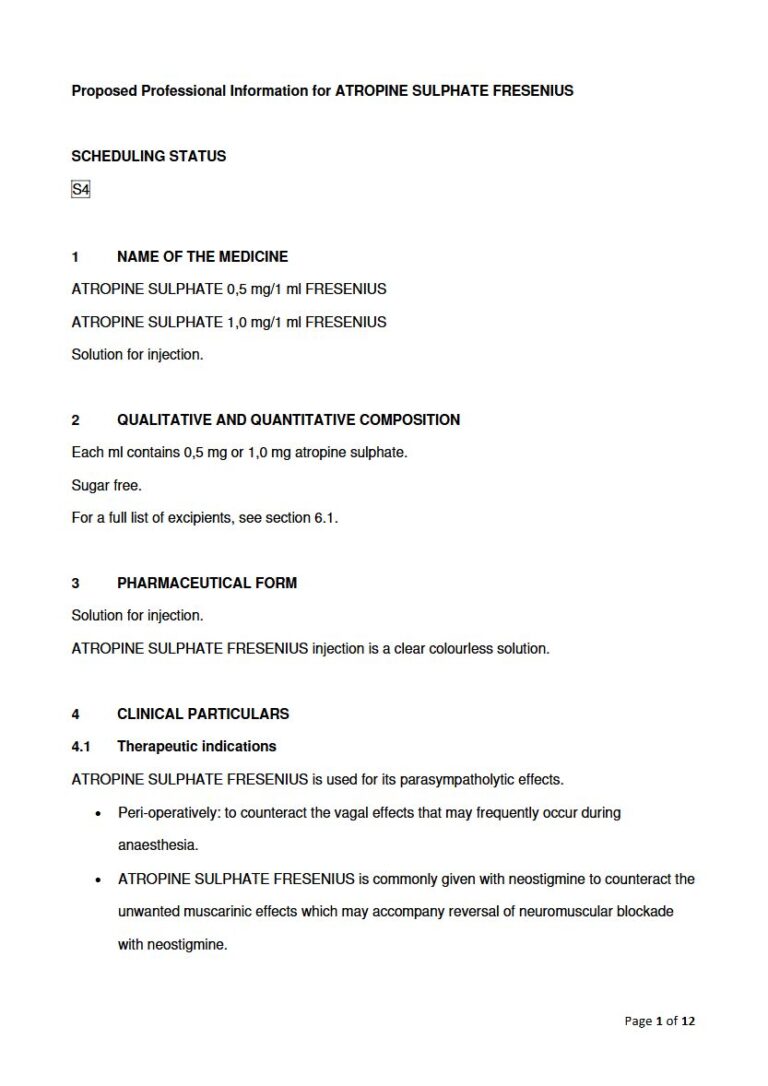
ATROPINE SULPHATE FRESENIUS is used for its parasympatholytic effects.
- Peri-operatively: to counteract the vagal effects that may frequently occur during anaesthesia.
- ATROPINE SULPHATE FRESENIUS is commonly given with neostigmine to counteract the unwanted muscarinic effects which may accompany reversal of neuromuscular blockade with neostigmine.
- ATROPINE SULPHATE FRESENIUS is a specific antidote for the cardiovascular collapse that may result from the injudicious administration of a choline ester or an inhibitor of cholinesterase. It is also used to antagonise reflex vagal cardiac slowing.
- ATROPINE SULPHATE FRESENIUS may be of value in the initial treatment of patients with acute myocardial infarction in whom excessive vagal tone causes sinus or nodal bradycardia.
- In the treatment of muscarinic toxicity, and in poisoning caused by pesticides that are organophosphate cholinesterase inhibitors, ATROPINE SULPHATE FRESENIUS is a specific antidote for the so-called rapid type of mushroom poisoning due to the cholinomimetic alkaloid muscarine, found in Amanita muscaria and a few other fungi.
4.2 Posology and method of administration
Persons with Downu2019s syndrome appear to have an increased susceptibility to the actions of atropine, whereas those with albinism may be resistant.
Premedication: To diminish the risk of vagal inhibition of the heart and to reduce salivary and bronchial secretions.
Adult dose: IM or SC; 0,3 to 0,6 mg usually in conjunction with 10 to 15 mg of morphine sulphate about an hour before anaesthesia. Alternatively: IV; 0,3 to 0,6 mg immediately before induction of anaesthesia.
Paediatric dose: SC; weighing up to 3 kg: 0,1 mg; weighing 7 to 9 kg: 0,2 mg; weighing 12 to 16 kg: 0,3 mg; weighing 20 to 27 kg: 0,4 mg; weighing 32 kg: 0,5 mg; weighing 41 kg: 0,6 mg.
Post-operatively: Adult dose: Slow IV; 0,6 to 1,2 mg in conjunction with neostigmine to reverse the effects of non-depolarising muscle relaxants.
Dysrhythmias: Adult dose: IV; 0,4 to 1 mg and repeated as needed to a total dose of 2 mg.
Bradycardia or asystole due to overdosage with parasympathomimetic medicines: 1 to 2 mg SC, IM or IV.
Anticholinesterase/organophosphate poisoning: ATROPINE SULPHATE FRESENIUS should be given in adequate doses. Following an initial injection of 2 to 4 mg, given intravenously if possible, otherwise intramuscularly, 2 mg should be given every 5 to 10 minutes until muscarinic symptoms disappear, if they reappear, or until signs of ATROPINE SULPHATE FRESENIUS toxicity appear. More than 200 mg may be required on the first day. A mild degree of atropine block should then be maintained for up to 48 hours or as long as symptoms are evident.
Intoxication by cholinergic agonists: Should serious toxic reactions to these medicines arise, 0,5 to 1,0 mg ATROPINE SULPHATE FRESENIUS should be given subcutaneously or intravenously.
Intoxication by cholinomimetics: Treatment consists of the parenteral administration of ATROPINE SULPHATE FRESENIUS and adequate measures to support the respiration and the circulation and to counteract pulmonary oedema.
Mushroom poisoning: Treatment with 1 to 2 mg ATROPINE SULPHATE FRESENIUS given intramuscularly every 30 minutes effectively blocks the muscarine intoxication symptoms.
4.3 Contraindications
- Hypersensitivity to atropine sulphate or to any of the excipients listed in section 6.1.
- ATROPINE SULPHATE FRESENIUS should not be given to patients with closed-angle glaucoma or to patients with a narrow angle between the iris and the cornea, since it may increase the intra-ocular pressure and precipitate an acute attack.
- It is contraindicated in patients with prostatic enlargement, and in those with paralytic ileus, pyloric stenosis and status asthmaticus.
- It should not be given to patients with myasthenia gravis unless it is given to reduce adverse muscarinic effects of an anti-cholinesterase medicine.
- Due to the risk of provoking hyperpyrexia ATROPINE SULPHATE FRESENIUS should not be given to patients, especially children, when the ambient temperature is high. It should also be used cautiously in patients with fever.
- ATROPINE SULPHATE FRESENIUS should not be given to patients who are being treated with a monoamine-oxidase inhibitor, or within ten days of the discontinuation of such treatment.
- ATROPINE SULPHATE FRESENIUS is contraindicated in case of intoxication produced by Amanita muscaria and related species due to the anticholinergic and hallucinogenic properties of a variety of isoxazole derivatives.
4.4 Special warnings and precautions for use
- ATROPINE SULPHATE FRESENIUS should be used with caution in children, geriatric patients and those with Downu2019s syndrome, who may be more susceptible to its adverse effects.
- Doses of ATROPINE SULPHATE FRESENIUS up to 1 mg are mildly stimulant to the central nervous system. Higher doses may induce mental disturbances and depression of the central nervous system. Children and older people are particularly susceptible.
- It is generally advisable to be cautious in giving atropine to any patient with diarrhoea or urinary retention.
- Caution should be observed in administering this medicine to patients with coronary insufficiency or cardiac failure.
- ATROPINE SULPHATE FRESENIUS and other antimuscarinic medicines should be used with caution in conditions characterised by tachycardia such as thyrotoxicosis, cardiac insufficiency or failure, and in cardiac surgery, where it may further accelerate the heart rate.
- Care is required in patients with acute myocardial ischaemia or infarction as the ischaemia and infarction may be made worse.
- ATROPINE SULPHATE FRESENIUS should be given with care to patients with hypertension.
- Paradoxical atrioventricular block or sinus arrest has been reported following administration of ATROPINE SULPHATE FRESENIUS in a few patients after heart transplantation.
- The use of ATROPINE SULPHATE FRESENIUS for therapeutic or diagnostic procedures in heart transplant patients should be undertaken with extreme caution, and ECG monitoring and equipment for immediate temporary pacing should be available.
- Caution is required when ATROPINE SULPHATE FRESENIUS is administered systemically to patients with chronic obstructive pulmonary diseases, as a reduction in bronchial secretions may lead to the formation of bronchial plugs.
- In treatment of parkinsonism, increases in dosages and transfer to other forms of treatment should be gradual and antimuscarinic medicines should not be withdrawn abruptly.
- In patients with ulcerative colitis its use may lead to ileus or megacolon and its effects on the lower oesophageal sphincter may exacerbate reflux.
- Antimuscarinics such as ATROPINE SULPHATE FRESENIUS may delay gastric emptying, decrease gastric motility and relax the oesophageal sphincter. They should be used with caution in patients whose condition may be aggravated by these effects. e.g. reflux oesophagitis.
4.5 Interaction with other medicines and other forms of interaction
- The effects of ATROPINE SULPHATE FRESENIUS and other antimuscarinic medicines may be enhanced by the concomitant administration of other medicines with antimuscarinic properties, such as amantadine, some antihistamines, butyrophenones, phenothiazines, tricyclic antidepressants, domperidone, antispasmodics and anti-parkinsonism medicines.
- Additive anticholinergic adverse effects may also occur with antipsychotics, quinidine and disopyramide.
- ATROPINE SULPHATE FRESENIUS should not be given to patients who are being treated with a monoamine-oxidase inhibitor, or within ten days of the discontinuation of such treatment (see section 4.3).
- The reduction in gastric motility caused by ATROPINE SULPHATE FRESENIUS may affect the absorption of other medicines such as ketoconazole, chlorpromazine, olanzapine, clozapine, mexiletine.
- Antimuscarinic medicines including ATROPINE SULPHATE FRESENIUS antagonise the effects of gastrointestinal prokinetic medicines, such as metoclopramide and neostigmine, on gastric motility.
- The degree of absorption of digoxin may be increased.
- Sublingual medicines such as nitrates may have reduced absorption due to dry mouth.
- Beta-blockers may reduce the cardio acceleratory effect of ATROPINE SULPHATE FRESENIUS.
- During anaesthesia, the heart rate responsiveness to IV ATROPINE SULPHATE FRESENIUS could be decreased (and not effectively overcome by a large dose of ATROPINE SULPHATE FRESENIUS) when the subject is receiving concomitant propofol; it could be due to propofol-induced suppression of the sympathetic nervous system.
4.6 Fertility, pregnancy and lactation
Pregnancy: ATROPINE SULPHATE FRESENIUS crosses the placenta. Well-controlled studies in humans have not been done. Intravenous administration of ATROPINE SULPHATE FRESENIUS during pregnancy or near term may produce tachycardia in the foetus.
Breastfeeding: ATROPINE SULPHATE FRESENIUS is distributed into breast milk and may cause antimuscarinic effects in the infant. Use thereof should be avoided during breastfeeding since infants are usually very sensitive to the effects of anticholinergics. Lactation may be inhibited.
Fertility: There are no adequate preclinical fertility data with atropine, and no epidemiological data.
4.7 Effects on ability to drive and use machines
ATROPINE SULPHATE FRESENIUS may cause blurred vision, drowsiness, confusion, hallucinations and other neuro-psychiatric effects (see sections 4.8 and 4.9). Patients should be advised that they should not drive, operate machinery or take part in any activities that could, if they are affected, put them or others at risk.
4.8 Undesirable effects
The most frequently reported adverse events are due to the action of ATROPINE SULPHATE FRESENIUS on muscarinic receptors and at high doses, nicotinic receptors. These effects are dose related and usually reversible when therapy is discontinued.
Immune system disorders: Less frequent: Anaphylaxis.
Psychiatric disorders: Frequency unknown: Confusion state, especially in the elderly. At higher doses hallucinations, restlessness, delirium (see section 4.9).
Nervous system disorders: Frequency unknown: Dizziness.
Eye disorders: Frequency unknown: Dilatation of the pupils with difficulty in accommodation of the eye, photophobia, raised intraocular pressure.
Cardiac disorders: Less frequent: Paradoxical atrioventricular block, especially after heart transplantation (see section 4.4). Frequency unknown: Transient bradycardia followed by tachycardia, palpitations, dysrhythmias. Exacerbation of myocardial ischemia or myocardial infarction.
Vascular disorders: Frequency unknown: Flushing.
Respiratory, thoracic and mediastinal disorders: Frequency unknown: Formation of mucous plugs may result from reduced bronchial secretion (see section 4.4).
Gastrointestinal disorders: Frequency unknown: Dry mouth with difficulty in swallowing, reduction in the tone and motility of the gastrointestinal tract, constipation, nausea, vomiting, inhibition of gastric secretion. Ileus or megacolon may occur in patients with ulcerative colitis, and the effect on the lower oesophageal sphincter may exacerbate reflux.
Skin and subcutaneous tissue disorders: Frequency unknown: Dry skin, urticaria, rash, skin exfoliation.
Renal and urinary disorders: Frequency unknown: Urinary retention, difficulty in micturition.
General disorders and administration site conditions: Frequency unknown: Tolerance occurs to a limited extent; vomiting, malaise, sweating and salivation have been recorded in patients with parkinsonism upon sudden withdrawal of the large doses required for therapeutic effect. Thirst, fever.
4.9 Overdose
Symptoms: Delirium or toxic psychoses can occur after overdosage, as well as hallucinatory effects. Symptoms develop promptly and include marked dryness of the mouth accompanied by a burning sensation, difficulty in swallowing. Vision becomes blurred and photophobia is prominent. The skin is hot, dry and flushed. A rash may appear, especially over the face, neck and upper part of the trunk; desquamation may follow. The body temperature rises and the pulse is weak and very rapid. Palpitation is prominent, and the blood pressure may be elevated. Nausea and vomiting can occur. Urinary urgency and difficulty in micturition are sometimes noted. Restlessness, tremor, excitement and confusion, giddiness and muscular in-coordination occur. The effects of CNS stimulation are followed by increasing drowsiness, stupor and general central depression terminating in death from circulatory and respiratory failure.
Treatment: In severe cases, physostigmine, 1 to 4 mg, should be administered intravenously, intramuscularly or subcutaneously, the dose may be repeated if necessary since it is rapidly eliminated from the body. Diazepam may be administered for sedation of the delirious patient but the risk of central depression occurring late in the course of atropine poisoning contraindicates large doses of sedative. An adequate airway should be maintained and respiratory failure may be treated with oxygen and carbon dioxide inhalation. Fever is reduced by the application of cold packs or sponging with tepid water. Adequate fluid intake is important. Urethral catheterisation may be necessary. If photophobia is present or likely, the patient should be nursed in a darkened room.
