
Amiodarone 30mg/ml Accord Injection
PDF Leaflet Revision Date: 07 July 2023
Clinical Summary
Quick overview from the medicine insert
Indication
Tachydysrhythmias including atrial fibrillation and ventricular fibrillation.
Dosage (summary)
5 mg/kg IV infusion over 20 mins to 2 hours; max 1200 mg/24 hours.
Onset of Action / Duration
Onset: 15 mins, Duration: variable.
Special Populations
- Elderly
- Renal impairment
- Hepatic impairment
Pregnancy & Breastfeeding
Contraindicated in pregnancy and lactation due to risks to fetus and infant.
Key Drug Interactions
- Warfarin
- Digoxin
- Sofosbuvir
- Beta-blockers
- Calcium channel blockers
Contraindications
- Hypersensitivity to amiodarone
- Severe bradycardia
- High grade AV block
- Severe respiratory failure
Common side effects
- Bradycardia
- Hypotension
- Infusion phlebitis
Counselling Points
- Inform healthcare provider of all medications
- Monitor for signs of bradycardia
- Avoid grapefruit juice
Serious warnings
- Requires cardiac monitoring
- Risk of severe bradycardia and heart block
- Potential for pulmonary toxicity
Important Disclaimer
The Amiodarone 30mg/ml Accord Injection professional information leaflet below is the property of Accord Healthcare and is provided on Medinsert exactly as issued, with no.. alterations or editorial changes. We make every effort to keep content current by updating documents as soon as new versions become available. Medinsert serves as a trusted access point for healthcare professionals, but does not replace official sources or clinical judgement. For more details, please read our full disclaimer. read more>>
 Healthcare Professionals Only
This content is for registered healthcare professionals
Sign in or create a free account to read the full package insert.
Free for HPCSA-registered professionals. Powered by Medinsert.
Clinical Particulars
Section 4 of the official insert — extracted exactly as issued, no alterations
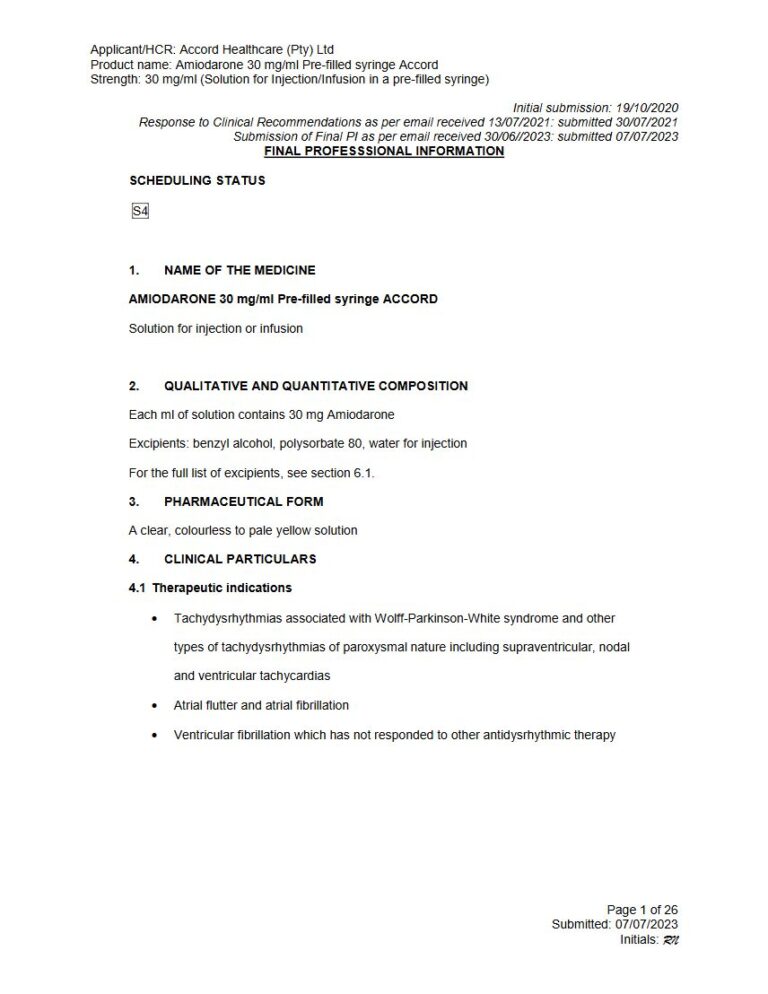
4.1 Therapeutic indications
- Tachydysrhythmias associated with Wolff-Parkinson-White syndrome and other types of tachydysrhythmias of paroxysmal nature including supraventricular, nodal and ventricular tachycardias
- Atrial flutter and atrial fibrillation
- Ventricular fibrillation which has not responded to other antidysrhythmic therapy
4.2 Posology and method of administration
AMIODARONE 30 mg/ml Pre-filled syringe ACCORD is incompatible with saline and should be administered only in 5 % dextrose. The use of medical equipment or devices containing plasticiser such as DEHP (di-2-ethylhexyl phthalate) in the presence of AMIODARONE 30 mg/ml Pre-filled syringe ACCORD results in leaching out of DEHP. In order to minimise patient exposure to DEHP, the final dilution for infusion may preferably be administered through non DEHP-containing sets. AMIODARONE 30 mg/ml Pre-filled syringe ACCORD should only be used when facilities exist for cardiac monitoring or defibrillation, should the need arise.
The recommended dose is 5 mg/kg body mass given by intravenous infusion over a period of 20 minutes to 2 hours, administered as a dilute solution in 250 ml 5 % dextrose. This may be followed by repeat infusions up to 1 200 mg (approximately 15 mg/kg body mass) in up to 500 ml 5 % dextrose per 24 hours, the rate of infusion being adjusted on the basis of clinical response.
AMIODARONE 30 mg/ml Pre-filled syringe ACCORD may, at the discretion of the healthcare professional, be given as a bolus injection of 150 mg - 300 mg in 10 - 20 ml over a minimum of 3 minutes. This should not be repeated for at least 15 minutes. Patients treated in this way must be closely monitored e.g. in an intensive care unit.
When given by infusion, AMIODARONE 30 mg/ml Pre-filled syringe ACCORD may reduce drop size and, if appropriate, adjustments should be made to the rate of infusion.
Maintenance therapy: Oral therapy should be initiated concomitantly at the usual loading dose as soon as possible after an adequate response is obtained and the intravenous therapy gradually phased out.
Repeated or continuous infusion via peripheral veins may lead to local discomfort and inflammation. When repeated or continuous infusion is anticipated, administration by a central venous catheter is recommended.
Special populations: Use in the elderly: It is important that the minimum effective dose is used. There is no evidence that dosage requirements are different for elderly patients, and they may be more susceptible to bradycardia and conduction defects if too high a dose is employed.
Method of administration: For intravenous injection or infusion.
4.3 Contraindications
- Hypersensitivity to amiodarone, iodine or to any of the other ingredients of AMIODARONE 30 mg/ml Pre-filled syringe ACCORD listed in section 6.1.
- AMIODARONE 30 mg/ml Pre-filled syringe ACCORD should not be used prophylactically in the preoperative period of cardio-pulmonary surgery.
- Sinus bradycardia and sino-atrial heart block.
- In patients with severe conduction disturbances (high grade AV Block, bifascicular or trifascicular block) or sinus node disease, AMIODARONE 30 mg/ml Pre-filled syringe ACCORD should be used in conjunction with a pacemaker.
- Severe respiratory failure, circulatory collapse and severe arterial hypotension.
- Congestive heart failure is also a contra-indication when using as a bolus injection.
- Concomitant administration of amiodarone with medicines which may prolong the QT interval.
- Latent or manifest heart failure may be worsened and, in this case ACCORD AMIODARONE 30 mg/ml should be associated with the usual cardiotonic and diuretic treatments.
- Thyroid dysfunction.
- Too high a dosage may lead to severe bradycardia and to conduction disturbances with the appearance of an idioventricular rhythm, particularly in elderly patients or during digoxin therapy. In these circumstances, AMIODARONE 30 mg/ml Pre-filled syringe ACCORD treatment should be withdrawn. If necessary, beta-adrenostimulants or glucagon may be given.
- Pregnancy and lactation.
- Paediatric patients.
4.4 Special warnings and precautions for use
AMIODARONE 30 mg/ml Pre-filled syringe ACCORD should only be used in a special care unit under continuous monitoring (ECG and blood pressure). IV infusion is preferred to an intravenous bolus due to the haemodynamic effects sometimes associated with rapid injection (see section 4.8). Circulatory collapse may be precipitated by too rapid administration or overdosage (atropine has been used successfully in such patients presenting with bradycardia). Repeated or continuous infusion via peripheral veins may lead to injection site reactions (see section 4.8). When repeated or continuous infusion is anticipated, administration by a central venous catheter is recommended.
When given by infusion amiodarone hydrochloride may reduce drop size and, if appropriate, adjustments should be made to the rate of infusion.
Anaesthesia: Before surgery, the anaesthetist should be informed that the patient is being treated with amiodarone (see section 4.5).
Cardiac disorders: Caution should be exercised in patients with hypotension and decompensated cardiomyopathy and severe heart failure (see section 4.3). Too high a dosage may lead to severe bradycardia and to conduction disturbances with the appearance of an idioventricular rhythm, particularly in elderly patients or during cardiac glycoside therapy. In these circumstances, amiodarone treatment should be withdrawn. If necessary beta-adrenostimulants or glucagon may be given. Because of the long half-life of amiodarone, if bradycardia is severe and symptomatic the insertion of a pacemaker should be considered. Amiodarone has a low pro-dysrhythmic effect. Onsets of new dysrhythmias or worsening of treated dysrhythmias, sometimes fatal, have been reported. It is important, but difficult to differentiate a lack of efficacy of the medicine from a prodysrhythmic effect, whether or not this is associated with a worsening of the cardiac condition. Prodysrhythmic effects generally occur in the context of QT prolongation factors such as medicine interactions and/or electrolytic disorders (see sections 4.5 and 4.8). Despite QT interval prolongation, amiodarone exhibits a low torsadogenic activity.
The pharmacological action of amiodarone induces ECG changes QT prolongation (related to prolonged repolarisation) with the possible development of U-waves and deformed Twaves; these changes do not reflect toxicity.
General anaesthesia: Caution is advised in patients undergoing general anaesthesia, or receiving high dose oxygen therapy. Potentially severe complications have been reported in patients taking amiodarone undergoing general anaesthesia: bradycardia unresponsive to atropine, hypotension, disturbances of conduction, decreased cardiac output (see section 4.5).
Endocrine disorders: Amiodarone may induce hyperthyroidism, particularly in patients with a personal history of thyroid disorders or patients who are taking/have previously taken oral amiodarone. Serum ultrasensitive thyroid-stimulating hormone (usTSH) level should be measured when thyroid dysfunction is suspected. Thyroid function tests should be performed where appropriate prior to therapy in all patients. Amiodarone contains iodine and thus may interfere with radio-iodine uptake. However, thyroid function tests (free-T3, free-T4, usTSH) remain interpretable. Amiodarone inhibits peripheral conversion of thyroxine (T4) to triiodothyronine (T3) and may cause isolated biochemical changes (increase in serum free-T4, free-T3 being slightly decreased or even normal) in clinically euthyroid patients. There is no reason in such cases to discontinue amiodarone treatment if there is no clinical or further biological (usTSH) evidence of thyroid disease. Both hyper- and hypothyroidism have occurred during, or soon after, treatment with AMIODARONE 30 mg/ml Pre-filled syringe ACCORD. Simple monitoring of the usual biochemical tests is confusing because some (PBI and 131 I uptake) are invalidated and others (T4, T3 and FTI) may be altered where the patient is clearly euthyroid. Clinical monitoring is therefore recommended and should be continued for some months after discontinuation of amiodarone treatment. This is particularly important in the elderly. In patients whose history indicates an increased risk of thyroid dysfunction, regular testing is recommended. Clinical features of hyperthyroidism such as mass loss, asthenia, restlessness, increase in heart rate or a recurrence of the cardiac dysrhythmia, angina or congestive heart failure, should alert the clinician. The diagnosis may be supported by the finding of an elevated serum tri-iodothyronine (T3), a low level of thyroid stimulating hormone (TSH as measured by high sensitivity methods) and a reduced TSH response to thyrotrophin releasing hormone (TRH). Elevation of reverse T3 (rT3) may also be found. The clinical features of hypothyroidism such as mass gain and reduced activity or excessive bradycardia should alert the clinician. The onset may be abrupt. The diagnosis may be supported by the presence of an elevated serum TSH level and an exaggerated TSH response to TRH. The thyroxine (T4), T3 and free thyroxine index (FTI) may be low. In the case of hyperthyroidism, AMIODARONE 30 mg/ml Pre-filled syringe ACCORD should be withdrawn. Courses of anti-thyroid medication have been used for the treatment of severe thyroid hyperactivity, large doses may be required initially. These may not always be effective and concomitant high dose corticosteroid therapy may be required for several weeks. Thyroid hypofunction usually resolves within 3 months of cessation of ACCORD AMIODARONE 30 mg/ml; it may be treated cautiously with L-thyroxine. Concomitant use of AMIODARONE 30 mg/ml Pre-filled syringe ACCORD should only be used in life threatening situations, when TSH levels may provide a guide to L-thyroxine dosage.
Respiratory, thoracic and mediastinal disorders: Cases of interstitial pneumonitis have been reported with intravenous amiodarone. When the diagnosis is suspected, a chest X-ray should be performed. Amiodarone therapy should be re-evaluated since interstitial pneumonitis is generally reversible following early withdrawal of amiodarone, and corticosteroid therapy should be considered (see section 4.8). Clinical symptoms often resolve within a few weeks followed by slower radiological and lung function improvement. Some patients can deteriorate despite discontinuing amiodarone hydrochloride. Fatal cases of pulmonary toxicity have been reported. Cases of severe respiratory complications, sometimes fatal, have been observed usually in the period immediately following surgery (adult acute respiratory distress syndrome); a possible interaction with a high oxygen concentration may be implicated (see sections 4.5 and 4.8).
Hepato-biliary disorders: Severe hepatocellular insufficiency may occur within the first 24 hours of IV amiodarone, and may sometimes be fatal. Close monitoring of transaminases is therefore recommended as soon as amiodarone is started.
Severe bradycardia and heart block: Life-threatening cases of bradycardia and heart block have been observed when sofosbuvir-containing regimens are used in combination with amiodarone. Bradycardia has generally occurred within hours to days, but later cases have been mostly observed up to 2 weeks after initiating hepatitis C virus (HCV) treatment. Amiodarone should only be used in patients on sofosbuvir-containing regimens when other alternative anti-dysrhythmic treatments are not tolerated or are contraindicated. Should concomitant use of amiodarone be considered necessary, it is recommended that patients undergo cardiac monitoring in an in-patient setting for the first 48 hours of coadministration, after which outpatient or self-monitoring of the heart rate should occur on a daily basis through at least the first 2 weeks of treatment. Due to the long half-life of amiodarone, cardiac monitoring as outlined above should also be carried out for patients who have discontinued amiodarone within the past few months and are to be initiated on sofosbuvir-containing regimen. All patients receiving amiodarone in combination with a sofosbuvir-containing regimen should be warned of the symptoms of bradycardia and heart block and should be advised to seek medical advice urgently should they experience them.
Porphyria: AMIODARONE 30 mg/ml Pre-filled syringe ACCORD should be avoided in porphyria as it may precipitate an attack.
4.5 Interactions with other medicines
Concomitant use of amiodarone with the following medicines is not recommended: beta-blockers, heart rate lowering calcium channel inhibitors (verapamil, diltiazem), stimulant laxative medicines which may cause hypokalaemia. In cases of hypokalaemia, corrective action should be taken and QT interval monitored. In case of torsade de pointes antidysrhythmic medicines should not be given; pacing may be instituted and IV magnesium may be used. Increased plasma levels of flecainide have been reported with co-administration of amiodarone. The flecainide dose should be reduced accordingly and the patient closely monitored.
Benzyl alcohol: AMIODARONE 30 mg/ml Pre-filled syringe ACCORD contains benzyl alcohol in each 10 ml syringe and may cause allergic reactions. The minimum amount of benzyl alcohol at which toxicity may occur is not known with an increased risk in young children due to accumulation. The administration of medicines containing benzyl alcohol to newborns or premature neonates has been associated with serious adverse events and a fatal u201cGasping Syndromeu201d (symptoms include a striking onset of gasping syndrome, hypotension, bradycardia and cardio-vascular collapse). As benzyl alcohol may cross the placenta, this medicine should be used with caution in pregnancy. High volumes should be used with caution and only if necessary, especially in subjects with liver or kidney impairment or those who are pregnant or breast-feeding because of the risk of accumulation and toxicity (metabolic acidosis).
4.6 Fertility, pregnancy and lactation
Women of childbearing potential: Given the long half-life of amiodarone, women of child-bearing age would need to plan for a pregnancy starting at least half a year after finishing therapy, in order to avoid exposure of the embryo/foetus during early pregnancy.
Pregnancy: Amiodarone and N-desmethylamiodarone cross the placental barrier and achieve 10-25 % of the maternal plasma concentrations in the infant. Most frequent complications include impaired growth, preterm birth and impaired function of the thyroid gland in newborn babies. Hypothyroidism, bradycardia and prolonged QT intervals were observed in approximately 10 % of the newborn babies. In isolated cases an increased thyroid gland or cardiac murmurs were found. The malformation rate does not appear to be increased. However, the possibility of cardiac defects should be kept in mind. Therefore, amiodarone is contra-indicated during pregnancy (see section 4.3).
Breast-feeding: Amiodarone and its active metabolite are excreted into the breast milk in significant quantities. AMIODARONE 30 mg/ml Pre-filled syringe ACCORD is contraindicated during lactation (see section 4.3). If therapy is required during the lactation period, or if amiodarone was taken during pregnancy, breast-feeding should be stopped. The use is allowed only in special life-threatening circumstances as specified in sections 4.1, 4.3 and 4.4.
Fertility: Elevated serum levels of Luteinizing hormone (LH) and Follicle-stimulating hormone (FSH) were found in male patients after long-term treatment indicating testicular dysfunctions.
4.7 Effects on ability to drive and use machines
AMIODARONE 30 mg/ml Pre-filled syringe ACCORD may affect the ability to drive or use machinery.
4.8 Undesirable effects
Summary of safety profile: The most common adverse drug effects reported with intravenous amiodarone hydrochloride are infusion phlebitis, bradycardia, and hypotension.
Tabulated list of undesirable effects:
| SYSTEM ORGAN CLASS | INCIDENCE | ADVERSE REACTION |
|---|---|---|
| Blood and lymphatic system disorders | Less frequent | Haemolytic anaemia, thrombocytopenia |
| Immune system disorders | Less frequent | Anaphylactic shock, angiooedema |
| Endocrine disorders | Less frequent | Syndrome of inappropriate antidiuretic hormone secretion (SIADH) |
| Psychiatric disorders | Frequency unknown | Delirium (including confusion) |
| Nervous system disorders | Frequent | Extrapyramidal tremor |
| Eye disorders | Frequent | Microdeposits |
| Cardiac disorders | Frequent | Dose-dependent bradycardia |
| Vascular disorders | Frequent | Hypotension and increased heart rate immediately following injection. |
| Respiratory, thoracic and mediastinal disorders | Less frequent | Interstitial pneumonitis (see section 4.4), acute adult respiratory distress syndrome, sometimes with fatal sequelae, bronchospasm and/or apnoea in patients with serious respiratory problems, especially patients with asthma. |
| Gastro-intestinal disorders | Less frequent | Nausea |
| Hepato-biliary disorders | Less frequent | A mild to moderate increase in transaminase levels, acute liver function disorders, with increased serum transaminase and/or jaundice, including hepatic failure, sometimes with fatal sequelae (see section 4.4). |
| Skin and subcutaneous tissue disorders | Frequent | Eczema |
| General disorders and administration site conditions | Frequent | At the site of injection or infusion: pain, erythema, oedema, necrosis, extravasation, infiltration, inflammation, induration, thrombophlebitis, phlebitis, cellulitis, infection, pigmentation changes. |
4.9 Overdose
In cases of acute overdose or too rapid intravenous administration, the following can be observed: nausea, vomiting, constipation, sweating, bradycardia and prolonged QT interval. Atropine has been used successfully in patients presenting with bradycardia. Following substantial overdose, onset of hypotension, heart block and Torsades de Pointes should also be expected. In exceptional cases, hyperthyroidism may occur. Few cases of sinus bradycardia, heart block, attacks of ventricular tachycardia, torsades de pointes, circulatory failure and hepatic injury have been reported. Following substantial overdose, prolonged ECG monitoring must be performed. Intensive care unit admission should be considered. Hypotension can be treated with infusion fluids or vasopressors. The use of alpha- or beta-adrenergic medicines or temporary pacing may be indicated. Class Ia and III antiarrhythmic medicines should be avoided, as they are associated with QT interval prolongation and induction of Torsades de Pointes. Further treatment should be supportive and symptomatic. The patient should be monitored and if bradycardia occurs beta-adrenostimulants or glucagon may be given. Spontaneously resolving attacks of ventricular tachycardia may also occur. Due to the pharmacokinetics of amiodarone, adequate and prolonged surveillance of the patient, particularly their cardiac status, is recommended. Neither amiodarone nor its metabolites are dialysable.
