
Acyclovir 25mg/ml Accord Injection
PDF Leaflet Revision Date: 22 August 2024
Clinical Summary
Quick overview from the medicine insert
Indication
Treatment and prophylaxis of herpes simplex and varicella zoster infections in immunocompromised patients.
Dosage (summary)
5 mg/kg every 8 hours for herpes simplex; 10 mg/kg every 8 hours for varicella zoster.
Special Populations
- Elderly
- Renal impairment
Pregnancy & Breastfeeding
Safety in pregnancy not established; avoid breastfeeding during treatment.
Key Drug Interactions
- Probenecid
- Cimetidine
- Lithium
Contraindications
- Hypersensitivity to acyclovir or excipients
Common side effects
- Nausea
- Vomiting
- Rashes
- Phlebitis
Counselling Points
- Maintain hydration
- Report skin reactions
- Do not breastfeed during treatment
Serious warnings
- Risk of DRESS and AGEP
- Monitor renal function
Important Disclaimer
The Acyclovir 25mg/ml Accord Injection professional information leaflet below is the property of Accord Healthcare and is provided on Medinsert exactly as issued, with no.. alterations or editorial changes. We make every effort to keep content current by updating documents as soon as new versions become available. Medinsert serves as a trusted access point for healthcare professionals, but does not replace official sources or clinical judgement. For more details, please read our full disclaimer. read more>>
 Healthcare Professionals Only
This content is for registered healthcare professionals
Sign in or create a free account to read the full package insert.
Free for HPCSA-registered professionals. Powered by Medinsert.
Clinical Particulars
Section 4 of the official insert — extracted exactly as issued, no alterations
4.1 Therapeutic indications
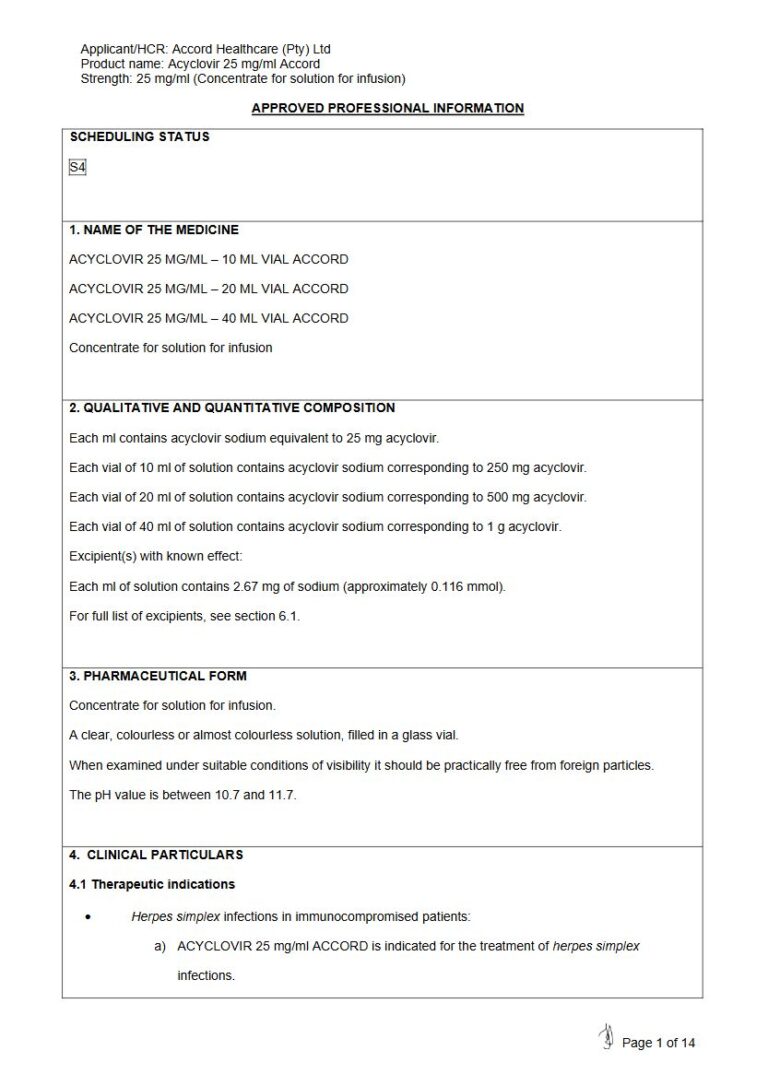
u2022 Herpes simplex infections in immunocompromised patients: a) ACYCLOVIR 25 mg/ml ACCORD is indicated for the treatment of herpes simplex infections.
b) ACYCLOVIR 25 mg/ml ACCORD is indicated for the prophylaxis of herpes simplex infections in patients.
u2022 ACYCLOVIR 25 mg/ml ACCORD is indicated in the treatment of varicella zoster infections in immuno-compromised patients: a) Chickenpox u2013 prophylaxis and therapy of pneumonia complications.
b) Shingles u2013 only if the lesions are not older than 72 hours
u2022 ACYCLOVIR 25 mg/ml ACCORD is indicated for treatment of herpes simplex infections in the neonate.
u2022 ACYCLOVIR 25 mg/ml ACCORD is indicated for the treatment of herpes simplex encephalitis.
u2022 ACYCLOVIR 25 mg/ml ACCORD is indicated for the prevention of reactivation of cytomegalovirus infection in seropositive patients following bone marrow transplantation.
4.2 Posology and method of administration
Posology
Dosage in adults
INDICATION IMMUNE STATUS DOSAGE
Herpes simplex infection (except herpes encephalitis) Immunocompromised 5 mg/kg every 8 hours
Varicella zoster infection Immunocompromised (normal renal function) 10 mg/kg every 8 hours
Herpes simplex encephalitis Normal or immuno-compromised (normal renal function) 10 mg/kg every 8 hours
Obese patients should be dosed at the recommended adult dose using ideal body weight, rather than actual body weight.
Special populations
Elderly
The possibility of renal impairment in the elderly must be considered and the dosage should be adjusted accordingly (see Renal impairment below). Adequate hydration should be maintained.
Renal Impairment
Caution is advised when administering ACYCLOVIR 25 mg/ml ACCORD to adults and paediatric patients with impaired renal function. The following adjustments in dosage are suggested:
Creatinine clearance (ml/min/1,73m2) Percentage of recommended dose (%) Dosing interval (hours)
> 50 100 % 8
25 - 50 100 % 1 2
10 - 25 100 % 2 4
0 - 10 50 % 2 4
Dosage for the prevention of cytomegalovirus reactivation following bone marrow transplantation
Adults: 500 mg/m2 ACYCLOVIR 25 mg/ml ACCORD should be given intravenously 3 times daily at approximately 8-hour intervals. The duration of treatment recommended in bone marrow transplant recipients is from 5 days before, up to 30 days after transplant.
Paediatric population
Dosage in children
The dose of ACYCLOVIR 25 mg/ml ACCORD for children aged between 3 months and 12 years is calculated on the basis of body surface area.
INDICATION IMMUNE STATUS DOSAGE
Herpes simplex (except herpes encephalitis) Immunocompromised 250 mg/m2 every 8 hours
Varicella zoster infection Immunocompromised (normal renal function) 500 mg/m2 every 8 hours
Herpes simplex encephalitis Normal (normal renal function) 500 mg/m2 every 8 hours
Children with impaired renal function require an appropriately modified dose and/or dose interval, according to the degree of impairment as indicated under u2018Dosage in renal impairmentu2019.
Children: Limited data suggest that for the prevention of cytomegalovirus reactivation in children over 2 years of age, who have undergone bone marrow transplantation, the adult dose may be given.
Dosage in neonates
The dosage of ACYCLOVIR 25 mg/ml ACCORD in neonates is calculated on the basis of body mass. Neonates with herpes simplex infections should be given ACYCLOVIR 25 mg/ml ACCORD in doses of 10 mg/kg every 8 hours.
Guidelines for acyclovir administration in neonates with renal impairment:
u2022 Creatinine clearance of 20 - 50 ml/min/1,73 m2 or serum creatinine 70 - 100 u03bcmol/l: a dose of 10 mg/kg/12 hours.
u2022 Creatinine clearance of 10 - 25 ml/min/1,73 m2 or serum creatinine 110 - 130 u03bcmol/l with decreasing urine output: a dose of 10 mg/kg/24 hours.
u2022 Renal failure with creatinine clearance of 130 u03bcmol/l or urine output < 1 ml/kg/hour and peritoneal dialysis: a dose of 5 mg/kg/24 hours.
Method of administration
For intravenous use. The required dose of ACYCLOVIR 25 mg/ml ACCORD should be administered by slow intravenous infusion over a one-hour period. A course of treatment with ACYCLOVIR 25 mg/ml ACCORD usually lasts 5 days, but this may be adjusted according to the patient's condition and response to therapy. Treatment for herpes encephalitis and neonatal herpes simplex infections usually lasts 10 days. The duration of prophylactic administration of ACYCLOVIR 25mg/ml ACCORD is determined by the duration of the period at risk. For reconstitution of ACYCLOVIR 25mg/ml ACCORD, see section 6.6.
4.3 Contraindications
Hypersensitivity to acyclovir or valacyclovir, or to any of the excipients of ACYCLOVIR 25 mg/ml ACCORD listed in section 6.1.
4.4 Special warnings and precautions for use
Safety of ACYCLOVIR 25mg/ml ACCORD in pregnancy and lactation has not been established (see section 4.6).
Drug reaction with eosinophilia and systemic symptoms (DRESS) and Acute generalised exanthematous pustulosis (AGEP)
Patients need to be advised of the risk of DRESS and AGEP which are considered to be serious cutaneous adverse reactions (SCARs). At the time of prescription, patients should be advised of the signs and symptoms and monitored closely for skin reactions. If a patient develops reactions that can be classified as SCARs, treatment with ACYCLOVIR 25 mg/ml ACCORD should be withdrawn immediately and an alternative treatment considered (as appropriate). Treatment with ACYCLOVIR 25 mg/ml ACCORD must not be restarted with the patient at any time.
Use in patients with renal impairment and in elderly patients
Acyclovir, as contained in ACYCLOVIR 25 mg/ml ACCORD, is eliminated by renal clearance, therefore the dose must be reduced in patients with renal impairment (see section 4.2). Elderly patients are likely to have reduced renal function and therefore the need for dose reduction must be considered in this group of patients. Both elderly patients and patients with renal impairment are at increased risk of developing neurological side effects and should be closely monitored for evidence of these effects. In the reported cases, these reactions were generally reversible on discontinuation of treatment (see section 4.8).
The dose of ACYCLOVIR 25 mg/ml ACCORD must be adjusted in patients with impaired renal function in order to avoid accumulation of acyclovir in the body (see Dosage in renal impairment). In patients receiving ACYCLOVIR 25 mg/ml ACCORD at higher doses (e.g. for herpes encephalitis), specific care regarding renal function should be taken, particularly when patients are dehydrated or have any renal impairment. Adequate hydration should be maintained in patients given i.v. or high oral doses of acyclovir. Intravenous doses should be given by infusion over one hour to avoid precipitation of acyclovir in the kidney; rapid or bolus injection should be avoided. The risk of renal impairment is increased by use with other nephrotoxic medicines. Care is required if administering i.v. acyclovir with other nephrotoxic medicines.
Product contains sodium. This medicinal product contains 2.67 mg sodium per ml of solution equivalent to 0.13 % of the WHO recommended maximum daily intake of 2 g sodium for an adult.
4.5 Interactions with other medicines and other forms of interaction
No clinically significant interactions have been identified. Acyclovir as contained in ACYCLOVIR 25 mg/ml ACCORD is eliminated primarily unchanged in the urine via active renal tubular secretion. Any medicines administered concurrently that compete with this mechanism may increase acyclovir plasma concentrations. Probenecid and cimetidine increase the AUC of acyclovir by this mechanism, and reduces acyclovir renal clearance. In patients receiving intravenous ACYCLOVIR 25 mg/ml ACCORD, caution is required during concurrent administration with medicines which compete with acyclovir for elimination, because of the potential for increased plasma levels of one or both medicines or their metabolites. Increases in plasma AUCs of acyclovir and of the inactive metabolite of mycophenolate mofetil, an immunosuppressant medicine used in transplant patients, have been shown when the medicines are co-administered. If lithium is administered with high dose acyclovir IV, the lithium serum concentration should be closely monitored because of the risk of lithium toxicity. Care is also required (with monitoring for changes in renal function) if administering intravenous ACYCLOVIR 25 mg/ml ACCORD with medicines which affect other aspects of renal physiology (e.g. ciclosporin, tacrolimus).
4.6 Fertility, pregnancy and lactation
Safety in pregnancy has not been established
Lactation
Following oral administration of 200 mg five times a day, acyclovir has been detected in breast milk at concentrations ranging from 0,6 to 4,1 times the corresponding plasma levels. These levels would potentially expose nursing infants to acyclovir dosages of up to 0,3 mg/kg/day. Lactating women on ACYCLOVIR 25 mg/ml ACCORD treatment should not breastfeed.
Fertility:
There is no information on the effect of ACYCLOVIR 25 mg/ml ACCORD on human female fertility. In a study of 20 male patients with normal sperm count, oral acyclovir administered at doses of up to 1 g per day for up to six months has been shown to have no clinically significant effect on sperm count, motility or morphology.
4.7 Effects on ability to drive and use machines
ACYCLOVIR 25 mg/ml ACCORD is generally used in an in-patient hospital population and information on ability to drive and operate machinery is not usually relevant.
4.8 Undesirable effects
a. Summary of the safety profile
The adverse reactions listed have been observed in controlled and uncontrolled clinical trials in approximately 700 patients who received acyclovir at ~ 5 mg/kg (250 mg/m2) 3 times daily and approximately 300 patients who received 10 mg/kg (500 mg/m2) 3 times daily.
b. Tabulated summary of adverse reactions
The following convention has been used for the classification of undesirable effects in terms of frequency.
Undesirable effects in clinical studies and post marketing
System Organ Class Frequency Adverse reaction
Blood and lymphatic system disorders Less frequent Decreases in haematological indices (anaemia, thrombocytopenia, leucopenia).
Immune system disorders Less frequent Anaphylaxis, angioedema.
Psychiatric and nervous system disorders Less frequent Headache, dizziness, agitation, confusion, tremor, ataxia, dysarthria, hallucinations, psychotic symptoms, convulsions, somnolence, encephalopathy, coma.
Vascular disorders Frequent Phlebitis.
Respiratory, thoracic and mediastinal disorders Less frequent Dyspnoea.
Gastrointestinal disorders Frequent Nausea, vomiting.
Less frequent Diarrhoea, abdominal pain.
Hepatobiliary disorders Frequent Reversible increases in liver-related enzymes.
Less frequent Reversible increases in bilirubin, hepatitis, jaundice.
Skin and subcutaneous tissue disorders Frequent Rashes (including photosensitivity), urticaria, pruritus, fevers.
Less frequent Accelerated diffuse hair loss.
Frequency unknown Drug reaction with eosinophilia and systemic symptoms (DRESS) and Acute generalised exanthematous pustulosis (AGEP) (see section 4.4)
Renal and urinary disorders Frequent Increases in blood urea and creatinine levels.
Less frequent Renal impairment, acute renal failure.
General disorders and administration site conditions Less frequent Fatigue, fever, local inflammatory reactions.
Description of selected adverse reactions
Severe local inflammatory reactions sometimes leading to ulceration have occurred when ACYCLOVIR 25 mg/ml ACCORD has been inadvertently infused into extravascular tissues. Rapid increases in blood urea and creatinine levels are believed to be related to peak plasma levels and the state of hydration of the patient. To avoid this effect, ACYCLOVIR 25 mg/ml ACCORD should not be given as an intravenous bolus injection, but by slow infusion over a one-hour period. Adequate hydration of the patient should be maintained. Renal impairment usually responds rapidly to rehydration of the patient and/or dosage reduction or withdrawal of ACYCLOVIR 25 mg/ml ACCORD. Progression to acute renal failure, may occur.
Reporting of suspected adverse reactions
Reporting suspected adverse reactions after authorisation of the medicine is important. It allows continued monitoring of the benefit/risk balance of the medicine. Healthcare professionals are asked to report any suspected adverse reactions to SAHPRA via the u201c6.04 Adverse Drug Reaction Reporting Formu201d, found online under SAHPRAu2019s publications: https://www.sahpra.org.za/Publications/Index/8
4.9 Overdose
Overdosage of intravenous ACYCLOVIR 25 mg/ml ACCORD has resulted in elevations in serum creatinine, blood urea nitrogen and subsequent renal failure. Neurological effects including confusion, hallucinations, agitation, seizures and coma have been described in association with overdosage. Haemodialysis significantly enhances the removal of acyclovir from the blood and may, therefore, be considered an option in the management of overdose of ACYCLOVIR 25 mg/ml ACCORD. Treatment is symptomatic and supportive.
