
Androcur Tablets & Injection
PDF Leaflet Revision Date: 14 December 2021
Clinical Summary
Quick overview from the medicine insert
Indication
Severe androgenization in females and anti-androgen treatment in males.
Dosage (summary)
50 mg for 10 days in females; 100 mg twice to three times daily for males.
Special Populations
- Children and adolescents
- Geriatric patients
- Hepatic impairment
- Renal impairment
Pregnancy & Breastfeeding
Contraindicated in pregnancy and lactation.
Key Drug Interactions
- CYP3A4 inhibitors
- CYP3A4 inducers
- Statins
Contraindications
- Pregnancy
- Lactation
- Liver diseases
- Meningiomas
- Severe chronic depression
Common side effects
- Decreased libido
- Erectile dysfunction
- Weight increase
- Depressed mood
Counselling Points
- Take with liquid after meals
- Use contraceptive during treatment
- Monitor liver function regularly
Serious warnings
- Hepatic toxicity
- Risk of meningiomas
- Thromboembolic events
Important Disclaimer
The Androcur Tablets & Injection professional information leaflet below is the property of Bayer and is provided on Medinsert exactly as issued, with no.. alterations or editorial changes. We make every effort to keep content current by updating documents as soon as new versions become available. Medinsert serves as a trusted access point for healthcare professionals, but does not replace official sources or clinical judgement. For more details, please read our full disclaimer. read more>>
 Healthcare Professionals Only
This content is for registered healthcare professionals
Sign in or create a free account to read the full package insert.
Free for HPCSA-registered professionals. Powered by Medinsert.
Clinical Particulars
Section 4 of the official insert — extracted exactly as issued, no alterations
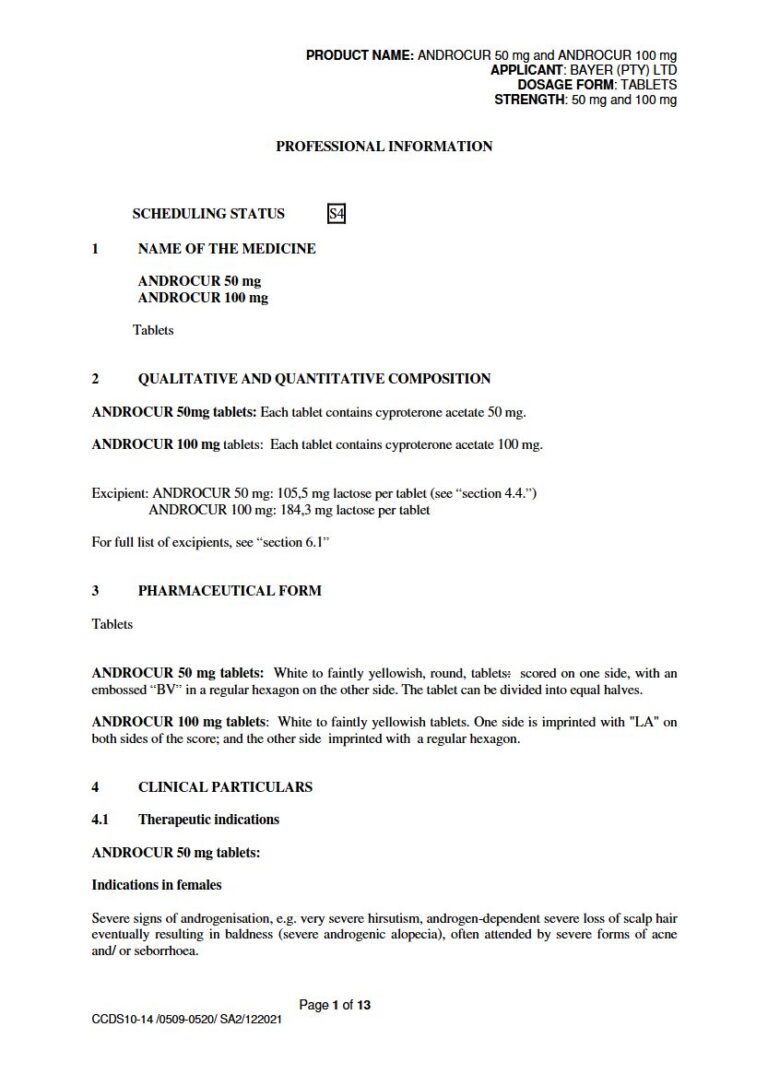
4.1 Therapeutic indications
ANDROCUR 50 mg tablets: Indications in females Severe signs of androgenisation, e.g. very severe hirsutism, androgen-dependent severe loss of scalp hair eventually resulting in baldness (severe androgenic alopecia), often attended by severe forms of acne and/ or seborrhoea.
Indications in males Reduction of drives in sexual deviations. Anti-androgen treatment in inoperable carcinoma of the prostate. ANDROCUR 100 mg tablets: Inoperable carcinoma of the prostate.
4.2 Posology and method of administration
Method of administration Oral use
Posology The tablets are to be taken with some liquid after meals The maximum daily dose is 300 mg. Pregnant women must not take ANDROCUR 50 mg. Therefore, pregnancy must be excluded before the start of therapy (see u201c section 4.3 u201d ). For the duration of ANDROCUR therapy women of child-bearing age must also receive a combined oral contraceptive. This will provide the necessary contraceptive protection and will stabilise the menstrual cycle. Dosage and directions for use as per the package insert of that product must be strictly adhered to. Prior to commencing ANDROCUR treatment it is always necessary for the patient to receive one complete cycle of a combined oral contraceptive. Extra non-hormonal methods (with the exception of the rhythm and temperature methods) should be employed during the first 3 weeks of the first pack of the combined oral contraceptive. This menstrual cycle may be shorter than 4 weeks. Subsequent cycles should then be regular. In the second pack of the combined oral contraceptive, which starts the very next day after completion of the first pack of the combined oral contraceptive, ANDROCUR treatment is commenced on the 5th day of this menstrual cycle (1st day of bleeding = 1st day of the menstrual cycle). Two ANDROCUR 50 mg tablets (= 100 mg) are to be taken from the 5th to the 14th day of the cycle (i.e. for ten days). Every 28 days (the usual duration of a menstrual cycle), the above dosage regimen is to be followed. Women receiving the cyclical combined therapy should keep to a particular time of the day for tablet- taking. Seven inactive tablets are taken once daily after 21 days, during which time a withdrawal bleeding occurs. Exactly 4 weeks after the first course of treatment was started, i.e. on the same day of the week, the next cyclical course of combined treatment is started, regardless of whether bleeding has stopped or not. Following clinical improvement, the daily dose of ANDROCUR 50 mg during the 10 days of the combined treatment with a combined oral contraceptive can be reduced to one or half a tablet of ANDROCUR 50 mg. Re-evaluate the treatment with ANDROCUR 50 at the start of the menopause. Long-term use (years) of ANDROCUR 50 should be avoided (see u201c section 4.4 u201d ). In hysterectomized patients or postmenopausal women ANDROCUR 50 may be administered alone. According to the severity of the complaints, the average dose should be 1 to u00bd tablet ANDROCUR 50 once daily for 21 days, followed by a 7-day tablet free interval Missed bleeding If no bleeding occurs during the inactive tablet phase, the treatment must be interrupted, and pregnancy must be excluded before tablet-taking is resumed. Missed tablets Women receiving the cyclical combined therapy should keep to a particular time of the day for tablet taking. If more than 12 hours elapse from the time that she normally takes her combined oral contraceptive, contraceptive protection may be reduced in this cycle. Attention is drawn to the special notes (especially on contraceptive reliability and to the missed tablet recommendations) in the package insert for the combined oral contraceptive. If bleeding fails to occur after this cycle, pregnancy must be excluded before tablet-taking is resumed. Missed ANDROCUR 50 mg tablets may diminish the therapeutic efficacy and may lead to intermenstrual bleeding. The missed ANDROCUR 50 mg tablet should be disregarded (no double dose should be taken to make up for the missed tablet) and tablet-taking resumed at the regular time together with the combined oral contraceptive. Reduction of drive in sexual deviations in men Generally, treatment is started with one tablet ANDROCUR 50 mg twice daily. It may be necessary to increase the dose to two tablets twice daily, or even two tablets three times daily for a short period of time. The duration of ANDROCUR treatment should be defined on an individual basis. When a satisfactory result has been achieved, one should try to maintain the therapeutic effect with the lowest possible dose. Quite often half a 50 mg tablet twice daily (50 mg daily) is sufficient. When establishing the maintenance dose or when discontinuing the preparation, dosage should not be reduced abruptly, but gradually. To this end, the daily dose should be reduced by one 50 mg tablet, or better u00bd of a 50 mg tablet, at intervals of several weeks. To stabilise the therapeutic effect, it is necessary to take ANDROCUR 50 mg over a protracted period of time, if possible, with the simultaneous use of psychotherapeutic measures. Antiandrogen treatment in inoperable carcinoma of the prostate 100 mg twice to three times daily (= 200 to 300 mg per day). Treatment should not be interrupted, nor the dosage reduced after improvement or remissions have occurred. u2022 To reduce the initial increase of male sex hormones in combination therapy with GnRH agonists 100 mg twice daily (= 200 mg per day) alone for 5-7 days, followed by 100 mg twice daily (= 200 mg per day) for 3-4 weeks together with a GnRH agonist in the dosage recommended by the marketing authorization holder (see prescribing information of GnRH u2022 To treat hot flushes in patients under combination therapy with GnRH analogues or who have had orchidectomy 100 mg once to twice daily (= 100-200 mg per day).
4.3 Contraindications
Contraindications in the women u2022 Pregnancy. u2022 Lactation. u2022 Liver diseases. u2022 Dubin-Johnson syndrome, Rotor syndrome. u2022 History of jaundice or persistent pruritus during a previous pregnancy. u2022 History of herpes of pregnancy. u2022 Previous or existing liver tumours. u2022 Wasting diseases. u2022 Severe chronic depression. u2022 Previous or existing thromboembolic processes. u2022 Severe diabetes with vascular changes. u2022 Sickle-cell anaemia. u2022 Hypersensitivity to the active substance or any of the components of ANDROCUR 50 mg. With regard to the cyclical combined therapy of severe signs of androgenisation, attention is also drawn to the data on contraindications contained in the package insert for the product used in addition to ANDROCUR 50 mg.
Reduction of drive in sexual deviations in men u2022 Liver diseases. u2022 Dubin-Johnson syndrome, Rotor syndrome. u2022 Previous or existing liver tumours. u2022 Presence or history of meningiomas u2022 Wasting diseases. u2022 Severe chronic depression. u2022 Previous or existing thromboembolic processes. u2022 Severe diabetes with vascular changes. u2022 Sickle-cell anaemia. u2022 Hypersensitivity to the active substance or to any of the excipients of ANDROCUR.
Antiandrogen treatment in operable carcinoma of prostate u2022 Liver diseases. u2022 Dubin-Johnson syndrome, Rotor syndrome. u2022 Previous or existing liver tumours (only if these are not due to metastases from carcinoma of the prostate). u2022 Presence or history of meningiomas u2022 Wasting diseases (with the exception of inoperable carcinoma of the prostate). u2022 Severe chronic depression. u2022 Existing thromboembolic processes. u2022 Hypersensitivity to the active substance or to any of the excipients of ANDROCUR.
4.4 Special warnings and precautions for use
ANDROCUR should be used with caution in cardiovascular disease, ischaemic heart disease, cerebrovascular disease and hypertension. Strict medical supervision is necessary if the patient suffers from diabetes. Specifically, to be observed in woman Before starting treatment, a thorough general medical and gynaecological examination (including the breasts and a cytological smear of the cervix) should be carried out and pregnancy must be excluded. If, during the combined treatment, spotting occurs during the 3 weeks in which the tablets are being taken, tablet-taking should not be interrupted. However, if persistent or recurrent bleeding occurs at irregular intervals, a gynaecological examination must be carried out to exclude organic disease. Attention is drawn to the special notes on side effects, reasons for immediate discontinuation of treatment and all relevant data contained in the package insert of the oral contraceptive combination preparation. Specifically, to be observed in males In the indication u201creduction of drive in sexual deviationsu201d, the drive-reducing effect of ANDROCUR 50 mg can be diminished under the disinhibitory influence of alcohol.
Effects on ability to drive and use machines It should be pointed out to patients whose occupation demands great concentration (e.g. road users, machine operators) that ANDROCUR can lead to tiredness and diminished vitality and can impair the ability to concentrate.
Liver Direct hepatic toxicity, including jaundice, hepatitis and hepatic failure, has been observed in patients treated with ANDROCUR. At dosages of 100 mg and above also cases with fatal outcome have been reported. Most reported fatal cases were in males with advanced carcinoma of the prostate. Toxicity is dose-related and develops usually several months after treatment has begun. Liver function tests should be performed pre-treatment, at regular interval during treatment and whenever any symptoms or signs suggestive of hepatotoxicity occur. If hepatotoxicity is confirmed, ANDROCUR should be withdrawn, unless the hepatotoxicity can be explained by another cause, e.g. metastatic disease, in which case ANDROCUR should be continued only if the perceived benefit outweighs the risk.
In very rare cases benign, and malignant, liver tumours which may lead to life-threatening intra-abdominal haemorrhage have been observed after the use ANDROCUR. If severe upper abdominal complaints, liver enlargement or signs of intra-abdominal haemorrhage occur, a liver tumour should be included in the differential-diagnostic considerations.
Meningioma The occurrence of meningiomas (single and multiple) has been reported in association with long-term use (years) of cyproterone acetate in pre-and postmenopausal women at doses of 25 mg/day and above. The risk of meningioma increases with increasing cumulative doses of cyproterone acetate. If a patient treated with ANDROCUR is diagnosed with meningioma, treatment with cyproterone containing products, including ANDROCUR, must be permanently stopped (see u201c section 4.3 u201d ).
Thromboembolic events The occurrence of thromboembolic events has been reported in patients using ANDROCUR, although a causal relationship has not been established. Patients with previous arterial or venous thrombotic/thromboembolic events (e.g. deep venous thrombosis, pulmonary embolism, myocardial infarction) or with a history of cerebrovascular accidents or with advanced malignancies are at increased risk of further thromboembolic events. In patients with inoperable carcinoma of the prostate, presenting with a history of thromboembolic processes or suffering from sickle-cell anaemia or from severe diabetes with vascular changes, a careful risk-benefit evaluation must be carried out in each individual case before ANDROCUR is prescribed.
Anaemia Anaemia has been reported during treatment with ANDROCUR, therefore the red blood cell count should be checked regularly during treatment.
Diabetes mellitus Strict medical supervision is necessary if the patient suffers from diabetes, because the requirement for oral antidiabetics or insulin can change during ANDROCUR treatment (see also u201c section 4.3 u201d )
Shortness of breath A sensation of shortness of breath may occur under high-dosed treatment with ANDROCUR. The differential diagnosis in such cases must include the stimulating effects on breathing known for progesterone and synthetic progesterone which is accompanied by hypocapnia and compensated respiratory alkalosis, and which is not considered to require treatment.
Adrenocortical function During treatment, adrenocortical function should be checked regularly, as preclinical data suggest a possible suppression due to the corticoid-like effect of ANDROCUR with high doses (see u201c section 5.4 u201d ).
Other conditions In the indication u201creduction of drive in sexual deviationsu201d, the drive-reduced effects of ANDROCUR can be diminished under the influence of alcohol. ANDROCUR 50 contains 105,5 mg lactose per tablet and ANDROCUR 100 mg contains 184,3 lactose per tablet. Patient with rare hereditary problems of galactose intolerance, the Lapp lactase deficiency or glucose-galactose malabsorption should not take this medicine. Prolactin levels may increase with higher doses of ANDROCUR.
4.5 Interaction with other medicines and other forms of interaction
Although clinical interaction studies have not been performed, it is expected that ketoconazole, itraconazole, clotrimazole, ritonavir and other strong inhibitors of CYP3A4 will inhibit the metabolism of ANDROCUR as it is metabolised by CYP3A4. On the other hand, inducers of CYP3A4 such as e.g. rifampicin, phenytoin and products containing St Johnu2019s Wort may reduce the levels of ANDROCUR. Based on in vitro inhibition studies, an inhibition of the cytochrome P450 enzymes CYP2C8, 2C9, 2C19, 3A4 and 2D6 is possible at high therapeutic ANDROCUR doses of 3 times 100 mg per day. The risk of statin-associated myopathy or rhabdomyolysis may be increased when those HMGCoA inhibitors (statins), which are primarily metabolised by CYP3A4, are co-administered with high therapeutic ANDROCUR doses since they share the same metabolic pathway.
4.6 Fertility, pregnancy and lactation
ANDROCUR is contraindicated during pregnancy and lactation (see u201c section 4.3 u201d ). In a study with 6 women who received a single oral dose of 50 mg ANDROCUR, 0,2 % of the dose was excreted in breast milk.
4.7 Effects on ability to drive and use machines
It should be pointed out to patients whose occupation demands great concentration(e.g. road users, machine operators) that ANDROCUR 50 mg can lead to tiredness and diminished vitality and can impair the ability to concentrate.
4.8 Undesirable effects
a) Summary of the safety profile The most frequently observed adverse drug reactions (ADRs) in patients receiving ANDROCUR 100 are decreased libido (u2265 1/10), erectile dysfunction (u2265 1/10), and reversible inhibition of spermatogenesis (u2265 1/10). The most commonly reported adverse drug reactions (ADRs) in patients receiving ANDROCUR 50 mg, are spotting, weight increase and depressed mood with a frequency not known. The most serious (ADRs) in patients receiving ANDROCUR are hepatic toxicity (u2265 1/100 and < 1/10), benign and malignant liver tumours (< 1/10,000) which may lead to intra-abdominal haemorrhage and thromboembolic events (frequency u201cnot knownu201d).
b) Tabulated summary of adverse reactions The frequencies of ADRs reported with ANDROCUR are reported in the table below. Frequencies are defined as very common (u2265 1/10), common (u2265 1/100 and < 1/10), uncommon (u2265 1/1 000 and < 1/100), rare (u2265 1/10 000 and < 1/1 000), very rare (< 1/10 000). The ADRs identified only during post-marketing surveillance and for which a frequency could not be estimated are listed under u201cnot knownu201d.
Table 1: Adverse drug reactions reported in clinical trials or during post-marketing surveillance in patients treated with ANDROCUR System Organ Class MedDRA Very common Common Uncommon Rare Very rare Not known Neoplasms benign, malignant and unspecified Benign and malignant liver tumours* a Meningiomas # Blood and lymphatic system disorders Thromboembolic events Changes in the number of red cells Anaemia* Immune system disorders Hypersensitivity reaction a Endocrine disorders Reduction of adrenocortical function Increase in prolactin levels Metabolism and nutrition disorders Weight increased or weight decreased a Psychiatric disorders Libido decreased a Erectile dysfunction a Depressed mood a Restlessness (temporary) a Libido increased Vascular disorders Thromboembolic events**
c) Description of selected adverse reactions Under treatment with ANDROCUR 100, sexual drive and potency are reduced, and gonadal function is inhibited. These changes are reversible after discontinuation of therapy. Over the course of several weeks, ANDROCUR 100 inhibits spermatogenesis as a result of the antiandrogenic and anti-gonadotropic actions. Spermatogenesis recovers gradually within a few months of discontinuing the therapy. ANDROCUR 100 may lead to gynaecomastia (sometimes combined with tenderness to touch of the mamillae) which usually regresses after withdrawal of the preparation. Permanent enlargement of the mammary glands may occur. Galactorrhoea and benign nodules have been reported. Long-term androgen deprivation with ANDROCUR 100 may lead to osteoporosis. Meningiomas have been reported in association with long-term use (several years) of ANDROCUR doses of 25 mg and above (see u201c section 4.3 u201d and u201c section 4.4. u201d ) In women, ovulation is inhibited under the combined treatment, so that a state of infertility exists. The most appropriate MedDRA terms to describe a certain adverse reaction is listed. Synonyms or related conditions are not listed but should be taken into account as well.
Reporting of suspected adverse reactions Reporting suspected adverse reactions after authorisation of the medicine is important. It allows continued monitoring of benefit/risk balance of the medicine. Health care providers are asked to report any suspected adverse reaction to SAHPRA via the u201c6.04 Adverse Drug Reactions Reporting Formu201d, found online under SAHPRA u2019s publications: https://www.sahpra.org.za/Publications/Index/8
4.9 Overdose
Acute toxicity studies following single administration showed that cyproterone, active ingredient of ANDROCUR, can be classified as practically non-toxic. Nor is any risk of acute intoxication to be expected after a single inadvertent intake of a multiple of the dose required for therapy. Treatment is supportive and symptomatic.
