
Arixtra 2.5mg/0.5ml Injection
PDF Leaflet Revision Date: 19 April 2022
Clinical Summary
Quick overview from the medicine insert
Indication
Prevention and treatment of venous thromboembolic events and acute coronary syndromes.
Dosage (summary)
2.5 mg once daily by subcutaneous injection; initial dose 6 hours post-surgery.
Special Populations
- Elderly
- Renal impairment
- Hepatic impairment
- Body weight < 50 kg
Pregnancy & Breastfeeding
Contraindicated in pregnancy and lactation.
Key Drug Interactions
- NSAIDs
- Platelet inhibitors
- Fibrinolytics
Contraindications
- Hypersensitivity to fondaparinux
- Active major bleeding
- Severe renal impairment
- Infective endocarditis
- Body weight < 50 kg
Common side effects
- Bleeding
- Thrombocytopenia
- Nausea
- Headache
Counselling Points
- Administer subcutaneously, not intramuscularly.
- Monitor for signs of bleeding.
- Strict adherence to dosing schedule is crucial.
Serious warnings
- Risk of spinal/epidural hematomas
- Increased risk of bleeding in renal impairment
Important Disclaimer
The Arixtra 2.5mg/0.5ml Injection professional information leaflet below is the property of Pharmacare Ltd and is provided on Medinsert exactly as issued, with no.. alterations or editorial changes. We make every effort to keep content current by updating documents as soon as new versions become available. Medinsert serves as a trusted access point for healthcare professionals, but does not replace official sources or clinical judgement. For more details, please read our full disclaimer. read more>>
 Healthcare Professionals Only
This content is for registered healthcare professionals
Sign in or create a free account to read the full package insert.
Free for HPCSA-registered professionals. Powered by Medinsert.
Clinical Particulars
Section 4 of the official insert — extracted exactly as issued, no alterations
4.1. Therapeutic indications
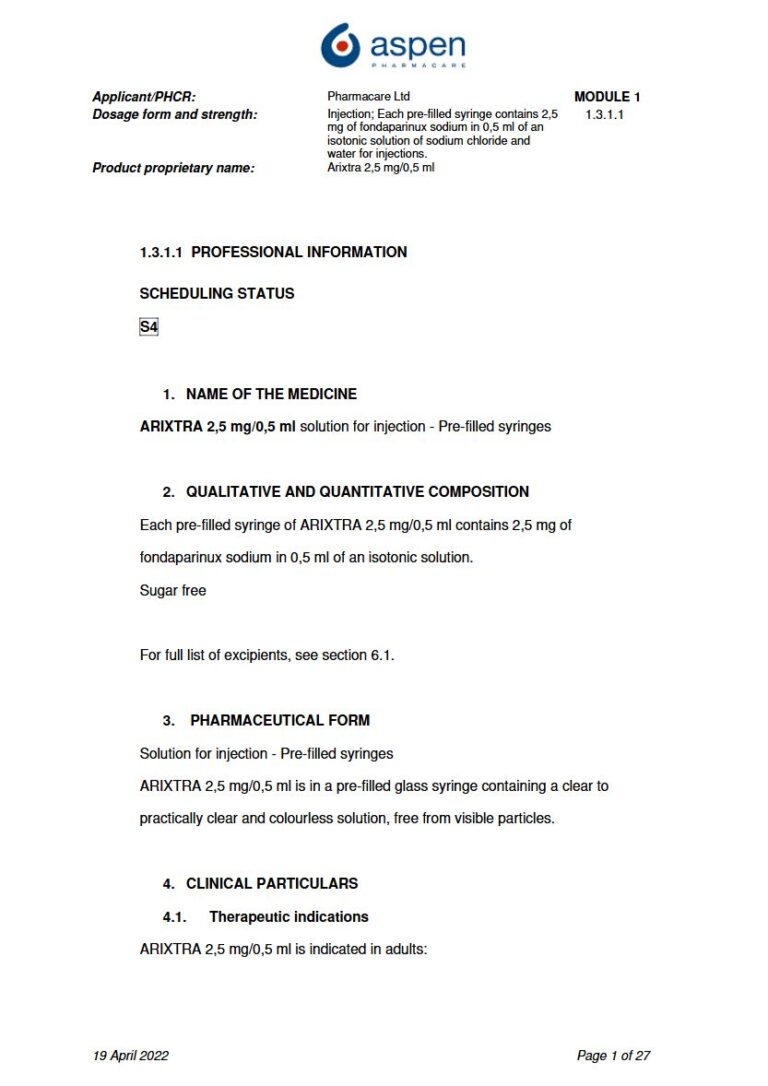
ARIXTRA 2,5 mg/0,5 ml is indicated in adults:
- To reduce the risk of venous thromboembolic events (VTE) in patients undergoing major orthopaedic surgery of the lower limbs such as hip fracture, major knee surgery or hip replacement surgery.
- To reduce the risk of venous thromboembolic events (VTE) in patients undergoing abdominal surgery who are at risk of thromboembolic complications.
- For the treatment of unstable angina or non-ST segment elevation myocardial infarction (UA/NSTEMI) acute coronary syndrome for the prevention of death, myocardial infarction and refractory ischaemia. ARIXTRA 2,5 mg/0,5 ml has been shown to reduce all-cause mortality in patients with UA/NSTEMI.
- For the treatment of ST segment elevation myocardial infarction (STEMI) acute coronary syndrome for the prevention of death and myocardial re-infarction in patients who are managed with thrombolytics or who initially are to receive no other form of reperfusion therapy. ARIXTRA 2,5 mg/0,5 ml has been shown to reduce all-cause mortality in patients with STEMI.
- To reduce the risk of venous thromboembolic events (VTE) in medical patients who are at risk of thromboembolic complications due to restricted mobility during acute illness such as cardiac insufficiency and/or acute respiratory disorders, and/or acute infectious or inflammatory disease.
4.2. Posology and method of administration
Posology
Adults
Orthopaedic and abdominal surgery: The recommended dose of ARIXTRA 2,5 mg/0,5 ml is 2,5 mg once daily administered post-operatively by subcutaneous injection. The initial dose should be given 6 hours following surgical closure provided that haemostasis has been established. Administration before 6 hours has been associated with increased risk of bleeding. Treatment should be continued for at least 7 u00b1 2 days and for as long as the risk of VTE persists.
Treatment of Unstable Angina/Non-ST Segment Elevation Myocardial Infarction (UA/NSTEMI): The recommended dose of ARIXTRA 2,5 mg/0,5 ml is 2,5 mg once daily, administered by subcutaneous injection. Treatment should be initiated as soon as possible following diagnosis and continued for up to 8 days or until hospital discharge. If a patient is to undergo percutaneous coronary intervention (PCI) while on ARIXTRA 2,5 mg/0,5 ml, ARIXTRA 2,5 mg/0,5 ml should be stopped and unfractionated heparin (UFH) as per standard practice should be administered during PCI, taking into account the patientu2019s potential risk of bleeding, including the time since the last dose of ARIXTRA 2,5 mg/0,5 ml (see section 4.4). The timing of restarting subcutaneous ARIXTRA 2,5 mg/0,5 ml after sheath removal should be based on clinical judgement. In the UA/NSTEMI clinical trial, treatment with ARIXTRA 2,5 mg/0,5 ml was restarted no earlier than 2 hours after sheath removal. In patients who are to undergo coronary artery bypass graft (CABG) surgery, ARIXTRA 2,5 mg/0,5 ml should not be given during the 24 hours before surgery and may be restarted 48 hours post-operatively.
Treatment of ST Segment Elevation Myocardial Infarction (STEMI): The recommended dose of ARIXTRA 2,5 mg/0,5 ml is 2,5 mg once daily. The first dose of ARIXTRA 2,5 mg/0,5 ml is administered intravenously and subsequent doses are administered by subcutaneous injection. Treatment should be initiated as soon as possible following diagnosis and continued for up to 8 days or until hospital discharge. If a patient is to undergo non-primary percutaneous coronary intervention (PCI) while on ARIXTRA 2,5 mg/0,5 ml, ARIXTRA 2,5 mg/0,5 ml should be stopped and unfractionated heparin (UFH) as per standard practice should be administered during PCI, taking into account the patientu2019s potential risk of bleeding, including the time since the last dose of ARIXTRA 2,5 mg/0,5 ml (see section 4.4). The timing of restarting subcutaneous ARIXTRA 2,5 mg/0,5 ml after sheath removal should be based on clinical judgment. In the STEMI clinical trial treatment with ARIXTRA 2,5 mg/0,5 ml was restarted no earlier than 3 hours after sheath removal.
ARIXTRA 2,5 mg/0,5 ml is administered by subcutaneous or intravenous injection. It must NOT be administered by intramuscular injection.
Medical patients at risk of thromboembolic complications: The recommended dose of ARIXTRA 2,5 mg/0,5 ml is 2,5 mg once daily administered by subcutaneous injection. A treatment duration of 6 to 14 days has been clinically studied in medical patients.
Special populations
Elderly: No dosing adjustment is necessary. In elderly patients, ARIXTRA 2,5 mg/0,5 ml should be used with care, including strict adherence to the timing of the first dose (see section 4.4).
Renal impairment: Prevention of VTE: No dosage reduction is required in patients with a creatinine clearance greater than or equal to 30 ml/min (see section 4.4).
4.3 Contraindications
ARIXTRA 2,5 mg/0,5 ml is contraindicated in:
- Patients with hypersensitivity to fondaparinux or to any excipients in ARIXTRA 2,5 mg/0,5 ml (see section 6.1).
- Active major bleeding.
- Severe renal impairment (creatinine clearance < 20 ml/min).
- Infective endocarditis.
- Pregnancy and lactation (see section 4.6).
- Patients with body weight less than 50 kg.
ARIXTRA 2,5 mg/0,5 ml should not be given to patients who have undergone surgery of the brain, eye, ear or spinal cord or who have injuries of the brain, eye, ear or spinal cord.
4.4. Special warnings and precautions for use
Spinal/epidural anaesthesia: Epidural or spinal haematomas which may result in long-term or permanent paralysis cannot be excluded with the concurrent use of ARIXTRA 2,5 mg/0,5 ml and spinal/epidural anaesthesia or spinal puncture. The risk of these events may be higher with post-operative use of indwelling epidural catheters or the concomitant use of other medicines affecting haemostasis, including NSAID, acetylsalicylic acid and other platelet inhibitors. Epidural and spinal catheters should be removed at the end of surgical procedures.
ARIXTRA 2,5 mg/0,5 ml is not intended for intramuscular administration. ARIXTRA 2,5 mg/0,5 ml cannot be used interchangeably (unit for unit) with heparin, low molecular weight heparins or heparinoids, as they differ in anti-Xa and anti-IIa activity, units, and dosage. Each of these medicines has its own instructions for use.
Percutaneous coronary intervention (PCI) and risk of guiding catheter thrombus: Clinical trials have shown an increased risk of guiding catheter thrombus in patients treated solely with ARIXTRA 2,5 mg/0,5 ml for anticoagulation during PCI compared to control.
Renal impairment: The plasma clearance of ARIXTRA 2,5 mg/0,5 ml decreases with the severity of renal impairment and is associated with an increased risk of haemorrhage. Patients with renal impairment, particularly those with a creatinine clearance of less than 30 ml/min are at increased risk of both major bleeding episodes and VTE (see section 4.3).
Prevention of VTE: There are limited clinical data available for the use of ARIXTRA 2,5 mg/0,5 ml for prevention of VTE in patients with creatinine clearance less than 20 ml/min. Therefore, ARIXTRA 2,5 mg/0,5 ml is not recommended for prevention of VTE in these patients (see section 4.2, 4.3 and 5.2).
Medicines that may enhance the risk of haemorrhage should not be administered concomitantly with fondaparinux. These medicines include desirudin, fibrinolytic medicines GP IIb/IIIa receptor antagonists, heparin, heparinoids, or Low Molecular Weight Heparin (LMWH). When required, concomitant therapy with vitamin K antagonist should be administered in accordance with the information of section 4.5.
Other antiplatelet medicines (acetylsalicylic acid, dipyridamole, sulfinpyrazone, ticlopidine or clopidogrel), and NSAIDs should be used with caution. If co-administration is essential, close monitoring is necessary (see section 4.5).
Prevention of VTE following surgery (timing of first ARIXTRA 2,5 mg/0,5 ml injection): The timing of the first injection requires strict adherence. The first dose should be given no earlier than 6 hours following surgical closure, and only after haemostasis has been established. Administration before 6 hours has been associated with an increased risk of major bleeding. Patient groups at particular risk are those from 75 years of age, body weight of less than 50 kg, or renal impairment with creatinine clearance less than 50 ml/min.
Treatment of UA/NSTEMI and STEMI: There are limited clinical data available for the use of ARIXTRA 2,5 mg/0,5 ml for the treatment of UA/NSTEMI and STEMI in patients with creatinine clearance between 20 to 30 ml/min. Therefore, the medical practitioner should determine if the benefit of treatment outweighs the risk (see section 4.2 and section 5.2). ARIXTRA 2,5 mg/0,5 ml is not recommended in patients with a creatinine clearance of less than 20 ml/min (see section 4.3).
Treatment of UA/NSTEMI and STEMI: ARIXTRA 2,5 mg/0,5 ml should be used with caution in patients who are being treated concomitantly with other medicines that increase the risk of haemorrhage (such as GPIIb/IIIa inhibitors or thrombolytics).
Renal function should be assessed periodically in patients receiving ARIXTRA 2,5 mg/0,5 ml. ARIXTRA 2,5 mg/0,5 ml should be discontinued immediately in patients who develop severe renal impairment or labile renal function while on therapy. After discontinuation of ARIXTRA 2,5 mg/0,5 ml, its anticoagulant effects may persist for 2 to 4 days in patients with normal renal function (i.e. at least 3 to 5 half-lives). The anticoagulant effects of ARIXTRA 2,5 mg/0,5 ml may persist even longer in patients with renal impairment (see section 5.2).
Elderly patients: The elderly population is at increased risk of bleeding. As renal function generally decreases with age, elderly patients may show reduced elimination and increased exposure of fondaparinux. ARIXTRA 2,5 mg/0,5 ml should be used with caution in elderly patients (see section 4.2).
Low body weight: Patients with body weight less than 50 kg are at increased risk of bleeding. Elimination of fondaparinux decreases with weight decrease. For prophylaxis following surgery, ARIXTRA 2,5 mg/0,5 ml should be used with caution in these patients (see sections 4.2 and 4.3).
Severe hepatic impairment: In patients with an elevation in prothrombin time, the use of ARIXTRA 2,5 mg/0,5 ml should be considered with caution, because of an increased risk of bleeding due to a possible deficiency of coagulation factors in patients with severe hepatic impairment (see section 4.2).
Haemorrhage: ARIXTRA 2,5 mg/0,5 ml Injection, like other coagulants, should be used with extreme caution in conditions with increased risk of haemorrhage, such as congenital or acquired bleeding disorders, active ulcerative and angiodysplastic gastrointestinal disease, haemorrhagic stroke or intracranial haemorrhage, or shortly after brain, spinal, or ophthalmological surgery, or in patients treated concomitantly with platelet inhibitors.
Laboratory testing: Because routine coagulation tests such as prothrombin time (PT), International Normalised Ratio (INR) and activated partial thromboplastin time (aPTT) are insensitive measures of ARIXTRA 2,5 mg/0,5 ml activity and international standards of heparin or LMWH are not calibrators to measure anti-Factor Xa activity of ARIXTRA 2,5 mg/0,5 ml, if during ARIXTRA 2,5 mg/0,5 ml therapy unexpected changes in coagulation parameters or major bleeding occurs, ARIXTRA 2,5 mg/0,5 ml should be discontinued.
Spinal/epidural anaesthesia: Spinal or epidural haematomas, which may result in long-term or permanent paralysis, can occur with the use of anticoagulants and neuraxial (spinal/epidural) anaesthesia or spinal puncture. The risk of these events may be higher with post-operative use of indwelling epidural catheters or concomitant use of other medicines affecting haemostasis such as NSAIDs.
Thrombocytopenia: Thrombocytopenia can occur with the administration of ARIXTRA 2,5 mg/0,5 ml. Moderate thrombocytopenia (platelet counts between 100 000/mm3 and 50 000/mm3) occurred in 2,9 % in patients given ARIXTRA 2,5 mg/0,5 ml 2,5 mg in clinical trials. Severe thrombocytopenia (platelet counts less than 50 000/mm3) occurred at a rate of 0,2 % in patients given ARIXTRA 2,5 mg/0,5 ml 2,5 mg in clinical trials. Thrombocytopenia of any degree should be monitored closely. If the platelet count falls below 100 000/mm3, ARIXTRA 2,5 mg/0,5 ml should be discontinued.
Heparin induced thrombocytopenia: ARIXTRA 2,5 mg/0,5 ml does not bind to platelet factor 4 and does not cross-react with sera from patients with heparin induced thrombocytopenia (HIT)-type II. It should be used with caution in patients with a history of HIT. The efficacy and safety of ARIXTRA 2,5 mg/0,5 ml have not been studied in HIT-type II. Spontaneous reports of HIT in patients treated with ARIXTRA 2,5 mg/0,5 ml have been received. A causal association between treatment with ARIXTRA 2,5 mg/0,5 ml and the occurrence of HIT has not been established.
Latex allergy: The needle shield of the pre-filled syringe may contain dry natural latex rubber that has the potential to cause allergic reactions in latex sensitive individuals.
Paediatric population: The safety and efficacy of ARIXTRA 2,5 mg/0,5 ml in patients under the age of 18 years has not been studied (see section 4.2).
4.5. Interaction with other medicines and other forms of interaction
In clinical studies performed with ARIXTRA 2,5 mg/0,5 ml, the concomitant use of oral warfarin, platelet inhibitors (acetylsalicylic acid), NSAIDs (piroxicam) and digoxin did not interact with the pharmacokinetics/pharmacodynamics of ARIXTRA 2,5 mg/0,5 ml. In addition, ARIXTRA 2,5 mg/0,5 ml neither influenced the pharmacodynamics of warfarin, acetylsalicylic acid, piroxicam and digoxin, nor the pharmacokinetics of digoxin at steady state. Medicines that may enhance the risk of haemorrhage should be discontinued prior to initiation of ARIXTRA 2,5 mg/0,5 ml therapy. If co-administration is essential, close monitoring may be appropriate. Since ARIXTRA 2,5 mg/0,5 ml does not inhibit CYP450s (CYP1A2, CYP2A6, CYP2C9, CYP2C19, CYP2D6, CYP2E1 or CYP3A4) in vitro, ARIXTRA 2,5 mg/0,5 ml is not expected to interact with other medicines in vivo by inhibition of CYP-mediated metabolism.
Since fondaparinux does not bind significantly to plasma proteins other than ATIII, no interaction with other medicines by protein binding displacement are expected.
4.6. Fertility, pregnancy and lactation
The use of ARIXTRA 2,5 mg/0,5 ml is contraindicated in pregnancy and lactation (see section 4.3).
Pregnancy: There are no adequate data from the use of fondaparinux, as in ARIXTRA 2,5 mg/0,5 ml, in pregnant women. Animal studies are insufficient with respect to effects on pregnancy, embryo/foetal development, parturition and postnatal development because of limited exposure.
Breastfeeding: It is not known whether ARIXTRA 2,5 mg/0,5 ml is excreted in human milk. Breastfeeding is not recommended during treatment with ARIXTRA 2,5 mg/0,5 ml.
Fertility: There are no data available on the effect of fondaparinux, as in ARIXTRA 2,5 mg/0,5 ml, on human fertility.
4.7 Effects on ability to drive and use machines
ARIXTRA 2,5 mg/0,5 ml has a minor influence on a patientu2019s ability to drive and use machines. Since adverse reactions such as dizziness have been reported in patients receiving ARIXTRA 2,5 mg/0,5 ml, patients should not drive, use machinery or perform any tasks that require concentration, until they are certain that ARIXTRA 2,5 mg/0,5 ml does not adversely affect their ability to do so (see section 4.4 and 4.8).
4.8 Undesirable effects
(a) Tabulated list of adverse reactions
System organ class
Frequent
Less frequent
- Infections and infestations: Post-operative wound infections
- Blood and the lymphatic system disorders: Anaemia, bleeding (various sites including rare cases of intracranial/intracerebral and retroperitoneal bleedings), purpura
- Thrombocytopenia, thrombocythaemia, abnormal platelets, coagulation disorder
- Immune system disorders: Allergic reactions (including very rare reports of angioedema, anaphylactoid/anaphylactic reaction)
- Metabolism and nutrition disorders: Hypokalaemia
- Psychiatric disorders: Insomnia
- Nervous system disorders: Headache; anxiety, confusion, dizziness, somnolence, vertigo
- Vascular disorders: Hypotension
- Respiratory, thoracic and mediastinal disorders: Dyspnoea, coughing
- Gastrointestinal disorders: Nausea, vomiting, abdominal pain, dyspepsia, gastritis, constipation, diarrhoea
- Hepato-biliary disorders: Abnormal liver function tests, increased hepatic enzymes, hyperbilirubinaemia
- Skin and subcutaneous tissue disorders: Rash, pruritus, localized bullous eruption, wound secretion
- Renal and urinary disorders: Urinary tract infections, urinary retention
- General disorders and administrative site conditions: Oedema, peripheral oedema, fever, reaction at injection site, chest pain, leg pain, fatigue, flushing, syncope
Reporting of suspected adverse reactions: Reporting suspected adverse reactions after authorisation of the medicine is important. It allows continued monitoring of the benefit/risk balance of the medicine. Healthcare providers are asked to report any suspected adverse reactions to: SAHPRA: https://www.sahpra.org.za/health-products-vigilance/ Aspen Pharmacare: E-mail: [email protected] Tel: 0800 118 088
4.9. Overdose
Symptoms: ARIXTRA 2,5 mg/0,5 ml doses above the recommended regimen may lead to an increased risk of bleeding.
Treatment: There is no antidote for ARIXTRA 2,5 mg/0,5 ml. Overdosage associated with bleeding complications should lead to treatment discontinuation, search for the primary cause and initiation of appropriate therapy, which may include surgical haemostasis, blood replacements, fresh plasma transfusion, plasmapheresis should be considered.
