
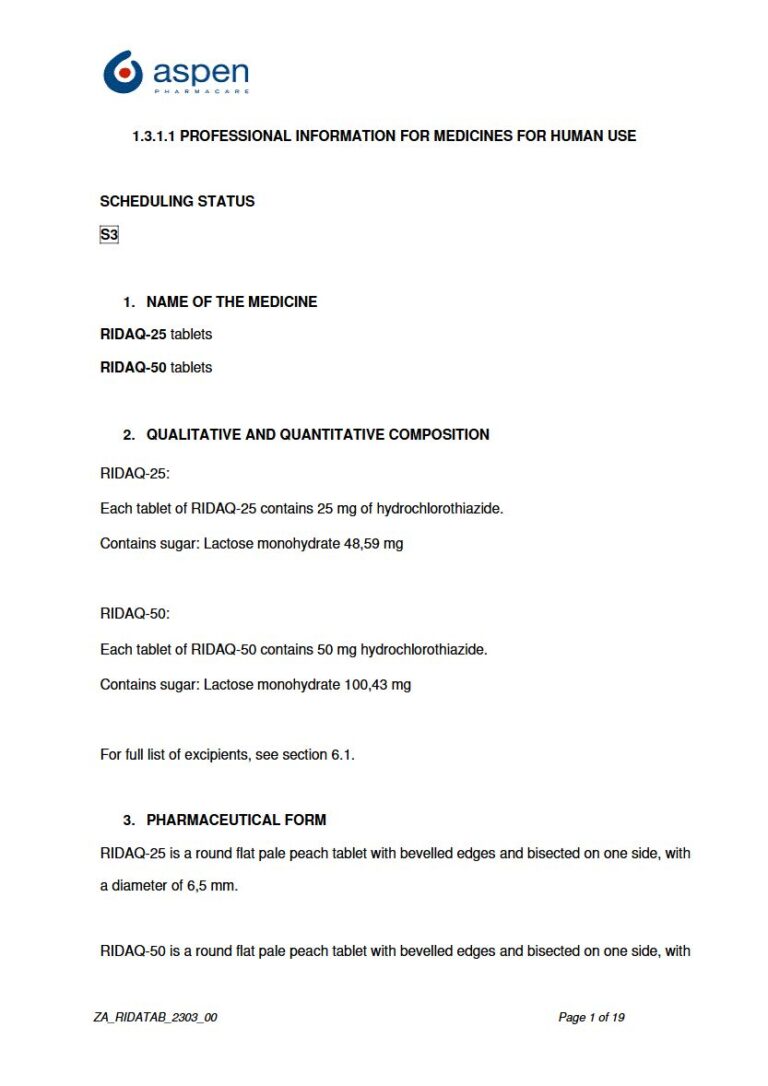
Ridaq 25 mg/50 mg Tablets
PDF Leaflet Revision Date: 04 March 2023
Clinical Summary
Quick overview from the medicine insert
Indication
Oedema and essential hypertension.
Dosage (summary)
Adults: 25-100 mg daily; may start with 200 mg for some cases.
Onset of Action / Duration
Onset: 2 hours, Duration: 12 hours
Special Populations
- Elderly
- Renal impairment
- Hepatic impairment
Pregnancy & Breastfeeding
Not recommended in pregnancy (especially 2nd/3rd trimester) or lactation.
Key Drug Interactions
- Antidiabetic medicines
- Digitalis glycosides
- Lithium
- NSAIDs
Contraindications
- Hypersensitivity to hydrochlorothiazide
- Anuria
- Severe renal impairment
- Severe hepatic impairment
- Addisonu2019s disease
- Hypercalcaemia
Common side effects
- Hypokalaemia
- Hyponatraemia
- Dizziness
- Nausea
- Photosensitivity
Counselling Points
- Monitor for electrolyte imbalances
- Avoid sun exposure
- Report any skin changes
Serious warnings
- Risk of non-melanoma skin cancer
- Electrolyte imbalance
- Acute angle-closure glaucoma
Important Disclaimer
The Ridaq 25 mg/50 mg Tablets professional information leaflet below is the property of Pharmacare Ltd and is provided on Medinsert exactly as issued, with no.. alterations or editorial changes. We make every effort to keep content current by updating documents as soon as new versions become available. Medinsert serves as a trusted access point for healthcare professionals, but does not replace official sources or clinical judgement. For more details, please read our full disclaimer. read more>>
 Healthcare Professionals Only
This content is for registered healthcare professionals
Sign in or create a free account to read the full package insert.
Free for HPCSA-registered professionals. Powered by Medinsert.
Clinical Particulars
Section 4 of the official insert — extracted exactly as issued, no alterations
4.1. Therapeutic indications
RIDAQ is indicated for:
- Oedema due to sodium and water retention. Paradoxically, RIDAQ appears to have an antidiuretic effect on patients with diabetes insipidus and may be of value in the management of the disease.
- Essential hypertension: preferably in combination with reduced doses of specific anti-hypertensive medicines.
4.2. Posology and method of administration
Posology
Adults
For the treatment of oedema: An initial dose of 25 mg to 100 mg is usually given, and later reduced to a smaller maintenance dose, often given on alternative days. An initial dose of up to 200 mg may be necessary in some patients, but larger doses have no additional effect.
Adults - as an adjunct in the treatment of hypertension: 25 mg to 100 mg daily in conjunction with a reduced dose of the hypotensive medicine. The dosage should not be higher than necessary to achieve the desired effect. Prolonged treatment may result in potassium ion loss. Potassium supplements may be necessary.
Paediatric population
2.5 mg per kg body mass daily in two divided doses.
Method of administration
For oral administration.
4.3. Contraindications
RIDAQ is contraindicated in:
- Patients with hypersensitivity to hydrochlorothiazide, other sulphonamide-derived medicines or to any of the excipients in RIDAQ (see section 6.1).
- Patients with anuria or severe renal (creatinine clearance < 30 mL/min) impairment.
- Patients with severe hepatic impairment.
- Patients with Addisonu2019s disease.
- Patients with pre-existing hypercalcaemia.
- Patients with a history of previous and/or current basal cell carcinomas and/or squamous cell carcinomas of the skin and lip.
- The second and third trimesters of pregnancy and during lactation (see section 4.6).
4.4. Special warnings and precautions for use
Hypersensitivity reactions
Sensitivity reactions may occur in patients with or without a history of allergy or bronchial asthma.
Hepatobiliary disorders
RIDAQ should be used with caution in patients with impaired hepatic function or progressive liver disease since minor alterations of fluid and electrolyte balance may precipitate hepatic coma and may increase the risk of hepatic encephalopathy. Patients with hepatic cirrhosis are particularly at risk from hypokalaemia.
Renal and urinary disorders
RIDAQ should be given with caution in renal function impairment since they can further reduce renal function (see section 4.3). In patients with renal disease, RIDAQ may precipitate azotaemia and oliguria. Cumulative effects of the medicine may develop in patients with impaired renal function. RIDAQ is ineffective at creatinine clearance values of 30 mL/min or below (i.e. moderate or severe renal insufficiency). If progressive renal impairment becomes evident, as indicated by rising non-protein nitrogen, careful reappraisal of therapy is necessary, with consideration given to discontinuing diuretic therapy.
Hyperuricaemia
Hyperuricaemia may occur, or RIDAQ may precipitate attacks of acute gout in susceptible patients.
Diabetes mellitus
RIDAQ may cause hyperglycaemia and aggravate or unmask diabetes mellitus. Glucose tolerance is impaired by RIDAQ. Blood glucose concentrations should be monitored in patients taking antidiabetic medicines, including insulin and oral hypoglycaemic medicines, since requirements may change.
Electrolyte imbalance
All patients should be carefully observed for signs of fluid and electrolyte imbalance e.g. hyponatraemia, hyperchloraemic alkalosis, hypokalaemia and hypomagnesaemia. Serum and urine electrolyte determinations are particularly important, especially in the presence of vomiting or during parenteral fluid therapy. Warning signs or symptoms of fluid and electrolyte imbalance, irrespective of cause, include dryness of mouth, thirst, weakness, lethargy, drowsiness, restlessness, confusion, seizures, muscle pains or cramps, muscular fatigue, hypotension, oliguria, tachycardia, and gastrointestinal disturbances such as nausea and vomiting. Elderly patients are particularly susceptible to electrolyte imbalance.
Hypercalcaemia
RIDAQ can reduce urinary excretion of calcium, sometimes resulting in mild hypercalcaemia. RIDAQ may cause intermittent and slight elevation of serum calcium in the absence of known disorders of calcium metabolism. Marked hypercalcaemia may be evidence of hidden hyperparathyroidism. RIDAQ should be discontinued before carrying out tests for parathyroid function.
Hypokalaemia
Hypokalaemia may develop, especially with brisk diuresis when severe cirrhosis is present, in patients receiving concomitant therapy with corticosteroids or adrenocorticotropic hormone (ACTH) also known as corticotropin, or after prolonged therapy. Interference with adequate oral electrolyte intake will also contribute to hypokalaemia. Hypokalaemia may cause cardiac dysrhythmia and may also sensitise or exaggerate the response of the heart to the toxic effects of digitalis (e.g., increased ventricular irritability). Hypokalaemia may be avoided or treated by use of potassium sparing diuretics or potassium supplements such as foods with a high potassium content.
Chloride deficit
Although any chloride deficit is generally mild and usually does not require specific treatment except under extraordinary circumstances (as in liver disease or renal disease), chloride replacement may be required in the treatment of metabolic alkalosis.
Hyponatraemia
Dilutional hyponatraemia may occur in oedematous patients in hot weather; appropriate therapy is water restriction, rather than administration of salt, except in rare instances when the hyponatremia is life threatening. In actual salt depletion, appropriate replacement is the therapy of choice.
Hypomagnesaemia
Thiazides, including RIDAQ, have been shown to increase the urinary excretion of magnesium; this may result in hypomagnesaemia.
Cholesterol and triglyceride levels
Increases in cholesterol and triglyceride levels may be associated with RIDAQ therapy.
Systemic lupus erythematosus (SLE)
There is a possibility that RIDAQ may exacerbate or activate systemic lupus erythematosus in susceptible patients.
Antihypertensive medicines
RIDAQ may add to or potentiate the action of other antihypertensive medicines (see section 4.5).
Lithium
Lithium should generally not be given with diuretics (see section 4.5).
Non-melanoma skin cancer
An increased risk of non-melanoma skin cancer (NMSC) (basal cell carcinoma (BCC) and squamous cell carcinoma (SCC)) with increasing cumulative dose of hydrochlorothiazide (HCTZ), as in RIDAQ, exposure has been observed in two epidemiological studies. Photosensitising actions of RIDAQ could act as a possible mechanism for NMSC. Patients taking RIDAQ should be informed of the risk of NMSC and advised to regularly check their skin for any new lesions and promptly report any suspicious skin lesions. Possible preventive measures such as limited exposure to sunlight and UV rays and, in case of exposure, adequate protection should be advised to the patients to minimise the risk of skin cancer. Suspicious skin lesions should be promptly examined potentially including histological examinations of biopsies. RIDAQ should not be used by patients who have had previous and/or current basal cell carcinomas and/or squamous cell carcinomas of the skin and/or lip (see section 4.3).
Eye disorders
Choroidal effusion, acute myopia and secondary angle-closure glaucoma: Sulfonamide or sulfonamide derivative medicines can cause an idiosyncratic reaction resulting in choroidal effusion with visual field defect, transient myopia and acute angle-closure glaucoma. Symptoms include acute onset of decreased visual acuity or ocular pain and typically occur within hours to weeks of medicine initiation. Untreated acute angle-closure glaucoma can lead to permanent vision loss. The primary treatment is to discontinue medicine intake as rapidly as possible. Prompt medical or surgical treatments may need to be considered if the intraocular pressure remains uncontrolled.
Post-sympathectomy
The antihypertensive effects of RIDAQ may be enhanced in the post-sympathectomy patient.
Anti-doping test
RIDAQ could produce a positive analytical result in an anti-doping test.
Excipients
RIDAQ contains lactose monohydrate thus patients with rare hereditary problems of galactose intolerance, total lactase deficiency or glucose galactose malabsorption should not take this RIDAQ.
4.5. Interaction with other medicines and other forms of interaction
Calcium salts: Increased serum calcium levels due to decreased excretion may occur when administered concurrently with thiazide diuretics such as RIDAQ.
Antidiabetic medicines (insulin and oral antidiabetics): Dosage adjustment of the antidiabetic medicines may be necessary.
Digitalis glycosides: RIDAQ may enhance the toxicity of digitalis glycosides by depleting serum-potassium concentrations.
Non-depolarising skeletal muscle relaxants: RIDAQ may enhance the neuromuscular blocking action of competitive muscle relaxants, such as tubocurarine.
Antihypertensive medicines, alcohol, barbiturates and opioids: RIDAQ may enhance the effect of other antihypertensive medicines, while postural hypotension associated with this therapy may be enhanced by concomitant ingestion of alcohol, barbiturates, or opioids. Diuretic therapy with RIDAQ should be discontinued for 2 to 3 days prior to initiation of therapy with an ACE-inhibitor, to reduce the likelihood of first dose hypotension.
Corticosteroids, amphotericin B (parenteral), ACTH (corticotropin), beta 2-agonists or carbenoxolone, stimulant laxatives: The potassium-depleting effect of RIDAQ may be enhanced by corticosteroids, amphotericin B, ACTH or corticotropin, carbenoxolone or stimulant laxatives, beta 2-agonists such as salbutamol.
Pressor amines: RIDAQ has been reported to diminish the response to pressor amines, such as noradrenaline and adrenalin, but the clinical significance of this effect is uncertain.
Lithium: Concomitant administration of RIDAQ and lithium is not generally recommended since RIDAQ may reduce the renal clearance of lithium and may lead to toxic blood concentrations of lithium (see section 4.4).
Non-steroidal anti-inflammatory drugs (NSAIDs): In some patients, the administration of NSAIDs can reduce the diuretic, natriuretic and antihypertensive effects of loop, potassium-sparing and thiazide diuretics, such as RIDAQ. Therefore, when RIDAQ and NSAIDs are used concomitantly, the patient should be observed closely to determine if the desired effect of the diuretic is obtained.
Medicines associated with Torsades de pointes: Because of the risk of hypokalaemia, caution should be used when RIDAQ is co-administered with medicines associated with torsades de pointes, e.g. anti-dysrhythmics, antipsychotics and other medicines known to induce torsades de pointes.
Colestyramine resin and colestipol: These medicines may delay or decrease absorption of hydrochlorothiazide, as in RIDAQ, by up to 84 % and 43 % respectively. Sulphonamide diuretics should be taken at least one hour before or four to six hours after these medicines.
Carbamazepine: Concomitant use of carbamazepine and hydrochlorothiazide, as in RIDAQ, has been associated with the risk of symptomatic hyponatraemia. Electrolytes should be monitored during concomitant use. If possible, another class of diuretics should be used.
Laboratory tests: RIDAQ should be discontinued before carrying out tests for parathyroid function (see section 4.4). RIDAQ may cause diagnostic interference of the bentiromide test. RIDAQ may decrease serum Protein Bound Iodine (PBI) levels without signs of thyroid disturbance. Periodic determination of serum electrolytes to detect possible electrolyte imbalance should be done at appropriate intervals.
4.6. Fertility, pregnancy and lactation
The safety of RIDAQ in pregnancy and lactation has not been established (see section 4.3).
Pregnancy
There is limited experience with RIDAQ during pregnancy, especially during the first trimester. RIDAQ crosses the placenta barrier and appears in cord blood. There have been reports of neonatal jaundice, icterus, thrombocytopenia and electrolyte imbalances following maternal treatment. Reductions in maternal blood volume could also adversely affect placental perfusion. RIDAQ should not be used for gestational oedema, gestational hypertension or pre-eclampsia due to the risk of decreased plasma volume and placental hypoperfusion, without a beneficial effect on the course of the disease. RIDAQ should not be used for essential hypertension in pregnant women.
Lactation
RIDAQ is distributed into breastmilk and is not recommended for use in lactation. RIDAQ in high doses causing intense diuresis can inhibit the milk production.
Fertility
No data are available.
4.7. Effects on ability to drive and use machines
RIDAQ has moderate influence on the ability to drive and use machines. Since adverse reactions such as dizziness, drowsiness and visual disturbance have been reported in patients receiving RIDAQ, patients should not drive, use machinery or perform any tasks that require concentration, until they are certain that RIDAQ does not adversely affect their ability to do so (see section 4.4 and/or 4.8).
4.8. Undesirable effects
a) Tabulated list of adverse reactions
System organ class Frequency unknown (cannot be estimated from the available data)
- Infections and infestations: Sialadenitis
- Neoplasm benign, malignant and unspecified (including cysts and polyps): Non-melanoma skin cancer (basal cell carcinoma and squamous cell carcinoma)
- Blood and the lymphatic system disorders: Blood dyscrasias, thrombocytopenia, granulocytopenia, leukopenia, aplastic anaemia, haemolytic anaemia, agranulocytosis, neutropenia, bone marrow depression
- Immune system disorders: Anaphylactic reactions, purpura, hypersensitivity reactions
- Metabolism and nutrition disorders: Electrolyte imbalances, hypochloraemic alkalosis, hyponatraemia, hypokalaemia, hyperglycaemia, hyperuricaemia, gout, hypomagnesaemia, anorexia
- Psychiatric disorders: Restlessness, depression, sleep disturbances
- Nervous system disorders: Lethargy, drowsiness, seizures, headache, dizziness, paraesthesia, light-headedness
- Eye disorders: Yellow vision (xanthopsia), transient blurred vision, acute myopia and secondary acute angle-closure glaucoma, choroidal effusion
- Ear and labyrinth disorders: Vertigo
- Cardiac disorders: Cardiac dysrhythmias
- Vascular disorders: Postural hypotension, necrotising angiitis (vasculitis, cutaneous vasculitis)
- Respiratory, thoracic and mediastinal disorders: Pulmonary oedema, pneumonitis, respiratory distress
- Gastrointestinal disorders: Gastrointestinal disturbances, dry mouth, gastric irritation, nausea, vomiting, constipation, diarrhoea, intestinal ulceration, pancreatitis, cramping
- Hepato-biliary disorders: Intrahepatic cholestatic jaundice
- Skin and subcutaneous tissue disorders: Photosensitivity reactions, skin rashes, erythema multiforme including Stevens-Johnson Syndrome (SJS), exfoliative dermatitis including toxic epidermal necrolysis (TEN), alopecia, cutaneous lupus erythematosus-like reactions, reactivation of cutaneous lupus erythematosus, urticaria
- Musculoskeletal and connective tissue disorders: Muscle pain and cramps, muscle spasm
- Renal and urinary disorders: Oliguria, glycosuria, urinary excretion of calcium is reduced, renal failure, renal dysfunction, interstitial nephritis
- Reproductive system and breast disorders: Impotence
- General disorders and administrative site conditions: Thirst, weakness, fever
b) Description of selected adverse reactions
Eye disorders: Cases of choroidal effusion with visual field defect have been reported after the use of thiazide and thiazide-like diuretics.
Metabolism and nutrition disorders: Electrolyte imbalances, hypochloraemic alkalosis, hyponatraemia (may occur in patients with severe heart failure who are very oedematous, particularly with large doses in conjunction with restricted salt in the diet), and hypokalaemia (intensifies the effect of digitalis on cardiac muscle and administration of digitalis or its glycosides may have to be temporarily suspended and patients with cirrhosis of the liver are particularly at risk), metabolic disturbances especially at high doses, hyperglycaemia in diabetic and other susceptible patients, hyperuricaemia and precipitate attacks of gout in some patients, hypomagnesaemia, anorexia.
Vascular disorders: Postural hypotension (aggravated by barbiturates, alcohol, narcotics or antihypertensive medicines), necrotising angiitis (vasculitis, cutaneous vasculitis).
Reporting of suspected adverse reactions: Reporting suspected adverse reactions after authorisation of the medicine is important. It allows continued monitoring of the benefit/risk balance of the medicine. Healthcare providers are asked to report any suspected adverse reactions to: SAHPRA: https://www.sahpra.org.za/Publications/Index/8 . Aspen Pharmacare: E-mail: [email protected] Tel: 0800 118 088/ +27(0)11 239-6200
4.9. Overdose
Symptoms
RIDAQ can produce acute renal failure either from overdosage, producing saline depletion and hypovolaemia or, occasionally, as a result of a hypersensitivity reaction. The most frequent signs and symptoms observed are those caused by electrolyte depletion (hypokalaemia, hypochloraemia, hyponatraemia) and dehydration resulting from excessive diuresis. If digitalis has also been administered, hypokalaemia may accentuate cardiac dysrhythmias.
Treatment
In massive overdosage, treatment should be symptomatic, supportive and directed at fluid and electrolyte replacement. In cases of recent ingestion emesis or gastric lavage should be carried out. Dehydration, electrolyte imbalance, hepatic coma and hypotension should be corrected by established procedures. If required, give oxygen or artificial respiration for respiratory impairment. The degree to which RIDAQ is removed by haemodialysis has not been established.
