
Arimidex 1mg FC Tablets
PDF Leaflet Revision Date: 15 December 2021
Clinical Summary
Quick overview from the medicine insert
Indication
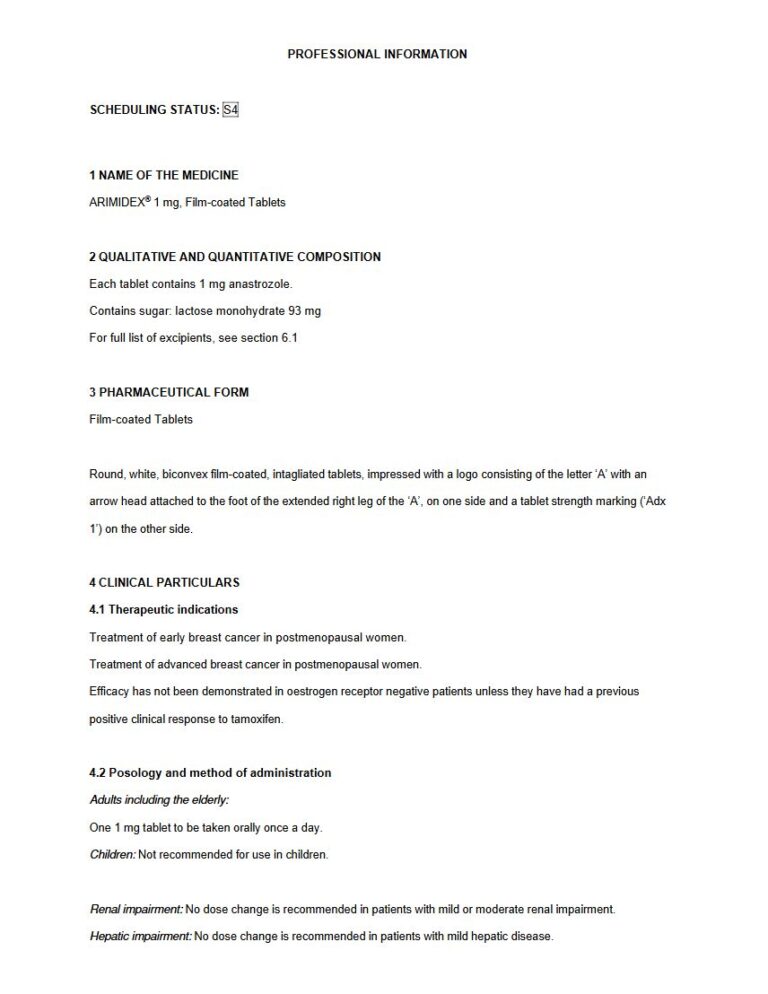
Treatment of early and advanced breast cancer in postmenopausal women.
Dosage (summary)
1 mg orally once daily for adults, no dose change for mild/moderate renal or hepatic impairment.
Special Populations
- Renal impairment
- Hepatic impairment
Pregnancy & Breastfeeding
Contraindicated in pregnancy and lactation.
Key Drug Interactions
- Tamoxifen
- Oestrogen-containing therapies
Contraindications
- Hypersensitivity
- Pre-menopausal women
- Severe renal impairment
- Moderate/severe hepatic disease
Common side effects
- Headache
- Hot flushes
- Nausea
- Rash
- Arthralgia
- Asthenia
Counselling Points
- Take daily at the same time
- Report any unusual bleeding
- Caution when driving if experiencing somnolence
Serious warnings
- May reduce bone mineral density
- Not recommended for pre-menopausal women
Important Disclaimer
The Arimidex 1mg FC Tablets professional information leaflet below is the property of Astrazeneca Pharmaceuticals and is provided on Medinsert exactly as issued, with no.. alterations or editorial changes. We make every effort to keep content current by updating documents as soon as new versions become available. Medinsert serves as a trusted access point for healthcare professionals, but does not replace official sources or clinical judgement. For more details, please read our full disclaimer. read more>>
 Healthcare Professionals Only
This content is for registered healthcare professionals
Sign in or create a free account to read the full package insert.
Free for HPCSA-registered professionals. Powered by Medinsert.
Clinical Particulars
Section 4 of the official insert — extracted exactly as issued, no alterations
4.1 Therapeutic indications
Treatment of early breast cancer in postmenopausal women. Treatment of advanced breast cancer in postmenopausal women. Efficacy has not been demonstrated in oestrogen receptor negative patients unless they have had a previous positive clinical response to tamoxifen.
4.2 Posology and method of administration
Adults including the elderly: One 1 mg tablet to be taken orally once a day.
Children: Not recommended for use in children.
Renal impairment: No dose change is recommended in patients with mild or moderate renal impairment.
Hepatic impairment: No dose change is recommended in patients with mild hepatic disease.
4.3 Contraindications
ARIMIDEX is contraindicated in:
- patients with hypersensitivity to the active substance or to any of the excipients of ARIMIDEX (see section 6.1)
- pre-menopausal women
- pregnancy and lactation (see section 4.6)
- patients with severe renal impairment (creatinine clearance less than 20 ml/min)
- patients with moderate or severe hepatic disease
4.4 Special warnings and precautions for use
As ARIMIDEX lowers circulating oestrogen levels it may cause a reduction in bone mineral density with a consequent increased risk of fracture. This increased risk should be managed according to treatment guidelines for managing bone health in postmenopausal women. ARIMIDEX is not recommended for use in pre-menopausal women as safety and efficacy have not been established in this group of patients. ARIMIDEX is not recommended for use in children as safety and efficacy have not been established in this group of patients. The menopause should be defined biochemically in any patient where there is doubt about hormonal status. There are no data to support the safe use of ARIMIDEX in patients with moderate or severe hepatic impairment or patients with severe impairment of renal function (creatinine clearance < 20 ml/min) (see section 4.3).
Lactose: ARIMIDEX contains lactose. Patients with the rare hereditary conditions of galactose intolerance e.g. galactosaemia, Lapp lactase deficiency, glucose-galactose malabsorption or fructose intolerance should not take ARIMIDEX.
4.5 Interaction with other medicines and other forms of interaction
Antipyrine and cimetidine clinical interaction studies indicate that the co-administration of ARIMIDEX with other medicines is unlikely to result in clinically significant interactions mediated by cytochrome P450. A review of the clinical trial safety database did not reveal evidence of clinically significant interaction in patients treated with ARIMIDEX who also received other commonly prescribed medicines. There were no clinically significant interactions with bisphosphonates.
There is no clinical information to date on the use of ARIMIDEX in combination with other anti-cancer agents. Tamoxifen and/or oestrogen-containing therapies should not be co-administered with ARIMIDEX, as they would diminish its pharmacological action.
4.6 Fertility, pregnancy and lactation
ARIMIDEX is contraindicated in pregnancy and lactation (see section 4.3).
4.7 Effects on ability to drive and use machines
Asthenia and somnolence have been reported with the use of ARIMIDEX and caution should be observed when driving or operating machinery while such symptoms persist.
4.8 Undesirable effects
a. Summary of the safety profile
The most frequently reported adverse reactions were headache, hot flushes, nausea, rash, arthralgia, joint stiffness, arthritis, and asthenia.
b. Tabulated summary of adverse reactions
The following side effects have been reported from clinical trials, post-marketing studies or spontaneous reports. Frequency groupings are defined according to the following convention: very common (u2265 1/10); common (u2265 1/100 to < 1/10); uncommon (u2265 1/1 000 to < 1/100); rare (u2265 1/10 000 to < 1/1 000); very rare (< 1/10 000).
System Organ Class Frequency Adverse reactions Metabolism and nutrition disorders Common Anorexia; hypercholesterolaemia Uncommon Hypercalcaemia (with or without an increase in parathyroid hormone)* Psychiatric disorders Very Common Depression Nervous system disorders Very Common Headache Common Carpal tunnel syndrome; somnolence; sensory disturbances (including paraesthesia, taste loss and taste perversion) Vascular disorders Very Common Hot flushes Post-marketing experience: No additional side effects are reported other than those already included in clinical trials, see * in Table above. Gastro-intestinal disorders Very Common Nausea Common Diarrhoea; vomiting Hepato-biliary disorders Common Increase in alkaline phosphatase*, alanine aminotransferase* and aspartate aminotransferase* Uncommon Increase in gamma-GT and bilirubin*; hepatitis* Skin and subcutaneous tissue disorders Very Common Rash* Common Hair thinning (alopecia); allergic reactions* Uncommon Urticaria* Rare Erythema multiformae*; anaphylactoid reaction*, cutaneous vasculitis (including some reports of Henoch-Schu00f6nlein purpura) Very Rare Stevens-Johnson syndrome*; angioedema* Musculoskeletal and connective tissue disorders Very Common Arthralgia/Joint stiffness, arthritis, osteoporosis Common Bone pain; myalgia* Uncommon Trigger finger* Reproductive system and breast disorders Common Vaginal dryness; vaginal bleeding 1 General disorders and administration site conditions Very Common Asthenia 1 Vaginal bleeding has been reported commonly, mainly in patients with advanced breast cancer during the first few weeks after changing from existing hormonal therapy to treatment with ARIMIDEX. If bleeding persists, further evaluation should be considered. *Also reported in post-marketing studies or spontaneous reports
c. Description of selected adverse reactions
In a large phase III study conducted in 9 366 postmenopausal women with operable breast cancer treated for 5 years, ischaemic cardiovascular events were reported more frequently in patients treated with ARIMIDEX compared to those treated with tamoxifen, although the difference was not statistically significant. The observed difference was mainly due to more reports of angina pectoris and was associated with a sub-group of patients with pre-existing ischaemic heart disease. Thromboembolism, fluid retention and dizziness have also been observed in clinical trials with ARIMIDEX.
Reporting of suspected adverse reactions
Reporting suspected adverse reactions after authorisation of the medicine is important. It allows continued monitoring of the benefit/risk balance of the medicine. Health care providers are asked to report any suspected adverse reactions to SAHPRA via the u201c6.04 Adverse Drug Reaction Reporting Formu201d, found online under SAHPRAu2019s publications: https://www.sahpra.org.za/Publications/Index/8
4.9 Overdose
There is limited clinical experience of overdose of ARIMIDEX. There are no reports where a patient has taken a dose exceeding 60 mg. No toxicity was observed and no clinically relevant adverse effects have been seen. Acute toxicity was seen in animals at a dose greater than 45 mg /kg (equivalent to 2,7 g). Clinical trials have been conducted with various dosages of ARIMIDEX, up to 60 mg in a single dose given to healthy male volunteers and up to 10 mg daily given to postmenopausal women with advanced breast cancer; these dosages were well tolerated. A single dose of ARIMIDEX that results in life threatening symptoms has not been established. Refer to section 4.8 in the case of an overdose. There is no specific antidote to overdosage and treatment must be symptomatic. In the management of an overdose, consideration should be given to the possibility that multiple agents may have been taken. Vomiting may be induced if the patient is alert. Dialysis may be helpful because ARIMIDEX is not highly protein bound. General supportive care, including frequent monitoring of vital signs and close observation of the patient, is indicated.
