
Rebutrix 150 mg. 500 mg FILM COATED TABLETS
PDF Leaflet Revision Date: 29 July 2025
Clinical Summary
Quick overview from the medicine insert
Indication
Treatment of advanced breast, colorectal, and gastric cancers.
Dosage (summary)
1,250 mg/mu00b2 twice daily for 14 days, followed by a 7-day rest period.
Special Populations
- Elderly
- Hepatic impairment
- Renal impairment
Pregnancy & Breastfeeding
Contraindicated in pregnancy; avoid breastfeeding during treatment and for 2 weeks after.
Key Drug Interactions
- Warfarin
- Phenytoin
- Leucovorin
- Sorivudine
Contraindications
- Hypersensitivity to capecitabine
- Severe renal impairment
- Severe hepatic impairment
- Dihydropyrimidine dehydrogenase deficiency
Common side effects
- Diarrhoea
- Nausea
- Fatigue
- Hand-foot syndrome
Counselling Points
- Take with water within 30 mins after meals.
- Report any severe diarrhoea or toxicity.
- Use effective contraception during treatment.
Serious warnings
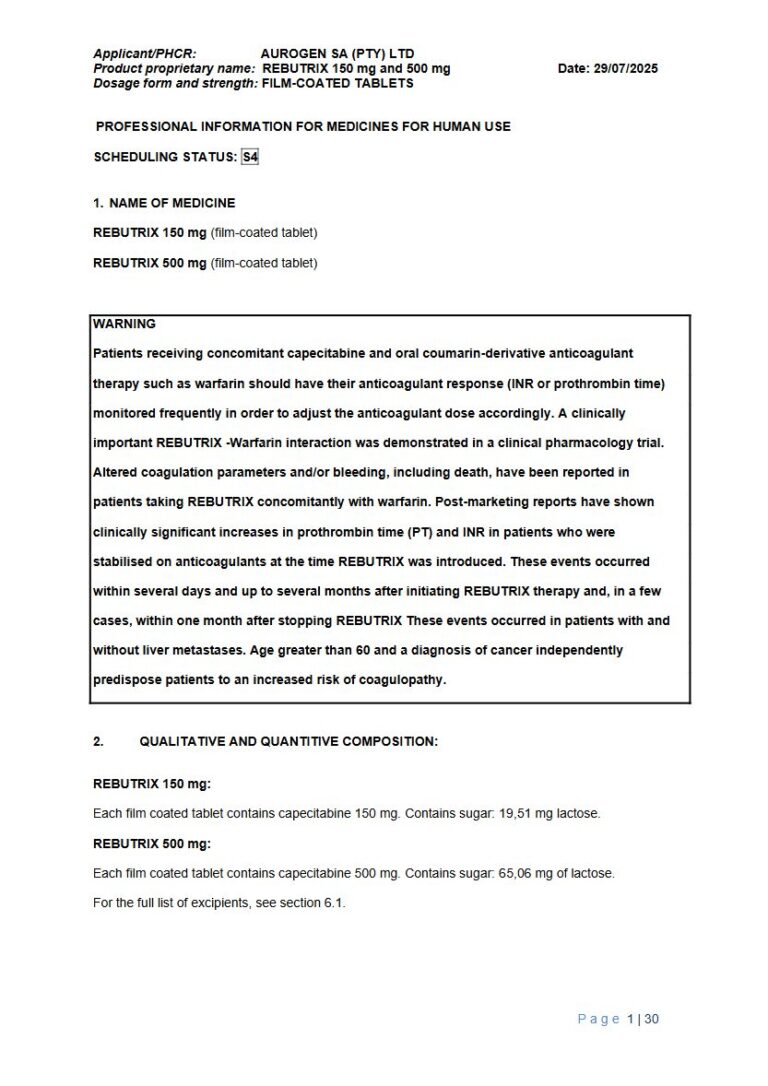
- Monitor INR with anticoagulants
- Risk of severe mucocutaneous reactions
- Cardiotoxicity
Important Disclaimer
The Rebutrix 150 mg. 500 mg FILM COATED TABLETS professional information leaflet below is the property of Aurogen Sa and is provided on Medinsert exactly as issued, with no.. alterations or editorial changes. We make every effort to keep content current by updating documents as soon as new versions become available. Medinsert serves as a trusted access point for healthcare professionals, but does not replace official sources or clinical judgement. For more details, please read our full disclaimer. read more>>
 Healthcare Professionals Only
This content is for registered healthcare professionals
Sign in or create a free account to read the full package insert.
Free for HPCSA-registered professionals. Powered by Medinsert.
Clinical Particulars
Section 4 of the official insert — extracted exactly as issued, no alterations
4.1 Therapeutic indications
Breast Cancer
Metastatic breast cancer (Combination therapy): REBUTRIX in combination with docetaxel is indicated for the treatment of patients with locally advanced or metastatic breast cancer after failure of cytotoxic chemotherapy which should have included an anthracycline.
Metastatic breast cancer (Monotherapy): REBUTRIX is indicated as monotherapy for the treatment of patients with locally advanced or metastatic breast cancer after failure of taxanes and an anthracycline-containing chemotherapy regimen or for whom further anthracycline therapy is not indicated.
Colorectal cancer
Colon cancer: REBUTRIX is indicated as adjuvant treatment after surgery, of patients with Dukes C colon cancer.
Metastatic colorectal cancer: REBUTRIX is indicated as treatment of patients with metastatic colorectal adenocarcinoma. The benefit relates to time to progression, while overall survival was not influenced.
Gastric Cancer: REBUTRIX is indicated as first line treatment of patients with advanced gastric adenocarcinoma in combination with other anti-chemotherapeutic regimen. The benefit relates to time to progression, while overall survival was not influenced.
4.2 Posology and method of administration
REBUTRIX should only be prescribed by a qualified medical practitioner experienced in the utilization of antineoplastic medicines.
REBUTRIX tablets should be swallowed with water within 30 minutes after a meal. Treatment should be discontinued if progressive disease or intolerable toxicity is observed.
Adults
Monotherapy u2013 Colon, colorectal and breast cancer
The recommended monotherapy dose of REBUTRIX is 1 250 mg/m2 administered twice daily (morning and evening: equivalent to 2 500 mg/m2 total daily dose) for 14 days followed by a 7 day rest period.
Adjuvant treatment in patients with Stage III colon cancer is recommended for a maximum of six months.
Combination therapy
Colorectal and Gastric cancer: In combination treatment, the starting dose of REBUTRIX should be reduced to 1 000 mg/m2 when administered twice daily for 14 days followed by a 7-day rest period. For the REBUTRIX. Dose Reduction Schedule, please refer to Table 1. The inclusion of biological medicines in a combination regimen has no effect on the starting dose of REBUTRIX.
Premedication to maintain adequate hydration and anti-emesis according to the cisplatin prescribing information should be started prior to cisplatin administration for patients receiving the REBUTRIX plus cisplatin combination.
Breast Cancer: In combination with docetaxel for locally advanced or metastatic breast cancer, the recommended dose of REBUTRIX is 1 250 mg/m2 twice daily for 14 days followed by a 7 day rest period, combined with docetaxel at 75 mg/m2 as a 1 hour intravenous infusion every 3 weeks. Pre- medication with an oral corticosteroid such as dexamethasone according to the docetaxel prescribing information should be started prior to docetaxel administration for patients receiving the REBUTRIX plus docetaxel combination.
REBUTRIX dose is calculated according to body surface area.
4.3 Contraindications
REBUTRIX is contra-indicated in:
- patients with known hypersensitivity to capecitabine or to any of its components.
- patients who have a history of severe and unexpected reactions to fluoropyrimidine therapy, or with known hypersensitivity to fluorouracil (capecitabine metabolite).
- patients with known dihydropyrimidine dehydrogenase (DPD) deficiency.
- patients with severe leukopaenia, neutropenia, or thrombocytopenia.
- patients with severe hepatic impairment.
- in patients with severe renal impairment (creatinine clearance below 30 ml/min).
- pregnancy and breastfeeding (see section 4.6).
REBUTRIX should not be administered with sorivudine or its chemically related analogues, such as brivudine. (See section 4.5). If contra-indications exist for any of the medicines in the combination regimen, that medicine should not be used.
4.4 Special warnings and precautions for use
Coagulopathy
Patients receiving concomitant capecitabine and oral coumarin-derivative anticoagulant therapy should have their anticoagulant response (INR or prothrombin time) monitored closely with great frequency and the anticoagulant dose should be adjusted accordingly (See Boxed Warning and section 4.5).
Diarrhoea
Capecitabine can induce diarrhoea, sometimes severe. Patients with severe diarrhoea should be carefully monitored and given fluid and electrolyte replacement if they become dehydrated. In 875 patients with either metastatic breast or colorectal cancer who received capecitabine monotherapy, the median time to first occurrence of Grade 2 to 4 diarrhoea was 34 days (range from 1 to 369 days). The median duration of Grade 3 to 4 diarrhoea was 5 days. National Cancer Institute of Canada (NCIC) Grade 2 diarrhoea is defined as an increase of 4 to 6 stools/day or nocturnal stools, Grade 3 diarrhoea as an increase of 7 to 9 stools/day or incontinence and malabsorption, and Grade 4 diarrhoea as an increase of u226510 stools/day or grossly bloody diarrhoea or the need for parenteral support. If Grade 2, 3 or 4 diarrhoea occurs, administration of capecitabine should be immediately interrupted until the diarrhoea resolves or decreases in intensity to Grade 1 (see section 4.2). Standard antidiarrhoeal treatments (e.g. loperamide) are recommended. (See section 4.8)
Necrotising enterocolitis (typhlitis) has been reported.
Cardiotoxicity
The cardiotoxicity observed with capecitabine includes myocardial infarction/ischemia, angina, dysrhythmias, cardiac arrest, cardiac failure, sudden death, electrocardiographic changes, and cardiomyopathy. These adverse reactions may be more common in patients with a prior history of coronary artery disease.
Dihydropyrimidine Dehydrogenase Deficiency
Patients with certain homozygous or certain compound heterozygous mutations in the DPD gene that result in complete or near complete absence of DPD activity are at increased risk for acute early- onset of toxicity and severe, life-threatening, or fatal adverse reactions caused by capecitabine (e.g., mucositis, diarrhoea, neutropenia, and neurotoxicity). Patients with partial DPD activity (see section 4.3) may also have increased risk of severe, life-threatening, or fatal adverse reactions caused by capecitabine.
Withhold or permanently discontinue capecitabine based on clinical assessment of the onset, duration and severity of the observed toxicities in patients with evidence of acute early-onset or unusually severe toxicity, which may indicate near complete or total absence of DPD activity. No capecitabine dose has been proven safe for patients with complete absence of DPD activity. There is insufficient data to recommend a specific dose in patients with partial DPD activity as measured by any specific test.
Dehydration and Renal Failure
Dehydration has been observed and may cause acute renal failure which can be fatal. Patients with pre-existing compromised renal function or who are receiving concomitant capecitabine with known nephrotoxic medicines are at higher risk. Patients with anorexia, asthenia, nausea, vomiting or diarrhoea may rapidly become dehydrated. Monitor patients when capecitabine is administered to prevent and correct dehydration at the onset. If Grade 2 (or higher) dehydration occurs, capecitabine treatment should be immediately interrupted and the dehydration corrected. Treatment should not be restarted until the patient is rehydrated and any precipitating causes have been corrected or controlled. Dose modifications should be applied for the precipitating adverse event as necessary (see section 4.2).
Patients with moderate renal impairment at baseline require dose reduction (see section 4.2 and 5.2). Patients with mild and moderate renal impairment at baseline should be carefully monitored for adverse reactions. Prompt interruption of therapy with subsequent dose adjustments is recommended if a patient develops a Grade 2 to 4 adverse event as outlined in Table 2 (see section 4.2 and 5.2).
Mucocutaneous and Dermatologic Toxicity
Severe mucocutaneous reactions, some with fatal outcome, such as Stevens-Johnson syndrome and Toxic Epidermal Necrolysis (TEN) can occur in patients treated with capecitabine (see section 4.8). Capecitabine should be permanently discontinued in patients who experience a severe mucocutaneous reaction possibly attributable to capecitabine treatment.
Hand-and-foot syndrome (palmar-plantar erythrodysesthesia or chemotherapy-induced acral erythema) is a cutaneous toxicity. Median time to onset was 79 days (range from 11 to 360 days) with a severity range of Grades 1 to 3 for patients receiving capecitabine monotherapy in the metastatic setting. Grade 1 is characterized by any of the following: numbness, dysesthesia/paresthesia, tingling, painless swelling or erythema of the hands and/or feet and/or discomfort which does not disrupt normal activities. Grade 2 hand-and-foot syndrome is defined as painful erythema and swelling of the hands and/or feet and/or discomfort affecting the patientu2019s activities of daily living. Grade 3 hand -and- foot syndrome is defined as moist desquamation, ulceration, blistering or severe pain of the hands and/or feet and/or severe discomfort that causes the patient to be unable to work or perform activities of daily living. Persistent or severe hand-and-foot syndrome (Grade 2 and above) can eventually lead to loss of fingerprints which could impact patient identification. If Grade 2 or 3 hand-and-foot syndrome occurs, administration of capecitabine should be interrupted until the event resolves or decreases in intensity to Grade 1. Following Grade 3 hand-and-foot syndrome, subsequent doses of capecitabine should be decreased (see section 4.2).
Hyperbilirubinemia
If medicine-related Grade 3 to 4 elevations in bilirubin, or medicinerelated elevations in hepatic aminotransferases (ALT, AST) occur, administration of capecitabine should be immediately interrupted until the hyperbilirubinemia decreases to u22643 ,0 X ULN or hepatic aminotransferases decreases to u22642 ,5 x ULN. (See recommended dose modifications under section 4.2).
Haematologic
Patients with baseline neutrophil counts of <1,5 x 10⁹/L and/or thrombocyte counts of <100 x 109/L should not be treated with capecitabine. If unscheduled laboratory assessments during a treatment cycle show Grade 3 or 4 hematologic toxicity, treatment with capecitabine should be interrupted. (See section 4.2).
Elderly Patients
Patients u226580 years old may experience a greater incidence of Grade 3 or 4 adverse reactions.
Hepatic Insufficiency
Patients with mild to moderate hepatic dysfunction due to liver metastases should be carefully monitored when capecitabine is administered. The effect of severe hepatic dysfunction on the disposition of capecitabine is not known (see section 4.3 and 5.2).
Paediatric Use
The safety and effectiveness of REBUTRIX in paediatric patients has not been established.
Lactose: As this medicinal product contains anhydrous lactose as an excipient, patients with rare hereditary problems of galactose intolerance, Lapp lactase deficiency or glucose-galactose malabsorption should not take this medicine.
4.5 Interaction with other medicines and other forms of interaction
Anticoagulants
Altered coagulation parameters and/or bleeding have been reported in patients taking REBUTRIX concomitantly with coumarin-derivative anticoagulants such as warfarin and phenprocoumon (see Boxed Warning). In a medicine interaction study with single-dose warfarin administration, there was a significant increase in the mean AUC of S-warfarin (see section 5.2). The maximum observed INR value increased by 91%. This interaction is probably due to an inhibition of cytochrome P450 2C9 by capecitabine and/or its metabolites.
Sorivudine and analogues
A clinically significant interaction between sorivudine and 5-FU, resulting from the inhibition of dihydropyrimidine dehydrogenase by sorivudine, has been described in the literature. This interaction, which leads to increased fluoropyrimide toxicity is potentially fatal. Therefore, REBUTRIX should not be administered with sirovudine or its chemically related analogues such as brivudine. (See section 4.3).
Phenytoin
The level of phenytoin should be carefully monitored in patients taking REBUTRIX and phenytoin dose may need to be reduced. Postmarketing reports indicate that some patients receiving REBUTRIX and phenytoin had toxicity associated with elevated phenytoin levels. Formal medicine interaction studies with phenytoin have not been conducted, but the mechanism of interaction is presumed to be inhibition of the CYP2C9 isoenzyme by REBUTRIX and/or its metabolites.
Leucovorin
The concentration of 5-fluorouracil is increased and its toxicity may be enhanced by leucovorin. Deaths from severe enterocolitis, diarrhoea, and dehydration have been reported in elderly patients receiving weekly leucovorin and fluorouracil.
CYP2C9 substrates
Other than warfarin, no formal medicine interaction studies between REBUTRIX and other CYP2C9 substrates have been conducted. Care should be exercised when REBUTRIX is co-administered with CYP2C9 substrates.
Allopurinol
Concomitant use with allopurinol may decrease concentration of REBUTRIX active metabolites (see section 5.2), which may decrease REBUTRIX efficacy. Avoid the use of allopurinol during treatment with REBUTRIX.
Interferon Alpha
The maximum tolerated dose (MTD) of capecitabine alone using the intermittent regimen is 3000 mg/m2 per day whereas it is only 2000 mg/m2 per day when REBUTRIX was combined with interferon alpha-2a (3MIU//m2 per day) compared to 3000 mg/m2 when REBUTRIX was used alone.
Antacids
The effect of an aluminium hydroxide and magnesium hydroxide-containing antacid on the pharmacokinetics of capecitabine was investigated. There was a small increase in plasma concentrations of capecitabine and one metabolite (5'-DFCR); there was no effect on the 3 major metabolites (5'-DFUR, 5-FU and FBAL).
Radiotherapy
The MTD of capecitabine alone using the intermittent regimen is 3000 mg/m2 per day, whereas, when combined with radiotherapy for rectal cancer, the MTD of capecitabine is 2000 mg/m2 per day using either a continuous schedule or given daily Monday through Friday during a 6-week course of radiotherapy.
Oxaliplatin
No clinically significant differences in exposure to capecitabine or its metabolites, free platinum or total platinum occurred when capecitabine was administered in combination with oxaliplatin or in combination with oxaliplatin and bevacizumab.
Bevacizumab
There was no clinically significant effect of bevacizumab on the pharmacokinetic parameters of capecitabine or its metabolites in the presence of oxaliplatin.
Food Interaction
Food was shown to reduce both the rate and extent of absorption of REBUTRIX (see section 5.2). In all clinical trials, patients were instructed to administer REBUTRIX within 30 minutes after a meal. It is recommended that REBUTRIX be administered with food (see section 4.2).
4.6 Fertility, pregnancy and lactation
Pregnancy
REBUTRIX is contraindicated during pregnancy (see section 4.3). Based on findings in animal reproduction studies and its mechanism of action, REBUTRIX can cause foetal harm when administered to a pregnant woman (see section 5.2). Limited available human data are not sufficient to inform the medicine-associated risk during pregnancy. In animal reproduction studies, administration of REBUTRIX to pregnant animals during the period of organogenesis caused embryo lethality and teratogenicity in mice and embryo lethality in monkeys at 0.2 and 0.6 times the exposure (AUC) in patients receiving the recommended dose respectively (see section 5.3). Apprise pregnant women of the potential risk to a foetus.
Lactation
There is no information regarding the presence of REBUTRIX in human milk, or on its effects on milk production or the breast-fed infant. Capecitabine metabolites were present in the milk of lactating mice [see Data]. Because of the potential for serious adverse reactions from capecitabine exposure in breast-fed infants, advise women not to breastfeed during treatment with REBUTRIX and for 2 weeks after the final dose. (See section 4.3).
Fertility
Pregnancy Testing
Pregnancy testing is recommended for females of reproductive potential prior to initiating REBUTRIX.
Contraception
Females REBUTRIX can cause fetal harm when administered to a pregnant woman. Advise females of reproductive potential to use effective contraception during treatment and for 6 months following the final dose of REBUTRIX. The recommended duration of contraception in female patients should be until the end of relevant systemic exposure to the genotoxic compound including potential genotoxic metabolites (i.e. five half-lives after the last dose) plus 6 months. The duration of folliculogenesis is described as 6 to 12 months. The 6-month contraception recommendation for genotoxic pharmaceuticals after cessation of therapy covers the growth and maturation phase of folliculogenesis and is expected to allow elimination of most damaged follicles and oocytes.
Males Based on genetic toxicity findings, advise male patients with female partners of reproductive potential to use effective contraception during treatment and for 3 months following the last dose of REBUTRIX. The recommended duration of contraception in male patients should be until the end of relevant systemic exposure to the genotoxic compound incl. potential genotoxic metabolites (i.e. five half-lives after the last dose) plus 90 days. Use of contraception for a period of 3 months after cessation of therapy will minimize the risk of adverse embryo-fetal effects from genotoxic pharmaceuticals. The 3 months cover the period of spermatogenesis and the epididymal maturation.
Infertility
Based on animal studies, REBUTRIX may impair fertility in females and males of reproductive potential.
4.7 Effects on ability to drive and use machines
REBUTRIX has minor or moderate influence on the ability to drive and use machines. REBUTRIX may cause dizziness, fatigue and nausea.
4.8 Undesirable Effects
a. Summary of the safety profile
The overall safety profile of REBUTRIX is based on data from over 3000 patients treated with REBUTRIX as monotherapy or capecitabine in combination with different chemotherapy regimens in multiple indications. The safety profiles of REBUTRIX monotherapy for the metastatic breast cancer, metastatic colorectal cancer and adjuvant colon cancer populations are comparable.
The most commonly reported and/or clinically relevant treatment-related adverse drug reactions (ADRs) were gastrointestinal disorders (especially diarrhoea, nausea, vomiting, abdominal pain, stomatitis), hand-foot syndrome (palmar-plantar erythrodysesthesia), fatigue, asthenia, anorexia, cardiotoxicity, increased renal dysfunction on those with preexisting compromised renal function, and thrombosis/embolism.
b. Tabulated list of adverse reactions
ADRs considered by the investigator to be possibly, probably, or remotely related to the administration of capecitabine are listed in table 4 for capecitabine given as monotherapy and in table 5 for capecitabine given in combination with different chemotherapy regimens in multiple indications. The following headings are used to rank the ADRs by frequency. Within each frequency grouping, ADRs are presented in order of decreasing seriousness.
Capecitabine Monotherapy: Table 4 lists ADRs associated with the use of capecitabine monotherapy based on a pooled analysis of safety data from three major studies.
Table 4 Summary of related ADRs reported in patients treated with capecitabine monotherapy
Body System Frequent All Grades Less frequent Severe and/or Life- threatening (Grade 3-4) or considered medically relevant Frequency unknown (Post-Marketing Experience)
Infections and infestations Herpes viral infection, Nasopharyngitis, Lower respiratory tract infection Sepsis, Urinary tract infection, Cellulitis, Tonsillitis, Pharyngitis, Oral candidiasis, Influenza, Gastroenteritis, Fungal infection, Herpes Infection, Tooth abscess
Neoplasm benign, malignant and unspecified Lipoma
Blood and lymphatic system disorders Neutropenia, Anaemia Febrile neutropenia, Pancytopenia, Granulocytopenia, Thrombocytopenia, Leukopenia, Haemolytic anaemia, International Normalised Ratio (INR) increased/Prothrombin time prolonged
Immune system disorders Hypersensitivity
Metabolism and nutrition disorders Anorexia Dehydration, Weight decreased Diabetes, Hypokalaemia, Appetite disorder, Malnutrition, Hypertriglyceridaemia,
Psychiatric disorders Insomnia, Depression Confusional state, Panic attack, Depressed mood, Libido decreased
Nervous system disorders Headache, Lethargy Dizziness, Parasthesia Dysgeusia Aphasia, Memory impairment, Ataxia, Syncope, Balance disorder, Sensory disorder, Neuropathy peripheral Toxic leukoencephalopathy (very rare)
Eye disorders Lacrimation increased, Conjunctivitis, Eye irritation Visual acuity reduced, Diplopia Lacrimal duct stenosis (rare), Corneal disorders(rare), keratitis (rare), punctate keratitis (rare)
Ear and labyrinth disorders Vertigo, Ear pain
Cardiac disorders Angina unstable, Angina pectoris, Myocardial ischaemia/infarction, Atrial fibrillation, Arrhythmia, Tachycardia, Sinus tachycardia, Palpitations Ventricular fibrillation (rare), QT prolongation (rare), Torsade de pointes (rare), Bradycardia (rare), Vasospasm (rare)
Vascular disorders Thrombophlebitis Deep vein thrombosis, Hypertension, Petechiae, Hypotension, Hot flush, Peripheral coldness
Respiratory, thoracic and mediastinal disorders Dyspnoea, Epistaxis, Cough, Rhinorrhoea Pulmonary embolism, Pneumothorax, Haemoptysis, Asthma, Dyspnoea exertional
Gastrointestinal disorders Diarrhoea, Vomiting, Nausea, Stomatitis, Abdominal pain Gastrointestinal haemorrhage, Constipation, Upper abdominal pain, Dyspepsia, Flatulence, Dry mouth, Loose stools Intestinal obstruction, Ascites, Enteritis, Gastritis, Dysphagia, Abdominal pain lower, Oesophagitis, Abdominal discomfort, Gastrooesophageal reflux disease, Colitis, Blood in stool
Hepatobiliary disorders Hyperbilirubinemia, Liver function test abnormalities Jaundice Hepatic failure (rare), Cholestatic hepatitis (rare)
Skin and subcutaneous tissue disorders Palmar-plantar erythro- dysaesthesia syndrome** Rash, Alopecia, Erythema, Dry skin, Pruritus, Skin hyper- pigmentation, Rash macular, Skin desquamation, Dermatitis, Pigmentation disorder, Nail disorder Blister, Skin ulcer, Rash, Urticaria, Photosensitivity reaction, Palmar erythema, Swelling face, Purpura, Radiation recall syndrome Cutaneous lupus erythematosus (rare), Severe skin reactions such as Stevens- Johnson Syndrome and toxic Epidermal Necrolysis (very rare) (see section 4.4.)
Muskuloskeletal and connective tissue disorders Pain in extremity, Back pain, Arthralgia Joint swelling, Bone pain, Facial pain, Musculoskeletal stiffness, Muscular weakness
Renal and urinary disorders Hydronephrosis, Urinary incontinence, Haematuria, Nocturia, Blood creatinine increased Reproductive system and breast disorders Vaginal haemorrhage
General disorders and administration site conditions Fatigue, Asthenia Pyrexia, Oedema peripheral, Malaise, non-cardiac chest pain Oedema, Chills, Influenza like illness, Rigors, Body temperature increased
** Based on the post-marketing experience, persistent or severe palmar-plantar erythrodysaesthesia syndrome can eventually lead to loss of fingerprints (see section 4.4)
Capecitabine in combination therapy: Table 5 lists ADRs associated with the use of capecitabine in combination with different chemotherapy regimens in multiple indications based on safety data from over 3000 patients. ADRs are added to the appropriate frequency grouping (frequent or less frequent) according to the highest incidence seen in any of the major clinical trials and are only added when they were seen in addition to those seen with capecitabine monotherapy or seen at a higher frequency grouping compared to capecitabine monotherapy (see table 4). Uncommon ADRs reported for capecitabine in combination therapy are consistent with the ADRs reported for capecitabine monotherapy or reported for monotherapy with the combination medicinal product (in literature and/or respective summary of product characteristics). Some of the ADRs are reactions commonly seen with the combination medicinal product (e.g. peripheral sensory neuropathy with docetaxel or oxaliplatin, hypertension seen with bevacizumab); however, an exacerbation by capecitabine therapy cannot be excluded.
4.9 Overdosage
The manifestations of acute overdose would include nausea, vomiting, diarrhoea, gastrointestinal irritation and bleeding, and bone marrow depression. Medical management of overdose should include customary supportive medical interventions aimed at correcting the presenting clinical manifestations. Although no clinical experience using dialysis as a treatment for REBUTRIX overdose has been reported, dialysis may be of benefit in reducing circulating concentrations of 5u2019 -DFUR, a low u2013 molecular-weight metabolite of the parent compound.
