
Asthavent Syrup
Clinical Summary
Quick overview from the medicine insert
Indication
Management of asthma and chronic obstructive pulmonary disease (COPD) for relief of bronchospasm.
Dosage (summary)
Children 2 to 6 years: 2.5 mL (1 mg) three to four times daily. Children over 6 years and adults: 5 mL (2 mg) three to four times daily.
Onset of Action / Duration
Onset of action: 5-15 minutes; Duration of action: 4-6 hours.
Special Populations
- Elderly patients
- Patients with renal impairment
- Patients with hepatic impairment
Pregnancy & Breastfeeding
Use with caution during pregnancy; may be used if benefits outweigh risks. Salbutamol is excreted in breast milk; caution is advised.
Key Drug Interactions
- Beta-blockers may reduce the effectiveness of Salbutamol.
- Diuretics may enhance the hypokalemic effect of Salbutamol.
- Monoamine oxidase inhibitors (MAOIs) may increase the risk of cardiovascular side effects.
Contraindications
- Hypersensitivity to Salbutamol or any component of the formulation.
- Severe cardiovascular disorders.
- Tachyarrhythmias.
Common side effects
- Tremor
- Nervousness
- Headache
- Palpitations
- Hypokalemia
Counselling Points
- Instruct patients on the proper use of the inhaler or nebulizer.
- Advise patients to monitor their symptoms and seek medical attention if they worsen.
- Inform patients about potential side effects and when to seek help.
Serious warnings
- Use with caution in patients with cardiovascular disease.
- Monitor for signs of hypokalemia, especially in patients on diuretics.
- Overuse may lead to decreased effectiveness and increased side effects.
Important Disclaimer
The Asthavent Syrup professional information leaflet below is the property of Cipla Medpro and is provided on Medinsert exactly as issued, with no.. alterations or editorial changes. We make every effort to keep content current by updating documents as soon as new versions become available. Medinsert serves as a trusted access point for healthcare professionals, but does not replace official sources or clinical judgement. For more details, please read our full disclaimer. read more>>
 Healthcare Professionals Only
This content is for registered healthcare professionals
Sign in or create a free account to read the full package insert.
Free for HPCSA-registered professionals. Powered by Medinsert.
Clinical Particulars
Section 4 of the official insert — extracted exactly as issued, no alterations
4.1 Therapeutic indications
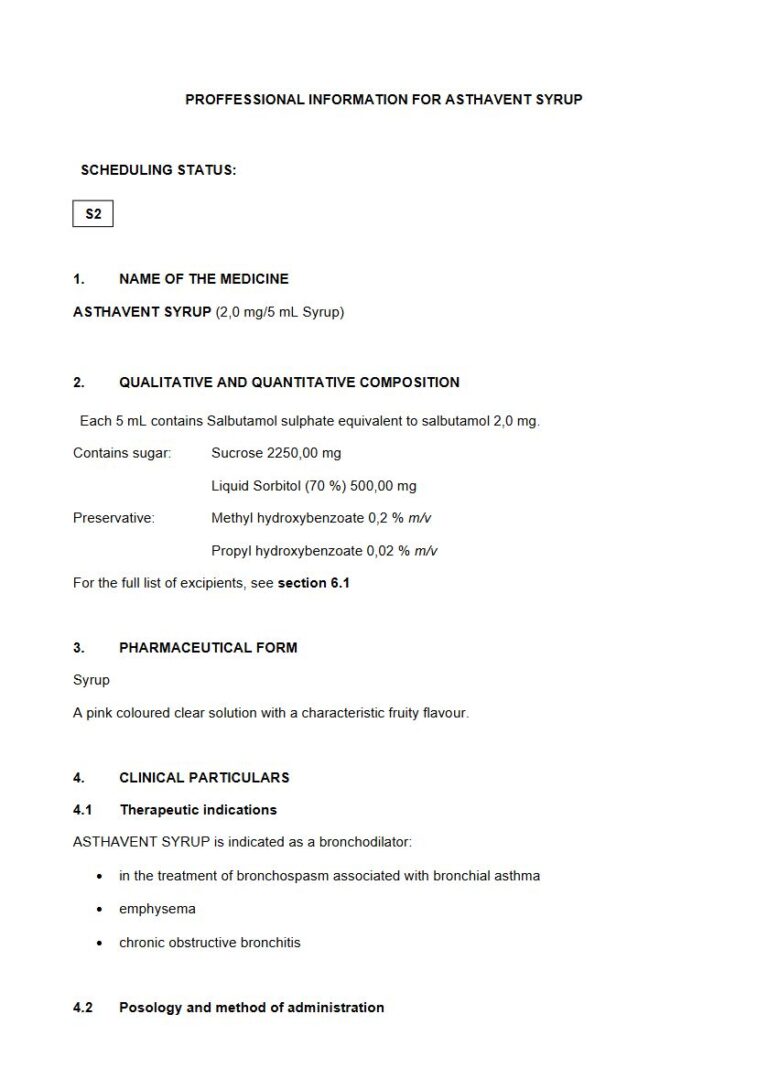
ASTHAVENT SYRUP is indicated as a bronchodilator:
- in the treatment of bronchospasm associated with bronchial asthma
- emphysema
- chronic obstructive bronchitis
4.2 Posology and method of administration
Posology
Adults: 5 mL to 10 mL three to four times daily. Some patients may require dosages of up to 20 mL.
Children: 2 to 6 years: 2.5 mL to 5 mL three to four times daily. Over 6 years: 5 mL three to four times daily. Do not exceed the recommended dose.
Special populations
Elderly Population: Elderly patients should be given the lower dose initially.
Paediatric population: The safety and efficacy of ASTHAVENT SYRUP in children aged younger than 2 years has not yet been established.
Method of administration
For oral administration
4.3 Contraindications
ASTHAVENT SYRUP is contraindicated in:
- Patients with known hypersensitivity to salbutamol or to any of the excipients used in the formulation of ASTHAVENT SYRUP (see section 6.1).
- Concurrent use with beta-blocking medicines.
- Hyperthyroidism.
- Cardiac disease.
- Prevention of premature labour associated with toxaemia of pregnancy or ante partum haemorrhage.
- Threatened abortion during first and second trimesters of pregnancy.
- Concurrent use with monoamine oxidase inhibitors (MAOIs) (see section 4.5).
4.4 Special warnings and precautions for use
Medical advice should be sought if relief from symptoms is not obtained within three hours of taking a previously effective dose, in order that alternative or additional measures may be taken if necessary. Tolerance may develop in asthmatic patients given salbutamol. If tolerance develops, and the patient's condition worsens, alternative or additional therapy should be instituted. The dosage of salbutamol should not be increased in these cases.
Salbutamol should be avoided or used with care in patients undergoing anaesthesia with any halogenated anaesthetics. Bronchodilators should not be the only or main treatment in patients with severe or unstable asthma. Increasing use of bronchodilators indicates deterioration of asthma control. If patients find that short acting relief bronchodilator treatment becomes less effective, medical attention must be sought.
Salbutamol causes peripheral vasodilation which may result in reflex tachycardia and increased cardiac output. Constant monitoring of potassium levels in patients with severe asthma is essential, potentially serious hypokalaemia may result from beta-2 agonist therapy. Hypokalaemia associated with high doses of salbutamol may result in increased susceptibility to digoxin-induced cardiac dysrhythmias. In common with other u03b2-adrenoceptor agonists, salbutamol can induce reversible metabolic changes such as increased blood glucose levels.
Diabetes: Administration of beta agonists is associated with a rise of blood glucose. Therefore blood glucose and lactate levels should be monitored in diabetics and diabetic treatment adjusted accordingly to meet the needs of the diabetic during tocolysis. Diabetic patients may be unable to compensate for the increase in blood glucose and the development of ketoacidosis has been reported. Concurrent administration of corticosteroids can exaggerate this effect.
Cardiovascular effects may be seen with sympathomimetic medications, including ASTHAVENT SYRUP. Tachyphylaxis with resistance may occur with prolonged use of high dosage. Care is necessary when treating patients with closed-angle glaucoma, and in those receiving antihypertensive therapy. It is important to avoid excessive doses as this is thought to be linked to sudden death probably due to the induction of ventricular dysrhythmias.
Salbutamol may be restricted in certain sports as it is considered to be a member of the prohibited group, Beta-2 agonists; competitors should check with the appropriate sports authorities.
ASTHAVENT SYRUP contains sucrose which may have an effect on the glycaemic control of patients with diabetes mellitus. ASTHAVENT SYRUP contains sucrose and sorbitol. Patients with rare hereditary conditions such as fructose intolerance, glucose-galactose mal-absorption or sucrase-isomaltase insufficiency should not take ASTHAVENT SYRUP. The additive effect of concomitantly administered products containing sorbitol (or fructose) and dietary intake of sorbitol (or fructose) should be taken into account. The content of sorbitol in medicinal products for oral use may affect the bioavailability of other medicinal products for oral use administered concomitantly.
4.5 Interactions with other medicines
The effects of salbutamol are antagonised by propranolol and other u03b2-adrenoceptor blocking medicines. An increased risk of dysrhythmias may occur if patients are receiving digoxin, quinidine, or tricyclic antidepressants. The effects of salbutamol may be altered by reserpine or methyldopa. Interaction with alpha- and beta-blocking medicines may occur. Salbutamol may interact with monoamine oxidase inhibitors, and should not be given to patients receiving such treatment or within 14 days after stopping treatment (see section 4.3).
Halogenated anaesthetics: Owing to the additional antihypertensive effect, there is increased uterine inertia with risk of haemorrhage; in addition, serious ventricular rhythm disorders due to increased cardiac reactivity, have been reported on interaction with halogenated anaesthetics. Treatment should be discontinued, whenever possible, at least 6 hours before any scheduled anaesthesia with halogenated anaesthetics (see section 4.4).
Anti-diabetics: The use of salbutamol and other beta-agonists are associated with a rise of blood glucose which may be interpreted as an attenuation of anti-diabetic therapy; therefore individual anti-diabetic therapy may need to be adjusted.
Potassium depleting medicine: Owing to the hypokalaemic effect of beta-agonists, concurrent administration of serum potassium depleting medicine known to exacerbate the risk of hypokalaemia, such as diuretics, digoxin, methyl xanthines (e.g. theophylline) and corticosteroids, should be administered cautiously after careful evaluation of the benefits and risks with special regard to the increased risk of cardiac arrhythmias arising as a result of hypokalaemia.
4.6 Fertility, pregnancy and lactation
Pregnancy: Salbutamol should only be used during pregnancy if it is considered essential by the physician.
Breastfeeding: As salbutamol is probably secreted in breast milk its use in nursing mothers requires careful consideration.
Fertility: No data available.
4.7 Effects on ability to drive and use machines
Patients should not drive, use machinery or perform any tasks that require concentration until they are certain that salbutamol does not adversely affect their ability to do so safely (see section 4.8).
4.8 Undesirable effects
Tabulated summary of adverse reactions
The following adverse reactions have been classified according to the following categories, frequent, less frequent and frequency unknown.
System organ class Adverse Reaction
Immune system disorders
- Less frequent: Hypersensitivity reactions including paradoxical bronchospasm, angioedema, urticaria, hypotension, and collapse.
Metabolism and nutrition disorders
- Less frequent: Decreased appetite, altered metabolism including disturbances of glucose metabolism, lactic acidosis, hypokalaemia
Psychiatric disorders
- Less frequent: Fear, anxiety, restlessness, insomnia, confusion, irritability, psychotic states, nervous tension.
Nervous system disorders
- Frequent: Tremor of skeletal muscle (particularly in the hands), headache
- Less frequent: Myoclonus
Cardiac disorders
- Less frequent: Palpitations, anginal pain, tachycardia, cardiac arrhythmias, hypotension with dizziness, cardiac dysrhythmias, myocardial ischaemia.
Vascular disorders
- Less frequent: Vascular constriction which can give rise to hypertension, peripheral vasodilation
Respiratory, thoracic and mediastinal disorders
- Less frequent: Dyspnoea, pulmonary oedema
Gastrointestinal disorders
- Less frequent: Nausea, vomiting, hypersalivation
Musculoskeletal and connective tissue disorders
- Less frequent: Muscle cramps
Renal and urinary disorders
- Less frequent: Difficulty in micturition, urinary retention.
General disorders and administrative site conditions
- Less frequent: Asthenia, increased sweating, fainting and flushing
Reporting of suspected adverse reactions
Reporting suspected adverse reactions after authorisation of the medicine is important. It allows continued monitoring of the benefit/risk balance of the medicine. Health care providers are asked to report any suspected adverse reactions to SAHPRA via the u201c6.04 Adverse Drug Reactions Reporting Formu201d, found online under SAHPRAu2019s publications: https://www.sahpra.org.za/Publications/Index/8 and to Cipla Medpro (Pty) Ltd at [email protected] or telephone 080 222 6662 (toll free)
4.9 Overdose
See sections 4.4 and 4.8.
Symptoms: Fine tremor of skeletal muscles, tachycardia, palpitations, hyperactivity, peripheral vasodilatation and metabolic effects including hypokalaemia have been reported. Hypokalaemia may occur following overdose with salbutamol. Serum potassium levels should be monitored. Lactic acidosis has been reported in association with high therapeutic doses as well as overdoses of short-acting beta-agonist therapy, therefore monitoring for elevated serum lactate and consequent metabolic acidosis (particularly if there is persistence or worsening of tachypnea despite resolution of other signs of bronchospasm such as wheezing) may be indicated in the setting of overdose.
Nausea, vomiting and hyperglycaemia have been reported, predominantly in children and when salbutamol overdose has been taken via the oral route.
Treatment: The preferred antidote for overdosage with salbutamol is a cardioselective beta blocking medicine, but beta blocking medicines should be used with caution in patients with a history of bronchospasm.
