
Auro Cefotaxime Injection
PDF Leaflet Revision Date: 26 February 2021
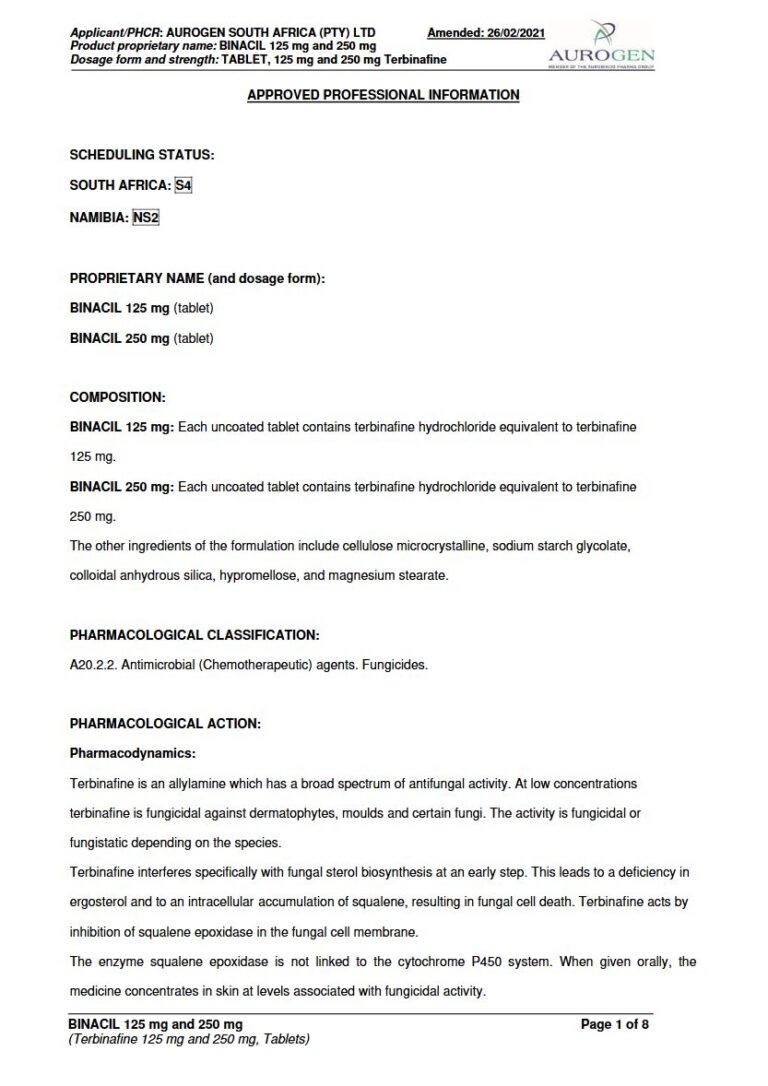
Clinical Summary
Quick overview from the medicine insert
Indication
Treatment of fungal infections of the skin and onychomycosis.
Dosage (summary)
250 mg once daily; duration varies by infection type.
Special Populations
- Renal impairment
- Hepatic impairment
Pregnancy & Breastfeeding
Contraindicated in pregnancy; not recommended during breastfeeding.
Key Drug Interactions
- Rifampicin
- Cimetidine
- Tricyclic antidepressants
- u03b2-blockers
- SSRIs
- MAO-Is
Contraindications
- Hypersensitivity to terbinafine
- Impaired liver function
- Pregnancy
- Lactation
Common side effects
- Headache
- Nausea
- Loss of appetite
- Dizziness
- Rash
Counselling Points
- Monitor for liver function
- Avoid alcohol
- Report any unusual symptoms
Serious warnings
- Risk of hepatotoxicity
- Discontinue if progressive skin rash occurs
Important Disclaimer
The Auro Cefotaxime Injection professional information leaflet below is the property of Aurogen South Africa and is provided on Medinsert exactly as issued, with no.. alterations or editorial changes. We make every effort to keep content current by updating documents as soon as new versions become available. Medinsert serves as a trusted access point for healthcare professionals, but does not replace official sources or clinical judgement. For more details, please read our full disclaimer. read more>>
 Healthcare Professionals Only
This content is for registered healthcare professionals
Sign in or create a free account to read the full package insert.
Free for HPCSA-registered professionals. Powered by Medinsert.
Clinical Particulars
Section 4 of the official insert — extracted exactly as issued, no alterations
4.1 Therapeutic indications
Fungal infections of the skin caused by Trichophyton (e.g. T. rubrum, T. mentagrophytes, T. verrucosum, T. violaceum), Microsporum canis and Epidermophyton floccosum. BINACIL is indicated in the treatment of:
- ringworm (tinea corporis, tinea cruris and tinea pedis) where oral therapy is considered appropriate due to the site, severity or extent of the infection.
- onychomycosis.
4.2 Posology and method of administration
The duration of treatment varies according to the indication and the severity of the infection. 250 mg once daily. Skin infections: Likely durations of treatment are as follows:
- Tinea pedis (interdigital, plantar/moccasin type): 2 to 6 weeks
- Tinea corporis: 4 weeks
- Tinea cruris: 2 to 4 weeks
- Onychomycosis: The duration of treatment for most patients is between 6 weeks and 3 months. Treatment periods of less than 3 months can be anticipated in patients with fingernail infection, toenail infection other than of the big toe, or patients of younger age. In the treatment of toenail infections, 3 months is usually sufficient although a few patients may require treatment of 6 months or longer. Poor nail outgrowth during the first weeks of treatment may enable identification of those patients in whom longer therapy is required. Complete resolution of the signs and symptoms of infection may not occur until several weeks after mycological cure.
Children: As data is still limited, its use is not recommended.
Elderly: There is no evidence to suggest that elderly patients require different dosages or experience side-effects different to those of younger patients. The possibility of impairment of liver or kidney function should be considered in this age group.
Impaired renal function: Patients with impaired renal function (creatinine clearance less than 50 ml/minute or serum creatinine of more than 300 mmol/l) should receive half the normal dose.
4.3 Contraindications
- Hypersensitivity to terbinafine hydrochloride or any of the excipients.
- Impaired liver function.
- Pregnancy and lactation.
4.4 Special warnings and precautions for use
- BINACIL should not be used in patients with existing liver disease and liver function tests should be performed in all patients before starting therapy. If clinical or biochemical indications of hepatotoxicity appear, BINACIL should be discontinued.
- BINACIL should also be discontinued if a progressive skin rash appears.
- BINACIL should be used with caution and in reduced doses in patients with renal impairment (see u201cDOSAGE AND DIRECTIONS FOR USEu201d).
- BINACIL may provoke or exacerbate psoriasis. BINACIL should be used with caution in patients with psoriasis, as very rare cases of exacerbation of psoriasis have been reported. Cases of cholestasis and hepatitis have been reported, these usually occur within two months of starting treatment.
4.5 Interactions with other medicines
The plasma clearance of BINACIL may be accelerated by medicines which induce metabolism (such as rifampicin) and may be inhibited by medicines which inhibit cytochrome P450 (such as cimetidine). Where co-administration of such medicines is necessary, the dosage of BINACIL may need to be adjusted accordingly.
It has been reported that BINACIL inhibits the CYP2D6-mediated metabolism. This in vitro finding may be of clinical relevance for patients receiving medicines predominantly metabolised by this enzyme, such as tricyclic antidepressants (TCA's), u03b2-blockers, selective serotonin reuptake inhibitors (SSRIs), and monoamine oxidase inhibitors (MAO-Is) Type B. Other studies undertaken in vitro and in healthy volunteers suggest that BINACIL shows negligible potential to inhibit or induce the clearance of medicines that are metabolised via other cytochrome P450 enzymes (e.g. ciclosporin, triazolam, oral contraceptives). However, some cases of menstrual disturbance (breakthrough bleeding and irregular cycles) have been reported in patients taking BINACIL concomitantly with oral contraceptives.
4.6 Fertility, pregnancy and lactation
BINACIL is contra-indicated in pregnancy. Terbinafine is excreted in breast milk and therefore mothers who receive treatment with BINACIL should not breast-feed their infants (see u201cCONTRA-INDICATIONSu201d).
4.7 Effects on ability to drive and use machines
There are no data regarding the ability to drive vehicles and use machinery. However, caution is advised when using BINACIL before the effect on the patient is established, especially since dizziness and fatigue may be experienced.
4.8 Undesirable effects
Blood and the lymphatic system disorders: Less frequent: Neutropenia, thrombocytopenia and agranulocytosis.
Immune system disorders: Less frequent: Angioedema.
Psychiatric disorders: Less frequent: Psychiatric disturbances such as depression and anxiety.
Nervous system disorders: Frequent: Headache. Less frequent: Paraesthesia, hypoaesthesia, dizziness and vertigo.
Gastrointestinal disorders: Frequent: Loss of appetite, nausea, mild abdominal pain, diarrhoea. Less frequent: Taste loss and taste disturbance have been reported in approximately 0,6% of patients treated with BINACIL. This usually resolves slowly on medicine discontinuation. The following side effects have been reported but the frequencies are unknown: Dyspepsia and fullness.
Hepato-biliary disorders: Less frequent: Jaundice, cholestasis and hepatitis. If hepatic dysfunction develops, treatment with BINACIL should be discontinued (see u201cSpecial Precautionsu201d).
Skin and subcutaneous tissue disorders: Less frequent: Stevens-Johnson syndrome, toxic epidermal necrolysis, rash, urticaria, photosensitivity and psoriasis. If progressive skin rash occurs, treatment with BINACIL should be discontinued.
Musculoskeletal, connective tissue and bone disorders: The following side effects have been reported but the frequencies are unknown: Arthralgia and myalgia. These may occur as part of a hypersensitivity reaction in association with allergic skin reactions.
General disorders and administrative site conditions: Less frequent: Malaise and fatigue.
4.9 Overdose
A few cases of overdose (up to 5 g) have been reported, giving rise to headache, nausea, epigastric pain and dizziness. The recommended treatment of overdosage consists of eliminating the drug, primarily by the administration of activated charcoal, and giving symptomatic supportive therapy if needed.
