
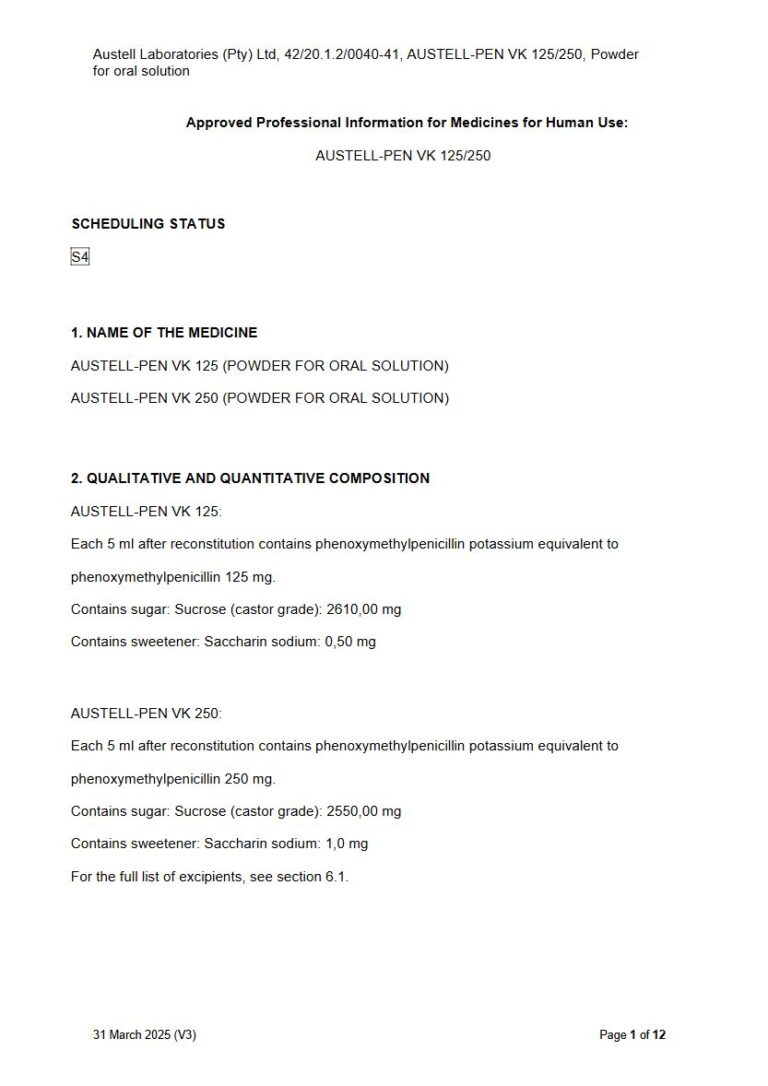
Austell-Pen Vk 125/250 Powder for oral solution
Clinical Summary
Quick overview from the medicine insert
Indication
Treatment of infections caused by susceptible strains of bacteria, including respiratory tract infections, skin infections, and otitis media.
Dosage (summary)
Adults: 250 mg to 500 mg every 6 hours. Children: 125 mg to 250 mg every 6 hours, depending on the severity of the infection.
Onset of Action / Duration
Onset of action typically occurs within 1 to 2 hours after administration, with duration of effect lasting approximately 6 hours.
Special Populations
- Renal impairment
- Hepatic impairment
- Elderly patients
Pregnancy & Breastfeeding
Considered safe for use during pregnancy and lactation; however, consult a healthcare provider before use.
Key Drug Interactions
- May interact with probenecid, increasing penicillin levels.
- May reduce the effectiveness of oral contraceptives.
Contraindications
- Hypersensitivity to penicillins or any component of the formulation.
- History of severe allergic reactions to beta-lactam antibiotics.
Common side effects
- Nausea
- Vomiting
- Diarrhea
- Rash
- Allergic reactions
Counselling Points
- Take the medication exactly as prescribed.
- Complete the full course of therapy, even if symptoms improve.
- Report any signs of allergic reactions or severe side effects to a healthcare provider.
Important Disclaimer
The Austell-Pen Vk 125/250 Powder for oral solution professional information leaflet below is the property of Austell Laboratories and is provided on Medinsert exactly as issued, with no.. alterations or editorial changes. We make every effort to keep content current by updating documents as soon as new versions become available. Medinsert serves as a trusted access point for healthcare professionals, but does not replace official sources or clinical judgement. For more details, please read our full disclaimer. read more>>
 Healthcare Professionals Only
This content is for registered healthcare professionals
Sign in or create a free account to read the full package insert.
Free for HPCSA-registered professionals. Powered by Medinsert.
Clinical Particulars
Section 4 of the official insert — extracted exactly as issued, no alterations
4.1 Therapeutic indications
AUSTELL - PEN VK is used prophylactically to prevent recurrence of rheumatic fever. It is also indicated in the treatment of:
- Mild to moderate infections caused by sensitive organisms.
- Pneumococcal infections of the middle ear.
- Streptococcal otitis media and sinusitis.
- Streptococcal pharyngitis caused by Streptococcus pyogenes.
4.2 Posology and method of administration
Posology
(1) Streptococcal infection:
Adults: 125 to 250 mg every 4 hours
Children: up to 1 year 60 mg every 6 hours
1 to 5 years: 125 mg every 6 hours
6 to 12 years: 250 mg every 6 hours
(2) Rheumatic fever prophylaxis: 125 mg every 12 hours.
Method of administration
AUSTELL - PEN VK is for oral administration. For instructions on reconstitution of the medicinal product before administration, see section 6.6.
4.3 Contraindications
- Hypersensitivity to the Phenoxymethylpenicillins or Cephalosporins or to any of the excipients listed in section 6.1.
- Use in Dysentry, and typhus, and other infections caused by penicillin resistant microbes such as Brucella and E.coli.
- For treatment of trivial disorders.
4.4 Special warnings and precautions for use
- Penicillins should be used with caution in individuals with histories of significant allergies and/or asthma. All degrees of hypersensitivity, including fatal anaphylaxis, have been observed with oral penicillin. These reactions are more likely to occur in individuals with a history of sensitivity to penicillins, cephalosporins, and other allergens. Enquiries should be made for such a history before therapy is begun.
- If any allergic reaction occurs, the medicine should be discontinued and the patient treated with the usual medicines (e.g. adrenaline and other pressor amines, antihistamines, and corticosteroids).
- Oral therapy should not be relied upon for patients with severe illness, or with nausea, vomiting, gastric dilation, achalasia, or intestinal hypermotility.
- Occasionally patients do not absorb therapeutic amounts of orally administered penicillin.
- Administer with caution in the presence of markedly impaired renal function, as safe dosage may be lower than the usually recommended doses.
- Streptococcal infections should be treated for a minimum of 10 days, and post therapy cultures should be performed to confirm the eradication of the organisms.
- Prolonged use of antibiotics may promote the overgrowth of non-susceptible organisms including fungi. If super infection occurs, appropriate measures should be taken.
- This product contains sucrose. Patients with rare hereditary problems of fructose intolerance, glucose-galactose malabsorption, or sucrase-isomaltase insufficiency should not take this medicine.
4.5 Interaction with other medicines and other forms of interaction
- Aminoglycosides: Neomycin is reported to reduce the absorption of phenoxymethylpenicillin.
- Anticoagulants: Penicillins may interfere with anticoagulants control.
- Bacteriostatic antibiotics: Certain bacteriostatic antibiotics such as Chloramphenicol, Erythromycin, and Tetracyclines have been reported to antagonise the bactericidal activity of penicillins and concomitant use is not recommended.
- Guar gum: Reduced absorption of phenoxymethylpenicillin.
- Methotrexate: Use of Phenoxymethylpenicillin while taking methotrexate can cause reduced excretion of methotrexate thereby increasing the risk of toxicity.
- Probenecid: Reduced excretion of phenoxymethylpenicillin by competing with it for renal tubular secretion.
- Sulfinpyrazone: Excretion of penicillins reduced by sulfinpyrazone.
- Typhoid vaccine (Oral): Penicillins may inactivate oral typhoid vaccine if ingested concomitantly.
4.6 Fertility, pregnancy and lactation
Safety in pregnancy and lactation has not been established.
4.7 Effects on ability to drive and use machines
None known
4.8 Undesirable effects
a) Summary of the safety profile
The most common reactions to oral penicillin are gastrointestinal effects and hypersensitivity reactions. Although hypersensitivity reactions have been reported much less frequently after oral than after parenteral therapy, it should be remembered that all forms of hypersensitivity, including fatal anaphylaxis have been observed with oral penicillin.
b) Tabulated list of adverse reactions
The table below shows all adverse drug reactions (ADRs) observed during clinical trials and postmarket spontaneous reports with phenoxymethylpenicillin
System Organ Class Frequency Frequent Less Frequent Not known Blood and lymphatic system disorders Neutropenia, haemolytic anaemia, leucopenia, prolongation of bleeding time and defective platelet function.
Cardiac disorders Kounis syndrome
Immune system disorders Allergic skin reactions such as exfoliative dermatitis, anaphylaxis, angio-oedema, urticaria and some maculopapular rashes.
Nervous system disorders Convulsions and other signs of toxicity to the central nervous system (CNS).
Gastrointestinal disorders Transient nausea, diarrhoea, pseudomembraneous colitis.
Hepatobiliary disorders Hepatitis and cholestatic jaundice
Skin and subcutaneous tissue disorders Urticarial, erythematous or exfoliative dermatitis, linear IgA mobilliform rash and pruritus
Renal and urinary disorders Nephropathy and interstitial nephritis. Care should be exercised when high doses are given to patients with renal impairment because of the risk of neurotoxicity.
General disorders and administration site conditions Sore mouth/tongue, black hairy tongue.
Reporting of suspected adverse reactions
Reporting suspected adverse reactions after authorisation of the medicine is important. It allows continued monitoring of the benefit/risk balance of the medicine. Health care providers are requested to report any suspected adverse drug reactions to SAHPRA via the Med Safety APP (Medsafety X SAHPRA) and eReporting platform (who-umc.org) found on SAHPRA website. Suspected adverse reactions can also be reported directly to the HCR via [email protected].
4.9 Overdose
Any form of actual toxicity of phenoxymethylpenicillin is rare and doses of 8 g have been well tolerated.
Signs and symptoms
A large oral overdose of penicillin may cause nausea, vomiting, stomach pain, diarrhoea, and rarely, major motor seizures. If other symptoms are present, consider the possibility of an allergic reaction. Hyperkalaemia may result from overdosage, particularly for patients with renal insufficiency.
Treatment
No specific antidote is known. Symptomatic and supportive therapy is recommended. Activated charcoal with a cathartic, such as sorbitol may hasten drug elimination. Penicillin may be removed by haemodialysis.
