
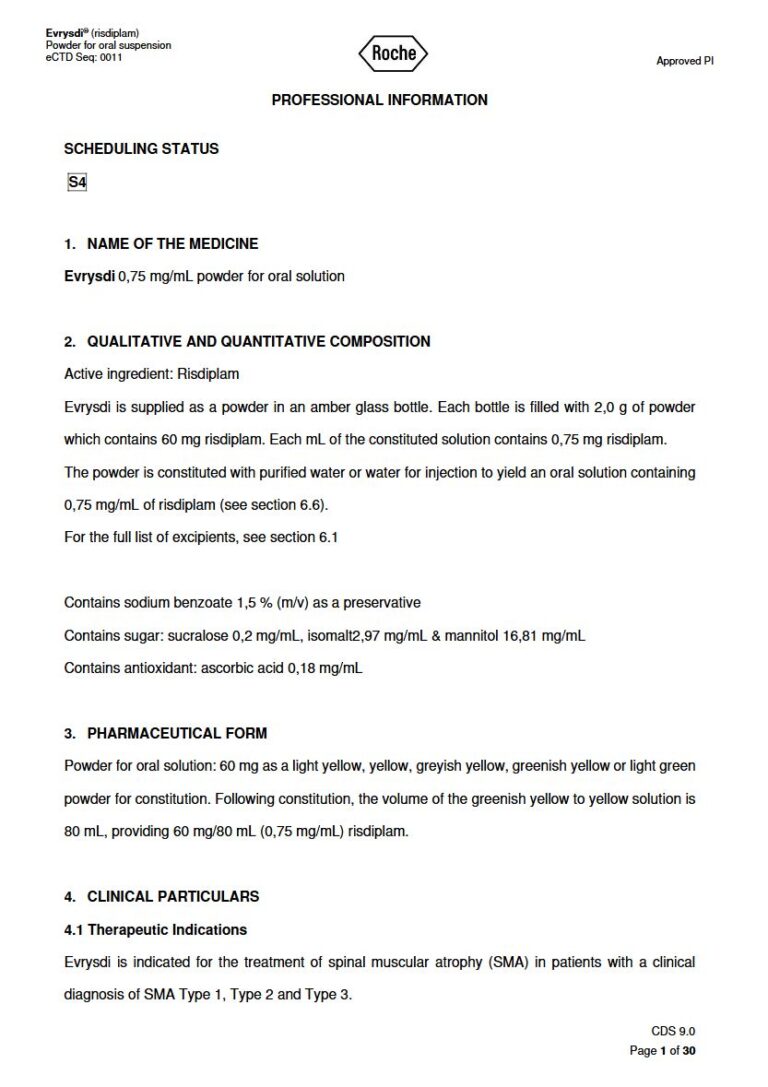
Evrysdi 0,75 mg/mL Powder for oral solution
PDF Leaflet Revision Date: 08 July 2025
Clinical Summary
Quick overview from the medicine insert
Indication
Treatment of spinal muscular atrophy (SMA) Types 1, 2, and 3.
Dosage (summary)
Oral once daily; 0.15 mg/kg for <2 months, 0.20 mg/kg for 2 months to <2 years, 0.25 mg/kg for u22652 years (<20 kg), 5 mg for u22652 years (u226520 kg).
Special Populations
- Elderly
- Renal impairment
- Hepatic impairment
Pregnancy & Breastfeeding
Contraindicated in pregnancy and breastfeeding; embryo-foetal toxicity observed.
Key Drug Interactions
- CYP3A inhibitors
- FMO1 and FMO3 substrates
Contraindications
- Hypersensitivity to risdiplam
- Pregnancy
- Lack of effective contraception in reproductive potential individuals
Common side effects
- Diarrhoea
- Rash
- Nausea
- Mouth ulcers
- Headache
Counselling Points
- Take at the same time daily
- Use effective contraception
- Discuss preparation with HCP
Serious warnings
- Embryo-foetal toxicity
- Potential male fertility effects
Important Disclaimer
The Evrysdi 0,75 mg/mL Powder for oral solution professional information leaflet below is the property of Roche and is provided on Medinsert exactly as issued, with no.. alterations or editorial changes. We make every effort to keep content current by updating documents as soon as new versions become available. Medinsert serves as a trusted access point for healthcare professionals, but does not replace official sources or clinical judgement. For more details, please read our full disclaimer. read more>>
 Healthcare Professionals Only
This content is for registered healthcare professionals
Sign in or create a free account to read the full package insert.
Free for HPCSA-registered professionals. Powered by Medinsert.
Clinical Particulars
Section 4 of the official insert — extracted exactly as issued, no alterations
4.1 Therapeutic Indications
Evrysdi is indicated for the treatment of spinal muscular atrophy (SMA) in patients with a clinical diagnosis of SMA Type 1, Type 2 and Type 3.
4.2 Posology and method of administration
General
Treatment with Evrysdi should be initiated by a medical practitioner with experience in the management of SMA. SMA treatment should be initiated as early as possible after SMA diagnosis.
Evrysdi oral solution must be constituted by a healthcare professional (HCP) prior to being dispensed.
Posology
Evrysdi is taken orally once daily using the oral syringe provided, at approximately the same time each day.
Recommended dosage
The recommended once daily dose of Evrysdi for SMA patients is determined by age and body weight (see Table 1).
Table 1: Dosing Regimen by Age and Body Weight
Age a and Body Weight Recommended Daily Dose
16 days to u02c2 2 months of age 0,15 mg/kg
2 months to < 2 years of age 0,20 mg/kg
u2265 2 years of age (< 20 kg) 0,25 mg/kg
u2265 2 years of age (u2265 20 kg) 5 mg
a based on corrected age for preterm infants
Dose changes must be made under the supervision of a HCP. Treatment with a daily dose above 5 mg has not been studied. No data are available in infants below 16 days of age.
Method of administration
Evrysdi is taken orally once a day at approximately the same time each day, using the re-usable oral syringe provided. It is recommended a HCP discuss with the patient or caregiver how to prepare the prescribed daily dose prior to administration of the first dose (see section 6.6). For comprehensive instructions on the administration, see Instructions for Use booklet provided. The patient should drink water after taking Evrysdi to ensure the medicinal product has been completely swallowed. If the patient is unable to swallow and has a nasogastric or gastrostomy tube in situ, risdiplam should be administered via the tube. The tube should be flushed with water after delivering Evrysdi (see section 6.6).
Delayed or Missed Doses
Risdiplam is taken orally once daily at approximately the same time each day. If a dose of Evrysdi is missed, administer as soon as possible if still within 6 hours of the scheduled dose. Otherwise, the missed dose should be skipped and the next dose should be administered at the regularly scheduled time the next day. If a dose is not fully swallowed or vomiting occurs after taking a dose of risdiplam another dose should not be administered to make up for the incomplete dose. Wait until the next day to administer the next dose at the regularly scheduled time.
Special Dosage Instructions
Elderly use
The pharmacokinetics (PK) and safety of Evrysdi have been assessed in subjects without SMA up to 69 years of age. Evrysdi has not been studied in patients with SMA above 60 years of age (see section 5.2).
Renal Impairment
The safety and efficacy of Evrysdi in patients with renal impairment have not been studied. No dose adjustment is expected to be required in patients with renal impairment (see section 5.2).
Hepatic Impairment
The PK, safety and tolerability of a single dose of 5 mg risdiplam were evaluated in subjects with mild or moderate hepatic impairment in a dedicated clinical study. Mild or moderate hepatic impairment had no impact on the PK of risdiplam. No dose adjustment is therefore required in patients with mild or moderate hepatic impairment. Evrysdi has not been studied in patients with severe hepatic impairment (see section 4.2 and 5.2).
Paediatric population
The safety and efficacy of Evrysdi in paediatric patients < 16 days of age have not yet been established (see section 5.2). The safety and efficacy of Evrysdi in preterm infants before reaching the corrected age of 16 days have not been established.
4.3 Contraindications
- Hypersensitivity to the Risdiplam or to any of the excipients listed in section 6.1.
- Women and men of reproductive potential who are not using highly effective contraception
- Pregnancy
4.4 Special warnings and precautions
Embryo-foetal toxicity
Patients of reproductive potential should be informed of the risks and must use highly effective contraception during treatment and until at least 1 month after the last dose of Evrysdi in female patients, and 4 months after the last dose of Evrysdi in male patients (see section 5.2).
Potential effects on male fertility
Due to reversible effects on male fertility based on observations from animal studies, male patients should not donate sperm while on treatment and for 4 months after the last dose of risdiplam. (see sections 4.6 and 5.2).
Excipients
Evrysdi contains isomalt (2,97 mg per mL). Patients with rare hereditary problems of fructose intolerance should not take this medicine.
Evrysdi contains 0,375 mg of sodium benzoate per mL. Sodium benzoate may increase jaundice (yellowing of the skin and eyes) in newborn babies (up to 4 weeks old). Evrysdi contains less than 1 mmol sodium (23 mg) per 5 mg dose, i.e. is essentially u2018sodium-freeu2019.
4.5 Interaction with other medicines and other forms of interaction
Evrysdi is primarily metabolised by hepatic enzymes flavin monooxygenase 1 and 3 (FMO1 and 3), and also by CYPs 1A1, 2J2, 3A4, and 3A7. Evrysdi is not a substrate of human multimedicine resistance protein 1 (MDR1).
Effects of other medicinal products on Evrysdi
Co-administration of 200 mg itraconazole twice daily, a strong CYP3A inhibitor, with a single oral dose of 6 mg Evrysdi did not exhibit a clinically relevant effect on the PK parameters of Evrysdi (11 % increase in AUC, 9 % decrease in Cmax). No dose adjustments are required when Evrysdi is coadministered with a CYP3A inhibitor. No medicine-medicine interactions are expected via the FMO1 and FMO3 pathway.
Effects of Evrysdi on concomitant medicines
In vitro Evrysdi and its major circulating metabolite M1 did not induce CYP1A2, 2B6, 2C8, 2C9, 2C19, or 3A4. In vitro Evrysdi and M1 did not inhibit (reversible or Time-Dependent Inhibition) any of the CYP enzymes tested (CYP1A2, 2B6, 2C8, 2C9, 2C19, 2D6) with the exception of CYP3A. Evrysdi is a weak inhibitor of CYP3A. In healthy adult subjects, oral administration of Evrysdi once daily for 2 weeks slightly increased the exposure of midazolam, a sensitive CYP3A substrate (AUC 11 %; Cmax 16 %). The extent of the interaction is not considered clinically relevant, and therefore no dose adjustment is required for CYP3A substrates. Based on physiologically based pharmacokinetic (PBPK) modelling, a similar magnitude of the effect is expected in children and infants as young as 2 months old.
In vitro studies have shown that Evrysdi and its major metabolite are not significant inhibitors of human MDR1, organic anion-transporting polypeptide (OATP) 1B1, OATP1B3, organic anion transporter 1 and 3 (OAT 1 and 3). However, Evrysdi and its metabolite are in vitro inhibitors of the human organic cation transporter 2 (OCT2) and the multimedicine and toxin extrusion (MATE) 1 and MATE2-K transporters. At therapeutic medicine concentrations, no interaction is expected with OCT2 substrates. Based on in vitro data, Evrysdi may increase plasma concentrations of medicines eliminated via MATE1 or MATE2-K. The clinical relevance of the co-administration with MATE1/2-K substrates is unknown.
4.6 Fertility, pregnancy and lactation
Pregnancy
Evrysdi should not be used during pregnancy. The safety during labour and delivery has not been established. There are no clinical data in pregnant women. Evrysdi has been shown to be embryo-foetotoxic and teratogenic in animals. Based on the findings from animal studies, Evrysdi crosses the placental barrier and may cause foetal harm (see section 5.3).
Lactation
Women taking Evrysdi should not breastfeed their infants. It is not known whether risdiplam is excreted in human breast milk. Studies in rats show that risdiplam is excreted into milk (see section 5.3).
Fertility
Male patients
Male fertility may be compromised while on treatment, based on nonclinical findings. In rat and monkey reproductive organs, sperm degeneration and reduced sperm numbers were observed. The effects on sperm cells are reversible upon discontinuation of Evrysdi. Prior to initiating treatment, fertility preservation strategies should be discussed with male patients. Male patients may consider sperm preservation prior to treatment initiation or after a treatment free period of at least 4 months. Male patients who wish to father a child should stop treatment for a minimum of 4 months. Treatment may be re-started after conception.
Female patients
Based on nonclinical data, an impact of Evrysdi on female fertility is not expected.
Contraception
Male and female patients of reproductive potential should adhere to the following contraception requirements:
u2022 Female patients of childbearing potential should use highly effective contraception during treatment and for at least 1 month after the last dose.
u2022 Male patients, with female partners of childbearing potential, should both use highly effective contraception during treatment and for at least 4 months after his last dose.
Pregnancy testing
The pregnancy status of female patients of reproductive potential should be verified prior to initiating Evrysdi therapy. Pregnant women should be clearly advised of the potential risk to the foetus.
4.7 Effects on ability to drive and use machines
Evrysdi has no or negligible influence on the ability to drive and use machines.
4.8 Undesirable effects
a. Summary of the Safety Profile
The safety profile of Evrysdi is based on four clinical trials FIREFISH, SUNFISH, RAINBOWFISH and JEWELFISH. The FIREFISH study is a two-part, open-label study that enrolled 62 patients with infantile-onset (Type 1) SMA between 2,2 and 6,9 months of age. The median exposure duration was 27,8 months (range: 0,6 to 46,5 months) (see section 5.1). The adverse drug reactions (ADRs) observed in clinical trials for infantile-onset SMA in Table 2 are based on the pooled analysis of patients from FIREFISH Part 1 and 2. ADRs are defined as adverse events occurring in u2265 5 % of patients and where a causal association with Evrysdi is possible.
The SUNFISH study is a two-part study with later-onset (Type 2 and 3) SMA between 2-25 years of age (see section 5.1). The ADRs observed in clinical trials for later-onset SMA in Table 2 are based on SUNFISH Part 2 (n=180), the randomised double-blind, placebo-controlled portion with a follow-up duration of at least 12 months. ADRs are defined as adverse events occurring in u2265 5 % more frequently or at least 2 times as frequently as in placebo control patients and where a causal association with Evrysdi is possible. The common adverse reactions of diarrhoea and rash occurred without an identifiable clinical or time pattern and resolved despite ongoing treatment in infantile-onset and later-onset SMA patients. These events are not suggestive of the effect on epithelial tissues observed in animal studies.
b. Tabulated list of adverse reactions
The corresponding frequency category for each adverse medicine reaction is based on the following convention: very common (u2265 1/10), common (u2265 1/100 to <1/10), uncommon (u2265 1/1,000 to <1/100), rare (u2265 1/10,000 to <1/1,000), very rare (<1/10,000). Adverse medicine reactions from clinical trials (Table 2) are listed by MedDRA system organ class.
Table 2 Summary of adverse drug reactions for infantile-onset SMA patients observed in FIREFISH (Part 1 and 2) study and later-onset SMA patients observed in SUNFISH Part 2 study
System Organ Class Infantile-onset SMA patients observed in FIREFISH (Part 1 and 2) study Later-onset SMA patients observed in SUNFISH Part 2 study
Gastrointestinal Disorders
Diarrhoea Very common Very common
Nausea Not applicable Common
Mouth ulcerations and aphthous ulcers Common Common
Skin and Subcutaneous Tissue Disorders
Rash* Very common Very common
Nervous system disorders
Headache Not applicable Very common
General disorders and administration site conditions
Pyrexia (including hyperxia) Very common Very common
Infections and infestations
Urinary tract infections (including cystitis) Common Common
Musculoskeletal and connective tissue disorders
Arthralgia Not applicable Common
* Includes dermatitis, dermatitis acneiform, dermatitis allergic, rash, rash maculo-papular, erythema, dermatitis allergic, rash erythematous, folliculitis, rash papular
The adverse reactions diarrhoea and rash occurred without an identifiable time or clinical pattern and resolved despite ongoing treatment with Evrysdi in infantile-onset and later-onset SMA patients. These events are not suggestive of the effect on epithelial tissues observed in animal studies. The RAINBOWFISH study is an open-label, single-arm study. At the time of interim analysis, the study had enrolled 18 patients with pre-symptomatic SMA between 16 and 40 days of age at first dose. The median exposure duration was 8,7 months (range: 0,5 to 22,8 months) (see section 5.1). The safety profile of Evrysdi in pre-symptomatic patients in the RAINBOWFISH study is consistent with the safety profile for symptomatic SMA patients treated with Evrysdi in clinical trials.
c. Safety Profile in Patients Previously Treated with Other SMA Modifying Therapies
Based on the primary analysis of the JEWELFISH study, the safety profile of Evrysdi in treatment non-naive patients who received Evrysdi for up to 59 months (including those previously on treatment with nusinersen (n=76) or with onasemnogene abeparvovec (n=14)) is consistent with the safety profile for treatment naive SMA patients treated with Evrysdi in the FIREFISH (Part 1 and Part 2) and SUNFISH (Part 1 and Part 2), and RAINBOWFISH studies. (see section 5.1).
Postmarketing Experience
The following adverse drug reaction has been identified from postmarketing experience with Evrysdi (Table 3). Adverse drug reaction is listed according to system organ classes in MedDRA.
Table 3 Adverse drug reactions from postmarketing experience
System Organ Class Adverse Reaction Frequency Category
Skin and subcutaneous disorders Cutaneous vasculitis 1 Unknown
1 Incidence rate and frequency category cannot be estimated based on available data
Cutaneous vasculitis was identified during postmarketing experience. Symptoms recovered after permanent discontinuation of Evrysdi.
Reporting of suspected adverse reactions
Reporting suspected adverse reactions after authorisation of the medicine is important. It allows continued monitoring of the benefit/risk balance of the medicine. Health care providers are requested to report any suspected adverse drug reactions to SAHPRA via the Med Safety APP (Medsafety X SAHPRA) and eReporting platform (who-umc.org) found on SAHPRA website.
4.9 Overdose
There is no experience with overdosage of Evrysdi in clinical trials. There is no known antidote for overdosage of Evrysdi. In case of overdosage, the patient should be closely supervised and supportive care instituted.
