
Coprin 100 mg Enteric Coated Tablets
PDF Leaflet Revision Date: 1 February 2022
Clinical Summary
Quick overview from the medicine insert
Indication
Cardiovascular risk reduction.
Dosage (summary)
100 to 300 mg daily, preferably at the same time.
Special Populations
- Elderly
- Renal impairment
- Hepatic impairment
Pregnancy & Breastfeeding
Contraindicated in third trimester; safety in breastfeeding unproven.
Key Drug Interactions
- Methotrexate (u226515 mg/week)
- Ibuprofen
- Anticoagulants
Contraindications
- Hypersensitivity to acetylsalicylic acid
- History of gastrointestinal bleeding
- Severe renal impairment
- Severe hepatic impairment
Common side effects
- Gastrointestinal bleeding
- Dyspepsia
- Nausea
- Vomiting
Counselling Points
- Take whole, do not chew
- Report any signs of bleeding
- Avoid alcohol
Serious warnings
- Increased bleeding risk
- Serious skin reactions
- Risk of Reye's syndrome in children
Important Disclaimer
The Coprin 100 mg Enteric Coated Tablets professional information leaflet below is the property of Smart Pharmaceuticals and is provided on Medinsert exactly as issued, with no.. alterations or editorial changes. We make every effort to keep content current by updating documents as soon as new versions become available. Medinsert serves as a trusted access point for healthcare professionals, but does not replace official sources or clinical judgement. For more details, please read our full disclaimer. read more>>
 Healthcare Professionals Only
This content is for registered healthcare professionals
Sign in or create a free account to read the full package insert.
Free for HPCSA-registered professionals. Powered by Medinsert.
Clinical Particulars
Section 4 of the official insert — extracted exactly as issued, no alterations
4.1 Therapeutic indications
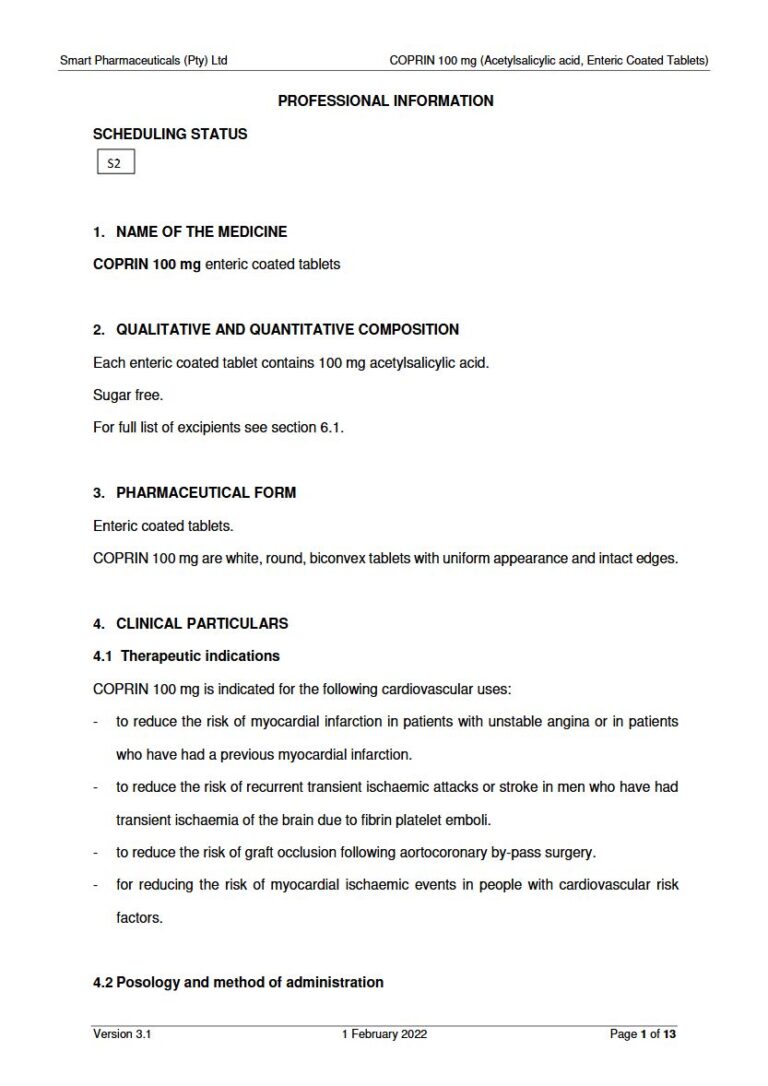
COPRIN 100 mg is indicated for the following cardiovascular uses:
- to reduce the risk of myocardial infarction in patients with unstable angina or in patients who have had a previous myocardial infarction.
- to reduce the risk of recurrent transient ischaemic attacks or stroke in men who have had transient ischaemia of the brain due to fibrin platelet emboli.
- to reduce the risk of graft occlusion following aortocoronary by-pass surgery.
- for reducing the risk of myocardial ischaemic events in people with cardiovascular risk factors.
4.2 Posology and method of administration
Posology
100 to 300 mg to be taken every day, preferably at the same time each day:
- to reduce the risk of myocardial infarction in patients with unstable angina or in patients who have had a previous myocardial infarction.
- to reduce the risk of recurrent transient ischaemic attacks or stroke in men who have had transient ischaemia of the brain due to fibrin platelet emboli.
- to reduce the risk of graft occlusion following aortocoronary by-pass surgery.
100 mg to be taken every day, preferably at the same time each day:
- for reducing the risk of myocardial ischaemic events in people with cardiovascular risk factors.
Paediatric population
Safety and efficacy in children and adolescents have not been established.
Method of administration
The tablets should be swallowed whole. Do not chew, break or crush the tablets as this will destroy the protective effect of the enteric coating.
4.3 Contraindications
- Hypersensitivity to acetylsalicylic acid, to other salicylates, or to any other excipient of the product (see section 6.1)
- patients with a history of bronchial asthma induced by administration of salicylates or of substances with similar action, especially non-steroidal anti-inflammatory medicines
- patients with a history of gastrointestinal perforation, ulceration or bleeding (PUBs) related to previous NSAIDs, including COPRIN
- active or history of recurrent ulcer/haemorrhage/perforations
- haemorrhagic diathesis
- severe renal impairment
- severe hepatic impairment
- severe cardiac failure
- administration of methotrexate in doses u2265 15 mg/week (see section 4.5)
- last trimester of pregnancy (see section 4.6).
4.4 Special warnings and precautions for use
COPRIN 100 mg should be used with particular caution in the following cases:
- hypersensitivity to analgesics, anti-inflammatory medicines, antirheumatic medicines and in the presence of other allergies (see section 4.3)
- history of gastro-intestinal ulcers including chronic or recurrent ulcers or history of gastro-intestinal bleedings
- with concomitant treatment with anticoagulants (see section 4.5)
- impaired renal function
- impaired hepatic function
- ibuprofen may interfere with the acetylsalicylic acid, resulting in inhibitory effect on platelet aggregation. Patients should tell their doctor if they are on COPRIN 100 mg regimen and take ibuprofen for pain.
- COPRIN 100 mg may lead to bronchospasm and induce asthma attacks or other hypersensitivity reactions. Risk factors are pre-existing bronchial asthma, hay fever, nasal polyps or chronic respiratory disease. The same applies also for patients who show allergic reactions (e.g. skin reactions, itching or urticaria) to other substances.
- Due to its inhibitory effect on platelet aggregation, which persists for several days after administration, COPRIN 100 mg may lead to an increased bleeding tendency during and after surgical interventions (including minor surgical interventions, e.g. dental extractions). Temporary discontinuation of treatment may be necessary.
- At low doses, acetylsalicylic acid decreases the excretion of uric acid. This fact may cause gout attacks in predisposed patients.
- COPRIN is not recommended during menorrhagia as it may increase menstrual bleeding.
- Caution is required in patients with a history of hypertension and/or heart failure as fluid retention and oedema have been reported in association with COPRIN therapy.
- In view of the COPRINu2019s inherent potential to cause fluid retention, heart failure may be precipitated in some compromised patients.
- The elderly have an increased frequency of adverse reactions to NSAIDs including COPRIN, especially gastrointestinal perforation, ulceration and bleeding (PUBs) which may be fatal.
- The risk of gastrointestinal perforation, ulceration or bleeding (PUBs) is higher with increasing doses of COPRIN, in patients with a history of ulcers, and the elderly.
- When gastrointestinal bleeding or ulceration occurs in patients receiving COPRIN, treatment with COPRIN should be stopped.
- COPRIN should be given with caution to patients with a history of gastrointestinal disease (e.g. ulcerative colitis, Crohnu2019s disease, hiatus hernia, gastro-oesophageal reflux disease, angiodysplasia) as the condition may be exacerbated.
- Serious skin reactions, some of them fatal, including exfoliative dermatitis, Stevens-Johnson syndrome, and toxic epidermal necrolysis have been reported. COPRIN should be discontinued at the first appearance of skin rash, mucosal lesions, or any other sign of hypersensitivity.
- Regular use of NSAIDs such as COPRIN during the third trimester of pregnancy, may result in premature closure of the foetal ductus arteriosus in utero, and possibly, in persistent pulmonary hypertension of the new-born. The onset of labour may be delayed and its duration increased.
- Drug Reaction with Eosinophillia and Systemic Symptoms (DRESS) has been reported in patients taking NSAIDs such as COPRIN. Some of these events have been fatal or life-threatening. DRESS typically, although not exclusively, presents with fever, rash, lymphadenopathy, and/or facial swelling. Other clinical manifestations may include hepatitis, nephritis, haematological abnormalities, myocarditis, or myositis. Sometimes symptoms of DRESS may resemble an acute viral infection. Eosinophillia is often present. Because this disorder is variable in its presentation, other organ systems not noted here may be involved. It is important to note that early manifestations of hypersensitivity, such as fever or lymphadenopathy, may be present even though rash is not evident. If such signs or symptoms are present, discontinue COPRIN and evaluate the patient immediately.
Paediatric population
Acetylsalicylic acid containing products should not be used in children and adolescents for viral infections with or without fever without consulting a medical practitioner. In certain viral diseases, particularly influenza A, influenza B and chickenpox, there is a risk of Reyeu2019s syndrome, a very rare but possibly life-threatening disease requiring immediate medical action. The risk may be increased when COPRIN 100 mg is given concomitantly. Persistent vomiting may occur with such diseases, and this may be a sign of Reyeu2019s syndrome.
4.5 Interactions with other medicines and other forms of interactions
Contraindicated interactions:
Methotrexate used at doses of 15 mg/week or more: increased haematological toxicity of methotrexate (decrease of the renal clearance of methotrexate by anti-inflammatory medicines, in general, and displacement of methotrexate from its plasma proteins bound to salicylates) (see section 4.3).
Combinations requiring precautions for use:
Methotrexate used at doses of less than 15 mg/week: increased haematological toxicity of methotrexate (decrease of the renal clearance of methotrexate by anti-inflammatory medicines, in general, and displacement of methotrexate from its plasma proteins bound to salicylates).
Ibuprofen may inhibit the effect of low doses of acetylsalicylic acid on platelet aggregation when these medicines are administered concomitantly. Treatment with ibuprofen in patients with increased cardiovascular risk may limit the cardio-protective effects of COPRIN 100 mg.
Anticoagulants, thrombolytics/other inhibitors of platelet aggregation/haemostasis: increased risk of bleeding.
Other non-steroidal anti-inflammatory medicines with salicylates at high doses: increased risk of ulcerations and gastrointestinal bleeding due to synergistic effect.
Selective reuptake inhibitors (SSRIs): increased risk of gastrointestinal bleeding.
Digoxin: increase of plasma concentrations of digoxin due to the decrease in renal excretion.
Antidiabetics, e.g. insulin, sulphonylurea: increase of the hypoglycaemic effect at high doses of acetylsalicylic acid via hypoglycaemic action of acetylsalicylic acid and displacement of sulfonylurea from its plasma proteins.
Diuretics in combination with acetylsalicylic acid at higher doses: decrease of the glomerular filtration via decrease of renal prostaglandin synthesis.
Systemic glucocorticoids, except hydrocortisone used as replacement therapy in Addisonu2019s disease: decrease of salicylate blood levels during corticosteroid treatment, and risk of salicylate overdose after this treatment is stopped by corticosteroids through increased elimination of salicylates.
Inhibitors of angiotensin converting enzyme (ACE) in combination with higher doses of acetylsalicylic acid: decrease of glomerular filtration due to vasodilator inhibition of prostaglandins. Furthermore, decrease of the antihypertensive effect.
Valproic acid: increased toxicity of valproic acid due to protein displacement from the binding sites.
Phenytoin: acetylsalicylic acid diminishes the binding of phenytoin to plasma albumin. This may lead to decreased total phenytoin levels in plasma, but increased free phenytoin fraction.
Metamizole: Metamizole may reduce the effect of acetylsalicylic acid on platelet aggregation, when taken concomitantly. This combination should be used with caution in patients taking COPRIN for cardio protection.
Ciclosporin, tacrolimus: Concomitant use of NSAIDs, including COPRIN, and ciclosporin or tacrolimus may increase the nephrotoxic effect of ciclosporin and tacrolimus. The renal function should be monitored in case of concomitant use of these medicines and COPRIN.
Antacids: The excretion of acetylsalicylic acid is increased by alkaline urine, which can occur with some antacids.
Alcohol: increase of the deterioration of the gastro-intestinal mucosa and prolonged bleeding time due to the additive effect of acetylsalicylic acid and alcohol.
Uricosuric medicines, such as benzbromarone, probenecid: decrease of uricosuric effect (competition of renal tubular uric acid elimination).
Carbonic anhydrase inhibitors (acetazolamide): Concomitant use with COPRIN may result in severe acidosis and increased central nervous system toxicity.
4.6 Fertility, pregnancy and lactation
Pregnancy
Inhibition of prostaglandin synthesis may adversely affect the pregnancy and/or the embryo/foetal development. During the first and second trimester of pregnancy, it is recommended that medicines containing acetylsalicylic acid not be administered. During the third trimester of pregnancy, all prostaglandin synthesis inhibitors may expose the foetus to:
- cardiopulmonary toxicity (with premature closure of the ductus arteriosus and pulmonary hypertension)
- renal dysfunction, which may progress to renal failure with oligo-hydroamniosis, the mother and the child, at the end of the pregnancy to:
- possible prolongation of bleeding time, an anti-aggregation effect which may occur even after very low doses
- inhibition of uterine contractions resulting in delayed or prolonged labour.
Consequently, COPRIN 100 mg is contraindicated during the third semester of pregnancy (see section 4.3).
Breastfeeding
Acetylsalicylic acid and its metabolites pass into breastmilk in small quantities. Safety is unproven. When regular use of COPRIN 100 mg is indicated, breastfeeding should be discontinued.
4.7 Effects on ability to drive and use machines
COPRIN 100 mg has no or negligible influence on the ability to drive and to use machines.
4.8 Undesirable effects
Blood and lymphatic system disorders
Less frequent: thrombocytopaenia, granulocytosis, aplastic anaemia. Serious bleedings, such as gastrointestinal tract haemorrhage, cerebral haemorrhage (especially in patients with uncontrolled hypertension and/or on concomitant antihaemostatic medicines), which in single cases may be potentially life-threatening (see section 4.4).
Frequency unknown: Perioperative haemorrhage, haematomas, epistaxis, urogenital bleedings, gingival bleedings
Immune system disorders
Less frequent: Hypersensitivity reactions (symptoms such as rash, urticaria, oedema, pruritus, rhinitis, nasal congestion cardio-respiratory distress) and severe reactions, including anaphylactic shock.
Metabolism and digestive system disorders
Frequency unknown: hyperuricaemia, hypoglycaemia.
Nervous system disorders
Less frequent: intracranial haemorrhage.
Frequency unknown: headache, vertigo.
Ear and labyrinth disorders
Frequency unknown: reduced hearing ability, tinnitus.
Cardiac disorders
Frequency unknown: oedema, hypertension, cardiac failure.
Vascular disorders
Less frequent: haemorrhagic vasculitis.
Respiratory, thoracic and mediastinal disorders
Less frequent: rhinitis, dyspnoea, bronchospasm, asthma attacks.
Gastrointestinal disorders
Frequent: dyspepsia, gastrointestinal and abdominal pain, peptic ulcers, perforation or gastrointestinal bleeding, sometimes fatal, nausea, vomiting, diarrhoea, flatulence, constipation, melaena, haematemesis, ulcerative stomatitis, exacerbation of colitis and Crohnu2019s disease, gastritis.
Less frequent: gastrointestinal inflammation and gastrointestinal ulcer. There have been reports of gastrointestinal ulcer haemorrhage and perforation, with the respective laboratory and clinical signs and symptoms.
Hepatobiliary disorders
Less frequent: transient hepatic impairment with increase in liver transaminases.
Skin and subcutaneous tissue disorders
Less frequent: urticaria, Steven-Johnsons syndrome, Lyells syndrome, purpura, erythema nodosum, erythema multiforme.
Frequency unknown: bullous reactions, toxic epidermal necrolysis, Drug Reaction with Eosinophilia and Systemic Symptoms (DRESS) (see section 4.4).
Renal and urinary tract disorders
Frequency unknown: impaired renal function, salt and water retention.
Reproductive system and breast disorders
Less frequent: menorrhagia.
Reporting of suspected adverse reactions
Reporting of suspected adverse reactions after authorisation of the medicine is important. It allows continued monitoring of the benefit/risk balance of the medicine. Health care providers are asked to report any suspected adverse reactions to SAHPRA via the u201c6.04 Adverse Drug Reactions Reporting Formu201d, found online under SAHPRAu2019s publications: https://www.sahpra.org.za/Publications/Index/8
4.9 Overdose
Poisoning must be feared in the elderly and above all in young children (therapeutic overdose or frequent accidental poisoning) in whom it may be fatal.
Symptoms
Moderate poisoning: Nausea, vomiting, tinnitus, feeling of impaired hearing, headache, vertigo, and mental confusion are observed in case of overdose and can be controlled by a dosage reduction.
Severe poisoning: Fever, hyperventilation, ketosis, respiratory alkalosis, metabolic acidosis, coma, cardiovascular shock, respiratory failure, severe hypoglycaemia.
Emergency management
Immediate transfer to hospital specialist unit, administration of activated charcoal, check of acid-base balance, alkaline diuresis so as to obtain a urine pH between 7,5 and 8, forced alkaline diuresis should be considered when the plasma salicylate concentration is greater than 500 mg/litre (3,6 mmol/litre) in adults or 300 mg/litre (2,2 mmol/litre) in children, possibility of haemodialysis in severe poisoning, fluid losses should be replaced, symptomatic treatment.
