
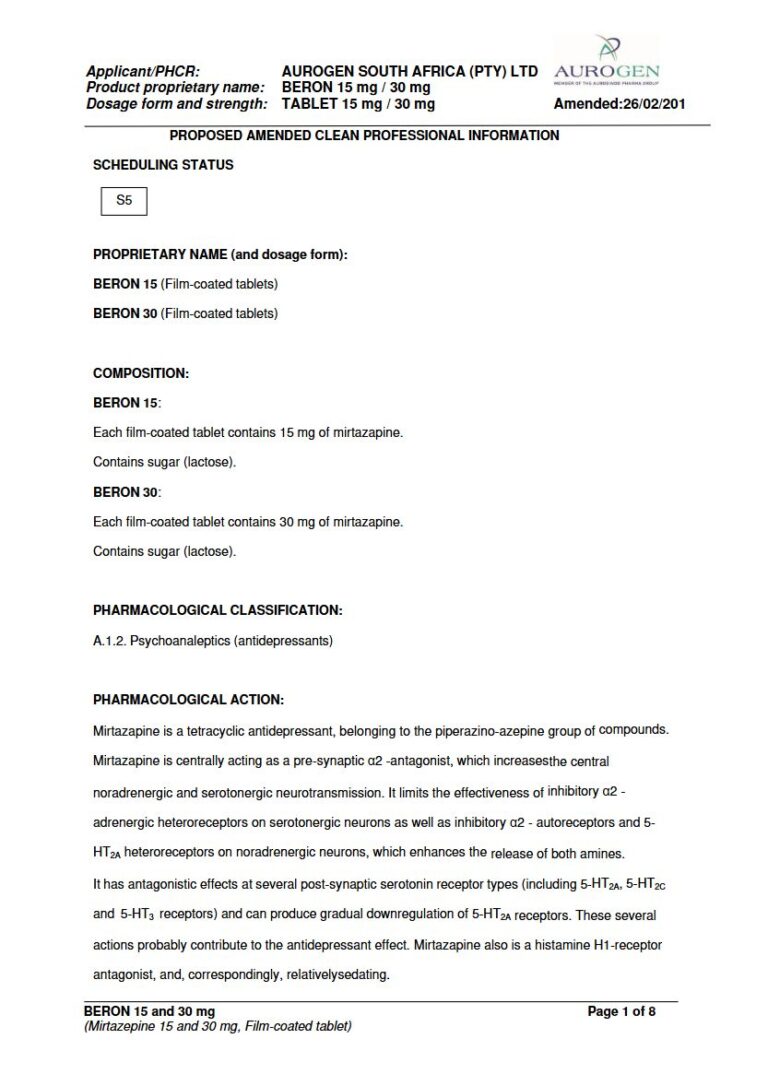
Beron 15mg & 30mg Tablets
Clinical Summary
Quick overview from the medicine insert
Indication
Treatment of major depressive disorder.
Dosage (summary)
Initial dose of 15 mg once daily, may be increased to a maximum of 45 mg based on clinical response.
Onset of Action / Duration
Therapeutic effects may be observed within 1 to 2 weeks, with full effects typically seen after 4 to 6 weeks.
Special Populations
- Elderly patients
- Patients with renal impairment
- Patients with hepatic impairment
Pregnancy & Breastfeeding
Use during pregnancy only if the potential benefit justifies the potential risk to the fetus. Mirtazapine is excreted in breast milk; caution is advised when administered to nursing mothers.
Key Drug Interactions
- CNS depressants may enhance sedative effects.
- MAO inhibitors can lead to serious interactions; avoid concomitant use.
- Serotonergic drugs may increase the risk of serotonin syndrome.
Contraindications
- Hypersensitivity to mirtazapine or any of the excipients.
- Concomitant use with monoamine oxidase inhibitors (MAOIs).
Common side effects
- Sedation
- Increased appetite and weight gain
- Dry mouth
- Dizziness
- Constipation
Counselling Points
- Take at the same time each day, preferably in the evening.
- Avoid alcohol while taking this medication.
- Report any unusual changes in mood or behavior to your healthcare provider.
Important Disclaimer
The Beron 15mg & 30mg Tablets professional information leaflet below is the property of Aurogen South Africa and is provided on Medinsert exactly as issued, with no.. alterations or editorial changes. We make every effort to keep content current by updating documents as soon as new versions become available. Medinsert serves as a trusted access point for healthcare professionals, but does not replace official sources or clinical judgement. For more details, please read our full disclaimer. read more>>
 Healthcare Professionals Only
This content is for registered healthcare professionals
Sign in or create a free account to read the full package insert.
Free for HPCSA-registered professionals. Powered by Medinsert.
Clinical Particulars
Section 4 of the official insert — extracted exactly as issued, no alterations
4.1 Indications
Treatment of major depressive illness.
4.2 Contra-indications
Hypersensitivity to BERON. Pregnancy and lactation, as there is insufficient clinical data available. Children, as insufficient clinical data are available.
4.3 Warnings and special precautions
Warnings
BERON should be used with caution in patients with epilepsy, hepatic or renal insufficiency, and cardiac disorders such as conduction disturbances, angina pectoris, and recent myocardial infarction, as well as in patients with hypotension. Careful dosage as well as regular and careful monitoring is necessary in these patients.
Caution should also be exercised in patients with diabetes mellitus, psychoses and those with a history of bipolar disorder. Treatment should be stopped if jaundice develops. Patients should be advised to report any of the following symptoms during treatment: Fever, sore throat, stomatitis, or other signs of infection. These may be signs of bone marrow depression (neutropenia, agranulocytosis). Treatment should be stopped and a blood count performed.
Patients with major depressive disorder, both adults and children, may experience worsening of their depression and or the emergence of suicidal ideation and behaviour, whether or not they are taking antidepressant medicines. This risk may persist until significant remission occurs. A causal role, however, for antidepressant medicine in inducing such behaviour has not been established. Patients being treated with BERON should, nevertheless, be observed closely for clinical worsening and suicidality, especially at the beginning of a course of therapy or at any time of dose changes, either increases or decreases. Because of the possibility of co-morbidity between major depressive disorder and other psychiatric and non-psychiatric disorders, the same precautions observed when treating patients with major depressive disorders should be observed when treating patients with other psychiatric and non-psychiatric disorders.
The following symptoms have been reported in patients being treated with antidepressants for major depressive disorder as well as for other indications, both psychiatric and non-psychiatric: anxiety, agitation, panic attacks, insomnia, irritability, hostility (aggressiveness), impulsivity, akathisia, hypomania, and mania. Although a causal link between the emergence of suicidal impulses has not been established, consideration should be given to changing the therapeutic regimen, including possibly discontinuing BERON, in patients for whom such symptoms are severe, abrupt in onset, or were not part of the patientu2019s presenting symptoms. If the decision is made to discontinue treatment, BERON should be tapered (See PRECAUTIONS and DOSAGE AND DIRECTIONS FOR USE.)
Special precautions:
u2022 Renal and urinary disorders: BERON has weak antimuscarinic activity, therefore caution should be exercised in patients with micturition disturbances,
u2022 (Eye disorders) closed-angle glaucoma, and raised intra-ocular pressure.
u2022 Psychiatric disorders: Patients should be closely monitored during early therapy until improvement in depression is observed because suicide is an inherent risk in depressed patients.
4.4 Effects on ability to drive and use machines
BERON may decrease alertness, judgement, thinking and concentration. Therefore operating machinery or driving a vehicle should be avoided during treatment.
4.5 Interactions
MAOI: BERON should not be used concomitantly or within two weeks of discontinuing a MAOI.
Alcohol: BERON may potentiate the central nervous depressant action of alcohol and patients should therefore be advised to avoid alcohol.
Anxiolytics or Hypnotics: Use of BERON may potentiate the sedative effects of anxiolytics and hypnotics. Caution should be taken when these drugs are prescribed together with BERON.
4.6 Fertility, pregnancy and lactation
BERON is contra-indicated in pregnancy and lactation.
4.7 Dosage and directions for use
Tablets should be taken orally. BERON should be given in an initial daily dose of 15 mg, which may be increased gradually according to clinical response. The usual effective dose lies within the range of 15 to 45 mg. Daily doses may be given as a single dose, preferably at bedtime, or in 2 equally divided doses. Changes in dose should be made at intervals of at least 1 to 2 weeks because of the long half-life. For treatment of acute, depressive episodes, treatment should be continued for at least 6 months. BERON should be withdrawn gradually to reduce the risk of withdrawal symptoms. The clearance of mirtazapine may be decreased in elderly patients and in patients with renal or hepatic impairment. This should be taken into account when prescribing BERON to this category of patients.
4.8 Undesirable effects
Body as a whole
Common (>1/100 u2264 1/10): Asthenia, flu like syndrome, increased sweating.
Nervous system disorders
Common (>1/100 u2264 1/10): Drowsiness or sedation, vertigo.
Uncommon (>1/1 000 u2264 1/100): Dizziness, headache.
Rare (> 1/10 000 u2264 1/1 000): Paraesthesia, epileptic seizures, nightmares, agitation, mania, hallucinations, convulsions, tremor, myoclonus and restless legs syndrome.
Metabolism and nutritional disorders
Common (>1/100 u2264 1/10): An increase in appetite and weight gain. Dry mouth, constipation, nausea. The following side effects have been reported but the frequencies are unknown: Vomiting, thirst, bitter taste (in the mouth).
Vascular disorders
Common (>1/100 u2264 1/10): Oedema, peripheral oedema.
Rare (> 1/10 000 u2264 1/1 000): Postural hypotension.
Skin and subcutaneous tissue disorders
Common (>1/100 u2264 1/10): Oedema.
Rare (> 1/10 000 u2264 1/1 000): Exanthema.
Hepatobiliary disorders
Uncommon (>1/1 000 u2264 1/100): Increases in liver enzyme levels have been reported. The following side effect has been reported but the frequency is unknown: jaundice.
Blood and lymphatic system disorders
Rare (> 1/10 000 u2264 1/1 000): Reversible agranulocytosis, leucopaenia and granulocytopaenia, orthostatic hypotension.
4.9 Overdose
There is no specific antidote for BERON. Treatment is symptomatic and supportive.
