
Biktarvy Tablets
PDF Leaflet Revision Date: 19 November 2025
Clinical Summary
Quick overview from the medicine insert
Indication
Treatment of HIV-1 infection in adults and children over 6 years.
Dosage (summary)
One tablet once daily, with or without food.
Special Populations
- Elderly
- Hepatic impairment
- Renal impairment
Pregnancy & Breastfeeding
Use during pregnancy requires monitoring; not recommended for breastfeeding.
Key Drug Interactions
- Dofetilide
- Rifampicin
- St. John's wort
Contraindications
- Hypersensitivity to components
- Severe hepatic impairment
Common side effects
- Headache
- Diarrhoea
- Nausea
Counselling Points
- Take missed dose within 18 hours
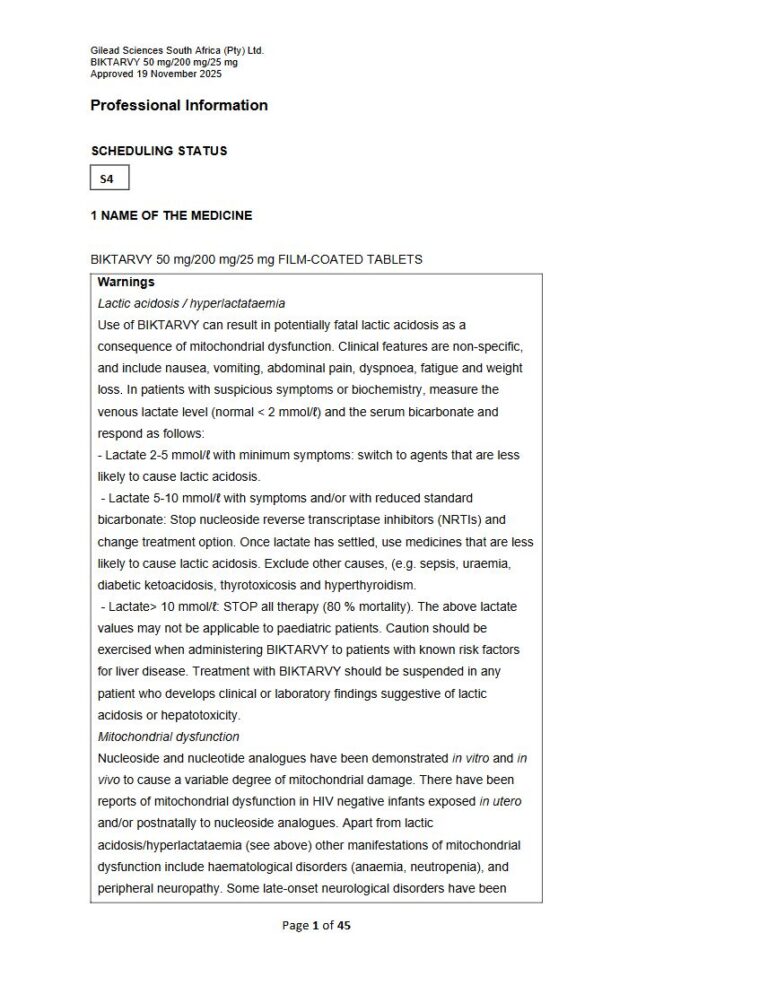
- Monitor for signs of lactic acidosis
- Avoid breastfeeding while on treatment
Serious warnings
- Lactic acidosis
- Hepatotoxicity
- Immune reactivation syndrome
Important Disclaimer
The Biktarvy Tablets professional information leaflet below is the property of Gilead Sciences South Africa and is provided on Medinsert exactly as issued, with no.. alterations or editorial changes. We make every effort to keep content current by updating documents as soon as new versions become available. Medinsert serves as a trusted access point for healthcare professionals, but does not replace official sources or clinical judgement. For more details, please read our full disclaimer. read more>>
 Healthcare Professionals Only
This content is for registered healthcare professionals
Sign in or create a free account to read the full package insert.
Free for HPCSA-registered professionals. Powered by Medinsert.
Clinical Particulars
Section 4 of the official insert — extracted exactly as issued, no alterations
4.1 Therapeutic indications
Biktarvy is indicated for the treatment of human immunodeficiency virus-1 (HIV-1) infection in adults, adolescents and paediatric patients at least 6 years of age and weighing at least 25 kg without any known mutation associated with resistance to the individual components and who have no antiretroviral treatment history or to replace the current antiretroviral regimen in those who are virologically-suppressed (HIV-1 RNA less than 50 copies per ml) on a stable antiretroviral regiment for at least 3 months.
4.2 Posology and method of administration
Therapy should be initiated by a medical practitioner experienced in the management of HIV infection.
Posology
Adults and paediatric patients aged 6 years and older weighing at least 25 kg
The recommended dose of BIKTARVY is one tablet once daily, with or without food.
Missed doses
If the patient misses a dose of Biktarvy within 18 hours of the time it is usually taken, the patient should take Biktarvy as soon as possible and resume the normal dosing schedule. If a patient misses a dose of Biktarvy by more than 18 hours, the patient should not take the missed dose and simply resume the usual dosing schedule. If the patient vomits within 1 hour of taking Biktarvy another tablet should be taken. If a patient vomits more than 1 hour after taking Biktarvy the patient does not need to take another tablet of Biktarvy until the next regularly scheduled dose.
Special populations
Elderly
No dose adjustment of Biktarvy is required in patients aged u2265 65 years (see sections 4.8 and 5.2).
Hepatic Impairment
No dose adjustment of Biktarvy is required in patients with mild (Child-Pugh Class A) or moderate (Child-Pugh Class B) hepatic impairment. Biktarvy has not been studied in patients with severe hepatic impairment (Child-Pugh Class C), therefore Biktarvy is not recommended for use in patients with severe hepatic impairment (see sections 4.4 and 5.2).
Renal impairment
No dose adjustment of Biktarvy is required in patients weighing u2265 35 kg with estimated creatinine clearance (CrCl) u2265 30 m l/min. No dose adjustment of Biktarvy is required in adult patients with end stage renal disease (estimated creatinine clearance < 15 ml/minute) who are receiving chronic haemodialysis. However, Biktarvy should generally be avoided and only be used in these patients if the potential benefits are considered to outweigh the potential risks (see sections 4.4 and 5.2). On days of haemodialysis, Biktarvy should be administered after completion of haemodialysis treatment.
Initiation of Biktarvy should be avoided in patients with estimated creatinine clearance u226515 ml/min and < 30 ml/min, or < 15 ml/min who are not receiving chronic haemodialysis, as the safety of Biktarvy has not been established in these populations (see section 5.2). No data are available to make dose recommendations in patients weighing < 35 kg with renal impairment or in paediatric patients less than 18 years with end stage renal disease.
Paediatric population
The safety and efficacy of BIKTARVY in children less than 6 years of age or weighing less than 25 kg have not been established.
Method of Administration
Biktarvy should be taken orally once daily with or without food. Due to the bitter taste, it is recommended that the film-coated tablets should not be chewed or crushed. For patients who are unable to swallow the whole tablet whole, the tablet may be split in half and both halves taken one after the other, ensuring that the full dose is taken immediately.
4.3 Contraindications
Known hypersensitivity to bictegravir, emtricitabine, tenofovir alafenamide, or to any of the excipients.
Co-administration with dofetilide is contraindicated due to the potential for increased dofetilide plasma concentrations and associated serious and/or life-threatening events.
Co-administration of bictegravir and medicines that potentially induce both CYP3A and UGT1A1, such as rifampicin and or St. Johnu2019s wort (Hypericum perforatum), is contraindicated due to the potential to decrease BIC plasma concentrations, which may result in the loss of therapeutic effect and development of resistance to Biktarvy (see sections 4.4 and 4.5).
4.4 Special warnings and precautions for use
Transmission of HIV
While effective viral suppression with antiretroviral therapy has been proven to substantially reduce the risk of sexual transmission, a residual risk remains. Appropriate prevention measures should be taken to reduce the risk of sexual transmission of HIV.
Patients co-infected with HIV and hepatitis B or C virus
Patients with chronic hepatitis B or C treated with antiretroviral therapy are at an increased risk for severe and potentially fatal hepatic adverse reactions. There are limited safety and efficacy data for Biktarvy in patients co-infected with HIV-1 and hepatitis C virus (HCV). Biktarvy contains tenofovir alafenamide, which is active against hepatitis B virus (HBV). Discontinuation of Biktarvy therapy in patients co-infected with HIV and HBV may be associated with severe acute exacerbations of hepatitis. Patients co-infected with HIV and HBV who discontinue Biktarvy should be closely monitored with both clinical and laboratory follow up for at least three months after stopping treatment. If appropriate, anti-hepatitis B therapy may be warranted, especially in HBV coinfected patients with advanced liver disease or cirrhosis since post-treatment exacerbation of hepatitis may lead to hepatic decompensation.
Liver disease
The safety and efficacy of Biktarvy in patients with significant underlying liver disorders have not been established. Patients with pre-existing liver dysfunction, including chronic active hepatitis, have an increased frequency of liver function abnormalities during combination antiretroviral therapy (CART), such as Biktarvy, and should be monitored according to standard practice. If there is evidence of worsening liver disease in such patients, interruption or discontinuation of treatment must be considered.
Weight and metabolic parameters
An increase in weight and in lipid and glucose blood levels may occur during treatment with Biktarvy. Although there is evidence for a treatment effect, such changes may in part be linked to disease control and life style. Body weight/ body mass index (BMI), lipids and blood glucose levels should be regularly monitored and appropriately managed in patients on treatment with Biktarvy.
Mitochondrial dysfunction
Nucleos(t)ide analogues may impact on mitochondrial function. There have been reports of mitochondrial dysfunction in HIV negative infants exposed in utero and/or postnatally to nucleoside analogues, as in Biktarvy. The main adverse reactions reported are haematological disorders (anaemia, neutropenia) and metabolic disorders (hyperlactataemia, hyperlipasaemia). Late onset neurological disorders have been reported (hypertonia, convulsions, abnormal behaviour). These findings should be considered for any child exposed in utero to nucleos(t)ide analogues, such as Biktarvy, who present with severe clinical findings of unknown aetiology, particularly neurologic findings. Any child exposed in utero to nucleoside and nucleotide analogues, even HIV negative children, should have clinical and laboratory follow-up and should be fully investigated for possible mitochondrial dysfunction in case of relevant signs or symptoms.
Immune Reactivation Syndrome
In HIV-infected patients with severe immune deficiency at the time of institution of CART, an inflammatory reaction to asymptomatic or residual opportunistic pathogens may arise and cause serious clinical conditions, or aggravation of symptoms. Typically, such reactions have been observed within the first few weeks or months of initiation of CART. Relevant examples include cytomegalovirus retinitis, generalised and/or focal mycobacterial infections, and Pneumocystis jirovecii pneumonia. Any inflammatory symptoms should be evaluated, and treatment instituted when necessary. Autoimmune disorders (such as Gravesu2019 disease and autoimmune Hepatitis) have also been reported to occur in the setting of immune reactivation; however, the reported time to onset is more variable and these events can occur many months after initiation of treatment.
Opportunistic infections
Patients should be advised that Biktarvy therapy does not cure HIV infection and that they may still develop opportunistic infections and other complications of HIV infection. Therefore, patients should remain under close clinical observation by medical practitioner experienced in the treatment of patients with HIV associated diseases.
Co-administration of Biktarvy in HIV patients currently treated for Tuberculosis (TB) with rifamycin is contraindicated. The safety and efficacy of Biktarvy in HIV patients treated for Tuberculosis (TB) has not been established.
Osteonecrosis
Although the aetiology is considered to be multifactorial (including corticosteroid use, alcohol consumption, severe immunosuppression, higher body mass index), cases of osteonecrosis have been reported particularly in patients with advanced HIV disease and/or long-term exposure to CART, such as Biktarvy. Patients should be advised to seek medical advice if they experience joint aches and pain, joint stiffness or difficulty in movement.
Nephrotoxicity
Post-marketing cases of renal impairment, including acute renal failure and proximal renal tubulopathy have been reported with tenofovir alafenamide-containing products. A risk of nephrotoxicity resulting from chronic exposure to low levels of tenofovir due to dosing with tenofovir alafenamide cannot be excluded (see section 5.3). It is recommended that renal function is assessed in all patients prior to, or when initiating, therapy with Biktarvy and that it is also monitored during therapy in all patients as clinically appropriate. In patients who develop clinically significant decreases in renal function, or evidence of proximal renal tubulopathy, discontinuation of Biktarvy should be considered.
Patients with end stage renal disease on chronic haemodialysis
Biktarvy should generally be avoided but may be used in adults with end stage renal disease (estimated CrCl < 15 ml/min) on chronic haemodialysis if the potential benefits outweigh the potential risks (see section 4.2). In a study of emtricitabine + tenofovir alafenamide in combination with elvitegravir + cobicistat as a fixed-dose combination tablet (E/C/F/TAF) in HIV-1 infected adults with end stage renal disease (estimated CrCl < 15 ml/min) on chronic haemodialysis, efficacy was maintained through 96 weeks but emtricitabine exposure was significantly higher than in patients with normal renal function. Efficacy was also maintained in the extension phase of the study in which 10 patients switched to Biktarvy for 48 weeks. Although no additional adverse reactions were identified, the implications of increased emtricitabine exposure remain uncertain (see sections 4.8 and 5.2).
Co-administration of other medicines or supplements
Biktarvy should not be co-administered simultaneously with antacids, oral medications or supplements containing magnesium, aluminium or iron under fasted conditions. Biktarvy should be administered at least 2 hours before, or with food 2 hours after antacids, oral medications or supplements containing magnesium and/or aluminium. Biktarvy should be administered at least 2 hours before iron supplements, or taken together with food at any time (see section 4.5). In pregnant patients, dosage adjustments are recommended for co-administration of polyvalent cation-containing antacids, oral medications or supplements (see section 4.5). Some medicines are not recommended for co-administration with Biktarvy: atazanavir, carbamazepine, ciclosporin (IV or oral use), oxcarbazepine, phenobarbital, phenytoin, rifabutin, rifapentine, or sucralfate. Biktarvy should not be co-administered with other antiretroviral medicinal products. (see sections 4.3 and 4.5).
Paediatric population
Reductions in bone mineral density (BMD u2265 4 %) of the spine and total body less head (TBLH) have been reported in patients aged between 3 to < 12 years who received tenofovir alafenamide-containing products for 48 weeks (see section 4.8). The long-term effects of changes in BMD on the growing bone, including the risk of fracture, are uncertain. A multidisciplinary approach is recommended to decide the appropriate monitoring during treatment.
4.5 Interaction with other medicines and other forms of interaction
Biktarvy is indicated for use as a complete regimen for the treatment of HIV-1 infection. Therefore, comprehensive information regarding interactions with other antiretroviral products is not provided. Interaction studies have only been performed in adults.
Bictegravir
Bictegravir is a substrate of CYP3A and UGT1A1. Co-administration of bictegravir and medicines that potently induce both CYP3A and UGT1A1, such as rifampicin or St Johnu2019s wort, may significantly decrease plasma concentrations of bictegravir, which may result in a loss of therapeutic effect of Biktarvy and development of resistance, therefore co-administration is contraindicated. Co-administration of bictegravir with medicines that potently inhibit both CYP3A and UGT1A1, such as atazanavir, may significantly increase plasma concentrations of bictegravir, therefore co-administration is not recommended. Bictegravir is an inhibitor of P-glycoprotein (P-gp), breast cancer resistance protein (BCRP), BSEP, OCT1 and OAT3 in vitro. Bictegravir inhibits organic cation transporter 2 (OCT2) and multidrug and toxin extrusion transporter 1 (MATE1) in vitro. Co-administration of Biktarvy with the OCT2 and MATE1 substrate metformin did not result in a clinically significant increase in metformin exposure. Biktarvy may be co-administered with metformin without dose adjustment. Biktarvy should not be co-administered with dofetilide, which is contraindicated due to the potential for increased dofetilide plasma concentrations and associated serious and/or life-threatening events (see section 4.3). Bictegravir is not an inhibitor or inducer of CYP3A in vivo.
Emtricitabine
In vitro and clinical pharmacokinetic drug-drug interaction studies have shown that the potential for CYP-mediated interactions involving emtricitabine with other medicines is low. Co-administration of emtricitabine with medicines that are eliminated by active tubular secretion may increase concentrations of emtricitabine, and/or the co-administered medicines. Medicines that decrease renal function may increase concentrations of emtricitabine.
Tenofovir alafenamide
Tenofovir alafenamide is transported by P-gp and BCRP. Co-administration of Biktarvy with medicinal products that strongly affect P-gp and BCRP activity may lead to changes in tenofovir alafenamide absorption. Medicines that induce P-gp activity (e.g. rifabutin, carbamazepine, phenobarbitone) are expected to decrease the absorption of tenofovir alafenamide, resulting in decreased plasma concentration of tenofovir alafenamide, which may lead to loss of therapeutic effect of Biktarvy and development of resistance. Co-administration of Biktarvy with other medicines that inhibit P-gp and BCRP may increase the absorption and plasma concentration of tenofovir alafenamide. Tenofovir alafenamide is not an inhibitor or inducer of CYP3A in vivo.
Other interactions
Interactions between the components of Biktarvy and potential co-administered medicines are listed in Table 1 (where 90 % confidence interval [CI] of the geometric least-squares mean [GLSM] ratio were within u201cu2194u201d, extended above u201cu2191u201d, or extended below u201cu2193u201d the predetermined equivalence boundaries; a value of 1.00 corresponds to no change of the pharmacokinetic parameters and where twice daily is indicated as u201cb.i.d.u201d and once daily as u201cq.d.u201d). The interactions described are based on studies conducted with Biktarvy, or the components of Biktarvy as individual agents and/or in combination or are potential medicine interactions that may occur with Biktarvy.
4.6 Fertility, pregnancy and lactation
Pregnancy
Data from an observational study in Botswana showed that use of doultegravir, another intergrase strand transfer inhibitor (INSTI) at the time of contraception and/or early pregnancy in humans, was associated with an increase in neural tube defects in newborns. A large amount of data on pregnant women (more than 1,000 exposed outcomes) indicates no malformative or foeto/neonatal toxicity associated with emtricitabine or tenofovir alafenamide. A moderate amount of data on pregnant women (between 300 -1000 pregnancy outcomes) indicates no malformative or foeto/neonatal toxicity associated with bictegravir. Animal studies do not indicate direct or indirect harmful effects of emtricitabine with respect to fertility parameters, pregnancy, foetal development, parturition or postnatal development. Studies of bictegravir and tenofovir alafenamide, administered separately, in animals have shown no evidence of harmful effects on fertility parameters, pregnancy, or foetal development (see section 5.3). In a study performed in pregnant women receiving Biktarvy, exposures of bictegravir, emtricitabine and tenofovir alafenamide were lower during pregnancy (see section 5.2). Therefore, if Biktarvy is used during pregnancy, viral load should be monitored closely in accordance with established treatment guidelines.
Lactation
Emtricitabine, bictegravir and tenofovir alafenamide are excreted in milk therefore Biktarvy should not be used by mothers breast-feeding their babies because there is insufficient data on the effects of Biktarvy in newborns/ infants. In order to avoid transmission of HIV to the infant it is recommended that women living with HIV do not breast-feed their infants.
Fertility
In animal studies there were no effects of bictegravir, emtricitabine or tenofovir alafenamide on mating or fertility parameters.
4.7 Effects on ability to drive and use machines
Treatment with Biktarvy may affect the patientu2019s ability to drive and use machines. Patients should be informed that dizziness has been reported during treatment with the components of Biktarvy (see section 4.8).
4.8 Undesirable Effects
Summary of the safety profile
In clinical studies of treatment-nau00efve patients receiving Biktarvy, the most frequently reported adverse reactions in the double-blind phase (Week 144) were headache (5 %), diarrhoea (5 %) and nausea (4 %).
Tabulated list of adverse reactions
The assessment of adverse reactions is based on safety data from across all Phase 2 and 3 studies with Biktarvy and from post-marketing experience. The adverse reactions in Table 2 are listed by system organ class and frequency. Frequencies are defined as follows: common (u2265 1/100 to < 1/10), uncommon (u2265 1/1 000 to < 1/100) and rare (u22651/10 000 to <1/1 000).
Table 2: Tabulated list of adverse reactions
Frequency Adverse reaction
Blood and lymphatic disorders
Uncommon: anaemia
Psychiatric disorders
Common: depression, abnormal dreams
Uncommon: suicidal ideation, suicide attempt (particularly in patients with a pre-existing history of depression or psychiatric illness), anxiety, sleep disorders
Nervous system disorders
Common: headache, dizziness
Gastrointestinal disorders
Common: diarrhoea, nausea
Uncommon: vomiting, abdominal pain, dyspepsia, flatulence
Hepatobiliary disorders
Uncommon: hyperbilirubinaemia
Skin and subcutaneous tissue disorders
Uncommon: rash, pruritus
Musculoskeletal and connective tissue disorders
Uncommon: arthralgia
GENERAL DISORDERS AND ADMINISTRATION SITE CONDITIONS
Common: Fatigue
With the exception of angioedema, anaemia, urticaria and Stevens-Johnson syndrome (see footnotes 2 - 5), all adverse reactions were identified from Biktarvy clinical studies. The frequencies were derived from the double-blind phase (week 144) of Phase 3 Biktarvy clinical studies in treatment-nau00efve patients (GS-US-380-1489 and GS-US-380-1490).
This adverse reaction was not observed in the clinical studies of emtricitabine + tenofovir alafenamide-containing products but identified from clinical studies or post-marketing experience for emtricitabine when used with other antiretrovirals.
4.9 Overdose
If overdose occurs the patient must be monitored for evidence of toxicity (see section 4.8). Treatment of overdose with Biktarvy consists of symptomatic and general supportive measures including monitoring of vital signs as well as observation of the clinical status of the patient. There is no specific antidote for overdose with Biktarvy. As bictegravir is highly bound to plasma proteins, it is unlikely that it will be significantly removed by haemodialysis or peritoneal dialysis. Emtricitabine can be removed by haemodialysis, which removes approximately 30 % of the emtricitabine dose over a 3-hour dialysis period starting within 1.5 hours of emtricitabine dosing. Tenofovir is efficiently removed by haemodialysis with an extraction coefficient of approximately 54 %. It is not known whether emtricitabine or tenofovir can be removed by peritoneal dialysis.
