
Lenacapavir 464 Mg Solution For Injection Gilead
PDF Leaflet Revision Date: 21 October 2025
Clinical Summary
Quick overview from the medicine insert
Indication
Pre-exposure prophylaxis (PrEP) for HIV-1 prevention.
Dosage (summary)
Initiation: 927 mg subcutaneous + 600 mg oral on Day 1, 600 mg oral on Day 2; Maintenance: 927 mg subcutaneous every 6 months.
Special Populations
- Elderly
- Renal impairment
- Hepatic impairment
Pregnancy & Breastfeeding
Considered safe during pregnancy; low levels in breast milk, no adverse effects in infants.
Key Drug Interactions
- Strong inducers of CYP3A
- St. John's wort
- Carbamazepine
- Phenytoin
Contraindications
- Hypersensitivity
- Unknown HIV-1 status
Common side effects
- Injection site reactions
- Pain
- Swelling
- Induration
Counselling Points
- Adhere to dosing schedule
- Confirm HIV-1 negative status before initiation
- Use safer sex practices
Serious warnings
- Risk of HIV-1 acquisition if not adherent to dosing
- Injection site necrosis with improper administration
Important Disclaimer
The Lenacapavir 464 Mg Solution For Injection Gilead professional information leaflet below is the property of Gilead Sciences South Africa and is provided on Medinsert exactly as issued, with no.. alterations or editorial changes. We make every effort to keep content current by updating documents as soon as new versions become available. Medinsert serves as a trusted access point for healthcare professionals, but does not replace official sources or clinical judgement. For more details, please read our full disclaimer. read more>>
 Healthcare Professionals Only
This content is for registered healthcare professionals
Sign in or create a free account to read the full package insert.
Free for HPCSA-registered professionals. Powered by Medinsert.
Clinical Particulars
Section 4 of the official insert — extracted exactly as issued, no alterations
4.1 Therapeutic indications
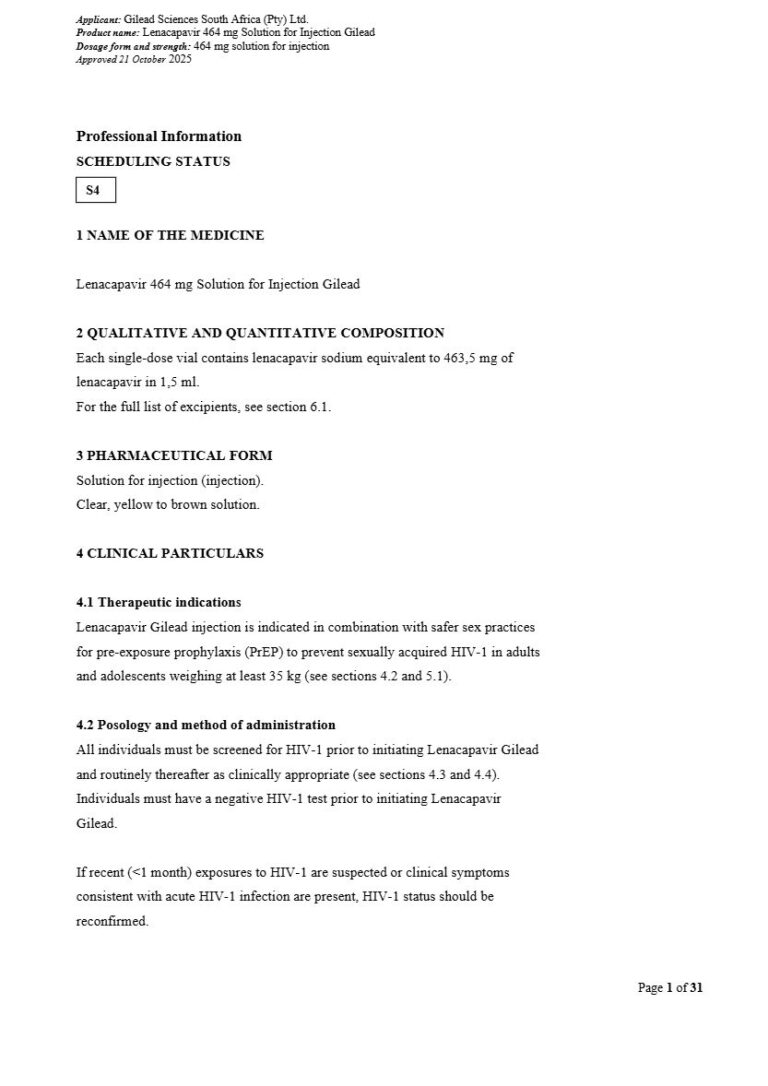
Lenacapavir Gilead injection is indicated in combination with safer sex practices for pre-exposure prophylaxis (PrEP) to prevent sexually acquired HIV-1 in adults and adolescents weighing at least 35 kg (see sections 4.2 and 5.1).
4.2 Posology and method of administration
All individuals must be screened for HIV-1 prior to initiating Lenacapavir Gilead and routinely thereafter as clinically appropriate (see sections 4.3 and 4.4). Individuals must have a negative HIV-1 test prior to initiating Lenacapavir Gilead. If recent (<1 month) exposures to HIV-1 are suspected or clinical symptoms consistent with acute HIV-1 infection are present, HIV-1 status should be reconfirmed.
Prior to starting Lenacapavir Gilead, healthcare professionals should select individuals for whom the required initiation and 6-monthly maintenance injection dosing schedule is appropriate, and counsel individuals about the importance of adherence to scheduled Lenacapavir Gilead dosing visits (see section 4.4).
Posology
The Lenacapavir Gilead dosing schedule in adults and adolescents weighing at least 35 kg consists of a required initiation dosing (subcutaneous injections and oral tablets) followed by once every 6-months maintenance dosing (subcutaneous injections) (Table 1).
Initiation
On Day 1, the required dose is 927 mg of Lenacapavir Gilead administered by subcutaneous injection and 600 mg taken orally. On Day 2, the required dose is 600 mg taken orally. Oral tablets can be taken with or without food (see Lenacapavir Gilead tablet Professional Information).
Maintenance
The required dose is 927 mg of Lenacapavir Gilead administered by subcutaneous injection every 6 months (26 weeks) from the date of the last injection (+/- 2 weeks).
Table 1: Dosing schedule for Lenacapavir Gilead initiation and maintenance
Time
Dose of Lenacapavir Gilead: Initiation
Day 1 927 mg subcutaneous injection (2 x 1.5 ml injections) 600 mg orally (2 x 300 mg tablets)
Day 2 600 mg orally (2 x 300 mg tablets)
Dose of Lenacapavir Gilead: Maintenance
Every 6 Months (26 weeks) +/- 2 weeks 927 mg subcutaneous injection (2 x 1.5 ml injections)
a The complete initiation dosing schedule, consisting of subcutaneous injections and oral tablets, is required; the efficacy of Lenacapavir Gilead has only been established with this dosing schedule.
b Two injections, with the second injection at least 5 centimetres from the first injection (see Method of Administration).
c From the date of the last injection.
Missed dose
Planned missed injections
During maintenance dosing, if an individual plans to miss a scheduled 6-month injection visit by more than 2 weeks, Lenacapavir Gilead tablets may be used for oral bridging on an interim basis (for up to 6 months if needed), until injections resume. Oral bridging should be initiated within 26 to 28 weeks from the last injection. The dosing schedule is 300 mg (1 tablet) taken orally once every 7 days. Resume the maintenance injection dosage within 7 days after the last oral dose (see Table 1).
Unplanned missed injections
During the maintenance period, if more than 28 weeks have elapsed since the last injection and Lenacapavir Gilead tablets have not been taken for oral bridging, restart the initiation dosing schedule from Day 1 (see Table 1).
Special populations
Elderly
No dose adjustment of Lenacapavir Gilead is required for elderly individuals (see section 5.2).
Renal impairment
No dose adjustment of Lenacapavir Gilead is required in individuals with mild, moderate, or severe renal impairment (creatinine clearance [CrCl] u2265 15 mL/min). Lenacapavir Gilead has not been studied in individuals with end stage renal disease (CrCl < 15 mL/min or on renal replacement therapy) (see section 5.2), therefore Lenacapavir Gilead should be used with caution in these individuals.
Hepatic impairment
No dose adjustment of Lenacapavir Gilead is required in individuals with mild or moderate hepatic impairment (Child-Pugh Class A or B). Lenacapavir Gilead has not been studied in individuals with severe hepatic impairment (Child-Pugh Class C) (see section 5.2), therefore Lenacapavir Gilead should be used with caution in these individuals.
Paediatric population
Safety and efficacy of Lenacapavir Gilead has been established in adolescents weighing at least 35 kg.
Method of administration
For subcutaneous use only. Lenacapavir Gilead injections must only be administered subcutaneously into the abdomen or upper buttocks (two injections, with the second injection at least 5 centimetres from the first injection) by a healthcare professional (see section 6.6). Do NOT administer intradermally (see section 4.4). For instructions on preparation and administration, see u2018Instructions for Useu2019 in the package leaflet. u2018Instructions for Useu2019 are also available as a card in the injection kit. A subcutaneous drug depot forms following Lenacapavir Gilead injection. In some individuals, this may lead to a nodule at the injection site (see sections 4.8 and 5.2).
4.3 Contraindications
Hypersensitivity to the active substance or to any of the excipients listed in section 6.1. Use in individuals with unknown HIV-1 status (see section 4.4). Co-administration with strong inducers of CYP3A, P-gp, and UGT1A1, other than rifampicin, such as:
- anticonvulsants: carbamazepine, phenytoin
- herbal products: St. Johnu2019s wort (Hypericum perforatum) (see section 4.5).
4.4 Special warnings and precautions for use
Prevention strategy
Lenacapavir Gilead should only be used to prevent HIV-1 acquisition in individuals confirmed to be HIV-negative. Confirm HIV-1 negative status prior to initiation of Lenacapavir Gilead and routinely thereafter as clinically appropriate in individuals receiving Lenacapavir Gilead. Use Lenacapavir Gilead to prevent HIV-1 acquisition as part of a strategy to reduce the risk of sexually transmitted infections (STIs). Select individuals for whom the required initiation and every 6-month maintenance injection dosing schedule is appropriate. Non-adherence to the required initiation and maintenance dosing schedule (see section 4.2) may lead to HIV-1 acquisition. Counsel and support individuals on adhering to the Lenacapavir Gilead administration schedule, on the use of other measures to prevent STIs, and on the importance of testing for HIV-1 and other STIs.
Risk of resistance
There is a risk of developing resistance to lenacapavir if an individual acquires HIV-1 either before or when receiving Lenacapavir Gilead, or following discontinuation of Lenacapavir Gilead. Lenacapavir Gilead alone does not constitute a complete regimen for HIV-1 treatment. Individuals who are confirmed to have HIV-1 must immediately begin a complete HIV-1 treatment regimen to reduce the risk of developing resistance.
Long-acting properties
Residual concentrations of lenacapavir may remain in the systemic circulation of individuals for prolonged periods (up to 12 months or longer). If Lenacapavir Gilead is discontinued and it is clinically appropriate to continue PrEP, alternative forms of PrEP should be considered and initiated within 28 weeks of the last Lenacapavir Gilead injection.
Injection Site Reactions with Improper Administration
Improper administration (intradermal injection) has been associated with serious injection site reactions, including necrosis and ulcer. Lenacapavir Gilead injections must only be administered subcutaneously (see section 4.2).
4.5 Interactions with other medicines
Co-administration of other medicines
Co-administration with medicinal products that are moderate inducers of CYP3A and P-gp, other than rifabutin, is not recommended (see section 4.5). Co-administration with medicinal products that are strong inhibitors of CYP3A, P-gp, and UGT1A1 together (i.e. all 3 pathways) is not recommended (see section 4.5).
Effect of other medicinal products on the pharmacokinetics of lenacapavir
Lenacapavir is a substrate of CYP3A, P-gp and UGT1A1. Strong inducers of CYP3A, P-gp, and UGT1A1 may significantly decrease plasma concentrations of lenacapavir which may result in reduced effectiveness of Lenacapavir Gilead. Concomitant administration of Lenacapavir Gilead with strong inducers of CYP3A, P-gp, and UGT1A1, other than rifampicin, is contraindicated (see section 4.3); dose adjustment of Lenacapavir Gilead is required if rifampicin is co-administered (see Table 2). Moderate inducers of CYP3A and P-gp may decrease plasma concentrations of lenacapavir. Concomitant administration of Lenacapavir Gilead with moderate inducers of CYP3A and P-gp, other than rifabutin, is not recommended (see section 4.4); dose adjustment of Lenacapavir Gilead is required if rifabutin is co-administered (see Table 2). Strong inhibitors of CYP3A, P-gp and UGT1A1 together (i.e., all 3 pathways) may significantly increase plasma concentrations of lenacapavir, therefore co-administration is not recommended (see section 4.4). Strong CYP3A4 inhibitors alone or strong inhibitors of CYP3A4 and P-gp together do not result in a clinically meaningful increase in lenacapavir exposure.
Effect of lenacapavir on the pharmacokinetics of other medicines
Lenacapavir is a moderate inhibitor of CYP3A and a P-gp inhibitor. Caution is advised if Lenacapavir Gilead is co-administered with a sensitive CYP3A and/or P-gp substrate with a narrow therapeutic index. Lenacapavir is not a clinically meaningful inhibitor of BCRP and does not inhibit OATP.
Use of other medicines after the discontinuation of Lenacapavir Gilead
If Lenacapavir Gilead is discontinued, residual concentrations of lenacapavir may remain in the systemic circulation of individuals for prolonged periods. These concentrations may affect the exposures of other drugs medicines (i.e. sensitive CYP3A and/or P-gp substrates) that are initiated within 9 months after the last subcutaneous dose of Lenacapavir Gilead.
4.6 Fertility, pregnancy and lactation
Pregnancy
A moderate amount of data on pregnant women (369 pregnancy outcomes) indicate no malformative or feto/neonatal toxicity of lenacapavir. The rates of adverse pregnancy outcomes in participants who received Lenacapavir Gilead were similar to reported background rates. Lenacapavir exposures during each trimester of pregnancy and postpartum were comparable to those in non-pregnant participants (see section 5.2). Animal studies do not indicate direct or indirect harmful effects with respect to pregnancy, foetal development, parturition or postnatal development (see section 5.3). The use of Lenacapavir Gilead may be considered during pregnancy, if clinically appropriate.
Breast-feeding
Lenacapavir is present in human milk. Lenacapavir was detected at very low levels in infants who were breastfed by individuals who became pregnant while receiving Lenacapavir Gilead (see section 5.2). No adverse effects of lenacapavir in breastfed infants have been observed. Lenacapavir Gilead can be used during breast-feeding.
Fertility
There are no data on the effects of lenacapavir on human male or female fertility. Animal studies indicate no effects of lenacapavir on male or female fertility (see section 5.3).
4.7 Effects on ability to drive and use machines
Lenacapavir Gilead is expected to have no or negligible influence on the ability to drive and use machines.
4.8 Undesirable effects
Summary of the safety profile
The most common adverse reaction in PURPOSE 1 and PURPOSE 2 was injection site reactions (69 % and 83 % respectively).
Tabulated list of adverse reactions
Frequencies are defined as very common (u22651/10), common (u22651/100 to <1/10), uncommon (u22651/1,000 to <1/100), rare (u22651/10,000 to <1/1,000), very rare (<1/10,000), and not known (cannot be estimated from the available data).
Table 3: Tabulated list of adverse reactions
Frequency a Adverse reactions General disorders and administration site conditions Very common Injection site reactions b
a. Frequency based on all adverse events in PURPOSE 1 and PURPOSE 2 (see section 5.1) attributed to lenacapavir (or to the procedure) by the investigator.
b. Includes injection site nodule, pain, induration, erythema, swelling, pruritus, bruising, warmth, discolouration, oedema, ulcer, haematoma, haemorrhage, and discomfort.
Description of injection-associated adverse reactions
Local injection site reactions (ISRs) PURPOSE 1 In PURPOSE 1, 69 % of participants receiving Lenacapavir Gilead experienced ISRs, compared to 35 % of participants receiving placebo injections (and comparator). Most participants who received Lenacapavir Gilead had mild (Grade 1, 50 %) or moderate (Grade 2, 19 %) severity ISRs. Grade 3 ISRs were reported in 4 (0.2 %) participants, and included ulcer and nodule. Lenacapavir Gilead was discontinued due to ISRs in 4 (0.2 %) participants. None of the ISRs were serious. The incidence of ISRs decreased with subsequent injections. Nodules: Injection site nodule was reported in 64% of participants who received Lenacapavir Gilead and resolved more slowly than other ISRs. The median duration of nodules was 190 (91, 274) days. Of the injection site nodule events associated with Day 1 Lenacapavir Gilead injections, 44% had resolved within a median time of 186 days. Other ISRs: The other ISRs reported in more than 2 % of participants who received Lenacapavir Gilead were pain (31 %), swelling (4 %), induration (4 %), and pruritus (2 %). The median duration of ISRs, excluding nodules and indurations, was 9 (4 to 29) days.
PURPOSE 2 In PURPOSE 2, 83 % of participants receiving Lenacapavir Gilead experienced ISRs, compared to 69 % of participants receiving placebo injections (and comparator). Most participants had mild (Grade 1, 66 %) or moderate (Grade 2, 17 %) severity ISRs. Grade 3 ISRs were reported in 14 (0.6 %) participants, and included ulcer, pain, erythema, oedema, and dermatitis. Lenacapavir Gilead was discontinued due to ISRs in 26 (1.2 %) participants. None of the ISRs were serious. The incidence of ISRs decreased with subsequent injections. Nodules: Injection site nodule was reported in 63 % of participants and resolved more slowly than other ISRs. The median duration of nodules was 183 (89, 274) days. Of the injection site nodule events associated with Day 1 Lenacapavir Gilead injections, 50 % had resolved within a median time of 192 days.
Other ISRs: The other ISRs reported in more than 2 % of participants who received Lenacapavir Gilead were pain (56 %), erythema (17 %), induration (16 %), swelling (7 %), bruising (3 %), pruritus (3 %), and warmth (2 %). The median duration of ISRs, excluding nodules and indurations, was 4 (2 to 8) days.
Paediatric population
The safety of Lenacapavir Gilead was evaluated in 59 adolescents aged 16 to <18 years and weighing u226535 kg in PURPOSE 1 and PURPOSE 2. The adverse reactions in adolescents were consistent with those in adults.
Reporting of suspected adverse reactions
Reporting suspected adverse reactions after authorisation of the medicine is important. It allows continued monitoring of the benefit/risk balance of the medicine. Health care professionals are asked to report any suspected adverse reactions to SAHPRA via the Med Safety APP (Medsafety X SAHPRA) and eReporting reporting platform (who-umc.org) found on SAHPRA website.
4.9 Overdose
If overdose occurs the individual must be monitored for signs or symptoms of adverse reactions (see section 4.8). Treatment of overdose with Lenacapavir Gilead consists of general supportive measures including monitoring of vital signs as well as observation of the clinical status of the individual. As lenacapavir is highly protein bound, it is unlikely to be significantly removed by dialysis.
