
Biltricide 600 mg Tablets
PDF Leaflet Revision Date: 24 July 2024
Clinical Summary
Quick overview from the medicine insert
Indication
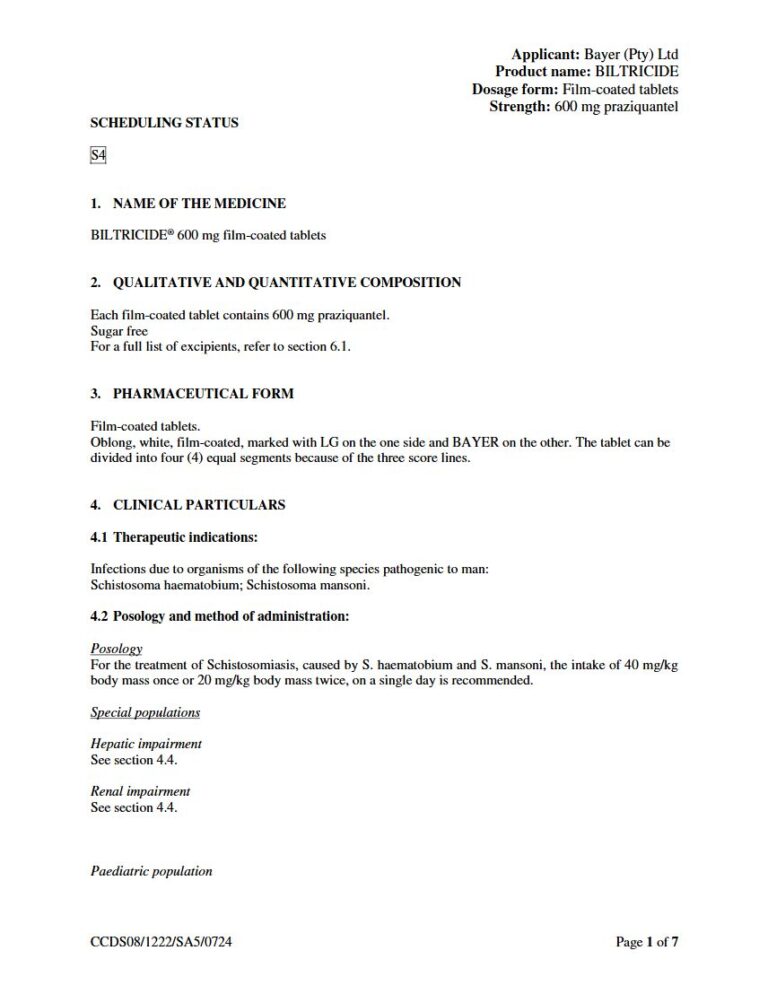
Treatment of Schistosomiasis caused by S. haematobium and S. mansoni.
Dosage (summary)
40 mg/kg body mass once or 20 mg/kg twice on a single day.
Onset of Action / Duration
Onset: 1-2 hours, Duration: 4-6 hours
Special Populations
- Hepatic impairment
- Renal impairment
Pregnancy & Breastfeeding
Not recommended in first trimester; breastfeeding should be paused during treatment.
Key Drug Interactions
- Strong inducers of Cytochrome P450
- Efavirenz
- Grapefruit juice
Contraindications
- Hypersensitivity to praziquantel
- Ocular cysticercosis
Common side effects
- Headache
- Dizziness
- Nausea
- Vomiting
- Fatigue
Counselling Points
- Take with liquid during or after meals
- Do not drive or operate machinery on treatment day
Serious warnings
- Caution in liver insufficiency
- Potential for life-threatening reactions in acute schistosomiasis
Important Disclaimer
The Biltricide 600 mg Tablets professional information leaflet below is the property of Bayer and is provided on Medinsert exactly as issued, with no.. alterations or editorial changes. We make every effort to keep content current by updating documents as soon as new versions become available. Medinsert serves as a trusted access point for healthcare professionals, but does not replace official sources or clinical judgement. For more details, please read our full disclaimer. read more>>
 Healthcare Professionals Only
This content is for registered healthcare professionals
Sign in or create a free account to read the full package insert.
Free for HPCSA-registered professionals. Powered by Medinsert.
Clinical Particulars
Section 4 of the official insert — extracted exactly as issued, no alterations
4.1 Therapeutic indications
Infections due to organisms of the following species pathogenic to man: Schistosoma haematobium; Schistosoma mansoni.
4.2 Posology and method of administration
Posology
For the treatment of Schistosomiasis, caused by S. haematobium and S. mansoni, the intake of 40 mg/kg body mass once or 20 mg/kg body mass twice, on a single day is recommended.
Special populations
Hepatic impairment
See section 4.4.
Renal impairment
See section 4.4.
Paediatric population
Post-marketing experience indicates that children (1-17 years of age) may experience similar side effects as adults during praziquantel treatment. The safety profile of children younger than 1 year of age has not been established.
Method of Administration
For oral use. BILTRICIDE film-coated tablets should be swallowed whole with a little liquid, preferably during or after meals. With single daily doses; it is recommended to take the film-coated tablets in the evening. If ingestion of tablets several times a day is prescribed, the interval between administrations should not be less than 4 hours and not more than 6 hours.
Special monitoring advice: When broken, each of the four segments of the tablet contains 150 mg of praziquantel, so that the dosage can be easily adjusted to the patient's body weight.
4.3 Contraindications
BILTRICIDE must not be used in cases of known hypersensitivity to praziquantel or to any of the excipients. BILTRICIDE should not be taken during the first trimester of pregnancy (see section 4.6). Since parasite destruction within the eye may cause irreversible lesions, ocular cysticercosis must not be treated with this compound. The concomitant administration of strong inducers of Cytochrome P450 such as rifampicin must be avoided as therapeutically effective plasma levels may not be achieved (see section 4.5).
4.4 Special warnings and precautions for use
In uncompensated liver insufficiency and in patients with hepatosplenic schistosomiasis, caution should be taken, since due to reduced medicine metabolisation in the liver, considerably higher and longer lasting concentrations of unmetabolised BILTRICIDE can occur in vascular and/or collateral circulation, leading to prolonged plasma half-life. If necessary, the patient should be hospitalised for the duration of the treatment.
Published in vitro data have shown a potential lack of efficacy of praziquantel against migrating schistosomulae. Data from two observational cohort studies in patients indicate that treatment with praziquantel in the acute phase of infection may not prevent progression into chronic phase.
In addition, the use of praziquantel in patients with schistosomiasis may be associated with clinical deterioration (paradoxical reactions, serum sickness Jarisch-Herxheimer like reactions: sudden inflammatory immune response suspected to be caused by the release of schistosomal antigens). These reactions predominantly occur in patients treated during the acute phase of schistosomiasis. They may lead to potentially life-threatening events, e.g. respiratory failure, encephalopathy, and/or cerebral vasculitis.
The concomitant administration of praziquantel with efavirenz, a strong inducer of cytochrome P 450 should be avoided as therapeutically effective plasma levels of praziquantel may not be achieved (see section 4.5). Since 80% of BILTRICIDE and its metabolites are excreted in the kidneys, excretion might be delayed in patients with impaired renal function. Patients suffering from cardiac irregularities should be monitored during treatment. When schistosomiasis or fluke infection is found in patients living in or coming from areas with endemic human cysticercosis, it is advised to hospitalise the patient for the duration of treatment. As BILTRICIDE can exacerbate central nervous system pathology due to schistosomiasis, paragonimiasis or Taenia solium cysticercosis, as a general rule this medicine should not be administered to individuals reporting a history of epilepsy and/or other signs of potential central nervous systems involvement such as subcutaneous nodules suggestive of cysticercosis. The patientu2019s ability to drive or to operate machinery may be temporarily impaired. (See section 4.7) Caution should be exercised where there is a possibility of a simultaneous occurrence of both Schistosomiasis and CNS-cysticercosis infection, as cerebral cysticercosis requires hospital-based treatment by a specialist.
4.5 Interactions with other medicines and other forms of interactions
Effects of other medicines on praziquantel
Concomitant administration of medicines decreasing the activity of drug metabolising liver enzymes (cytochrome P450) e.g. cimetidine, ketoconazole, itraconazole, erythromycin and ritonavir may increase plasma levels of BILTRICIDE. When administered concomitantly with grapefruit juice, an increase in praziquantel exposure of less than twofold was observed in clinical studies. Concomitant administration of medicines increasing the activity of drug metabolising liver enzymes (cytochrome P450), e.g. antiepileptic medicines and dexamethasone may reduce plasma levels of BILTRICIDE. Concomitant administration of strong inducers of cytochrome P450 such as rifampicin must be avoided. (see section 4.3). Concomitant administration with efavirenz should be avoided as therapeutically effective plasma levels of praziquantel may not be achieved (see section 4.4) and no dosage recommendation for praziquantel can be given due to missing pharmacokinetic and safety data. Therapeutic alternatives to praziquantel should be considered.
4.6 Fertility, pregnancy and lactation
Pregnancy
Safety in pregnancy has not been established.
Breastfeeding
BILTRICIDE appears in the milk of breastfeeding women at a concentration of 20 - 25 % of maternal serum. It is not known whether a pharmacological effect is likely to occur in children. For short-term therapy breastfeeding should be discontinued for the day(s) of treatment and for the following 24 hours.
4.7 Effects on ability to drive and use machines
Because of possible effects on vigilance, patients should be warned not to drive a car and not to operate machinery on the day of treatment (and during the subsequent 24 hours).
4.8 Undesirable effects
Side effects vary according to dose and duration of BILTRICIDE; furthermore, they are dependent on the parasite species, extent of parasitisation, duration of infection and localisation of the parasites in the body. Adverse Reactions are based on publications and on spontaneous reports sorted by CIOMS III categories of frequency and MedDRA System Organ Classes (in internationally agreed order). Frequencies of Adverse Reactions are mainly based on data from the medical literature. Status: 2004 (publication year of last literature source used).
Very Common uf0b3 10%
Common uf0b3 1% to 10%
Uncommon uf0b3 0.1% to <1%
Rare uf0b3 0.01% to <0.1%
Very Rare <0.01%
Immune System Disorders
Allergic reaction
Polyserositis
Eosinophilia
Nervous System Disorders
Headache
Dizziness
Vertigo
Somnolence
Seizures
Cardiac Disorders
Unspecific dyshythmias
Gastrointestinal Disorders
Gastrointestinal and abdominal pains
Nausea
Vomiting
Anorexia
Diarrhoea
Bloody diarrhoea
Skin and Subcutaneous Tissue Disorders
Urticaria
Rash
Pruritus
Musculoskeletal, Connective Tissue and Bone Disorders
Myalgia
General Disorders and Administration Site Conditions
Fatigue
Asthenia
Feeling unwell
Reporting suspected adverse reactions after authorisation of the medicine is important. It allows continued monitoring of the benefit/risk balance of the medicine. Healthcare professionals are asked to report any suspected adverse reactions to SAHPRA via the u201c6.04 Adverse Drug Reaction Reporting Formu201d, found online under SAHPRAu2019s publications: https://www.sahpra.org.za/Publications/Index/8
4.9 Overdosage
Pronounced dizziness, u201chang - overu201d feelings. There is no specific antidote and symptomatic measures should be applied. No data are available in humans. In the event of overdose, a fast-acting laxative should be given.
