
Bisolvon 0.2 % Solution
PDF Leaflet Revision Date: 17/03/2022
Clinical Summary
Quick overview from the medicine insert
Indication
Symptomatic relief of cough with excessive sputum production.
Dosage (summary)
Adults: 5-10 mL three times daily; Children: 2.5-5 mL three times daily.
Special Populations
- Elderly
- Renal impairment
- Hepatic impairment
Pregnancy & Breastfeeding
Avoid during pregnancy; not recommended during breastfeeding.
Key Drug Interactions
- Cough suppressants
- Opioids analgesics
Contraindications
- Hypersensitivity to bromhexine
Common side effects
- Dizziness
- Headache
- Nausea
- Rash
Counselling Points
- Expect increased secretions
- Do not exceed 5 days without medical advice
Serious warnings
- Severe skin reactions possible
- Use with caution in peptic ulceration
Important Disclaimer
The Bisolvon 0.2 % Solution professional information leaflet below is the property of Sanofi-Aventis South Africa and is provided on Medinsert exactly as issued, with no.. alterations or editorial changes. We make every effort to keep content current by updating documents as soon as new versions become available. Medinsert serves as a trusted access point for healthcare professionals, but does not replace official sources or clinical judgement. For more details, please read our full disclaimer. read more>>
 Healthcare Professionals Only
This content is for registered healthcare professionals
Sign in or create a free account to read the full package insert.
Free for HPCSA-registered professionals. Powered by Medinsert.
Clinical Particulars
Section 4 of the official insert — extracted exactly as issued, no alterations
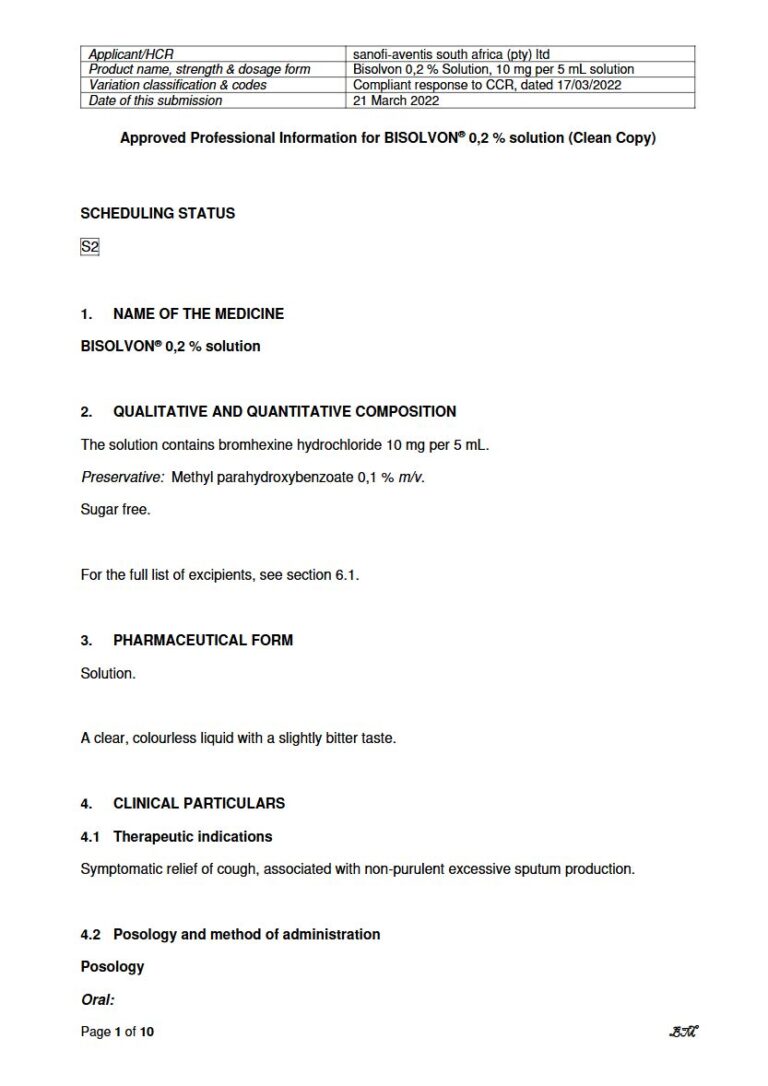
4.1 Therapeutic indications
Symptomatic relief of cough, associated with non-purulent excessive sputum production.
4.2 Posology and method of administration
Posology
Oral:
Adults and children over 10 years: 5 - 10 mL three times a day.
Children under 10 years: 2,5 - 5 mL three times a day.
Inhalation from a respirator:
Adults: 4 mL twice a day.
Children over 12 years: 2 mL twice a day.
Children over 6 to u2264 12 years: 1 mL twice a day.
Children 2 to u2264 6 years: 10 drops twice a day.
Children under 2 years: 5 drops twice a day.
Warming the solution prevents the possible occurrence of an initial irritating cough. If the preparation is used in the presence of bronchospasm, a bronchodilator should first be administered. The solution may be diluted 1:1 with physiological saline solution. In order to avoid precipitation the solution should be inhaled immediately after mixing.
Note: Patients being treated with BISOLVON 0,2 % solution should be notified of an expected increase in the flow of secretions. The duration of treatment should be determined on an individual basis depending on the response. BISOLVON 0,2% solution should not be taken for more than 5 days without medical advice.
Special populations
Paediatric population: See the paediatric dosage stated above. BISOLVON 0,2 % solution is not recommended for children 2 years or less (see section 4.4). The elderly, and patients with renal and hepatic impairment. There are no data for bromhexine pharmacokinetics in the elderly or in patients with renal or liver insufficiency.
4.3 Contraindications
Hypersensitivity to bromhexine or the excipients of the formulation listed in section 6.1.
4.4 Special warnings and precautions for use
There have been reports of severe skin lesions such as Stevens Johnson syndrome and Lyellu2019s syndrome in temporal association with the administration of secretolytic substances such as bromhexine, as contained in BISOLVON 0,2 % solution. Mostly these could be explained by the severity of the underlying disease or concomitant medication. If new skin or mucosal lesions occur, medical advice should be sought immediately and treatment with BISOLVON 0,2 % solution discontinued as a precaution.
Bromhexine should be used with caution in patients with a history of, or existing, peptic ulceration. Care is advisable in asthmatic patients. Concomitant administration with cough suppressants such as opioids analgesics is not recommended. In patients with impaired renal function or severe liver disease BISOLVON 0,2 % solution must be used with particular caution (i.e. at reduced doses or longer dosing intervals). See section 4.2. In patients with severe renal impairment, accumulation of the metabolites of bromhexine which are formed in the liver can be expected to occur. See section 4.2.
Occasional monitoring of liver function is advisable, especially on longer-term use. BISOLVON 0,2 % solution must not be given to children under 2 years except under medical supervision. BISOLVON 0,2 % solution contains 5 mg of the excipient methyl parahydroxybenzoate in each 5 mL of oral solution, which may cause allergic reactions (possibly delayed).
4.5 Interaction with other medicines and other forms of interaction
Concomitant administration of BISOLVON 0,2 % solution and cough suppressants may lead to the development of a dangerous accumulation of secretions owing to attenuation of the cough reflex and should be undertaken only after very careful risk-benefit assessment.
4.6 Fertility, pregnancy and lactation
Pregnancy
There are limited data from the use of bromhexine in pregnant women. Animal studies do not indicate direct or indirect harmful effects with respect to reproductive toxicity. As a precaution, the use of bromhexine should be avoided during pregnancy.
Breastfeeding
Bromhexine has been shown to be excreted in the milk in animal studies. Use during lactation is not recommended.
Fertility
No studies on the effect of BISOLVON 0,2 % solution on fertility have been performed. There is no evidence from the available preclinical studies to suggest that bromhexine has any effect on fertility.
4.7 Effects on ability to drive and use machines
BISOLVON 0,2 % solution may cause dizziness. Patients experiencing dizziness should avoid driving and use of machines.
4.8 Undesirable effects
The frequency of undesirable effects is defined using the following convention: Very common (u2265 1/10); common (u2265 1/100, < 1/10); uncommon (u2265 1/1000, < 1/100); rare (u2265 1/10 000, < 1/1000); very rare (< 1/10 000). Not known (Frequency cannot be estimated from the available data).
System organ class
- Very common (u2265 1/10)
- Common (u2265 1/100 to < 1/10)
- Uncommon (u2265 1/1,000 to <1/100)
- Rare (u2265 1/10,000 to < 1/1 000)
- Not known
Immune system disorders
- Hypersensitivity reactions X
- Anaphylactic reactions including shock, angioedema and pruritis X
Nervous system disorders
- Headache X
- Dizziness X
- Sweating X
Respiratory, thoracic and mediastinal disorders
- Bronchospasm X
- Dyspnoea (as a symptom of a hypersensitive reaction) X
Gastrointestinal disorders
- Nausea X
- Abdominal pain (especially upper abdominal pain) X
- Vomiting X
- Diarrhoea X
Skin and subcutaneous tissue disorders
- Rash X
- Urticaria X
- Severe cutaneous adverse reactions including erythema multiforme, Steven-Johnson syndrome/ toxic epidermal necrolysis and acute exanthematous pustulosis X
General disorders and administration site conditions
- Fever X
Methyl parahydroxybenzoate may cause hypersensitivity reactions (possibly delayed).
Reporting of suspected adverse reactions
Reporting suspected adverse reactions after authorisation of BISOLVON 0,2 % solution is important. It allows continued monitoring of the benefit/risk balance of BISOLVON 0,2 % solution. Health care providers are asked to report any suspected adverse reactions to SAHPRA via the u201c6.04 Adverse Drug Reactions Reporting Formu201d, found online under SAHPRAu2019s publications: u2022 https://www.sahpra.org.za/Publications/Index/8 , or to the u2022 Pharmacovigilance Unit at Sanofi at [email protected] (email) or 011 256 3700 (tel).
4.9 Overdose
Symptoms of overdose
No hazardous symptoms of overdose are known to have occurred in man to date. The symptoms which have been observed on accidental or deliberate overdose to date are identical with the known undesirable effects and may require symptomatic treatment.
Management of overdose
Following massive overdose, cardiovascular monitoring and, where appropriate, symptomatic treatment are indicated. In view of the low toxicity of bromhexine, more intensive measures to reduce absorption or accelerate elimination are generally not required. In addition, the pharmacokinetic profile of bromhexine is characterised by a high distribution volume, slow redistribution processes and a high level of protein binding and elimination is therefore unlikely to be significantly affected by dialysis or forced diuresis.
In children aged 2 years and above, symptoms are likely to be relatively mild even after ingestion of quite large amounts of bromhexine hydrochloride and decontamination is therefore not required where the amount ingested is less than 80 mg (e.g. 40 mL BISOLVON 0,2 % solution). The corresponding threshold in children aged under 2 years is 60 mg (6 mg/kg). In one published case review, it was reported that vomiting occurred in 4 out of 25 cases where excessive doses of bromhexine had been taken and that 3 young children had experienced impaired consciousness, ataxia, diplopia, mild metabolic acidosis and tachypnoea. Young children remained symptom-free, even, without decontamination after ingesting up to 40 mg bromhexine.
