
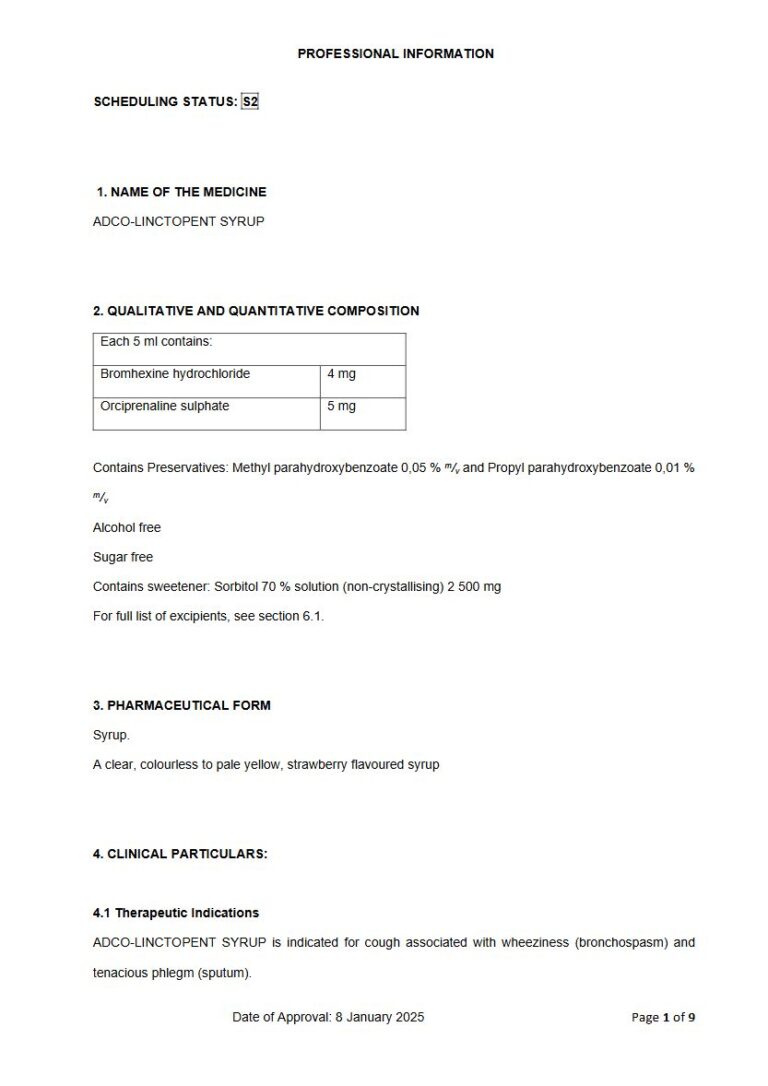
Adco-Linctopent Syrup
PDF Leaflet Revision Date: 8 January 2025
Clinical Summary
Quick overview from the medicine insert
Indication
Cough associated with wheeziness and tenacious phlegm.
Dosage (summary)
Adults: 10-20 ml three times daily; Children 3-12 years: 5-10 ml; 1-3 years: 2.5-5 ml; Infants: 2.5 ml.
Onset of Action / Duration
Onset: 15 mins, Duration: Not specified.
Special Populations
- Elderly
- Hepatic impairment
- Renal impairment
Pregnancy & Breastfeeding
Safety not established; may inhibit uterine contractions.
Key Drug Interactions
- MAOIs
- Beta-blockers
- Cardiac glycosides
- Corticosteroids
Contraindications
- Hypersensitivity
- Thyrotoxicosis
- Hypertrophic obstructive cardiomyopathy
- Pregnancy
- Breastfeeding
Common side effects
- Allergic reactions
- Hypokalaemia
- Nervousness
- Tachycardia
- Gastric irritation
Counselling Points
- Shake before use
- Avoid driving if drowsy
- Do not exceed recommended dose
Serious warnings
- Caution in asthmatics
- Risk of hypokalaemia
- May induce ventricular fibrillation with certain anesthetics
Important Disclaimer
The Adco-Linctopent Syrup professional information leaflet below is the property of Adcock Ingram and is provided on Medinsert exactly as issued, with no.. alterations or editorial changes. We make every effort to keep content current by updating documents as soon as new versions become available. Medinsert serves as a trusted access point for healthcare professionals, but does not replace official sources or clinical judgement. For more details, please read our full disclaimer. read more>>
 Healthcare Professionals Only
This content is for registered healthcare professionals
Sign in or create a free account to read the full package insert.
Free for HPCSA-registered professionals. Powered by Medinsert.
Clinical Particulars
Section 4 of the official insert — extracted exactly as issued, no alterations
4.1 Therapeutic Indications
ADCO-LINCTOPENT SYRUP is indicated for cough associated with wheeziness (bronchospasm) and tenacious phlegm (sputum).
4.2 Posology and method of administration
Posology
Adults and children over 12 years : 10 to 20 ml three times daily.
Children 3 to 12 years : 5 to 10 ml three times daily.
Children 1 to 3 years: 2,5 to 5 ml three times daily.
Infants : 2,5 ml three times daily.
DO NOT EXCEED THE RECOMMENDED DOSE.
Method of administration
For oral use only.
Shake the bottle before use
4.3. Contraindications
- Hypersensitivity to bromhexine hydrochloride, orciprenaline citrate or any of the other ingredients (see section 6.1)
- Thyrotoxicosis.
- Hypertrophic obstructive cardiomyopathy, and tachyarrhythmia.
- If the patient receives a monoamine oxidase inhibitor (MAOI) or within 14 days of MAOI treatment termination since sympathomimetics, such as orciprenaline sulphate, may interact with MAOIs.
- Pregnancy or breastfeeding.
4.4 Special warnings and precautions for use
Bromhexine hydrochloride:
Caution should be observed in patients with gastric ulcers due to the mucolytic action of bromhexine hydrochloride.
Care should be taken in asthmatic patients.
Clearance of bromhexine or its metabolites may be reduced in patients with severe hepatic or renal impairment.
Orciprenaline sulphate:
Other sympathomimetic bronchodilators should only be used with ADCO- LINCTOPENT SYRUP under strict medical supervision. However, anticholinergic bronchodilators may be inhaled at the same time.
Careful consideration should be given before administering ADCO- LINCTOPENT SYRUP to the elderly.
Hypokalaemia may be induced by higher than recommended doses of beta- agonists, especially in patients receiving digitalis glycosides or diuretics or are prone to cardiac dysrhythmias.
Caution should be exercised in patients suffering from hyperthyroidism due to sympathomimetic effects of orciprenaline sulphate.
In addition, care should be observed in patients suffering from cardiovascular diseases i.e., ischaemic heart disease, arrhythmias, or tachycardia, occlusive vascular disorders including arteriosclerosis, hypertension, aneurysms, pheochromocytoma, prostatism, and in patients who are unusually responsive to sympathomimetic amines.
Anginal pain may be precipitated in patients suffering from angina pectoris.
Care is also required when ADCO-LINCTOPENT SYRUP is given to patients with diabetes mellitus or closed angle glaucoma.
Caution is also needed in patients with convulsive disorders.
This medicine contains 1750 mg sorbitol in each 5 ml which is equivalent to 0,35 g/ml.
ADCO-LINCTOPENT SYRUP contains parahydroxybenzoates which may cause allergic reactions (possibly delayed).
ADCO-LINCTOPENT SYRUP contains 250 mg propylene glycol in each 5 ml dose which is equivalent to 50 mg per ml. If your baby is less than 4 weeks old, talk to your doctor or pharmacist before giving them ADCO-LINCTOPENT SYRUP, in particular if the baby is given other medicines that contain propylene glycol or alcohol. If your child than 5 years old, talk to your doctor or pharmacist before giving them ADCO-LINCTOPENT SYRUP, in particular if they use other medicines that contain propylene glycol or alcohol.
4.5. Interaction with other medicines and other forms of interaction
- The concomitant use of other sympathomimetic medicines, anticholinergics, and xanthine derivatives (such as theophylline) should be carefully controlled to avoid potentiation of effects.
- A potentially serious reduction in bronchodilation may occur during concomitant administration of beta- blockers. ADCO-LINCTOPENT SYRUP should not be administered concomitantly with beta-blocking medicines, due to orciprenaline sulphate's reversal of antihypertensive action.
- A reduction in dose of cardiac glycosides (e.g., digitalis), and quinidine might become necessary in patients suffering from congestive cardiac failure because of the positive inotropic effect of orciprenaline sulphate.
- An increased risk of arrhythmias may also occur if given to patients receiving cardiac glycosides, quinidine, or tricyclic antidepressants.
- With the concomitant administration of corticosteroids and ADCO-LINCTOPENT SYRUP, the risks of hypokalaemia, hyperglycaemia, and pulmonary oedema are increased.
- ADCO-LINCTOPENT SYRUP should be avoided or used with caution in patients undergoing anaesthesia with cyclopropane, halothane, or other halogenated anaesthetics, as it may induce ventricular fibrillation.
4.6. Fertility, pregnancy and lactation
Safety in pregnancy and lactation has not been established. ADCO-LINCTOPENT SYRUP may inhibit uterine contractions in pregnancy. No fertility data available.
4.7. Effects on ability to drive and use machines
ADCO-LINCTOPENT SYRUP may lead to drowsiness and impaired concentration that may be aggravated by the simultaneous intake of alcohol or other central nervous system depressants. Patients should be advised, particularly at the initiation of therapy, against taking charge of vehicles or machinery or performing potentially hazardous tasks where loss of concentration could lead to accidents.
4.8 Undesirable effects
a. Summary of the safety profile
The undesirable effects listed are based on the MedDRA system organ classes (SOC) classification system. The frequency groupings listed conform to the following convention: Frequent (u22651/10); common; Less frequent (u22651/1 000 to <1/100); rare (u22651/10 000 to <1/1 000); very rare (<1/10 000) and unknown (cannot be estimated from the available data).
b. Tabulated list of adverse reactions
| System organ class | Frequency | Undesirable effect |
|---|---|---|
| Immune system disorders | Frequent | Allergic reactions, especially in hypersensitive patients. |
| Immune system disorders | Less frequent | Anaphylaxis |
| Metabolism and nutritional disorders | Frequent | Potentially serious hypokalaemia may occur. |
| Metabolism and nutritional disorders | Unknown | Disturbances of glucose metabolism. Cases of lactic acidosis have been reported. |
| Endocrine disorders | Unknown | A transient rise in serum aminotransferase values has been reported |
| Psychiatric disorders | Frequent | Nervousness |
| Psychiatric disorders | Less frequent | Psychological alterations including fear, anxiety, excitement, restlessness, insomnia, confusion, irritability, and psychotic states. |
| Nervous system disorders | Frequent | Fine tremor of skeletal muscles, headache, and dizziness. |
| Nervous system disorders | Less frequent | Weakness |
| Cardiac disorders | Frequent | Tachycardia, arrhythmia, palpitations. |
| Cardiac disorders | Less frequent | Decrease in diastolic blood pressure and an increase in systolic blood pressure, particularly after higher doses. |
| Cardiac disorders | Unknown | Hypertension, anginal pain, cardiac arrest, hypotension with dizziness, fainting and flushing. |
| Respiratory, thoracic and mediastinal disorders | Less frequent | Bronchospasm |
| Respiratory, thoracic and mediastinal disorders | Unknown | Feeling of tightness in the chest, dyspnoea, or asthma exacerbation. |
| Gastrointestinal disorders | Frequent | Gastric irritation, nausea, vomiting. |
| Gastrointestinal disorders | Less frequent | Diarrhoea |
| Gastrointestinal disorders | Unknown | Reduced appetite, unpleasant taste, and hypersalivation |
| Skin and subcutaneous tissue disorders | Frequent | Skin reactions |
| Skin and subcutaneous tissue disorders | Less frequent | Skin rashes, angioedema, urticaria, sweating |
| Musculoskeletal, connective tissue and bone disorders | Frequent | Myalgia/muscle cramps or twitching. |
| Renal and urinary disorders | Unknown | Difficulty in micturition and urinary retention. |
Reporting of suspected adverse reactions
Reporting suspected adverse reactions after authorisation of the medicine is important. It allows continued monitoring of the benefit/risk balance of the medicine. Health care providers are asked to report any suspected adverse reactions to SAHPRA via the Med Safety APP (X SAHPRA) found on SAHPRA website and eReporting platform (who-umc.org) found on SAHPRA website. Adverse Drug Reactions may also be reported to Adcock Ingram Limited using the following email: [email protected]
4.9 Overdose
The expected symptoms with overdosage are those of excessive beta-adrenergic stimulation with the most prominent being tachycardia, central nervous system stimulation, palpitations, tremor, hypertension, hypokalaemia, hyperglycaemia, hypotension, widening of the pulse pressure, anginal pain, arrythmias and flushing. Treatment should be symptomatic and supportive. The administration of a cardio-selective beta-adrenergic blocking agent may be necessary to effectively antagonise the bronchodilator action of orciprenaline sulphate and for the management of cardiac arrhythmias. However, beta-blocker administration should be used with caution because it could induce severe bronchospasm or an asthma attack. In asthmatics the use of a cardio-selective beta-blocker such as atenolol or acebutolol is preferred.
