
Cardura Xl 4 mg / 8 mg FC tablets
PDF Leaflet Revision Date: 23 February 2024
Clinical Summary
Quick overview from the medicine insert
Indication
Treatment of mild to moderate hypertension and symptoms of benign prostatic hyperplasia (BPH).
Dosage (summary)
Initial: 4 mg once daily; may increase to 8 mg based on response.
Special Populations
- Elderly
- Renal impairment
- Hepatic impairment
Pregnancy & Breastfeeding
Not established; doxazosin transfers into breast milk.
Key Drug Interactions
- CYP 3A4 inhibitors
- PDE-5 inhibitors
Contraindications
- Hypersensitivity to doxazosin
- Pregnancy and lactation
- Gastrointestinal obstruction
Common side effects
- Dizziness
- Headache
- Hypotension
- Palpitations
Counselling Points
- Take with food
- Avoid sudden position changes
- Report prolonged erections
Serious warnings
- Postural hypotension
- Priapism
- Cataract surgery risks
Important Disclaimer
The Cardura Xl 4 mg / 8 mg FC tablets professional information leaflet below is the property of Upjohn South Africa and is provided on Medinsert exactly as issued, with no.. alterations or editorial changes. We make every effort to keep content current by updating documents as soon as new versions become available. Medinsert serves as a trusted access point for healthcare professionals, but does not replace official sources or clinical judgement. For more details, please read our full disclaimer. read more>>
 Healthcare Professionals Only
This content is for registered healthcare professionals
Sign in or create a free account to read the full package insert.
Free for HPCSA-registered professionals. Powered by Medinsert.
Clinical Particulars
Section 4 of the official insert — extracted exactly as issued, no alterations
4.1 Therapeutic indications
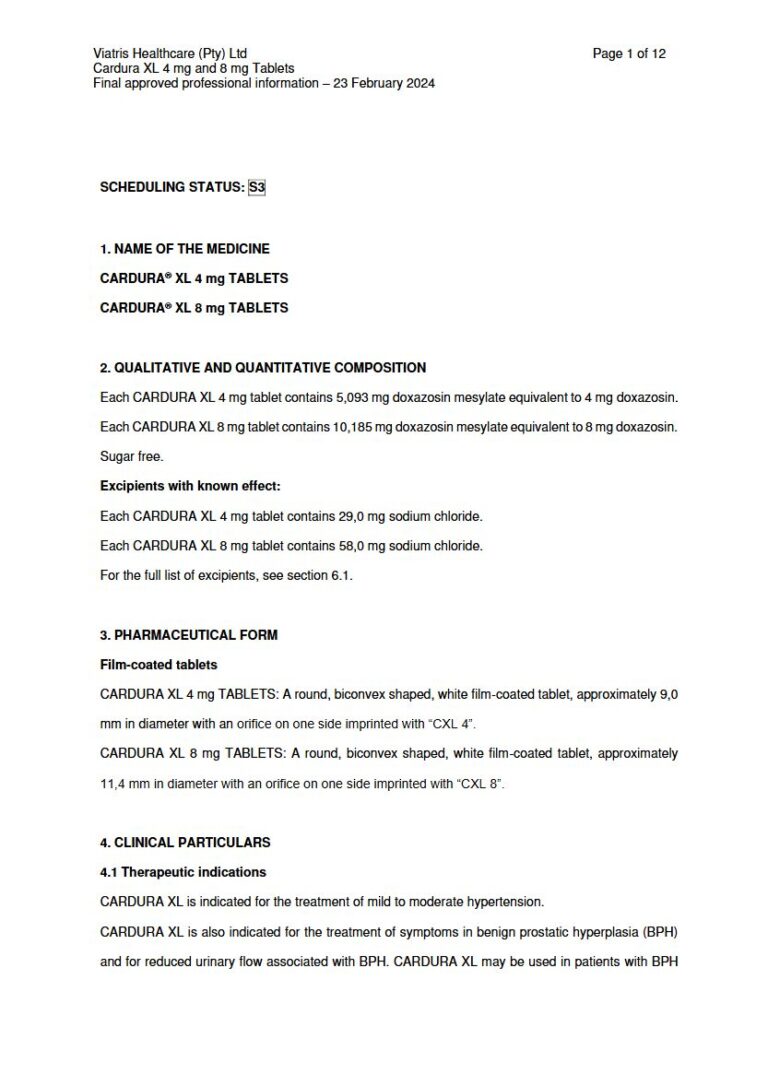
CARDURA XL is indicated for the treatment of mild to moderate hypertension. CARDURA XL is also indicated for the treatment of symptoms in benign prostatic hyperplasia (BPH) and for reduced urinary flow associated with BPH. CARDURA XL may be used in patients with BPH who are either hypertensive or normotensive.
4.2 Posology and method of administration
Posology
The initial dose of CARDURA XL in patients with hypertension and/or BPH is 4 mg once daily in the morning with food. Depending on the patientu2019s symptomatic response and tolerability, the dose may be increased to 8 mg, the maximum recommended dose. If CARDURA XL is discontinued for several days, therapy should be restarted using a 4 mg once daily dose. If switching from CARDURA to CARDURA XL, therapy should be initiated with the lowest dose (4 mg once daily). Prior to starting therapy with CARDURA XL, the final evening dose of CARDURA should not be taken.
Hypertension
The majority of patients will be controlled on CARDURA XL 4 mg daily. If necessary, the dosage may be increased to 8 mg once daily according to patient response. In patients not adequately controlled on a single antihypertensive medicine, CARDURA XL may be used in combination with a thiazide diuretic or a beta-adrenoceptor blocking medicine.
Benign prostatic hyperplasia
The recommended dosage of CARDURA XL is 4 mg once daily. Depending on the individual patient's urodynamics and BPH symptomatology, dosage may then be increased to 8 mg daily. The recommended titration interval is 3 u2013 4 weeks. Blood pressure should be evaluated routinely in these patients.
Special populations
Elderly population
Normal adult dosage is recommended. Due to an enhanced propensity to orthostasis in the elderly, or to an increased sensitivity to vasodilator medicines in the elderly, caution should be exercised in prescribing CARDURA XL to elderly patients, especially those who are u2265 70 years of age (see section 5.2).
Renal impairment
Since the pharmacokinetics of doxazosin is unchanged in patients with renal insufficiency, and there is no evidence that CARDURA XL aggravates existing renal dysfunction, the usual dosages may be used in these patients.
Hepatic impairment
There are only limited data in patients with liver impairment and on the effects of medicines known to influence hepatic metabolism (e.g. cimetidine). Doxazosin is wholly metabolised by the liver and should be administered with caution to patients with evidence of impaired hepatic function.
Paediatric population
The safety and efficacy of CARDURA XL in children have not been established.
Method of administration
For oral use. CARDURA XL should be taken with food. The tablets should be swallowed whole with a sufficient amount of liquid and must not be chewed, divided, cut, or crushed. In CARDURA XL, the medicine is contained within a non-absorbable shell that has been specially designed to slowly release the medicine. When this process is completed, the empty tablet is eliminated from the body. Patients should be advised that they should not be concerned if they occasionally observe the empty tablet in the stools.
4.3 Contraindications
CARDURA XL is contraindicated in:
u2022 Patients with a known hypersensitivity to doxazosin, quinazolines or any of the excipients (listed in section 6.1).
u2022 Pregnancy and lactation (see section 4.6).
u2022 Patients with a history of gastrointestinal obstruction, oesophageal obstruction, or any degree of decreased lumen diameter of the gastrointestinal tract.
4.4 Special warnings and precautions for use
Postural hypotension/syncope
Postural hypotension may occur with initiation of therapy with CARDURA XL, evidenced by dizziness and weakness or rarely loss of consciousness (syncope) particularly with the commencement of therapy. When instituting therapy with CARDURA XL, the patient should be advised on how to avoid symptoms resulting from postural hypotension and what measures to take should they develop. Patients should be warned about this. The patient should be cautioned to avoid situations where injury could result should dizziness or weakness occur during the initiation of CARDURA XL therapy.
Use with phosphodiesterase-5 (PDE-5) inhibitors
Concomitant administration of CARDURA XL with a PDE-5 inhibitor should be used with caution as it may lead to symptomatic hypotension in some patients. No studies have been conducted with doxazosin Gastrointestinal Therapeutic System (GITS).
Impaired hepatic function
CARDURA XL should be administered with particular caution to patients with evidence of impaired hepatic function (see sections 4.2 and 5.2).
Cataract surgery
Intraoperative Floppy Iris Syndrome (IFIS) has been observed during cataract surgery in some patients on or previously treated with alpha-1 adrenoceptor blockers. This variant of small pupil syndrome is characterised by the combination of a flaccid iris that billows in response to intraoperative irrigation currents, progressive intraoperative miosis despite preoperative dilatation with standard mydriatic medicines, and potential prolapse of the iris toward the phacoemulsification incisions. The patientu2019s surgeon should be prepared for possible modifications to their surgical technique, such as the utilisation of iris hooks, iris dilator rings, or viscoelastic substances. There does not appear to be a benefit of stopping alpha-1 adrenoreceptor blocker therapy prior to cataract surgery.
Priapism
Prolonged erections (priapism) have been reported with alpha-1 adrenoceptor blockers including CARDURA XL in post-marketing experience. If priapism is not treated immediately, it could result in penile tissue damage and permanent erectile dysfunction. Therefore, patients should be advised about the seriousness of the condition and seek immediate medical assistance.
Sodium
This medicine contains less than 1 mmol sodium (23 mg) per tablet, that is to say essentially u2018sodium freeu2019.
4.5 Interaction with other medicines and other forms of interaction
Concomitant administration of CARDURA XL with a PDE-5 inhibitor may lead to an additive hypotensive effect and symptomatic hypotension (see section 4.4). No studies have been conducted with doxazosin GITS. CARDURA XL is highly bound to plasma proteins (98 %). In vitro data in human plasma indicate that CARDURA XL has no effect on protein binding of digoxin, phenytoin, warfarin or indomethacin. In vitro studies suggest that CARDURA XL is a substrate of cytochrome P450 3A4 (CYP 3A4). Caution should be exercised when concomitantly administering CARDURA XL with a CYP 3A4 inhibitor such as clarithromycin, indinavir, itraconazole, ketoconazole, nefazodone, nelfinavir, ritonavir, saquinavir, telithromycin or voriconazole (see section 5.2). No adverse interaction has been noted in clinical experience to date with thiazide diuretics, furosemide, beta-adrenoceptor blocking medicines, antibiotics, oral hypoglycaemic medicines, non-steroidal anti-inflammatory drugs (NSAIDs), uricosuric products or anticoagulants. Administration of CARDURA XL may reduce serum concentrations of triglycerides, total and LDL-cholesterol and increase HDL-cholesterol. These potentially favourable effects on lipids persist when a thiazide-like diuretic is given concurrently. The long-term consequences of these medicine-induced changes in lipids are not known.
4.6 Fertility, pregnancy and lactation
Pregnancy and lactation
CARDURA XLu2019s safety and efficacy in pregnancy and lactation have not been formally established (see section 4.3). Doxazosin is known to transfer into breast milk and to cross the placental barrier.
Fertility
Fertility in males: Studies in rats after oral administration of doxazosin base showed reduced fertility in males, which was reversible after two weeks of treatment termination at doxazosin base exposure of 13-fold above the human exposure (AUC) at the MHRD of 8 mg CARDURA XL. There have been no reports of any effects of doxazosin on male fertility in humans.
4.7 Effects on ability to drive and use machines
The ability to engage in activities such as operating machinery or driving a motor vehicle may be impaired especially when initiating therapy.
4.8 Undesirable effects
The adverse event profile in elderly (> 65 years) patients with BPH showed no difference from the profile in the younger population. Tabulated summary of adverse reactions. Adverse events have been categorised as follows: Very common ( u2265 1/10); common ( u2265 1/100 to < 1/10); uncommon ( u2265 1/1 000 to < 1/100); rare ( u2265 1/10 000 to < 1/1 000); very rare ( < 1/10 000). In controlled clinical trials, the most common reactions associated with CARDURA XL were of a postural type (rarely associated with syncope) or non-specific and included:
MedDRA System organ class Frequency Undesirable effects
Infections and infestations Common Respiratory tract infection, urinary tract infection
Nervous system disorders Common Dizziness, headache, somnolence
Ear and labyrinth disorders Common Vertigo
Cardiac disorders Common Palpitation, tachycardia
Vascular disorders Common Hypotension, postural hypotension
Respiratory, thoracic and mediastinal disorders Common Bronchitis, coughing, dyspnoea, rhinitis
Gastrointestinal disorders Common Abdominal pain, dyspepsia, dry mouth, nausea
Skin and subcutaneous tissue disorders Common Pruritus
Musculoskeletal and connective tissue disorders Common Back pain, myalgia
Renal and urinary disorders Common Cystitis, urinary incontinence
General disorders and administration site conditions Common Asthenia, chest pain, influenza like symptoms, peripheral oedema
The incidence of adverse events following treatment with CARDURA XL (41 %) in clinical studies of patients with BPH was broadly similar to that following placebo (39 %) and less than that following conventional doxazosin (54 %). The adverse event profile in elderly (> 65 years) patients with BPH showed no difference from the profile in the younger population. In post-marketing experience, the following additional adverse events were reported.
MedDRA System organ class Undesirable effects
Blood and lymphatic system disorders Leukopenia, thrombocytopenia
Immune system disorders Allergic reactions
Metabolism and nutrition disorders Anorexia
Psychiatric disorders Anxiety, depression, insomnia, agitation, nervousness
Nervous system disorders Cerebrovascular accident a , hypoaesthesia, syncope, tremor, postural dizziness, paraesthesia
Eye disorders Blurred vision, IFIS (Intraoperative Floppy Iris Syndrome)
Ear and labyrinth disorders Tinnitus
Cardiac disorders Palpitation, tachycardia, angina pectoris, myocardial infarction, bradycardia, cardiac dysrhythmia
Vascular disorders Hypotension, hot flushes
Respiratory, thoracic and mediastinal disorders Coughing, dyspnoea, epistaxis, bronchospasm aggravated
Gastrointestinal disorders Dyspepsia, dry mouth, constipation, diarrhoea, flatulence, vomiting, gastrointestinal obstruction
Hepatobiliary disorders Cholestasis, hepatitis, jaundice
Skin and subcutaneous tissue disorders Pruritus, skin rash, alopecia, purpura, urticaria
Musculoskeletal and connective tissue disorders Arthralgia, muscle cramps, muscle weakness
Renal and urinary disorders Urinary incontinence, dysuria, haematuria, micturition frequency, micturition disorder, nocturia, polyuria
Reproductive system and breast disorders Impotence, gynaecomastia, priapism, retrograde ejaculation
General disorders and administration site conditions Chest pain, pain, fatigue, malaise
Investigations Abnormal liver function tests, weight increase
a Cerebrovascular accident was categorised by combining the frequencies of u201ccerebral infarctu201d, u201ccerebral ischaemiau201d and u201ccerebrovascular accidentu201d. Reporting of suspected adverse reactions. Reporting suspected adverse reactions after authorisation of the medicine is important. It allows continued monitoring of the benefit/risk balance of the medicine. Health care providers are asked to report any suspected adverse reactions to SAHPRA via the u201c6.04 Adverse Drug Reactions Reporting Formu201d, found online under SAHPRAu2019s publications: https://www.sahpra.org.za/Publications/Index/8.
4.9 Overdose
Should overdosage lead to hypotension, the patient should be immediately placed in a supine, head down position. Other supportive measures should be performed if thought appropriate in individual cases. Since doxazosin is highly protein bound, dialysis is not indicated. Treatment is symptomatic and supportive.
