
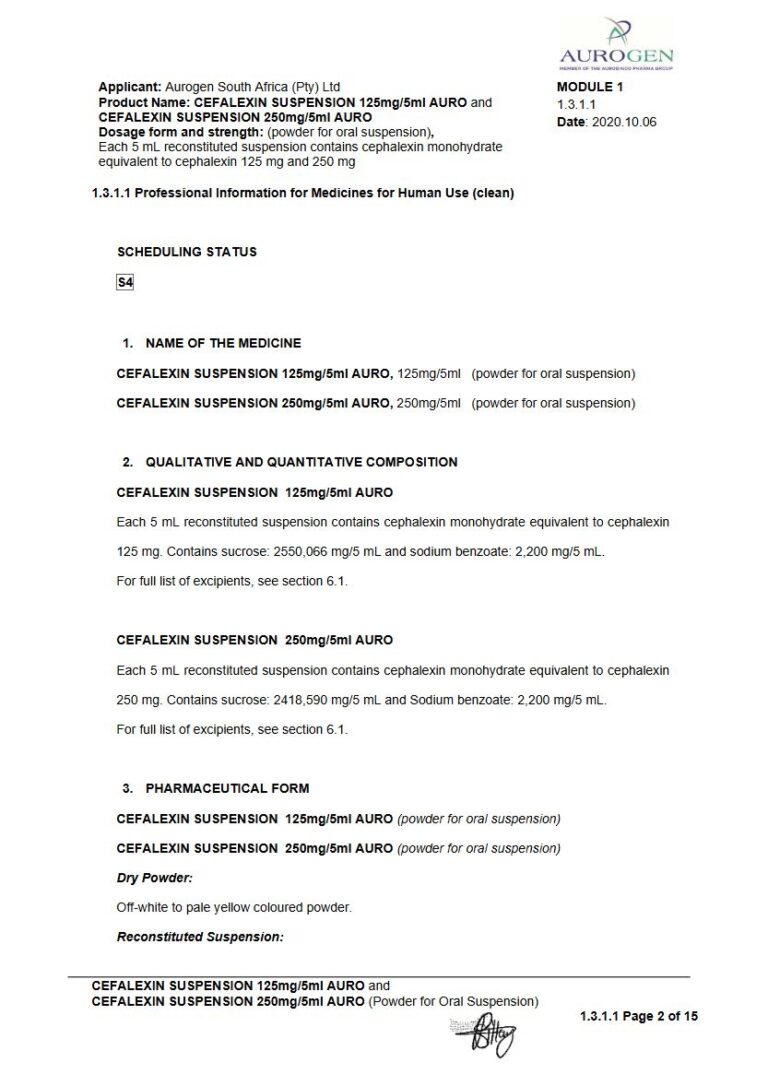
Cefalexin 125 Mg/5 Ml/250 Mg Oral Suspension
PDF Leaflet Revision Date: 06 October 2020
Clinical Summary
Quick overview from the medicine insert
Indication
Treatment of infections caused by susceptible micro-organisms.
Dosage (summary)
Adults: 250 mg every 6 hours or 500 mg every 12 hours; max 4 g daily.
Special Populations
- Elderly
- Renal impairment
Pregnancy & Breastfeeding
Contraindicated in pregnancy and lactation.
Key Drug Interactions
- Nephrotoxic agents
- Probenecid
- Metformin
- Oestrogen contraceptives
Contraindications
- Allergy to cephalosporins
- Hypersensitivity to cephalexin
Common side effects
- Nausea
- Vomiting
- Diarrhoea
- Headache
Counselling Points
- Take with or without food
- Monitor for allergic reactions
- Report severe diarrhoea
Serious warnings
- Hypersensitivity reactions
- Pseudomembranous colitis
- Seizure potential
Important Disclaimer
The Cefalexin 125 Mg/5 Ml/250 Mg Oral Suspension professional information leaflet below is the property of Aurogen South Africa and is provided on Medinsert exactly as issued, with no.. alterations or editorial changes. We make every effort to keep content current by updating documents as soon as new versions become available. Medinsert serves as a trusted access point for healthcare professionals, but does not replace official sources or clinical judgement. For more details, please read our full disclaimer. read more>>
 Healthcare Professionals Only
This content is for registered healthcare professionals
Sign in or create a free account to read the full package insert.
Free for HPCSA-registered professionals. Powered by Medinsert.
Clinical Particulars
Section 4 of the official insert — extracted exactly as issued, no alterations
4.1. Therapeutic indications
CEFALEXIN SUSPENSION AURO is indicated for the treatment of the following Infections caused by susceptible micro-organisms:
- Respiratory tract infections caused by Streptococcus pneumoniae and group A u03b2-haemolytic streptococci.
- Otitis media due to Streptococcus pneumoniae, H. influenzae, staphylococci, streptococci and N. catarrhalis.
- Skin and soft tissue infections, caused by staphylococci and/or streptococci.
- Genito-urinary tract infections, including acute prostatitis caused by E. coli, P. mirabilis and Klebsiella.
- Dental infections caused by staphylococci and/or streptococci.
Appropriate culture and susceptibility studies, should be performed to determine susceptibility of causative organism to cephalexin. Renal function studies should be performed when indicated.
4.2. Posology and method of administration
Posology
Adults
The adult dosage ranges from 1-4 g daily in divided doses. The usual adult dosage is 250 mg every 6 hours. For skin and soft tissue infections, streptococcal pharyngitis and mild uncomplicated urinary tract infections, the usual dosage is 250 mg every 6 hours, or 500 mg every 12 hours. Adults who are not able to take capsules may be given CEFALEXIN SUSPENSION AURO.
For more severe infections or those caused by less susceptible organisms, larger doses may be needed. If daily doses of CEFALEXIN SUSPENSION AURO greater than 4 grams are required, parenteral cephalosporin, in appropriate doses, should be considered.
Special Population:
The elderly and patients with impaired renal function: As for adults. Reduce dosage if renal function is markedly impaired.
Paediatric Population:
The usual recommended dosage for children is 25 mg/kg/day to 50 mg/kg/day in divided doses every six hours. In the treatment of beta-haemolytic streptococcal infections, a therapeutic dose should be administered for at least 10 days.
Method of administration
CEFALEXIN SUSPENSION AURO is administered orally. Cephalexin is acid stable and may be given without regard to meals. For instructions on reconstitution of CEFALEXIN SUSPENSION AURO, see section 6.6.
4.3. Contraindications
CEFALEXIN SUSPENSION AURO is contraindicated:
- Patients with known allergy to the cephalosporin group of antibiotics. (See section 4.4).
- Patients with hypersensitivity to cephalexin or any of the excipients of CEFALEXIN SUSPENSION AURO. (See section 4.4).
- Pregnancy and lactation (see section 4.6).
4.4. Special warnings and precautions for use
Hypersensitivity reactions
Before therapy with CEFALEXIN SUSPENSION AURO is started, careful enquiry should be made concerning previous hypersensitivity reactions to cephalosporins, penicillins or other medicine. CEFALEXIN SUSPENSION AURO should be administered with caution to penicillin-sensitive patients. There is evidence of cross allergencity between the penicillins and cephalosporins. Patients have been reported to have had severe reactions (including anaphylaxis) to both. Allergic reactions in the form of rash, urticaria, angioedema, anaphylaxis, erythema multiforme, Stevens-Johnson syndrome, or toxic epidermal necrolysis have been reported with the use of cephalexin. If an allergic reaction to cephalexin as contained in CEFALEXIN SUSPENSION AURO occurs, discontinue the medicine and institute appropriate treatment.
Pseudomembranous colitis
The diagnosis of pseudomembranous colitis must be considered in patients who develop diarrhoea in association with its use. Such colitis may be life threatening and appropriate measures should be taken, including discontinuation of CEFALEXIN SUSPENSION AURO.
Laboratory investigations
CEFALEXIN SUSPENSION AURO may interfere with the Jaffe method of measuring creatinine concentrations and may produce falsely high values; this should be borne in mind when measuring renal function. Positive direct Coombs' (antiglobulin) have been reported during treatment with the cephalosporin antibiotics and these can interfere with blood cross matching. A false-positive reaction for glucose in the urine may occur with Benedictu2019s or Fehling's solutions or with copper sulphate test tablets.
Elderly Use
This medicine is substantially excreted by the kidney, and the risk of toxic reactions to this drug may be greater in patients with impaired renal function. Because elderly patients are more likely to have decreased renal function, care should be taken in dose selection.
Prolonged Prothrombin Time with Renal or Hepatic Impairment
Cephalosporins may be associated with prolonged prothrombin time. Those at risk include patients with renal or hepatic impairment, or poor nutritional state, as well as patients receiving a protracted course of antibacterial therapy, and patients receiving anticoagulant therapy. Monitor prothrombin time in patients at risk and manage as indicated.
Renal Impairment
Cephalexin should be administered with caution in the presence of impaired renal function (creatinine clearance < 30 mL/min, with or without dialysis). Under such conditions, careful clinical observation and laboratory studies renal function monitoring should be conducted because safe dosage may be lower than that usually recommended. Dosage reduction may be necessary. Renal and haematological status should be monitored especially during prolonged and high-dose therapy.
Clostridium difficile u2013 Associated Diarrhoea
Clostridium difficile-associated diarrhoea (CDAD) has been reported with use of nearly all antibacterial agents, including cephalexin, and may range in severity from mild diarrhoea to fatal colitis. Treatment with antibacterial agents alters the normal flora of the colon leading to overgrowth of C.difficile. C. difficile produces toxins A and B, which contribute to the development of CDAD. Hypertoxin-producing strains of C. difficile cause increased morbidity and mortality, as these infections can be refractory to antimicrobial therapy and may require colectomy. CDAD must be considered in all patients who present with diarrhoea following antibiotic use. Careful medical history is necessary since CDAD has been reported to occur over two months after the administration of antibacterial agents. If CDAD is suspected or confirmed, ongoing antibiotic use not directed against C. difficile may need to be discontinued. Appropriate fluid and electrolyte management, protein supplementation, antibiotic treatment of C. difficile, and surgical evaluation should be instituted as clinically indicated.
Seizure Potential
Several cephalosporins have been implicated in triggering seizures, particularly in patients with renal impairment when the dosage was not reduced. If seizures occur, discontinue cephalexin. Anticonvulsant therapy can be given if clinically indicated.
Development of Drug-Resistant Bacteria
Prescribing cephalexin in the absence of a proven or strongly suspected bacterial infection is unlikely to provide benefit to the patient and increases the risk of the development of drug-resistant bacteria. Prolonged use of cephalexin may result in the overgrowth of non-susceptible organisms. Careful observation of the patient is essential. If superinfection occurs during therapy, appropriate measures should be taken.
Fructose intolerance
CEFALEXIN SUSPENSION AURO contains sugar (Sucrose). Patients with rare hereditary problems of fructose intolerance, glucose-galactose malabsorption or sucrose-isomaltase insufficiency should not take CEFALEXIN SUSPENSION AURO.
4.5. Interaction with other medicinal products and other forms of interaction
- The concomitant use of nephrotoxic medicines such as the aminoglycosides gentamicin and tobramycin may increase the risk of kidney damage with CEFALEXIN SUSPENSION AURO.
- There is also evidence for enhanced nephrotoxicity with the loop diuretic furosemide.
- The renal excretion of CEFALEXIN SUSPENSION AURO is inhibited by probenecid. Co-administration of probenecid with cephalexin is not recommended.
- There may be antagonism between CEFALEXIN SUSPENSION AURO and bacteriostatic anti-bacterials.
- Administration of cephalexin with metformin results in increased plasma metformin concentrations and decreased renal clearance of metformin. Careful patient monitoring and dose adjustment of metformin is recommended in patients concomitantly taking cephalexin and metformin.
- CEFALEXIN SUSPENSION AURO may decrease the efficacy of oestrogen containing contraceptives.
- Interaction with laboratory or diagnostic testing u2013 A false-positive reaction may occur when testing for the presence of glucose in the urine using Benedictu2019s solution or Fehlingu2019s solution.
4.6. Fertility, Pregnancy and Lactation
Pregnancy and lactation: The safety in pregnancy and lactation has not been established. CEFALEXIN SUSPENSION AURO is contraindicated during pregnancy (see section 4.3). Breastfeeding: Cephalexin is excreted in human milk. CEFALEXIN SUSPENSION AURO is contraindicated during lactation (see section 4.3).
Effects on fertility: No human data on the effect of Cephalexin on fertility are available. Reproduction studies have been performed on mice and rats using oral doses of cephalexin monohydrate 0.6 and 1.5 times the maximum daily human dose (66 mg/kg/day) based upon body surface area basis, and have revealed no evidence of impaired fertility or harm to the foetus.
4.7. Effects on ability to drive and use machines
CEFALEXIN SUSPENSION AURO may cause dizziness or drowsiness. Patients should therefore be advised not to drive or operate machinery until their individual susceptibility is known.
4.8. Undesirable effects
Blood and the lymphatic system disorders:
- Frequent: Eosinophilia
- Less frequent: Haemolytic anaemia, neutropenia or thrombocytopenia
Immune system disorders:
- Less frequent: Hypersensitivity reactions, including skin rashes, urticaria, eosinophilia, fever, allergic reactions, reactions resembling serum sickness-like reactions, and anaphylaxis
Nervous system disorders:
- Frequent: Headache
- Less frequent: Dizziness and drowsiness. Convulsions and confusion have been associated with high doses, especially in patients with renal impairment.
Gastro-intestinal disorders:
- Frequent: Nausea, vomiting and diarrhoea
- Less frequent: Abdominal cramps. Pseudomembranous colitis and overgrowth of non-susceptible organisms have been reported.
Hepato-biliary disorders:
- Less frequent: Hepatitis and cholestatic jaundice
Renal and urinary disorders:
- Less frequent: Nephrotoxicity, acute renal tubular necrosis, acute interstitial nephritis.
Reproductive system and breast disorders:
- Less frequent: Vulval candidiasis.
General disorders and administration site conditions:
- Less frequent: Fatigue
Investigations:
- Less frequent: Positive response to the Coombsu2019 test (antiglobulin), transient increases in liver enzyme values.
Paediatric population: Not specific
Reporting of suspected adverse reactions: Reporting suspected adverse reactions after authorisation of the medicinal product is important. It allows continued monitoring of the benefit/risk balance of the medicinal product. Healthcare professionals are asked to report any suspected adverse reactions to SAHPRA via The u20186.04 Adverse Drug Reactions Reporting Formu2019. Found under SAHPRAu2019s publications: https://www/sahpra.org.za/Publications/Index/8.
4.9. Overdose
Symptoms
Symptoms of oral overdose may include nausea, vomiting, epigastric distress, diarrhoea, and haematuria. In the event of an overdose, institute general supportive measures. Treatment is symptomatic and supportive. Cephalexin is removed by haemodialysis and peritoneal dialysis.
