
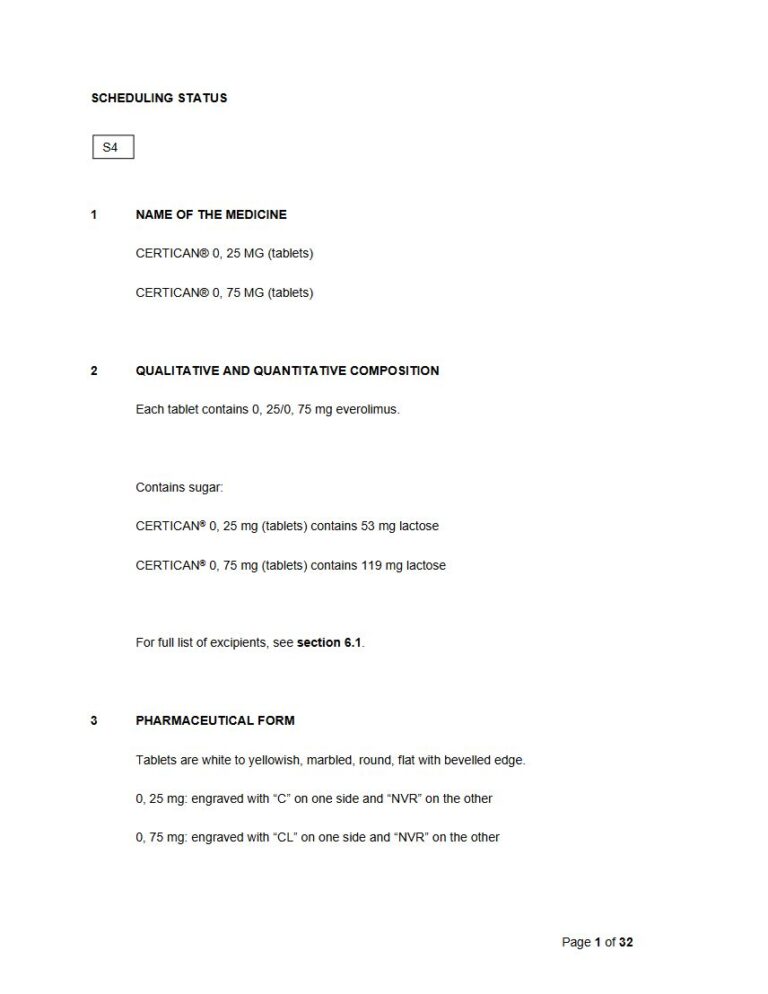
Certican 0,25 mg / 0, 75 mg Tablet.
PDF Leaflet Revision Date: 27 February 2023
Clinical Summary
Quick overview from the medicine insert
Indication
To reduce the risk of organ rejection in kidney, heart, and liver transplant patients.
Dosage (summary)
Kidney/heart: 0.75 mg twice daily; Liver: 1 mg twice daily.
Special Populations
- Elderly
- Renal impairment
- Hepatic impairment
Pregnancy & Breastfeeding
Contraindicated in pregnancy and breastfeeding.
Key Drug Interactions
- CYP3A4 inhibitors
- CYP3A4 inducers
- Ciclosporin
Contraindications
- Hypersensitivity to everolimus
- Pregnancy
- Lactation
- Live vaccines
Common side effects
- Infections
- Hyperlipidaemia
- Diabetes mellitus
- Headache
- Hypertension
Counselling Points
- Monitor for infections and blood glucose levels.
- Avoid live vaccines.
- Use effective contraception during treatment.
Serious warnings
- Increased risk of infections
- Lymphomas
- Renal dysfunction with ciclosporin
- Interstitial lung disease
Important Disclaimer
The Certican 0,25 mg / 0, 75 mg Tablet. professional information leaflet below is the property of Novartis South Africa and is provided on Medinsert exactly as issued, with no.. alterations or editorial changes. We make every effort to keep content current by updating documents as soon as new versions become available. Medinsert serves as a trusted access point for healthcare professionals, but does not replace official sources or clinical judgement. For more details, please read our full disclaimer. read more>>
 Healthcare Professionals Only
This content is for registered healthcare professionals
Sign in or create a free account to read the full package insert.
Free for HPCSA-registered professionals. Powered by Medinsert.
Clinical Particulars
Section 4 of the official insert — extracted exactly as issued, no alterations
4.1 Therapeutic indications
u2022 Kidney and heart transplant: To reduce the risk of organ rejection in adult patients at low to moderate immunological risk receiving an allogeneic renal or cardiac transplant. In kidney and heart transplantation, CERTICAN should be used in combination with ciclosporin for microemulsion and corticosteroids
u2022 Liver transplantation: CERTICAN is indicated for the prophylaxis of acute organ rejection in patients receiving a hepatic transplant. In liver transplantation, CERTICAN should be used in combination with tacrolimus and corticosteroids.
4.2 Posology and method of administration
Posology Treatment with CERTICAN should only be initiated and maintained by medical practitioners who are experienced in immunosuppressive therapy following organ transplantation and who have access to CERTICAN whole blood level monitoring.
Adults u2022 Kidney and heart transplantation - An initial dose regimen of 0, 75 mg twice daily, is recommended for the general kidney and heart transplant population, administered as soon as possible after transplantation.
u2022 Liver transplantation - The dose of 1, 0 mg twice daily is recommended for the hepatic transplant population with the initial dose approximately 4 weeks after transplantation.
u2022 The daily dose of CERTICAN should always be given orally in two divided doses twice daily. CERTICAN should be consistently given either with or without food (see section 5.2) and at the same time as ciclosporin for microemulsion or tacrolimus (see Therapeutic drug monitoring below).
u2022 CERTICAN is for oral use only.
u2022 CERTICAN tablets should be swallowed whole with a glass of water and not crushed before use.
u2022 Patients receiving CERTICAN require dose adjustments based on blood levels achieved, tolerability, individual response, change in co-medications and the clinical situation. Dose adjustments can be made at 4 - 5 days intervals (see Therapeutic drug monitoring).
Black patients: The incidence of biopsy-proven acute rejection episodes was significantly higher in black renal transplant patients than in non-black patients. Limited information indicates that black patients, may require a higher CERTICAN dose to achieve efficacy similar to that achieved in non-black patients at the recommended adult dose (see section 5.2). Currently the efficacy and safety data are too limited to allow specific recommendations for use of CERTICAN in black patients.
Special populations Paediatric population Use in children and adolescents (below 18 years): There are no adequate data of the use of CERTICAN in children and adolescents to support its use in patients in these age groups. Limited pharmacokinetic data, however, are available in kidney transplant paediatric patients (see section 5.2)
Elderly population Elderly patients (u2265 65 years): Clinical experience is limited in patients u2265 65 years of age. Nevertheless, there are no apparent differences in the pharmacokinetics of CERTICAN in patients u2265 65 -70 years of age as compared with younger adults (see section 5.2)
Patients with renal impairment: No dosage adjustment is required (see section 5.2).
Patients with hepatic impairment: Whole blood trough levels (C0) of CERTICAN should be closely monitored in patients with impaired hepatic function. For patients with mild hepatic impairment (Child-Pugh Class A), the dose should be reduced to approximately two-thirds of the normal dose. For patients with moderate hepatic impairment (Child-Pugh Class B) the dose should be reduced to approximately one half of the normal dose. For patients with severe hepatic impairment (Child-Pugh Class C), the dose should be reduced to approximately one third of the normal dose. Further dose titration should be based on therapeutic drug monitoring (see section 5.2).
4.3 Contraindications
u2022 CERTICAN is contraindicated in patients with a known hypersensitivity to everolimus, sirolimus, or to any of the excipients.
u2022 Pregnancy and lactation.
u2022 Use with live vaccines.
4.4 Special warnings and precautions for use
Management of immunosuppression: There are limited data regarding the use of CERTICAN without calcineurin inhibitor (CNI) (ciclosporin or tacrolimus). An increased risk of acute rejection was observed in patients who discontinued the administration of CNI compared with those who continued the administration of CNI.
In clinical trials, CERTICAN has been administered concurrently with ciclosporin for microemulsion, or with tacrolimus, basiliximab and corticosteroids. CERTICAN in combination with immunosuppressive agents other than these has not been adequately investigated.
CERTICAN has not been adequately studied in patients at high immunological risk.
Combination with thymoglobulin induction: The use of thymoglobulin (rabbit anti-thymocyte globulin) induction and the CERTICAN/ciclosporin/steroid regimen is not recommended. In a clinical study in heart transplant recipients an increased incidence of serious infections was observed within the first three months after transplantation in the subgroup of patients who had received induction with thymoglobulin combined with CERTICAN, steroid and ciclosporin at the blood concentration recommended for heart transplantation (higher than in kidney transplantation). This was associated with greater infection-related mortality among patients. The death rate was 10 % when CERTICAN was used with thymoglobulin induction.
Serious and opportunistic infections: Patients on a regimen of CERTICAN, are at increased risk of developing infections especially infections with opportunistic pathogens (bacterial, fungal, viral and protozoal). Fatal infections and sepsis have been reported in patients treated with CERTICAN (see section 4.8). Among opportunistic conditions to which immunosuppressed patients may be vulnerable are polyomavirus infections which include BK virus-associated nephropathy which can lead to kidney graft loss and the potentially fatal JC virus-associated progressive multifocal leukoencephalopathy (PML). These infections, often related to total immunosuppressive burden, should be considered in the differential diagnosis of immunosuppressed patients with deteriorating kidney graft function or neurological symptoms.
In clinical trials with CERTICAN, antimicrobial prophylaxis for Pneumocystis jiroveci (carinii) pneumonia was administered for the first 12 months following transplantation. Cytomegalovirus (CMV) prophylaxis was recommended for 3 months after transplantation, particularly for patients at increased risk for CMV disease.
Interaction with strong inhibitors or inducers of CYP3A4 and/or P-glycoprotein (PgP): Co-administration with strong inhibitors of CYP3A4 and/or the multidrug efflux pump P-glycoprotein (PgP) (e.g. ketoconazole, itraconazole, voriconazole, clarithromycin, telithromycin, ritonavir) may increase everolimus blood levels and is not recommended unless the benefit outweighs the risk. Coadministration with strong inducers of CYP3A4 and /or PgP (e.g. rifampicin, rifabutin) is not recommended unless the benefit outweighs the risk. If co-administration if inducers or inhibitors of CYP3A4 and/or PgP cannot be avoided, it is recommended that everolimus whole blood trough concentration and the clinical condition of the patient be monitored while they are concurrently administered with everolimus and after their discontinuation. Dose adjustments of everolimus may be required (see section 4.5).
Lymphomas and other malignancies: Patients on a regimen of immunosuppressive medicinal products, including CERTICAN, are at increased risk of developing lymphomas or other malignancies, particularly of the skin (see section 4.8). The absolute risk seems related to the duration and intensity of immunosuppression rather than to the use of a specific medicinal product. Patients should be monitored regularly for skin neoplasms and advised to minimise exposure to UV light and sunlight, and to use an appropriate sunscreen.
Porphyria: Safety has not been established.
Liver function impairment: Close monitoring of everolimus whole blood trough levels (C0) and everolimus dose adjustment is recommended in patients with impaired hepatic function (see section 4.2).
Hyperlipidaemia: In transplant patients, concomitant use of CERTICAN and ciclosporin for microemulsion or tacrolimus has been associated with an increase in serum cholesterol and triglycerides that may require treatment. Patients receiving CERTICAN should be monitored for hyperlipidaemia and if necessary treated with lipid-lowering medicinal products and appropriate dietary adjustments made (see section 4.5). The risk/benefit should be considered in patients with established hyperlipidaemia before initiating an immunosuppressive regimen including CERTICAN. Similarly, the risk/benefit of continued CERTICAN therapy should be re-evaluated in patients with severe refractory hyperlipidaemia. Patients administered an HMG-CoA reductase inhibitor and/or fibrate should be monitored for the possible development of adverse effects as described in the respective professional information leaflets of these medicinal products (see section 4.5).
Angioedema CERTICAN has been associated with the development of angioedema.
CERTICAN and calcineurin inhibitor-induced renal dysfunction: In renal and cardiac transplantation CERTICAN with full-dose ciclosporin increases the risk of renal dysfunction. Reduced doses of ciclosporin are required for use in combination with CERTICAN in order to avoid renal dysfunction. Appropriate adjustment of the immunosuppressive regimen, in particular reduction of the ciclosporin dose should be considered in patients with elevated serum creatinine levels (see section 4.2). In a liver transplant study CERTICAN with reduced tacrolimus exposure has not been found to worsen renal function in comparison to standard exposure tacrolimus without CERTICAN. Regular monitoring of renal function is recommended in all patients. Caution should be exercised when co-administering other medicinal products that are known to have a deleterious effect on renal function.
Proteinuria: The use of CERTICAN with calcineurin inhibitors in transplant recipients has been associated with increased proteinuria. The risk increases with higher everolimus blood levels. In renal transplant patients with mild proteinuria while on maintenance immunosuppressive therapy including a calcineurin inhibitor (CNI) there have been reports of worsening proteinuria when the CNI is replaced by CERTICAN. Reversibility has been observed with interruption of CERTICAN and reintroduction of the CNI. The safety and efficacy of conversion from CNI to CERTICAN in such patients have not been established. Patients receiving CERTICAN should be monitored for proteinuria.
Renal graft thrombosis: An increased risk of kidney arterial and venous thrombosis, resulting in graft loss, has been reported, mostly within the first 30 days post-transplantation.
Wound-healing complications: CERTICAN can impair healing increasing the occurrence of post-transplant complications such as wound dehiscence, fluid collections and wound infection which may require further surgical attention. Lymphocele is the most frequently reported such event in renal transplant recipients and tends to be more frequent in patients with higher body mass index. The frequency of pericardial and pleural effusion is increased in cardiac transplant recipients and the frequency of incisional hernias is increased in liver transplant recipients.
Thrombotic microangiopathic disorders: The concomitant administration of CERTICAN with a calcineurin inhibitor (CNI) may increase the risk of CNI-induced haemolytic uraemic syndrome/thrombotic thrombocytopenic purpura/thrombotic microangiopathy.
Interstitial lung disease/non-infectious pneumonitis: Cases of interstitial lung disease, implying lung intraparenchymal inflammation (pneumonitis) and/or fibrosis of non-infectious etiology, some fatal, have occurred in patients receiving rapamycin and their derivatives, including CERTICAN. A diagnosis of interstitial lung disease (ILD) should be considered in patients presenting with symptoms consistent with infectious pneumonia but not responding to antibiotic therapy and in whom infectious, neoplastic and other non-drug causes have been discounted through appropriate investigations. Cases of ILD have been reported with CERTICAN, which resolve on drug interruption with or without glucocorticoid therapy (see section 4.8 Undesirable effects). However, fatal cases have been reported.
New onset diabetes mellitus: CERTICAN has been shown to increase the risk of new onset diabetes mellitus after transplantation. Blood glucose concentrations should be monitored closely in patients treated with CERTICAN.
Male infertility: There are reports of reversible azoospermia and oligospermia in patients treated with CERTICAN. As preclinical toxicology studies have shown that everolimus can reduce spermatogenesis, male infertility must be considered a potential risk of prolonged CERTICAN therapy.
Lactose warning: CERTICAN contains lactose, which may have an effect on the glycaemic control of patients with diabetes mellitus. Patients with the rare hereditary conditions of galactose intolerance e.g. galactosaemia, Lapp lactase deficiency, glucose-galactose malabsorption or fructose intolerance should not take CERTICAN.
4.5 Interactions with other medicines
CERTICAN is mainly metabolised in the liver and, to some extent, in the intestinal wall by CYP3A4. It is also a substrate for the multidrug efflux pump, P-glycoprotein (PgP). Therefore, absorption and subsequent elimination of systemically absorbed CERTICAN may be influenced by medicinal products that affect CYP3A4 and/or PgP.
Concurrent treatment with strong CYP3A4-inhibitors and/or inducers is not recommended. Inhibitors of PgP may decrease the efflux of CERTICAN from intestinal cells and increase CERTICAN blood concentrations. In vitro, CERTICAN was a competitive inhibitor of CYP3A4 and a mixed inhibitor of CYP2D6, potentially increasing the concentrations of medicinal products eliminated by these enzymes. Thus, caution should be exercised when co-administering CERTICAN with CYP3A4- and CYP2D6 substrates having a narrow therapeutic index. All in vivo interaction studies were conducted without concomitant use of ciclosporin.
Ciclosporin (CYP3A4/PgP inhibitor): The bioavailability of CERTICAN was significantly increased by co-administration of ciclosporin. In a single-dose study in healthy subjects, ciclosporin for microemulsion (Neoral) increased the AUC of CERTICAN by 168 % (range, 46 % to 365 %), and Cmax by 82 % (range, 25 % to 158 %), as compared with administration of CERTICAN alone. Dose adjustment of CERTICAN might be needed if the ciclosporin dose is altered (see section 4.2).
CERTICAN had only a minor clinical influence on ciclosporin pharmacokinetics in renal and heart transplant patients receiving ciclosporin for microemulsion.
Rifampicin (CYP3A4 inducer): Pre-treatment of healthy subjects with multiple-dose of rifampicin followed by a single dose of CERTICAN increased CERTICAN clearance nearly 3-fold, decreasing Cmax by 58 % and AUC by 63 %. Combination with rifampicin is not recommended (see section 4.4).
Atorvastatin (CYP3A4-substrate) and pravastatin (PgP-substrate) Single-dose administration of CERTICAN with either atorvastatin or pravastatin to healthy subjects did not influence the pharmacokinetics of atorvastatin, pravastatin and CERTICAN, as well as total HMG-CoA reductase bioreactivity in plasma to a clinically relevant extent. However, these results cannot be extrapolated to other HMG-CoA reductase inhibitors. Patients should be monitored for the development of rhabdomyolysis and other adverse events as described in the package inserts of HMG-CoA reductase inhibitors.
Midazolam (CYP3A4A substrate): In a single dose midazolam 4 mg study, CERTICAN had no clinically significant effect on pharmacokinetic of midazolam. The Cmax of midazolam increased 1,25-fold (90 % CI, 1,14 u2013 1,37) and the AUCinf increased 1,30-fold (1,22 u2013 1,39). The half-life of midazolam was unaltered. This study indicated that everolimus is a weak inhibitor of CYP3A4.
Other possible interactions: Use caution when co-administration of moderate CYP3A4 inhibitors or PgP inhibitors cannot be avoided.
Moderate inhibitors of CYP3A4 and PgP may increase CERTICAN blood levels (e.g. antifungal medicines: fluconazole, itraconazole; macrolide antibiotics: clarithromycin, toleandomycin, telithromycin; calcium channel blockers: nicardipin, diltiazem: other substances: cisapride, metoclopramide, bromocriptine, cimetidine, danazol; HIV protease inhibitors: nelfinavir, indinavir, amprenavir. Following concomitant administration of everolimus and cannabidiol (Pgp inhibitor), the Cmax and AUC of everolimus were increased by approximately 2.5-fold. Closely monitor for side effects and adjust the everolimus dose as needed (see sections 4.2 and 4.4).
Inducers of CYP3A4 may increase the metabolism of CERTICAN and decrease CERTICAN blood levels (e.g. St. Johnu2019s wort (Hypericum perforatum), anticonvulsants: carbamazepine, phenobarbital, phenytoin; anti-HIV medicines: efavirenz, nevirapine.
Ketoconazole (CYP3A4 inhibitor): Pre-treatment of healthy subjects with multiple-dose ketoconazole followed by a single dose of CERTICAN increased everolimus Cmax by 3.9-fold (90 % CI 3.4- 4.6) and AUC by 15.0-fold (90 % CI 13.6 - 16.6) (see section 4.4).
Erythromycin (CYP3A4 inhibitor): Pre-treatment of healthy subjects with multiple-dose erythromycin followed by a single dose of CERTICAN increased everolimus Cmax by 2.0-fold (90 %CI 1.8-2.3) and AUC by 4.4-fold (90 % CI 3.5-5.4).
Verapamil (CYP3A4 inhibitor): Pre-treatment of healthy subjects with multiple-dose verapamil followed by a single dose of CERTICAN increased everolimus Cmax by 2.3-fold (90 % CI: 1.9-2.7) and AUC by 3.5-fold (90 % CI: 3.1-3.9).
Antibiotics: Rifabutin Not studied. Decreased exposure expected. Grapefruit: Grapefruit and grapefruit juice affect cytochrome P450 and PgP activity and should therefore be avoided. Vaccination: Immunosuppressants may affect the response to vaccination and vaccination during treatment with CERTICAN may therefore be less effective. The use of live vaccines should be avoided. (see section 4.3).
Octreotide: Coadministration of everolimus with depot octreotide increased octreotide Cmin with a geometric mean ratio (everolimus/placebo) of 1.47-fold (90 % CI: 1.32 to 1.64).
4.6 Fertility, pregnancy and lactation
Women of childbearing potential/ Contraception in males and females Women of childbearing potential should be advised to use effective contraception methods while they are receiving CERTICAN and for up to 8 weeks after treatment has been stopped (see section 4.3).
Pregnancy CERTICAN should not be given to pregnant women. Studies in animals have shown reproductive toxicity effects including embryotoxicity and fetotoxicity.
Breastfeeding Women taking CERTICAN should not breastfeed their infants. CERTICAN and/or its metabolites were readily transferred into the milk of lactating rats.
Fertility The potential for CERTICAN to cause infertility in male and female patients is unknown. Male infertility and secondary amenorrhoea have been observed with reports in the literature of reversible azoospermia and oligospermia in patients treated with mTOR inhibitors.
4.7 Effects on ability to drive and use machines
CERTICAN may affect mental and/or physical abilities to perform or execute tasks or activities requiring mental alertness, judgment and/or sound coordination and vision. No studies on the effects on the ability to drive and use machines have been performed.
4.8 Undesirable effects
a. Summary of the safety profile The frequencies of the adverse drug reactions listed below are derived from analysis of the 12-month incidences of events reported in multicentre, randomised, controlled trials investigating CERTICAN in combination with calcineurin inhibitors (CNI) and corticosteroids in transplant recipients. CERTICAN combined with ciclosporin, was studied in five trials in renal transplant recipients totalising 2 497 patients, and three trials in heart transplant recipients totalising 1 531 patients. CERTICAN, combined with tacrolimus, was studied in one trial which included 719 liver transplant recipients. The overall safety profile was not distinct from previous experiences with CERTICAN and expectations in a liver transplant population followed for up to 36 months.
Table 1 below contains adverse drug reactions possibly or probably related to CERTICAN seen in phase III clinical trials. Except where noted otherwise, the adverse reaction profile is relatively consistent across all transplant indications. It is compiled according to MedDRA standard organ classes. Within each system organ class, the adverse drug reactions are ranked by frequency, with the most frequent reactions first. In addition, the corresponding frequency category for each adverse drug reaction is based on the following convention (CIOMS III): very common (u22651/10); common (u22651/100 to <1/10); uncommon (u22651/1,000 to <1/100); rare (u22651/10,000 to <1/1,000); very rare (<1/10,000).
Table 4 Adverse drug reactions possibly or probably related to Certican Body system Incidence Adverse reaction Infections and infestations Very common Infections (viral, bacterial, fungal), upper respiratory tract infection, lower respiratory tract and lung infections (including pneumonia) 1, urinary tract infections 2 Common Sepsis, wound infection Neoplasms benign, malignant and unspecified Common Malignant or unspecified tumours, malignant and unspecified skin neoplasm Uncommon Lymphomas/post-transplant lymphoproliferative disorders (PTLD) Blood and lymphatic system disorders Very common Leukopaenia, anaemia/erythropenia, thrombocytopenia 1 Common Pancytopenia, thrombotic microangiopathies (including thrombotic thrombocytopenic purpura/haemolytic uraemic syndrome) Endocrine disorders Uncommon Hypogonadism male (testosterone decreased, FSH and LH increased) Metabolism and nutrition disorders Very common Hyperlipidaemia (cholesterol and triglycerides), new onset diabetes mellitus, hypokalaemia Psychiatric disorders Very common Insomnia, anxiety Nervous system disorders Very common Headache Cardiac disorders Very common Pericardial effusion 3 Common Tachycardia Vascular disorders Very common Hypertension, venous thromboembolic events Common Lymphocoele 4, epistaxis, renal graft thrombosis Very common Pleural effusion 1, cough 1, dyspnoea 1 Respiratory, thoracic and mediastinal disorders Uncommon Interstitial lung disease 5 Gastrointestinal disorders Very common Abdominal pain, diarrhoea, nausea, vomiting Common Pancreatitis, stomatitis/mouth ulceration, oropharyngeal pain Hepatobiliary disorders Uncommon Non-infectious hepatitis, jaundice Skin and subcutaneous tissue disorders Common Angioedema 6, acne, rash Musculoskeletal and connective tissue disorders Common Myalgia, arthralgia Renal and urinary disorders Common Proteinuria 2, renal tubular necrosis 7 Reproductive system and breast disorders Common Erectile dysfunction, menstrual disorder (including amenorrhoea and menorrhagia) Uncommon Ovarian cyst General disorders and administration site conditions Very common Peripheral oedema, pain, healing impaired, pyrexia Common Incisional hernia Investigations Common Hepatic enzyme abnormal 8 1 common in renal and liver transplantation 2 common in cardiac and liver transplantation 3 in cardiac transplantation 4 in renal and cardiac transplantation5the SMQ-based search for ILD showed the frequency of ILD in the clinical trials. 5 This broad search also included cases caused by related events, e.g. by infections. The frequency category given here is derived from the medical review of the known cases. 6 predominantly in patients receiving concomitant ACE inhibitors 7 in renal transplantation
In controlled clinical trials in which patients were monitored for at least 1 year, a total of 3,1 % developed lymphoma or lymphoproliferative disease malignancies, with 1,0 % developing skin malignancies and 0,6 % developing lymphoma or lymphoproliferative disorder. The occurrence of the adverse events may depend on the degree and duration of the immunosuppressive regimen. In the studies, combining CERTICAN with ciclosporin elevated serum creatinine was observed more frequently in patients given CERTICAN in combination with full dose ciclosporin for microemulsion than in control patients. The overall incidence of adverse events was lower with reduced dose ciclosporin for microemulsion (see section 5.1). The safety profile of CERTICAN in the trials in which it was administered with reduced-dose ciclosporin was similar to that described in the in which full dose of ciclosporin was administered, except that elevation of serum creatinine was less frequent, and mean and median serum creatinine values were lower, than in the other phase III studies. Cases of interstitial lung disease, implying lung intraparenchymal inflammation (pneumonitis) and/or fibrosis of non-infectious etiology, some fatal, have occurred in patients receiving rapamycin and their derivatives, including CERTICAN.
Adverse drug reactions from post-marketing spontaneous reports The following adverse drug reactions have been derived from post-marketing experience with CERTICAN via spontaneous case reports and literature cases. Because these reactions are reported voluntarily from a population of uncertain size, it is not possible to reliably estimate their frequency which is therefore categorized as not known. Adverse drug reactions are listed according to system organ classes in MedDRA. Within each system organ class, ADRs are presented in order of decreasing seriousness.
4.9 Overdose
u2022 In overdose, side effects can be precipitated and/or be of increased severity (see section 4.8).
u2022 In animal studies, CERTICAN showed a low acute toxic potential.
u2022 No lethality or severe toxicity was observed in either mice or rats given single oral doses of 2 000 mg/kg (limit test).
u2022 Reported experience with overdose in humans is very limited.
u2022 There was a single case of accidental ingestion of 1, 5 mg CERTICAN by a 2-year old child, but no adverse events were observed.
u2022 Single doses of up to 25 mg have been administered to transplant patients with acceptable acute tolerability.
u2022 General supportive measures should be initiated in all cases of overdose.
