
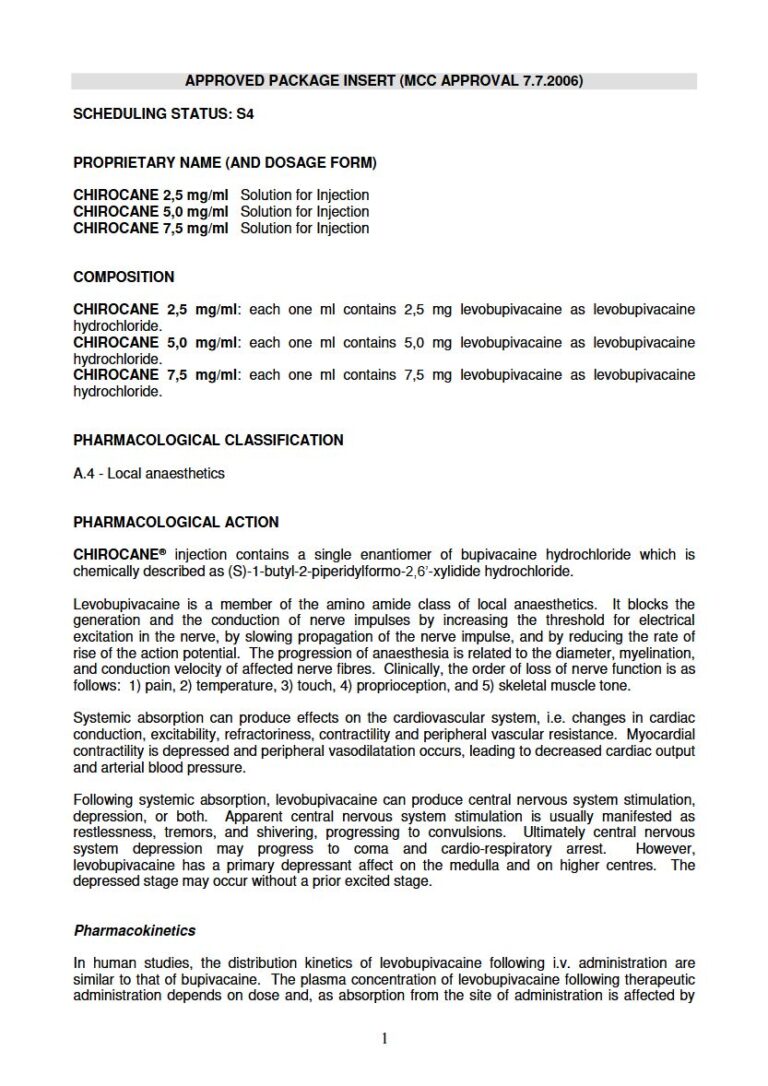
Chirocane 2.5mg. 5mg. 7mg Injection
PDF Leaflet Revision Date: 7 July 2006
Clinical Summary
Quick overview from the medicine insert
Indication
Surgical anaesthesia and pain management.
Dosage (summary)
Adults: 50-150 mg for epidural; 1-60 ml for local infiltration. Max 2 mg/kg.
Special Populations
- Renal impairment
- Hepatic impairment
Pregnancy & Breastfeeding
Safety not established; may cause maternal and fetal toxicity.
Key Drug Interactions
- CYP3A4 inducers
- CYP3A4 inhibitors
- Other local anaesthetics
Contraindications
- Hypersensitivity to levobupivacaine
- Severe renal impairment
- Severe hepatic impairment
Common side effects
- Hypotension
- Nausea
- Dizziness
- Convulsions
Counselling Points
- Avoid driving until effects of anaesthesia wear off
- Monitor for signs of CNS toxicity
- Seek immediate help for severe reactions
Serious warnings
- Risk of cardiac arrest with IV injection
- Use caution in hypotension
- Incremental dosing recommended
Important Disclaimer
The Chirocane 2.5mg. 5mg. 7mg Injection professional information leaflet below is the property of AbbVie and is provided on Medinsert exactly as issued, with no.. alterations or editorial changes. We make every effort to keep content current by updating documents as soon as new versions become available. Medinsert serves as a trusted access point for healthcare professionals, but does not replace official sources or clinical judgement. For more details, please read our full disclaimer. read more>>
 Healthcare Professionals Only
This content is for registered healthcare professionals
Sign in or create a free account to read the full package insert.
Free for HPCSA-registered professionals. Powered by Medinsert.
Clinical Particulars
Section 4 of the official insert — extracted exactly as issued, no alterations
4.1 Therapeutic indications
Adults
CHIROCANE u00ae is indicated in adults for:
- Surgical Anaesthesia
- Major: Epidural (including for caesarean section), intrathecal, peripheral nerve block.
- Minor: Local infiltration, peribulbar block in ophthalmic surgery.
- Pain Management
- Continuous epidural infusion, single or multiple bolus administration for post-operative, labour or chronic pain. For continuous epidural analgesia, CHIROCANE u00ae may be administered in combination with epidural fentanyl, morphine or clonidine.
Children
CHIROCANE u00ae is indicated in children for infiltration analgesia.
4.2 Posology and method of administration
CHIROCANE u00ae should be administered only by doctors who are well versed in the diagnosis and management of drug-related toxicity and other acute emergencies, which might arise from the block being administered. The immediate availability of oxygen, other resuscitative drugs, cardiopulmonary resuscitative equipment, and the personnel resources needed for proper management of toxic reactions and related emergencies must be ensured (see also SIDE-EFFECTS AND SPECIAL PRECAUTIONS). The rapid injection of a large volume of CHIROCANE u00ae solution should be avoided and fractional (incremental) doses should always be used. The smallest dose and concentration required to produce the desired result should be administered. The dose differs with the anaesthetic procedure, the area to be anesthetised, the vascularity of the tissues, the number of neuronal segments to be blocked, the intensity of the block, the degree of muscle relaxation required, the duration of the anaesthesia desired, individual tolerance, and the physical condition of the patient. Patients in poor general condition due to aging or other compromising factors, such as impaired cardiovascular function, advanced liver disease, or severe renal dysfunction, require special attention. For epidural technique it is advisable to use an adequate test dose (3 to 5 ml) of a short acting local anaesthetic solution containing epinephrine prior to induction of complete nerve block. This test dose should be repeated if the patient is moved in such a fashion as to have displaced the epidural catheter. It is recommended that adequate time be allowed for the onset of anaesthesia following administration of each test dose.
CHIROCANE u00ae is not compatible with alkaline solutions having a pH greater than 8,5. Studies have shown that levobupivacaine is compatible with 0,9 % Sodium Chloride Injection USP and with saline solutions containing morphine, fentanyl and clonidine. Compatibility studies with other parenteral products have not been studied. Disinfecting agents containing heavy metals, which cause release of ions (mercury, zinc, copper, etc.) should not be used for skin or mucous membrane disinfection since they have been related to incidents of swelling and oedema. When chemical disinfection of the container surface is desired, either isopropyl alcohol (91 %) or ethyl alcohol (70 %) is recommended. It is recommended that chemical disinfection be accomplished by wiping the vial stopper thoroughly with cotton or gauze that has been moistened with the recommended alcohol prior to use. These products are intended for single use and do not contain preservatives; any solution remaining from an open container should be discarded.
Dosage Recommendations
| Concentration % | Dose (ml) | Dose (mg) | Motor Block | |||
|---|---|---|---|---|---|---|
| Surgical Anaesthesia | Epidural for Surgery | 0,5 - 0,75 | 10 - 20 | 50 - 150 | Moderate to Complete | |
| Epidural for Caesarean Section | 0,5 | 15 - 30 | 75 - 150 | Moderate to Complete | ||
| Peripheral nerve | 0,25 - 0,5 | 1 - 40 | Maximum 150 | Moderate to Complete | ||
| Intrathecal | 0,5 | 3 | 15 | Moderate to Complete | ||
| Ophthalmic | 0,75 | 5 - 15 | 37,5 - 112,5 | Moderate to Complete | ||
| Local Infiltration - Adults | 0,25 | 1 - 60 | Maximum 150 | Not applicable | ||
| Local Infiltration Children < 12 yrs | 0,25 - 0,5 | 0,25 - 0,50 ml/kg | 1,25 - 2,5 mg/kg | Not applicable | ||
| Dental | 0,5 - 0,75 | 5 - 10 | 25 - 75 | Not applicable | ||
| Pain (*ab) Management | Labour Analgesia (epidural bolus) | 0,25 | 10 -20 | 25 - 50 | Minimal to Moderate | |
| Labour Analgesia (epidural infusion) | 0,125 (c) | 4 - 10 ml/h | 5 - 12,5 mg/h | Minimal to Moderate | ||
| Post-Operative Pain (epidural infusion) | 0,125 (c) | 0,25 | 10 - 15 ml/h | 5 - 7,5 ml/h | 12,5 - 18,75 mg/h | 12,5 - 18,75 mg/h |
a In pain management CHIROCANE u00ae can be used epidurally with fentanyl, morphine or clonidine
b In cases where CHIROCANE u00ae is combined with other agents e.g. opioids in pain management, the CHIROCANE u00ae dose should be reduced as use of a lower concentration (e.g. 1,25 mg/ml) is preferable.
c Dilutions of CHIROCANE u00ae standard solutions should be made with preservative free 0,9 % saline according to standard hospital procedures for sterility. The doses in the table are those considered to be necessary to produce a successful block and should be regarded as guidelines for use. Individual variations in onset and duration occur. The maximum single dose recommended is 2 mg/kg (150 mg). The maximum dose in 24 hours for intra-operative block and post-operative pain management is 6 mg/kg (400 mg). In children, the maximum recommended dose for infiltration analgesia (ilioinguinal-iliohypogastric block) is 1,25 mg/kg/side.
4.3 Contraindications
CHIROCANE u00ae is contra-indicated in patients with a known hypersensitivity to levobupivacaine or to any local anaesthetic agent of the amide type. CHIROCANE u00ae is contra-indicated for intravenous regional anaesthesia (Bieru2019s Block), severe renal and or hepatic impairment. Solutions of levobupivacaine should not be used for the production of obstetrical paracervical block anaesthesia. There are no data to support such use and there is additional risk of foetal bradycardia and death. CHIROCANE u00ae is contra-indicated for concomitant use with known CYP3A4 inducers (eg. phenytoin, phenobarbital, rifampin). CHIROCANE u00ae is contra-indicated for concomitant use with known CYP3A4 inhibitors (azole antimycotics, eg. ketoconazole).
4.4 Special warnings and precautions for use
The epidural use of CHIROCANE u00ae is contra-indicated in severe hypotension such as cardiogenic or hypovolaemic shock. In performing levobupivacaine blocks, unintended intravenous injection is possible and may result in cardiac arrest. Despite rapid detection and appropriate treatment, prolonged resuscitation may be required. CHIROCANE u00ae should be administered in incremental doses. Since levobupivacaine should not be injected rapidly in large doses, it is not recommended for emergency situations, where fast onset of surgical anaesthesia is necessary. For caesarean section, the 5 mg/ml (0,5 %) levobupivacaine solution in doses up to 150 mg is recommended. The 0,75 % concentration is not recommended for use in obstetrics. It is essential that aspiration for blood or cerebrospinal fluid (where applicable) be done prior to injecting CHIROCANE u00ae, both before the original dose and all subsequent doses, to avoid intravascular or intrathecal injection. However, a negative aspiration does not ensure against intravascular or intrathecal injection. CHIROCANE u00ae should be used with caution in patients receiving other local anaesthetics or agents structurally related to amide-type local anaesthetics, since the toxic effects of these drugs are additive. When contemplating a peripheral nerve block, where large volumes of local anaesthetic are needed, caution should be exercised when using the higher mg/ml concentrations of CHIROCANE u00ae. Animal studies demonstrate CNS and cardiac toxicity that is dose related, thus, equal volumes of higher concentration will be more likely to produce cardiac toxicity. Maximum single dose should not exceed 2 mg/kg and repeated dose should not exceed 6 mg/kg in 24 hours.
4.5 Interactions with other medicines
CHIROCANE u00ae should be used with caution in patients receiving other local anaesthetics or agents structurally related to amide-type local anaesthetics since the toxic effects of these drugs could be additive. In vitro studies indicate CYP3A4 isoform and CYP1A2 isoform mediate the metabolism of levobupivacaine to desbutyl levobupivacaine and 3-hydroxy levobupivacaine, respectively. Thus, agents likely to be concomitantly administered with CHIROCANE u00ae that are metabolised by this isoenzyme family may potentially interact with CHIROCANE u00ae. Although no clinical studies have been conducted, it is likely that the metabolism of levobupivacaine may be affected by the known CYP3A4 inducers (such as phenytoin, phenobarbital, rifampin), CYP3A4 inhibitors (azole antimycotics, e.g. ketoconazole, certain protease inhibitors, e.g. ritonavir, macrolide antibiotics, e.g. erythromycin, and calcium channel antagonists, e.g. verapamil), CYP1A2 inducers (omeprazole) and CYP1A2 inhibitors (furafylline and clarithromycin). Dosage adjustments may be warranted when CHIROCANE u00ae is concurrently administered with CYP3A4 inhibitors and CYP1A2 inhibitors, as systemic levobupivacaine levels may rise resulting in toxicity. CHIROCANE u00ae should be used with caution in patients receiving anti-arrhythmic agents with local anaesthetic activity, e.g. mexilitine, or class III anti-arrhythmic agents since their effect may be additive.
4.6 Fertility, pregnancy and lactation
The safety of CHIROCANE u00ae in pregnancy and breast-feeding has not been established.
4.7 Effects on ability to drive and use machines
Patients should be warned not to drive or operate machinery until all the effects of the anaesthesia and the immediate effects of surgery are passed.
4.8 Undesirable effects
Reactions to CHIROCANE u00ae are characteristic of those associated with amide-type anaesthetics. A major cause of the adverse reactions is excessive plasma levels, which may be due to overdose, unintentional intravascular injection, or slow metabolic degradation. Less frequent reports of convulsions have occurred following accidental intravenous administration. Accidental intrathecal injection of local anaesthetics can lead to high spinal anaesthesia with apnoea, severe hypotension and loss of consciousness. High epidural anaesthesia may produce a similar effect. Central nervous system effects: numbness of the tongue, light headedness, dizziness, blurred vision and muscle twitch followed by drowsiness, convulsions, unconsciousness and possible respiratory arrest. Cardiovascular effects are related to depression of the conduction system of the heart and a reduction in myocardial excitability and contractility. This results in decreased cardiac output, hypotension and ECG changes indicative of either heart block, bradycardia or ventricular tachyarrythmias that may lead to cardiac arrest. These may be preceded by CNS toxicity, i.e. convulsions, but cardiac arrest may occur without prodromal CNS effects. The most frequent adverse events reported in clinical trials irrespective of causality include hypotension (22 %), nausea (13 %), anaemia (11 %), post-operative pain (8 %), vomiting (8 %), back pain (7 %), fever (6 %), dizziness (6 %), foetal distress (6 %) and headache (5 %). Neurological damage is a less frequent but well recognised consequence of regional and particularly epidural and spinal anaesthesia. It may be due to direct injury to the spinal cord or spinal nerves, anterior spinal artery syndrome, injection of an irritant substance or an injection of a non-sterile solution. These may result in localised areas of paraesthesia or anaesthesia, motor weakness, loss of sphincter control and paraplegia. Less frequently, these may be permanent. Allergic-type reactions may occur as a result of sensitivity to CHIROCANE u00ae. These reactions are characterised by signs such as urticaria, pruritus, erythema, angioneurotic oedema (including laryngeal oedema), tachycardia, sneezing, nausea, vomiting, dizziness, syncope, excessive sweating, elevated temperature, and, possibly, anaphylactoid-like symptomatology (including severe hypotension). Cross sensitivity among members of the amide-type local anaesthetic group have been reported.
4.9 Overdose
Acute emergencies from CHIROCANE u00ae are generally related to high plasma levels or high dermatomal levels encountered during therapeutic use of local anaesthetics or to unintended intrathecal or intravascular injection of CHIROCANE u00ae (see SIDE EFFECTS, WARNINGS and SPECIAL PRECAUTIONS). Management of Toxic Reactions At the first sign of change of vital signs or the patientu2019s state of consciousness after injection or during continuous infusion, oxygen should be administered. Systemic adverse reactions following overdose or accidental intravascular injection involve both CNS and cardiovascular effects. CNS Effects Convulsions should be treated immediately with a suitable intravenous agent, e.g. thiopentone or diazepam titrated as necessary. These agents will depress the central nervous system, respiratory and cardiac function. Therefore their use may result in apnoea. Neuro-muscular blockers may be used only if the clinician is confident of maintaining a patent airway and managing a fully paralysed patient. If not treated promptly, convulsions with subsequent hypoxia and hypercarbia plus myocardial depression from the effects of the local anaesthetic on the heart, may result in cardiac arrhythmias, ventricular fibrillation or cardiac arrest. Cardiovascular Effects Hypotension must be treated symptomatically. Cardiac arrhythmia should be treated as required and ventricular fibrillation should be treated by cardioversion.
