
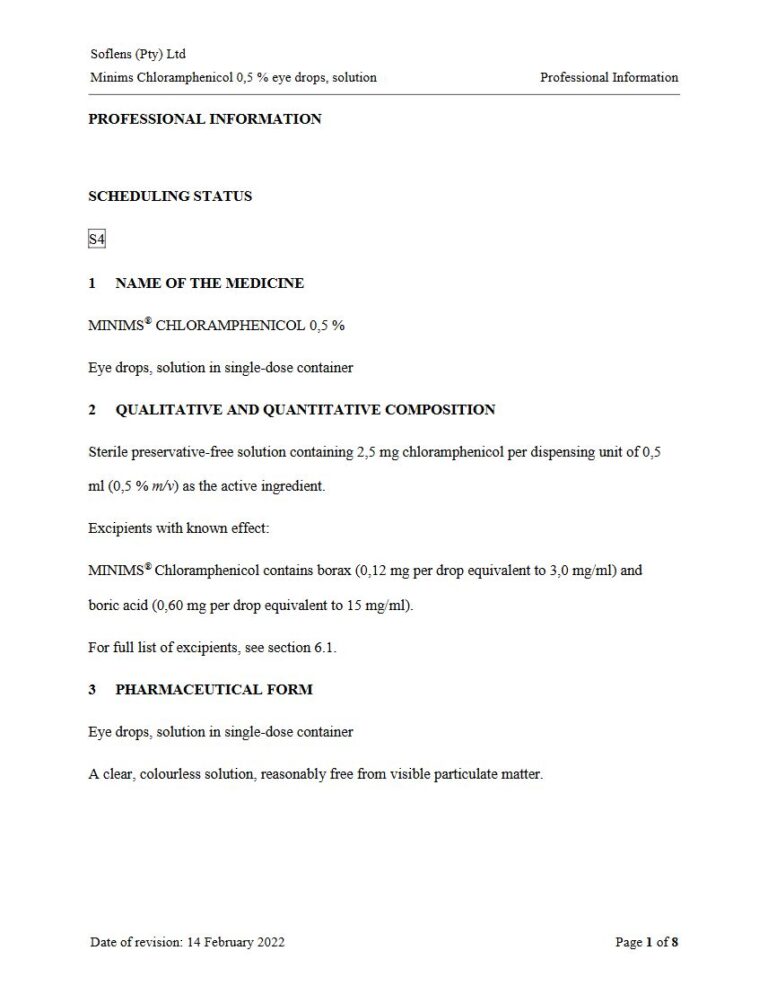
Minims Chloramphenicol 2.5mg / 0.5ml Eye Drops
PDF Leaflet Revision Date: 14 February 2022
Clinical Summary
Quick overview from the medicine insert
Indication
Local treatment of acute eye infections.
Dosage (summary)
1-2 drops in each affected eye up to 6 times daily; severe infections may require more frequent dosing.
Special Populations
- Elderly
- Newborn infants
Pregnancy & Breastfeeding
Safety in pregnancy and lactation not established; may cause bone marrow suppression in neonates.
Key Drug Interactions
- Chymotrypsin
Contraindications
- Hypersensitivity to chloramphenicol
- Not for minor infections or prophylactically
Common side effects
- Local irritation
- Burning
- Stinging
- Itching
- Dermatitis
Counselling Points
- May cause transient blurring of vision
- Do not drive or operate machinery until vision is clear
Serious warnings
- Risk of aplastic anaemia
- Avoid prolonged use
- Remove contact lenses during treatment
Important Disclaimer
The Minims Chloramphenicol 2.5mg / 0.5ml Eye Drops professional information leaflet below is the property of Soflens and is provided on Medinsert exactly as issued, with no.. alterations or editorial changes. We make every effort to keep content current by updating documents as soon as new versions become available. Medinsert serves as a trusted access point for healthcare professionals, but does not replace official sources or clinical judgement. For more details, please read our full disclaimer. read more>>
 Healthcare Professionals Only
This content is for registered healthcare professionals
Sign in or create a free account to read the full package insert.
Free for HPCSA-registered professionals. Powered by Medinsert.
Clinical Particulars
Section 4 of the official insert — extracted exactly as issued, no alterations
4.1 Therapeutic indications
Chloramphenicol is used for the local treatment of acute eye infections caused by susceptible organisms. Chloramphenicol is indicated in adults and children.
4.2 Posology and method of administration
Adults (including the Elderly)
One to two drops applied topically to each affected eye up to six times daily or more frequently if required. Severe infections may require one or two drops every fifteen to twenty minutes initially, reducing the frequency of instillation gradually as the infection is controlled.
Paediatric population
As for adults however, dosage adjustment may be necessary in newborn infants because of reduced systemic elimination due to immature metabolism and the risk of dose-related adverse effects. The maximum duration of treatment is 10 u2013 14 days.
4.3 Contraindications
- Hypersensitivity to chloramphenicol or any other ingredients (see Section 6.1 List of excipients).
- Chloramphenicol should not be used for minor infections or prophylactically, or as a long-term treatment for dry eye syndrome.
4.4 Special warnings and precautions for use
In severe infections topical use of chloramphenicol should be supplemented with appropriate systemic treatment. Caution should be exercised when treating anaemic patients. Chloramphenicol should not be used with other medicines which may suppress bone marrow function. Aplastic anaemia has, rarely, followed topical use of chloramphenicol eye drops and, whilst this hazard is an uncommon one, it should be borne in mind when the benefits of the use of chloramphenicol are assessed. Prolonged use should be avoided as it may increase the likelihood of sensitisation and the emergence of resistant organisms. The maximum duration of treatment is 10-14 days. Contact lenses should be removed during the period of treatment. Systemic absorption may be reduced by compressing the lacrimal sac at the medial canthus for a minute during and following the instillation of the drops. This blocks the passage of the drops via the naso-lacrimal duct to the wide absorptive area of the nasal and pharyngeal mucosa. It is especially advisable in children.
4.5 Interaction with other medicines and other forms of interaction
Chymotrypsin will be inhibited if given simultaneously with chloramphenicol.
4.6 Fertility, pregnancy and lactation
Pregnancy and Breastfeeding
Safety for use in pregnancy and lactation has not been established. Systematically absorbed/administered forms of chloramphenicol enter the foetal circulation and are distributed into breast milk. If given systematically to the mother shortly before parturition or whilst breastfeeding, chloramphenicol may cause bone marrow suppression of the neonate or u201cgrey baby syndromeu201d, characterised by cyanosis and hypothermia, owing to the limited glucuronidating capacity of the neonateu2019s liver. However, limited absorption following ophthalmic use at the recommended dosage is generally not expected to pose a risk to the foetus or neonate.
4.7 Effects on ability to drive and use machines
May cause transient blurring of vision on installation. Warn patients not to drive or operate hazardous machinery unless vision is clear.
4.8 Undesirable effects
Local
Local hypersensitivity reactions, such as transient irritation, burning, stinging, itching and dermatitis, may occur. Treatment with chloramphenicol should be discontinued immediately.
Systemic
Rarely, cases of major adverse haematological events (bone marrow depression, aplastic anaemia and death) have been reported following ocular use of chloramphenicol. Pale skin, weakness, increased heart rate, out of breath, headache, pain, fever, infection, bruises may be signs of a severe blood disorder. Hypersensitivity reactions including angioedema, anaphylaxis, urticaria, vesicular and maculopapular dermatitis may also occur.
Reporting of suspected adverse reactions
Reporting suspected adverse reactions after authorisation of the medicine is important. It allows continued monitoring of the benefit-risk of the medicine. Health care providers are asked to report any suspected adverse reactions to SAHPRA via the u201c6.04 Adverse Drug Reactions Reporting Formu201d, found online under SAHPRAu2019s publications: https://www.sahpra.org.za/Publications/Index/8 Suspected adverse reactions may also be reported directly to the Holder of the Certificate of registration using the following e-mail address: [email protected]
4.9 Overdose
Accidental ingestion of the medicine is unlikely to cause any toxicity due to the low content of antibiotic. MINIMS u00ae Chloramphenicol contain boric acid and borax as a buffer and if ingestion by infants or young children occurs, the poison centre should be contacted.
Treatment
If irritation, pain, lacrimation or photophobia occurs after undesired eye contact, the exposed eye(s) should be irrigated with copious amounts of room temperature water for at least 15 minutes. If symptoms persist after 15 minutes of irrigation, an ophthalmic examination should be considered.
