
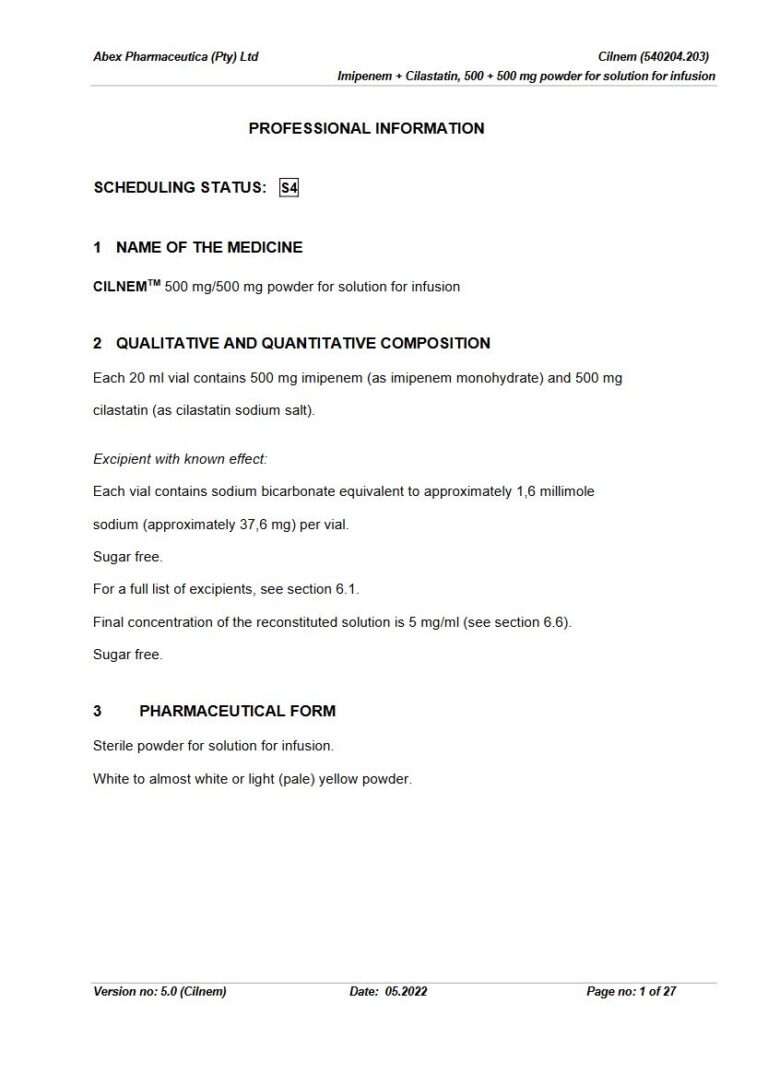
Cilnem 500 mg STERILE POWDER FOR SOLUTION FOR INFUSION
PDF Leaflet Revision Date: 24 May 2022
Clinical Summary
Quick overview from the medicine insert
Indication
Treatment of infections caused by susceptible bacteria.
Dosage (summary)
1-2 g daily in divided doses; max 4 g/day.
Special Populations
- Renal impairment
- Elderly
- Paediatric patients
Pregnancy & Breastfeeding
Not recommended in pregnancy; excreted in breast milk.
Key Drug Interactions
- Valproic acid
- Ganciclovir
- Oral anticoagulants
Contraindications
- Hypersensitivity to imipenem or cilastatin
- Meningitis
Common side effects
- Nausea
- Diarrhoea
- Seizures
- Rash
Counselling Points
- Avoid in pregnancy
- Monitor for allergic reactions
- Report severe diarrhoea
Serious warnings
- Risk of seizures in renal impairment
- Monitor hepatic function
Important Disclaimer
The Cilnem 500 mg STERILE POWDER FOR SOLUTION FOR INFUSION professional information leaflet below is the property of Abex Pharmaceutica and is provided on Medinsert exactly as issued, with no.. alterations or editorial changes. We make every effort to keep content current by updating documents as soon as new versions become available. Medinsert serves as a trusted access point for healthcare professionals, but does not replace official sources or clinical judgement. For more details, please read our full disclaimer. read more>>
 Healthcare Professionals Only
This content is for registered healthcare professionals
Sign in or create a free account to read the full package insert.
Free for HPCSA-registered professionals. Powered by Medinsert.
Clinical Particulars
Section 4 of the official insert — extracted exactly as issued, no alterations
4.1 Therapeutic indications
CILNEM is indicated for the treatment of the following infections caused by susceptible strains of the designated micro-organisms in the conditions listed below:
Intra-abdominal infections
- Enterococcus faecalis, Staphylococcus aureus (penicillinase-producing strains) *, Staphylococcus epidermidis, Citrobacter species, Enterobacter species, Escherichia coli, Klebsiella species, Morganella morganii*, Proteus species, Pseudomonas aeruginosa**, Bifidobacterium species, Clostridium species, Eubacteria species, Peptococcus species, Peptostreptococcus species, Propionibacterium species *, Bacteroides species including B. fragilis, Fusobacterium species.
Lower respiratory tract infections
- Staphylococcus aureus (penicillinase-producing strains), Acinetobacter species, Enterobacter species, Escherichia coli, Haemophilus influenzae, Haemophilus parainfluenzae*, Klebsiella species, Serratia marcescens.
Gynaecological infections
- Enterococcus faecalis, Staphylococcus aureus (penicillinase-producing strains)*, Staphylococcus epidermidis, Streptococcus agalactiae (Group B streptococcus), Enterobacter species *, Escherichia coli, Gardnerella vaginalis, Klebsiella species *, Proteus species, Bifidobacterium species *, Peptococcus species *, Peptostreptococcus species, Propionibacterium species *, Bacteroides species including B. fragilis.
Septicaemia
- Enterococcus faecalis, Staphylococcus aureus (penicillinase-producing strains), Enterobacter species, Escherichia coli, Klebsiella species, Pseudomonas aeruginosa**, Serratia species *, Bacteroides species including B. fragilis*.
Genito-urinary tract infections (complicated and uncomplicated)
- Enterococcus faecalis, Staphylococcus aureus (penicillinase-producing strains) *, Enterobacter species, Escherichia coli, Klebsiella species, Morganella morganii*, Proteus vulgaris, Providencia rettgeri*, Pseudomonas aeruginosa**.
Bone and joint infections
- Enterococcus faecalis, Staphylococcus aureus (penicillinase-producing strains), Staphylococcus epidermidis, Enterobacter species, Pseudomonas aeruginosa**.
Skin and soft tissue infections
- Enterococcus faecalis, Staphylococcus aureus (penicillinase-producing strains), Staphylococcus epidermidis, Acinetobacter species, Citrobacter species, Enterobacter species, Escherichia coli, Klebsiella species, Morganella morganii, Proteus vulgaris, Providencia rettgeri*, Pseudomonas aeruginosa**, Serratia species, Peptococcus species, Peptostreptococcus species, Bacteroides species including B. fragilis, Fusobacterium species *.
Endocarditis
- Staphylococcus aureus (penicillinase-producing strains)*
CILNEM is indicated for the treatment of mixed infections caused by susceptible strains of aerobic and anaerobic bacteria.
The majority of these mixed infections are associated with contamination by faecal flora or flora originating from the vagina, skin and mouth. In these mixed infections, Bacteroides fragilis is usually susceptible to CILNEM. CILNEM has demonstrated efficacy against many infections caused by aerobic and anaerobic Gram-positive and Gram-negative bacteria resistant to other antibiotics. CILNEM is not indicated for the treatment of meningitis.
* Efficacy of this organism in this organ system was studied in fewer than ten infections.
** If CILNEM is used in the treatment of infections caused by Pseudomonas aeruginosa, an aminoglycoside should be administered concomitantly.
Prophylaxis
To reduce the risk of wound sepsis in adult patients after colorectal surgery.
4.2 Posology and method of administration
Important: The dosage recommendations for CILNEM represent the quantity of imipenem to be administered. An equivalent amount of cilastatin is also present in the solution. The total daily dosage and route of administration of CILNEM should be based on the type or severity of infection and given in equally divided doses based on consideration of degree of susceptibility of the pathogen(s), renal function and body mass.
Posology
Treatment: Adults
Doses cited in Table 1 are based on a patient with normal renal function (creatinine clearance of greater than 70 ml/min/1,73 mu00b2) and a body weight of greater than or equal to 70 kg. A reduction in dose should be made for a patient with a creatinine clearance less than or equal to 70 ml/min/1,73 mu00b2 (see Tables 2 and 3) and/or body weight less than 70 kg. The reduction for body weight is especially important for patients with much lower body weights and/or moderate/severe renal insufficiency. Most infections respond to a daily dose of 1 - 2 g administered in 3 - 4 divided doses. For the treatment of moderate infections, a 1 g, twice daily, dosage regimen may also be used. In infections due to less susceptible organisms, the daily dosage of CILNEM may be increased to a maximum of 4 g/day or 50 mg/kg/day, whichever is lower. Each dose of less than or equal to 500 mg of CILNEM should be given by intravenous infusion over 20 to 30 minutes. Each dose greater than 500 mg should be infused over 40 to 60 minutes. In patients who develop nausea during the infusion, the rate of infusion may be slowed.
Table 1 u2013 Dosage schedule for adults with normal renal function and body weight greater than or equal to 70 kg
Type or severity of infection
- A Fully susceptible organisms including Gram-positive and Gram-negative aerobes and anaerobes
- B Moderately susceptible organisms, primarily some strains of P. aeruginosa
Mild
- 250 mg 6 hourly (TOTAL DAILY DOSE = 1,0 g)
- 500 mg 6 hourly (TOTAL DAILY DOSE = 2,0 g)
Moderate
- 500 mg 8 hourly (TOTAL DAILY DOSE = 1,5 g) or 500 mg 6 hourly (TOTAL DAILY DOSE = 2,0 g)
- 500 mg 6 hourly (TOTAL DAILY DOSE = 2,0 g) or 1 g 8 hourly (TOTAL DAILY DOSE = 3,0 g)
Severe, life-threatening only
- 500 mg 6 hourly (TOTAL DAILY DOSE = 2,0 g)
- 1 g 8 hourly (TOTAL DAILY DOSE = 3,0 g) or 1 g 6 hourly (TOTAL DAILY DOSE = 4,0 g)
Uncomplicated urinary tract infection
- 250 mg 6 hourly (TOTAL DAILY DOSE = 1,0 g)
- 250 mg 6 hourly (TOTAL DAILY DOSE = 1,0 g)
Complicated urinary tract infection
- 500 mg 6 hourly (TOTAL DAILY DOSE = 2,0 g)
- 500 mg 6 hourly (TOTAL DAILY DOSE = 2,0 g)
It is recommended that the maximum total daily dosage does not exceed 50 mg/kg/day or 4 g/day, whichever is lower. However, cystic fibrosis patients with normal renal function have been treated with CILNEM at doses up to 90 mg/kg/day in divided doses, not exceeding 4 g/day.
CILNEM has been used successfully as monotherapy in immunocompromised cancer patients for confirmed or suspected infections such as sepsis.
Prophylaxis: Adults
To reduce the risk of wound sepsis in adults after colorectal surgery: 1 000 mg CILNEM intravenously on induction of anaesthesia and 1 000 mg three hours later, with two additional 500 mg doses at eight and sixteen hours after induction.
There are insufficient data on which to base a dosage recommendation for prophylaxis in patients with a creatinine clearance of less than or equal to 70 ml/min/1,73 mu00b2.
Patients with renal impairment
To determine the reduced dose for adults with impaired renal function:
- The total daily dose is chosen from Table 1 based on infection characteristics.
- From Tables 2 and 3 the appropriate reduced dosage regimen is selected based on the daily dose from Table 1 and the patientu2019s creatinine clearance category. (For infusion times see Treatment: Adults).
4.3 Contraindications
- Hypersensitivity to imipenem, cilastatin or any component of CILNEM (see section 6.1).
- Hypersensitivity to any other carbapenem antibacterial medicine.
- Hypersensitivity (e.g. anaphylactic reaction, severe skin reaction) to any other type of beta-lactam antibacterial medicine (e.g. penicillins or cephalosporins).
- Meningitis.
- Pregnancy and lactation.
4.4 Special warnings and precautions for use
General
The selection of CILNEM to treat an individual patient should consider the appropriateness of using a carbapenem antibacterial medicine based on factors such as severity of the infection, the prevalence of resistance to other suitable antibacterial medicines and the risk of selecting for carbapenem-resistant bacteria. CILNEM is not recommended for the treatment of meningitis (see section 4.3). If meningitis is suspected, an appropriate antibiotic should be used. CILNEM may be used in children with sepsis as long as they are not suspected of having meningitis.
Hypersensitivity/cross-sensitivity
Serious and occasionally fatal hypersensitivity (anaphylactic) reactions have been reported in patients receiving therapy with beta-lactams. These reactions are more likely to occur in individuals with a history of sensitivity to multiple allergens. Before initiating therapy with CILNEM, careful inquiry should be made concerning previous hypersensitivity reactions to carbapenems, penicillins, cephalosporins, other beta-lactams and other allergens (see section 4.3). If an allergic reaction to CILNEM occurs, discontinue the therapy immediately. Serious anaphylactic reactions require immediate emergency treatment.
Hepatic effects
Hepatic function should be closely monitored during treatment with CILNEM due to the risk of hepatic toxicity (such as increase in transaminases, hepatic failure and fulminant hepatitis). Use in patients with liver disease: patients with pre-existing liver disorders should have liver function monitored during treatment with CILNEM. There is no dose adjustment necessary (see section 4.2).
Haematology
A positive direct or indirect Coombs test may develop during treatment with CILNEM.
Antibacterial spectrum
The antibacterial spectrum of CILNEM should be considered, especially in life-threatening conditions before embarking on any empiric treatment. Furthermore, due to the limited susceptibility of specific pathogens associated with e.g. bacterial skin and soft tissue infections, to CILNEM, caution should be exercised. The use of CILNEM is not suitable for treatment of these types of infections unless the pathogen is already documented and known to be susceptible or there is a very high suspicion that the most likely pathogen(s) would be suitable for treatment. Concomitant use of an appropriate anti-methicillin-resistant Staphylococcus aureus (MRSA) medicine may be indicated when MRSA infections are suspected or proven to be involved in the approved indications. Concomitant use of an aminoglycoside may be indicated when Pseudomonas aeruginosa infections are suspected or proven to be involved in the approved indications (see section 4.1).
Interaction with valproic acid
The concomitant use of CILNEM and valproic acid/sodium valproate is not recommended (see section 4.5).
Clostridium difficile associated colitis and diarrhoea
Antibiotic-associated colitis and pseudomembranous colitis have been reported with CILNEM and may range from mild to life-threatening in severity. It is important to consider this diagnosis in patients who develop diarrhoea during or after the use of CILNEM (see section 4.8). Discontinuation of therapy with CILNEM and the administration of specific treatment for Clostridium difficile should be considered. Medicines that inhibit peristalsis should not be given.
Renal impairment
CILNEM should be given with caution to patients with renal impairment. Imipenem and cilastatin accumulate in patients with reduced kidney function. Central nervous system (CNS) adverse reactions may occur if the dose is not adjusted to the renal function, see section 4.2 and u201cCentral nervous systemu201d below.
Central nervous system (CNS)
CNS adverse reactions such as myoclonic activity, confusional states, or seizures have been reported, especially when recommended doses based on renal function and body weight were exceeded. These experiences have been reported more frequently in patients with CNS disorders (e.g. brain lesions or history of seizures) and/or compromised renal function in whom accumulation of the administered entities could occur. Hence close adherence to recommended dose schedules is urged especially in these patients (see section 4.2). Anticonvulsant therapy should be continued in patients with a known seizure disorder. Neurological symptoms or convulsions may occur in children with known risk factors for seizures, or on concomitant treatment with medicines lowering the seizures threshold. These patients should be carefully monitored. If focal tremors, myoclonus, or seizures occur, patients should be evaluated neurologically and placed on anticonvulsant therapy if not already instituted. If CNS symptoms continue, the dose of CILNEM should be decreased or discontinued. Patients with creatinine clearances of less than 15 ml/min should not receive CILNEM unless haemodialysis is instituted within 48 hours. For patients on haemodialysis, CILNEM is recommended only when the benefit outweighs the potential risk of seizures (see section 4.2).
Paediatric population
Adequate data are not available to recommend the use of CILNEM in children under 3 months of age or paediatric patients with impaired renal function (serum creatinine > 0,02 g/l). See also section 4.2 Paediatric patients (3 months or older).
Sodium content
CILNEM contains 1,6 mmol (37,6 mg) sodium per 500 mg dose (one vial). This should be taken into consideration for patients on a controlled sodium diet.
4.5 Interactions with other medicines and other forms of interaction
CILNEM can induce beta-lactamases capable of hydrolysing other beta-lactam antibiotics. Caution should be exercised if such a combination is used.
Ganciclovir
Generalised seizures have been reported in patients who received ganciclovir and CILNEM. These medicines should not be used concomitantly.
Valproic acid or divalproex sodium
Decreases in valproic acid levels that may fall below the therapeutic range have been reported when valproic acid or divalproex sodium was co-administered with carbapenem medicines. The lowered valproic acid levels may lead to inadequate seizure control; therefore, concomitant use of CILNEM and valproic acid/divalproex sodium is not recommended and alternative antibacterial or anti-convulsant therapies should be considered (see section 4.4).
Oral anti-coagulants
There have been reports of increases in the anti-coagulant effects of orally administered anti-coagulants, including warfarin, in patients who are concomitantly receiving antibacterial medicines, including CILNEM. The risk may vary with the underlying infection, age and general status of the patient so that the contribution of the antibiotic to the increase in INR (international normalised ratio) is difficult to assess. It is recommended that the INR should be monitored frequently during and shortly after co-administration of CILNEM with an oral anti-coagulant medicine.
Probenecid
Concomitant administration of CILNEM and probenecid results in minimal increases in the plasma levels and plasma half-life of imipenem. The urinary recovery of active (non-metabolised) imipenem decreases to approximately 60 % of the dose when CILNEM is administered with probenecid. Concomitant administration of CILNEM and probenecid doubles the plasma level and half-life of cilastatin but has no effect on urinary recovery of cilastatin.
4.6 Fertility, pregnancy and lactation
Pregnancy
There are no adequate and well-controlled studies for the use of CILNEM in pregnant women. Studies in pregnant monkeys have shown reproductive toxicity; the potential risk for humans is unknown. CILNEM should therefore not be used during pregnancy.
Breastfeeding
Imipenem is excreted into human milk. If the use of CILNEM is deemed essential, the patient should stop nursing her baby.
Fertility
There are no data available regarding potential effects of imipenem/cilastatin treatment on male or female fertility.
4.7 Effects on ability to drive and use machines
Some side effects (such as hallucinations, dizziness, somnolence, and vertigo) have been reported that may affect some patients' ability to drive or operate machinery (see section 4.8). Patients suffering from such side effects should be advised not to drive or handle machinery.
4.8 Undesirable effects
a. Summary of the safety profile
The most frequently reported systemic adverse reactions that were reported which were at least possibly related to therapy were nausea, diarrhoea, vomiting, rash, fever, hypotension, seizures (see section 4.4), dizziness, pruritus, urticaria, somnolence. Similarly, the most frequently reported local adverse reactions were phlebitis/thrombophlebitis, pain at the injection site, erythema at the injection site and vein induration. Increases in serum transaminases and in alkaline phosphatase are also frequently reported.
b. Tabulated list of adverse reactions
System organ class/ Frequency Adverse reaction
Infections and infestations: Less frequent: Candidiasis, C. difficile associated pseudomembranous colitis (see section 4.4), gastro-enteritis
Blood and lymphatic system disorders: Frequent: Eosinophilia Less frequent: Pancytopenia, neutropenia, leucopenia, thrombocytopenia, thrombocytosis, agranulocytosis, haemolytic anaemia, bone marrow depression
Immune system disorders: Less frequent: Anaphylactic reactions, angioedema
Psychiatric disorders: Less frequent: Psychic disturbances including hallucinations, confusional states, somnolence Frequency unknown: Agitation
Nervous system disorders: Less frequent: Seizures, myoclonic activity, dizziness, encephalopathy, paraesthesia, focal tremor, taste perversion, aggravation of myasthenia gravis, headache Frequency unknown: Dyskinesia
Ear and labyrinth disorders: Less frequent: Hearing loss, vertigo, tinnitus
Cardiac disorders: Less frequent: Tachycardia, palpitations, cyanosis
Vascular disorders: Frequent: Thrombophlebitis Less frequent: Hypotension, flushing
Respiratory, thoracic and mediastinal disorders: Less frequent: Hyperventilation, dyspnoea, pharyngeal pain
Gastrointestinal disorders: Frequent: Nausea, vomiting, diarrhoea Less frequent: Staining of teeth and/or tongue, haemorrhagic colitis, abdominal pain, heartburn, glossitis, tongue papilla hypertrophy, increased salivation
Hepatobiliary disorders: Less frequent: Hepatic failure, hepatitis, fulminant hepatitis
Skin and subcutaneous tissue disorders: Frequent: Rash (e.g. exanthematous) Less frequent: Urticaria, pruritus, erythema, toxic epidermal necrolysis, Stevens-Johnson syndrome, erythema multiforme, exfoliative dermatitis, hyperhidrosis, skin texture changes
Musculoskeletal and connective tissue disorders: Less frequent: Polyarthralgia, thoracic spine pain
Renal and urinary disorders: Less frequent: Acute renal failure, oliguria/anuria, polyuria, reddish urine discolouration (harmless; not to be confused with haematuria)
Reproductive system disorders: Less frequent: Pruritus vulvae
General disorders and administration site conditions: Less frequent: Fever including drug fever, erythema at injection site, local pain and induration at injection site, chest discomfort, asthenia/weakness
Investigations: Frequent: Increases in serum transaminases, increases in serum alkaline phosphatase Less frequent: A positive direct antiglobulin (Coombs) test, prolonged prothrombin time (INR), decreased haemoglobin, increases in serum bilirubin, elevations in serum creatinine, elevations in blood urea.
Reporting of suspected adverse reactions
Reporting suspected adverse reactions after authorisation of the medicine is important. It allows continued monitoring of the benefit/risk balance of the medicinal product. Healthcare providers are asked to report any suspected adverse reactions to SAHPRA via the u201c6.04 Adverse Drug Reactions Reporting Formu201d, found online under SAHPRAu2019s publications: https://www.sahpra.org.za/Publications/Index/8.
4.9 Overdose
Symptoms
There are no data available on overdosage; refer to section 4.8.
Management
Treatment is symptomatic and supportive. Imipenem/cilastatin in CILNEM is haemodialysable. However, usefulness of this treatment is unknown.
