
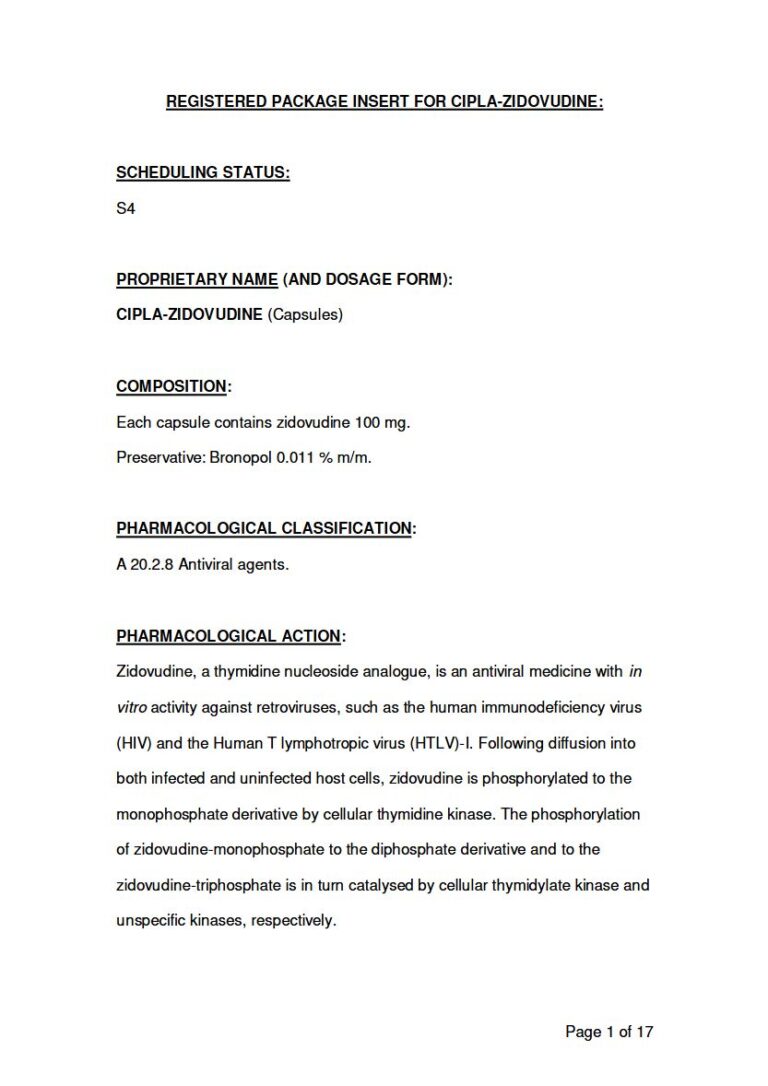
Cipla Zidovudine 100mg Capsule
Clinical Summary
Quick overview from the medicine insert
Indication
Treatment of HIV infection in combination with other antiretroviral agents.
Dosage (summary)
Adults: 500-600 mg daily in 2-3 doses; Children: 360-480 mg/m2 daily.
Special Populations
- Renal impairment
- Hepatic impairment
Pregnancy & Breastfeeding
Safety in pregnancy and lactation not established; avoid breastfeeding.
Key Drug Interactions
- Phenytoin
- Ribavirin
- Stavudine
Contraindications
- Hypersensitivity
- Low neutrophil count
- Low hemoglobin
- Breastfeeding
Common side effects
- Anaemia
- Neutropenia
- Nausea
- Vomiting
Counselling Points
- Monitor blood parameters regularly
- Not effective in preventing HIV transmission to others
Serious warnings
- Risk of lactic acidosis
- Not a cure for HIV
Important Disclaimer
The Cipla Zidovudine 100mg Capsule professional information leaflet below is the property of Cipla and is provided on Medinsert exactly as issued, with no.. alterations or editorial changes. We make every effort to keep content current by updating documents as soon as new versions become available. Medinsert serves as a trusted access point for healthcare professionals, but does not replace official sources or clinical judgement. For more details, please read our full disclaimer. read more>>
 Healthcare Professionals Only
This content is for registered healthcare professionals
Sign in or create a free account to read the full package insert.
Free for HPCSA-registered professionals. Powered by Medinsert.
Clinical Particulars
Section 4 of the official insert — extracted exactly as issued, no alterations
4.1 Therapeutic indications
CIPLA-ZIDOVUDINE is indicated in combination with other antiretroviral agents for the treatment of human immunodeficiency virus (HIV) infection in adults, children and mothers who are not breast-feeding. For the prophylaxis of maternal-foetal HIV transmission in HIV positive pregnant women of over 14 week gestation and their own newborn infants.
4.2 Posology and method of administration
Recommended dosage in adults:
CIPLA-ZIDOVUDINE in combination with other antiretroviral agents: 500 or 600 mg daily in two or three divided doses. More than 1000 mg daily in divided doses has been used. The effectiveness of dosages lower than 1000 mg daily in the treatment or prevention of HIV-associated neurological dysfunction is unknown.
For dosages of other antiretroviral agents used in combination therapy in advanced HIV infection: Please consult the package inserts of the individual agents.
Recommended dosage in children 3 months to 12 years of age:
CIPLA-ZIDOVUDINE in combination with other antiretroviral agents: 360 to 480 mg/m2 daily in three or four divided doses. For the treatment or prevention of HIV-associated neurological dysfunction, the effectiveness of dosages less than 720 mg/m2 daily, i.e. 180 mg/m2 every six hours, is unknown. The maximum dosage should not exceed 200 mg every six hours.
Recommended dosage in the prevention of mother-to-foetus transmission:
Pregnant women over 14 weeks of gestation: 500 mg orally per day, i.e. 100 mg five times per day, until the beginning of labour. During labour and delivery zidovudine should be administered intravenously at 2 mg/kg body mass over 1 hour, followed by a continuous intravenous infusion at 1 mg/kg per hour until the umbilical cord is clamped.
The newborn infants: starting within 12 hours after birth until at 6 weeks of age: 2 mg/kg body mass orally every 6 hours. Infants unable to receive oral dosing should be given zidovudine intravenously at 1.5 mg/kg body mass, infused over 30 minutes every 6 hours.
Dosage adjustments in patients with haematological toxicity:
Dosage reduction or interruption of CIPLA-ZIDOVUDINE therapy may be necessary in patients whose haemoglobin level falls to between 7.5 g/dl (4.65 mmol/l) and 9 g/dl (5.59 mmol/l) or whose neutrophil count falls to between 0.75 x I09/l and 1.0 x 10⁹/l.
Dosage adjustments of CIPLA-ZIDOVUDINE in combination with other antiretroviral medicines:
Dosage adjustments for each medicine should follow the dosing guidelines for the individual medicine. For severe adverse events, where the causative agent is unclear, or those persisting after dose interruption or reduction of one medicine, the other medicine should also be interrupted or dose reduced. The medical practitioner should refer to the package insert of the other antiretroviral medicines for a description of known adverse reactions.
Dosage in the elderly:
Zidovudine pharmacokinetics have not been studied in patients over 65 years of age and no specific data are available. Due to age-associated changes, such as the decrease in renal function and alterations in haematological parameters in this age group, special care is advised with the use of CIPLA-ZIDOVUDINE. Appropriate monitoring of these patients before and during CIPLA-ZIDOVUDINE therapy is advised.
Dosage in renal impairment:
Patients with advanced renal failure have a 50 % higher maximum plasma concentration of zidovudine compared to healthy individuals. Systemic exposure to zidovudine (measured as the area under the time-concentration curve) is increased 100 %; the half-life is not significantly altered. There is substantial accumulation of the major glucuronide metabolite in renal failure, but this does not appear to cause toxicity. In patients with severe renal impairment on peritoneal or haemodialysis, daily dosages of 300 to 400 mg in 3 to 4 divided dosages should be appropriate. Haematological parameters and clinical response may influence the need for subsequent dosage adjustment. Haemodialysis and peritoneal dialysis have no significant effect on the elimination of zidovudine but enhance the elimination of the glucuronide metabolite.
Dosage in hepatic impairment:
There are only limited data available, therefore precise dosage recommendations cannot be made, but dosage adjustments may be necessary. Data in patients with cirrhosis suggest that accumulation of zidovudine may occur in patients with hepatic impairment because of decreased glucuronidation. Medical practitioners will need to monitor for signs of intolerance and adjust the dose and/or increase the interval between doses as appropriate.
4.3 Contraindications
- Hypersensitivity to any of the ingredients.
- Abnormally low neutrophil cell counts (less than 0.75 x 10⁹/litre).
- Abnormally low haemoglobin levels (less than 7.5 g/decilitre).
- Co-administration with stavudine (d4T) and ribavirin (see INTERACTIONS).
- Breast-feeding.
- The safety of CIPLA-ZIDOVUDINE for the mother and foetus during the first trimester of pregnancy has not been established.
4.4 Special warnings and precautions for use
Patients should be warned about the concomitant use of self-administered medicines (see INTERACTIONS). PATIENTS SHOULD BE ADVISED THAT CIPLA-ZIDOVUDINE THERAPY HAS NOT BEEN SHOWN TO REDUCE THE RISK OF TRANSMISSION OF HIV TO OTHERS THROUGH SEXUAL CONTACT OR BLOOD CONTAMINATION.
Pregnant women considering the use of CIPLA-ZIDOVUDINE during pregnancy for prevention of HIV transmission to their infants should be advised that transmission might still occur despite therapy. CIPLA-ZIDOVUDINE is not a cure for HIV infection and patients remain at risk of developing illnesses associated with immune suppression, including opportunistic infections and neoplasms. In patients with early HIV disease on long-term treatment the risk of lymphoma development is unknown as data on the development of neoplasms, including lymphomas are limited. Patients receiving combination therapy may also continue to develop opportunistic infections and other complications of HIV infection, and therefore should remain under close observation by medical practitioners experienced in the treatment of patients with HIV-associated diseases.
4.5 Interactions with other medicines
As zidovudine is primarily eliminated by hepatic conjugation to its inactive glucuronidated metabolite, medicines that are primarily eliminated by hepatic metabolism, especially by glucuronidation, may have the potential to inhibit the metabolism of CIPLA-ZIDOVUDINE. The interactions listed below, though not exhaustive, are representative of the classes of medicines where caution should be exercised:
- Caution must be exercised in the concomitant use of self-administered medicines.
- Phenytoin levels should be carefully monitored in patients receiving both medicines. There is a risk of either sub-therapeutic or toxic levels of phenytoin resulting from co-administration of these medicines.
- Aspirin, codeine, morphine, indomethacin, ketoprofen, naproxen, oxazepam, lorazepam, cimetidine, clofibrate, dapsone, and isoprinosine may alter the metabolism of zidovudine by competitively inhibiting glucuronidation or directly inhibiting hepatic microsomal metabolism especially in chronic combination therapy.
- Concomitant therapy with potentially nephrotoxic, or myelosuppressive medicines, such as dapsone, systemic pentamidine, pyrimethamine, co-trimoxazole, amphotericin, flucytosine, ganciclovir, interferon, vincristine, vinblastine, and doxorubicin, may also increase the risk of toxicity with CIPLA-ZIDOVUDINE. If concomitant therapy with any of these medicines is necessary, then extra care should be employed in monitoring renal function and haematological parameters and, if required, the dosage of one or both medicines should be reduced.
- There is an in vitro antagonistic interaction between zidovudine and either ribavirin or stavudine. The concomitant use of either of these medicines with zidovudine should be avoided.
- Some patients receiving zidovudine may continue to experience opportunistic infections and concomitant use of prophylactic antimicrobial therapy may have to be considered. There is limited data that indicates no increased risk of toxicity with co-trimoxazole, aerosolised pentamidine, pyrimethamine and acyclovir.
- There is limited data suggesting that probenecid increases the mean half-life and the area under the time-concentration curve (AUC) of zidovudine, by reducing glucuronidation. Renal excretion of the inactive glucuronide metabolite, and possibly zidovudine itself, is reduced in the presence of probenecid.
- There is limited data suggesting that co-administration of zidovudine and rifampicin decreases the AUC of zidovudine. The clinical significance of this is not known.
- There is a modest increase in Cmax of zidovudine when administered with lamivudine, however overall exposure to zidovudine (AUC) is not altered. Zidovudine has no effect on the pharmacokinetics of lamivudine.
- See under Pharmacokinetics for information on the effect on the pharmacokinetics of zidovudine when administered with other antiretroviral medications.
4.6 Fertility, pregnancy and lactation
Safety in pregnancy and lactation has not been established (see CONTRA-INDICATIONS). The long-term consequences of in utero and infant exposure to CIPLA-ZIDOVUDINE are unknown (see Special Precautions).
4.7 Effects on ability to drive and use machines
Not stated in the document.
4.8 Undesirable effects
The adverse event profile appears to be similar for adults and children. Side-effects:
Haematological system: The most serious adverse reactions include anaemia, usually occurring after six weeks of therapy but occasionally earlier and often requiring transfusions; neutropenia, usually occurring at any time after 4 weeks of therapy but sometimes earlier; and leucopenia, which is usually secondary to neutropenia. Thrombocytopenia and pancytopenia with marrow hypoplasia have also been reported. Anaemia, neutropenia, and leucopenia occur more frequently at higher dosages of 1 200 to 1 500 mg/day, and in patients with advanced HIV disease, especially where there is poor bone marrow reserve prior to treatment, and particularly in patients with low T4 (T-helper) cell counts (less than 100/mm3). Dosage reduction or cessation of therapy may become necessary (see DOSAGE AND DIRECTIONS FOR USE). The incidence of neutropenia was also increased in patients with pre-existing neutropenia or anaemia, those with low vitamin B12 levels and those taking paracetamol concomitantly (see INTERACTIONS).
The following events have also been reported in patients treated with CIPLA-ZIDOVUDINE. The relationship between these events and the use of CIPLA-ZIDOVUDINE may be difficult to evaluate, particularly in medically complicated situations that characterise advanced HIV disease. A reduction in dose or suspension of CIPLA-ZIDOVUDINE therapy may be warranted in the management of these conditions.
Gastro-intestinal disorders: Nausea, vomiting, pigmentation of the oral mucosa, abdominal pain, dyspepsia, anorexia, diarrhoea, flatulence.
Hepatobilliary disorders: Liver disorders such as severe hepatomegaly with steatosis, raised blood levels of liver enzymes and bilirubin, pancreatitis.
Metabolic/Endocrine disorders: Lactic acidosis in the absence of hypoxia (see Special Precautions).
Musculoskeletal system disorders: Myalgia, myopathy, asthenia.
Psychiatry disorders: Anxiety, depression.
Skin and appendages: Nail and skin pigmentation, rash, urticaria, pruritus, sweating.
Respiratory system disorders: Dyspnoea, cough, chest pain.
Central and peripheral nervous system disorders: Headache, dizziness, insomnia, paraesthesia, somnolence, loss of mental acuity, convulsions.
Genitourinary system disorders: Urinary frequency, gynaecomastia.
Special senses disorders: Taste perversion.
Body as whole: Fever, malaise, generalised pain, chills, influenza-like syndrome.
4.9 Overdose
Symptoms or signs such as fatigue, headache, vomiting, and reports of haematological disturbances, have been identified following acute overdosage with zidovudine. Reported blood levels of zidovudine over 16 times the normal therapeutic level did not present with any short-term clinical, biochemical, or haematological sequelae in the patient. Haemodialysis appears to have a limited effect on elimination of zidovudine but enhances the elimination of the inactive glucuronide metabolite. TREATMENT IS SYMPTOMATIC AND SUPPORTIVE.
