
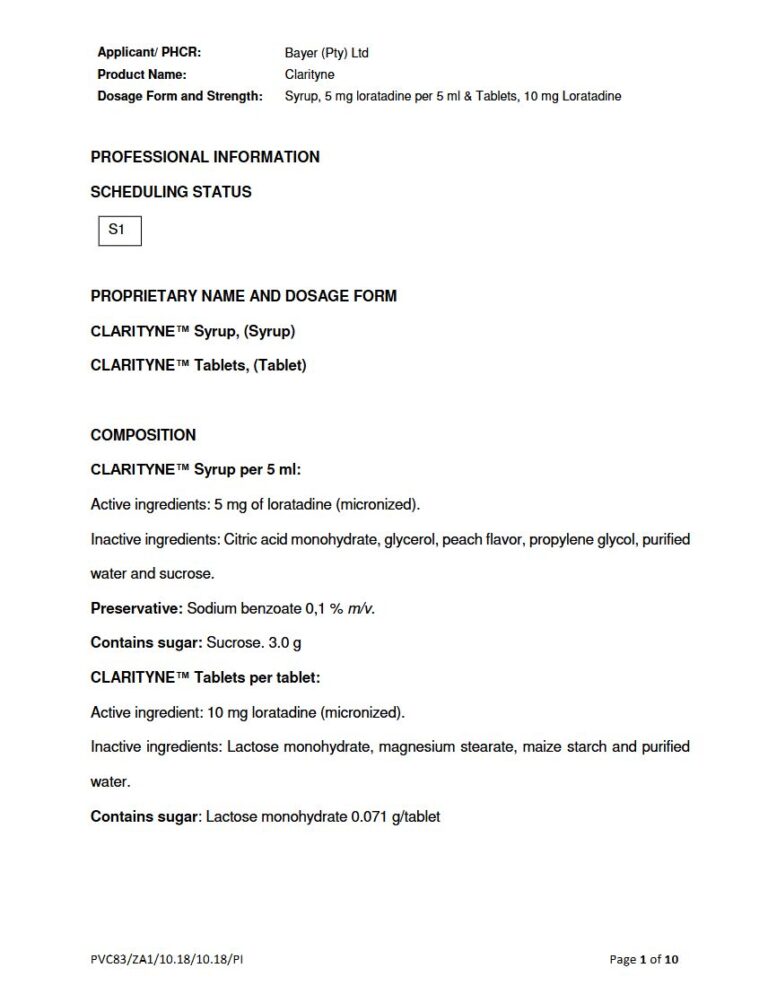
Clarityne Tablet & Syrup 5mg. 10mg Tablet & Syrup
PDF Leaflet Revision Date: 31 October 2018
Clinical Summary
Quick overview from the medicine insert
Indication
Relief of allergic rhinitis and chronic urticaria.
Dosage (summary)
Adults: 10 mg once daily; Children 2-12 years: 5-10 ml once daily based on weight.
Onset of Action / Duration
Onset: 1.5 hours, Duration: 24 hours
Special Populations
- Severe liver impairment
- Elderly
- Children under 2 years
Pregnancy & Breastfeeding
Safety during pregnancy and lactation not established.
Key Drug Interactions
- Ketoconazole
- Erythromycin
- Cimetidine
Contraindications
- Hypersensitivity to components
- Children under 2 years
Common side effects
- Somnolence
- Headache
- Increased appetite
- Insomnia
Counselling Points
- Take with or without food
- Avoid alcohol
- Monitor for sedation
Serious warnings
- Caution in severe liver impairment
- Possible sedation
Important Disclaimer
The Clarityne Tablet & Syrup 5mg. 10mg Tablet & Syrup professional information leaflet below is the property of Pi_Bayer and is provided on Medinsert exactly as issued, with no.. alterations or editorial changes. We make every effort to keep content current by updating documents as soon as new versions become available. Medinsert serves as a trusted access point for healthcare professionals, but does not replace official sources or clinical judgement. For more details, please read our full disclaimer. read more>>
 Healthcare Professionals Only
This content is for registered healthcare professionals
Sign in or create a free account to read the full package insert.
Free for HPCSA-registered professionals. Powered by Medinsert.
Clinical Particulars
Section 4 of the official insert — extracted exactly as issued, no alterations
4.1 Therapeutic indications
CLARITYNE u2122 is indicated for the relief of symptoms associated with perennial and /or seasonal allergic rhinitis, chronic urticaria and other allergic skin disorders
4.2 Posology and method of administration
For oral use only. CLARITYNE u2122 can be taken with or without meal.
CLARITYNE u2122 Syrup:
Children 2 to 12 years of age : Body Weight equal to or less than 30 kg: 5 ml (1 medicine measure) once daily.
Body Weight more than 30 kg : 10 ml (2 medicine measures) once daily.
Adults and Children 12 years of age and over: 10 ml (2 medicine measures) once daily.
CLARITYNE u2122 Tablets:
Adults: One tablet once daily.
4.3 Contraindications
CLARITYNE u2122 is contraindicated in patients who have shown sensitivity or idiosyncrasy to its components. Safety of CLARITYNE u2122 in the elderly has not been established. CLARITYNE u2122 is contraindicated in children under two years of age as safety has not been established.
4.4 Special warnings and precautions for use
Patients with severe liver impairment should be administered a lower initial dose of CLARITYNE u2122 because they may have a reduced clearance of loratadine; an initial dose of 5 ml (or 5 mg tablet) once daily, or 10 ml (or 10 mg tablet) every other day is recommended. Efficacy of CLARITYNE u2122 Syrup has not yet been established in children younger than 2 years of age. However, the pharmacokinetic profile of loratadine in infants 1 to 2 years after the administration of a single 2.5 mg dose of CLARITYNE u2122 Syrup is similar to that in older children and adults. When administered concomitantly with alcohol, loratadine has no potentiating effects as measured by psychomotor performance studies. CLARITYNE u2122 contains sugar. Patients with rare hereditary problems of fructose or galactose intolerance, the Lapp lactose deficiency or glucose-galactose malabsorption or sucrose-isomaltase insufficiency should not take CLARITYNE u2122. Weight gain has been reported with the use of loratadine, but the frequency is unknown.
4.5 Interactions with other medicines
The use of CLARITYNE u2122 should be discontinued approximately 48 hours prior to skin testing procedures since it may prevent or diminish otherwise positive reactions to dermal reactivity indicators. An increase in plasma concentrations of loratadine have been reported after concomitant use with ketoconazole, erythromycin or cimetidine in controlled clinical trials, but without clinically significant changes (including electrocardiographic). Other medicines known to inhibit hepatic metabolism should be co-administered with caution together with CLARITYNE u2122 until definitive interaction studies can be completed or in the absence of formal interaction studies.
4.6 Fertility, pregnancy and lactation
The safe use of CLARITYNE u2122 during pregnancy or lactation has not been established.
4.7 Effects on ability to drive and use machines
CLARITYNE u2122 lacks significant sedative effects. Patients should, however be warned that a small number of individuals may experience sedation. It is therefore advisable to determine individual response before driving or performing complicated tasks. This effect may be compounded by the simultaneous intake of alcohol or other central nervous system depressants.
4.8 Undesirable effects
In clinical trials involving adults and adolescents in a range of indications including allergic rhinitis and chronic idiopathic urticaria, at the recommended dose of 10 mg daily, side effects with CLARITYNE u2122 Tablets were reported in 2 % of patients in excess of those treated with placebo. The most frequent side effects reported in excess of placebo were somnolence (1.2 %), headache (0.6 %), increased appetite (0.5 %) and insomnia (0.1 %). Other side effects reported during post-marketing period are listed in the following table.
Immune system disorders: Anaphylaxis including angioedema
Metabolism and nutrition disorders: Increased appetite
Nervous system disorders: Headache, somnolence, sedation, nervousness, dizziness, convulsion
Cardiac disorders: Tachycardia, palpitation
Gastrointestinal disorders: Nausea, dry mouth, gastritis
Hepatobiliary disorders: Abnormal hepatic function
Skin and subcutaneous tissue disorders: Rash, alopecia
General disorders and administrative site conditions: Fatigue
4.9 Overdose
Refer to u201cSide Effectsu201d. Overdosage Information: Somnolence, tachycardia and headache have been reported with overdoses. In the event of overdosage, treatment should be started immediately. Treatment: Treatment is symptomatic and supportive. Consider standard measures to remove any unabsorbed medicine in the stomach, such as adsorption by activated charcoal administered as a slurry with water. The administration of gastric lavage should be considered. 0.9 % Sodium chloride solution is the lavage solution of choice, particularly in children. In adults, tap water can be used; however, as much as possible of the amount administered should be removed before the next instillation. Sodium chloride or saline cathartics draw water into the bowel by osmosis and therefore, may be valuable for their action in rapid dilution of bowel content. Loratadine is not cleared by haemodialysis to any appreciable extent. After emergency treatment, the patient should continue to be medically monitored.
