
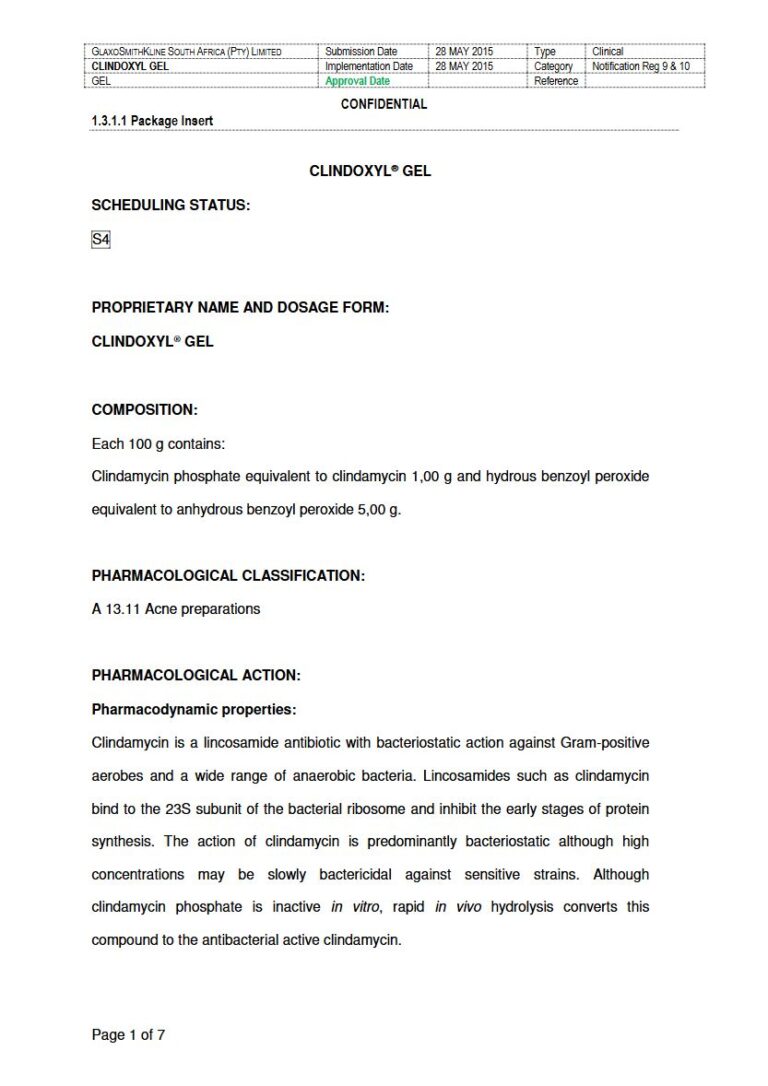
Clindoxyl Gel 100mg Gel
PDF Leaflet Revision Date: 28 May 2015
Clinical Summary
Quick overview from the medicine insert
Indication
Treatment of mild to moderate acne vulgaris.
Dosage (summary)
Apply once daily in the evening to affected areas after washing.
Special Populations
- Children under 12 years
Pregnancy & Breastfeeding
Safety in pregnancy and lactation not established.
Key Drug Interactions
- Topical antibiotics
- Vitamin A derivatives
- Abrasive soaps
Contraindications
- Hypersensitivity to clindamycin
- Hypersensitivity to benzoyl peroxide
Common side effects
- Erythema
- Peeling
- Dryness
- Pruritus
Counselling Points
- Avoid sun exposure
- Treatment may take 4-6 weeks for full effect
- Do not exceed 12 weeks of use
Serious warnings
- Avoid contact with eyes and sensitive skin
- May cause skin irritation
- Resistance may occur with long-term use
Important Disclaimer
The Clindoxyl Gel 100mg Gel professional information leaflet below is the property of Glaxosmithkline South Africa and is provided on Medinsert exactly as issued, with no.. alterations or editorial changes. We make every effort to keep content current by updating documents as soon as new versions become available. Medinsert serves as a trusted access point for healthcare professionals, but does not replace official sources or clinical judgement. For more details, please read our full disclaimer. read more>>
 Healthcare Professionals Only
This content is for registered healthcare professionals
Sign in or create a free account to read the full package insert.
Free for HPCSA-registered professionals. Powered by Medinsert.
Clinical Particulars
Section 4 of the official insert — extracted exactly as issued, no alterations
4.1 Indications
CLINDOXYL GEL is indicated in the treatment of mild to moderate acne vulgaris, particularly inflammatory lesions in adolescents and adults.
4.2 Contra-indications
CLINDOXYL GEL should not be used in patients with known hypersensitivity to clindamycin, lincomycin, benzoyl peroxide or any of the excipients in the formulation.
4.3 Warnings and special precautions
Contact with the mouth, eyes, skin and mucous membranes and with abraded or eczematous skin should be avoided. Application to sensitive areas of skin should be made with caution. In the event of accidental contact with the eyes, bathe with copious amounts of water. The product may bleach hair or coloured fabrics. It is recommended that exposure to sun or sunlamps be minimised. Patients should be advised that, in some cases, 4-6 weeks of treatment may be required before the full therapeutic effect is observed. It should be used with caution in atopic patients, in whom further skin drying may occur. The frequency of application should be reduced if excessive irritation or dryness develops. With long term use of CLINDOXYL GEL resistance may occur. Cross resistance may occur with other antibiotics such as lincomycin and erythromycin when using antibiotic monotherapy. There have been isolated reports of pseudomembraneous colitis or diarrhoea due to other topical treatments containing clindamycin.
4.4 Interactions
Concomitant topical antibiotics, medicated or abrasive soaps and cleansers, soaps and cosmetics that have a strong drying effect and products with high concentrations of alcohol and or astringents should be used with caution as a cumulative irritant effect may occur. Simultaneous application of CLINDOXYL GEL and topical acne preparations containing vitamin A derivatives should be avoided. Potential synergism exists between clindamycin and gentamycin.
4.5 Fertility, pregnancy and lactation
Safety in pregnancy and lactation has not been established.
4.6 Dosage and directions for use
For application to the skin. For external use only.
Adults and adolescents: Apply once daily in the evening, to the affected areas after the skin has been thoroughly washed, rinsed with warm water and gently patted dry.
Use in children: The safety and efficacy of CLINDOXYL GEL has not been established in prepubescent children (under 12 years of age). Treatment with CLINDOXYL GEL should not exceed more than 12 weeks of continuous use.
4.7 Side effects
CLINDOXYL GEL may cause erythema, peeling, dryness and pruritus at the site of application. Uncommonly, paraesthesia, worsening of acne and contact dermatitis can occur. Reported frequency in clinical trials are: Very common (>1/10): Erythema; peeling; dryness Common (>1/100, 1/1000, < 1/100): Paraesthesia; worsening of acne. There have been isolated reports of pseudomembraneous colitis or diarrhoea due to other topical treatments containing clindamycin. In the post marketing environment there have been isolated instances of allergic reactions which can be sudden and severe.
4.8 Known symptoms of overdose and particulars of its treatment
No case of overdose has been reported.
