
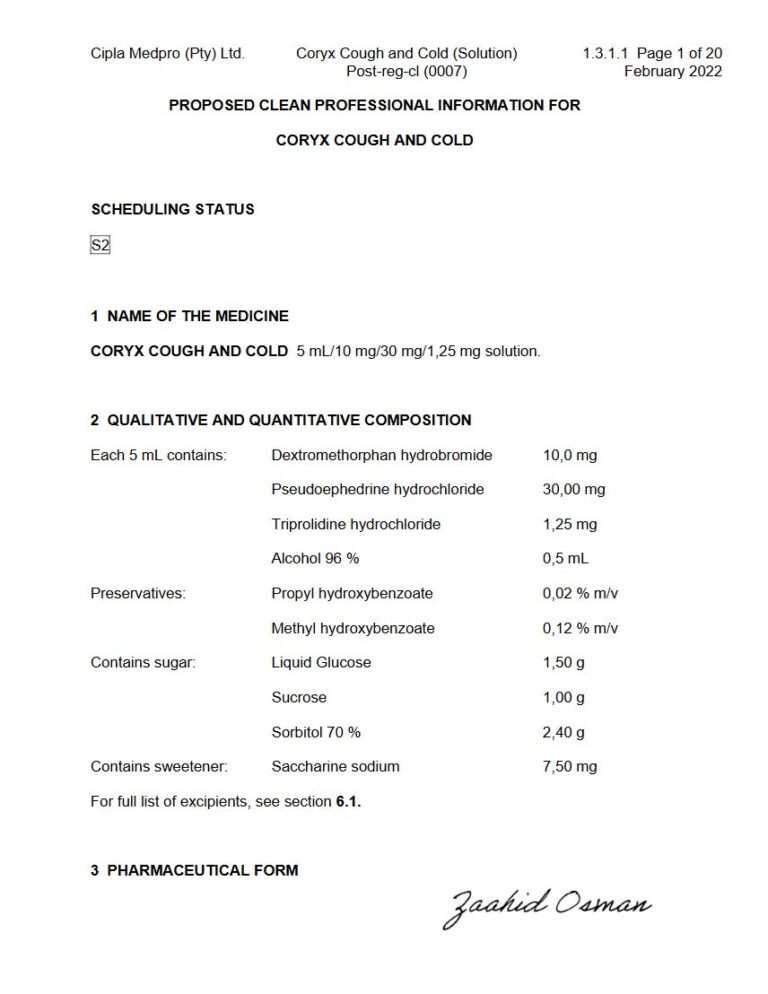
Coryx Cough And Cold 5 mL/10 mg/30 mg/1.25 mg Solution
PDF Leaflet Revision Date: 26 April 2022
Clinical Summary
Quick overview from the medicine insert
Indication
Alleviation of cough.
Dosage (summary)
Adults: 10 mL; Children 6-12 years: 5 mL; Children 2-5 years: 2.5 mL, three times daily.
Special Populations
- Elderly
- Patients with cardiovascular disease
- Patients with diabetes mellitus
Pregnancy & Breastfeeding
Contraindicated during pregnancy and lactation.
Key Drug Interactions
- CNS depressants
- Monoamine oxidase inhibitors
- Sympathomimetics
Contraindications
- Hypersensitivity to ingredients
- Younger than 2 years
- Cardiovascular disease
- Hypertension
- Prostatism
- Thyrotoxicosis
- Narrow angle glaucoma
- Asthma during an attack
Common side effects
- Sedation
- Dizziness
- Dry mouth
- Constipation
Counselling Points
- Avoid alcohol and CNS depressants
- Do not drive or operate machinery
- Report any adverse reactions
Serious warnings
- May cause drowsiness
- Risk of respiratory failure
- Potential for abuse and dependence
Important Disclaimer
The Coryx Cough And Cold 5 mL/10 mg/30 mg/1.25 mg Solution professional information leaflet below is the property of Cipla Medpro and is provided on Medinsert exactly as issued, with no.. alterations or editorial changes. We make every effort to keep content current by updating documents as soon as new versions become available. Medinsert serves as a trusted access point for healthcare professionals, but does not replace official sources or clinical judgement. For more details, please read our full disclaimer. read more>>
 Healthcare Professionals Only
This content is for registered healthcare professionals
Sign in or create a free account to read the full package insert.
Free for HPCSA-registered professionals. Powered by Medinsert.
Clinical Particulars
Section 4 of the official insert — extracted exactly as issued, no alterations
4.1 Therapeutic indications
CORYX COUGH AND COLD is indicated for the alleviation of cough.
4.2 Posology and method of administration
Adults and children over 12 years: 10 mL
Children 6 to 12 years: 5 mL
Children 2 to 5 years: 2,5 mL
CORYX COUGH AND COLD should be given three times daily. The dosage must not be exceeded. CORYX COUGH AND COLD is contraindicated in infants younger than 2 years of age (see section 4.3).
4.3 Contraindications
CORYX COUGH AND COLD is contraindicated in patients:
u2022 With hypersensitivity to any of the ingredients.
u2022 Younger than 2 years of age.
u2022 With cardiovascular disease (especially coronary insufficiency).
u2022 With hypertension.
u2022 With prostatism.
u2022 With thyrotoxicosis.
u2022 With bladder dysfunction.
u2022 With narrow angle glaucoma.
u2022 With phaeochromocytoma.
u2022 Being treated with monoamine oxidase inhibitors and within two weeks of stopping such treatment (see section 4.5).
u2022 Being treated with ephedrine and other sympathomimetic agents, as a hypertensive response may result (see section 4.5).
u2022 Who are pregnant or breast feeding as the safety has not been established (see section 4.6).
u2022 With asthma during an asthma attack.
u2022 At risk of developing respiratory failure.
4.4 Special warnings and precautions for use
CORYX COUGH AND COLD may lead to drowsiness and impaired concentration, which may be aggravated by simultaneous intake of alcohol or other central nervous system depressant agents (see section 4.7). It is possible that some sedating antihistamines, such as triprolidine, and therefore CORYX COUGH AND COLD, could mask the warning signs of ototoxic damage caused by medicines, such as aminoglycoside antibiotics.
Contains sucrose. Patients with rare hereditary conditions such as fructose intolerance, glucose-galactose mal-absorption or sucrase isomaltase insufficiency should not take CORYX COUGH AND COLD. Contains glucose and sucrose which may have an effect on the glycaemic control of patients with diabetes mellitus. Contains sorbitol and may have a laxative effect. Patients with the rare hereditary condition of sorbitol/ maltitol/ lactitol intolerance should not take CORYX COUGH AND COLD. Pseudoephedrine, and therefore CORYX COUGH AND COLD, should be given with caution to patients with organic heart disease, cardiac decompensation or angina of effort and in patients receiving digoxin. CORYX COUGH AND COLD should be used with caution in patients with diabetes mellitus, and with occlusive vascular disorders (arteriosclerosis). Use carefully in elderly and debilitated patients. Elderly patients are more susceptible to the central nervous system depressant and hypnotic effects.
CORYX COUGH AND COLD should be used with caution in patients with cardiovascular disease, glaucoma, liver impairment, prostatic hypertrophy and urinary retention. Antitussive medicines should not be administered to patients with productive coughs. Dextromethorphan, and therefore CORYX COUGH AND COLD, should not be given to patients in, or at risk of, developing respiratory failure (see section 4.3). Caution is needed in patients with a history of asthma and it should not be given during an acute attack (see section 4.3). Care is also advisable in patients with bronchitis, emphysema, or in other conditions where chronic or persistent cough occurs. Dextromethorphan abuse and dependence may occur, especially following prolonged use of high doses of CORYX COUGH AND COLD.
4.5 Interaction with other medicines and other forms of interaction
Triprolidine, and therefore CORYX COUGH AND COLD, may enhance the sedative effects of central nervous system depressants including alcohol, barbiturates, hypnotics, narcotic analgesics, sedatives, and tranquillisers. Triprolidine, and therefore CORYX COUGH AND COLD, may have an additive antimuscarinic action when combined with other antimuscarinic medicines, such as atropine and some antidepressants (both tricyclic antidepressants and monoamine oxidase inhibitors). It is possible that some sedating antihistamines, such as triprolidine, and therefore CORYX COUGH AND COLD, could mask the warning signs of ototoxic damage caused by medicines, such as aminoglycoside antibiotics. Since antihistamines may suppress the cutaneous histamine response to allergen extracts, CORYX COUGH AND COLD should be discontinued several days before skin testing. Triprolidine, and therefore CORYX COUGH AND COLD, may affect the metabolism of certain medicines in the liver. Pseudoephedrine, and therefore CORYX COUGH AND COLD, may give rise to a hypertensive crisis in patients receiving monoamine oxidase inhibitors (MAOIs) [including reversible inhibitors of monoamine oxidase A (RIMAs)]. In addition there have been reports of severe and sometimes fatal reactions following the use of dextromethorphan in patients receiving MAOIs (see section 4.3). Due to a possible interaction with pseudoephedrine, caution should be exercised when CORYX COUGH AND COLD is administered to patients undergoing anaesthesia with halothane or other halogenated anaesthetics. There is an increased risk of dysrhythmias in patients receiving cardiac glycosides (digoxin), quinidine, or tricyclic antidepressants, as well as an increased risk of vasoconstrictor or pressor effects in patients receiving ergot alkaloids or oxytocin. CORYX COUGH AND COLD should not be co-administered with quinidine or tricyclic antidepressants. The effects of pseudoephedrine are diminished by guanethidine, reserpine and probably methyldopa and may be diminished or enhanced by antidepressants. Pseudoephedrine, and therefore CORYX COUGH AND COLD, may also diminish the effects of guanethidine and may increase the possibility of dysrhythmias in digitalised patients. Concomitant use of CORYX COUGH AND COLD with sympathomimetic medicines, such as nasal decongestants, appetite suppressants and amphetamine-like psychostimulants, or with medicines that interfere with the catabolism of sympathomimetic medicines, may cause a rise in blood pressure largely because of interaction with pseudoephedrine (see section 4.3). Because of its pseudoephedrine content, CORYX COUGH AND COLD may partially reverse the hypotensive action of medicines which interfere with sympathetic activity including bretylium, bethanidine, debrisoquine, methyldopa and beta-adrenergic blocking medicines. Since dextromethorphan is primarily metabolised by the cytochrome P450 isoenzyme CYP2D6, the possibility of interactions with inhibitors of this enzyme, including amiodarone, fluoxetine, haloperidol, paroxetine, propafenone, quinidine, and thioridazine, should be borne in mind when these medicines are co-administered with CORYX COUGH AND COLD. Serotonin syndrome-like symptoms have occurred when dextromethorphan, as contained in CORYX COUGH AND COLD, has been taken with linezolid.
4.6 Fertility, pregnancy and lactation
Pregnancy
The use of CORYX COUGH AND COLD is contraindicated during pregnancy and lactation (see section 4.3).
Breastfeeding
The use of CORYX COUGH AND COLD is contraindicated during pregnancy and lactation (see section 4.3).
4.7 Effects on ability to drive and use machines
CORYX COUGH AND COLD may lead to drowsiness and impaired concentration, which may be aggravated by simultaneous intake of alcohol or other central nervous system depressant medicines. Patients should not drive, climb dangerous heights or operate machinery as impaired decision-making could lead to accidents.
4.8 Undesirable effects
Sedation or insomnia may occur. Triprolidine as contained in CORYX COUGH AND COLD:
Blood and lymphatic system disorders:
Less frequent: Blood dyscrasias, including agranulocytosis, leucopenia, haemolytic anaemia, and thrombocytopenia.
Immune system disorders:
The following side-effects have been reported and frequencies are unknown: Allergy, anaphylaxis, and hypersensitivity reactions (including bronchospasm and angioedema).
Metabolism and nutrition disorders:
The following side-effects have been reported and frequencies are unknown: Sweating.
Psychiatric disorders:
Frequent: Sedation varying from slight drowsiness to deep sleep, and including lassitude, dizziness, and incoordination, although paradoxical stimulation may occasionally occur, especially at high doses and in children or the elderly. Symptoms of cerebral stimulation in adults include insomnia, nervousness, tachycardia, tremors, muscle twitching, and convulsions. The following side-effects have been reported and frequencies are unknown: Inability to concentrate, elation or depression, irritability, nightmares, and sleep disturbances.
Nervous system disorders:
Frequent: Headache, and psychomotor impairment. The following side-effects have been reported and frequencies are unknown: Paraesthesia, tremor, muscular weakness, confusion, deepening coma, extrapyramidal effects, as well as tingling, heaviness, and weakness of the hands. Large doses may precipitate fits in epileptics.
Eye disorders:
Frequent: Blurred vision. Ear and labyrinth disorders:
The following side-effects have been reported and frequencies are unknown: Tinnitus.
Cardiac disorders:
The following side-effects have been reported and frequencies are unknown: Hypotension, palpitations, dysrhythmias, impaired circulation to the extremities.
Respiratory, thoracic and mediastinal disorders:
Frequent: Thickened respiratory tract secretions. The following side-effects have been reported and frequencies are unknown: Tightness of the chest.
Gastrointestinal disorders:
Frequent: Dryness of the mouth, constipation, and increased gastric reflux. The following side-effects have been reported and frequencies are unknown: Nausea, vomiting, diarrhoea, colic, epigastric pain, and anorexia.
Skin and subcutaneous tissue disorders:
The following side-effects have been reported and frequencies are unknown: Dermatological reactions may occur, including photosensitisation of the skin and lichenoid skin eruption, hair loss.
Musculoskeletal, connective tissue and bone disorders:
The following side-effects have been reported and frequencies are unknown: Myalgia.
Renal and urinary disorders:
Frequent: Urinary difficulty or retention. Pseudoephedrine as contained in CORYX COUGH AND COLD:
Endocrine disorders:
The following side-effects have been reported and frequencies are unknown: Disturbances of glucose metabolism. Metabolism and nutrition disorders:
Less frequent: Sweating. The following side-effects have been reported and frequencies are unknown: Thirst. Psychiatric disorders:
Frequent: Anxiety, restlessness, insomnia, and nervousness. Less frequent: Hallucinations. The following side-effects have been reported and frequencies are unknown: Giddiness, agitation, fear, irritability, and psychotic states. Adverse mental effects (particularly in children) have been associated with combination preparations containing pseudoephedrine. Nervous system disorders:
Less frequent: Convulsions, dizziness, headache, weakness and tremors. The following side-effects have been reported and frequencies are unknown: Confusion, fainting, and muscular weakness. Eye disorders:
The following side-effects have been reported and frequencies are unknown: Miosis. Cardiac disorders:
Frequent: Tachycardia. Less frequent: Reflex bradycardia, palpitations. The following side-effects have been reported and frequencies are unknown: Precordial pain, hypertension resulting in intracranial haemorrhage, anginal pain, especially in patients suffering from angina pectoris, cardiac dysrhythmias, cardiac arrest, flushing, vasoconstriction which may result in hypertension, and cerebral haemorrhage, impaired circulation to the extremities. Respiratory, thoracic and mediastinal disorders:
Less frequent: Dyspnoea (shortness of breath) or troubled breathing. The following side-effects have been reported and frequencies are unknown: Pulmonary oedema. Gastrointestinal disorders:
Less frequent: Nausea or vomiting. The following side-effects have been reported and frequencies are unknown: Loss of appetite, dry mouth. Ischaemic colitis has been reported after acute or chronic use of pseudoephedrine in combination cold and allergy preparations.
Skin and subcutaneous tissue disorders:
Less frequent: Skin rashes. The following side-effects have been reported and frequencies are unknown: Fixed drug eruption due to pseudoephedrine, taking the form of erythematous nummular patches, have been reported. Renal and urinary disorders:
Less frequent: Urinary retention, difficulty with micturition, especially in patients with prostatic enlargement, or painful urination. General disorders:
Less frequent: Pallor. Dextromethorphan as contained in CORYX COUGH AND COLD:
Psychiatric disorders:
Less frequent: Drowsiness. The following side-effects have been reported and frequencies are unknown: Excitation. Toxic psychosis (hyperactivity, visual and auditory hallucinations) may occur. Nervous system disorders:
Less frequent: Mental confusion, headache, and dizziness. Respiratory, thoracic and mediastinal disorders:
The following side-effects have been reported and frequencies are unknown: Respiratory depression may occur with very high doses. Gastrointestinal disorders:
Less frequent: Constipation, nausea, vomiting, stomach pain, and gastrointestinal disturbance.
4.9 Overdose
The symptoms may include drowsiness, weakness, incoordination, difficulty with micturition, respiratory depression, irritability, convulsions, hypertension, palpitations and gastrointestinal disturbance. Paranoid psychoses, delusions and hallucinations may follow an overdose with pseudoephedrine. Triprolidine intoxication may lead to ataxia, death from respiratory failure, and respiratory collapse. Overdosage may be fatal, especially in infants and children in whom main symptoms are central nervous system stimulation and antimuscarinic effects including ataxia, excitement, hallucinations, muscle tremor, convulsions, dilated pupils, dry mouth, flushed face and hyperpyrexia. Respiratory depression can be treated with naloxone. Treatment is symptomatic and supportive.
