
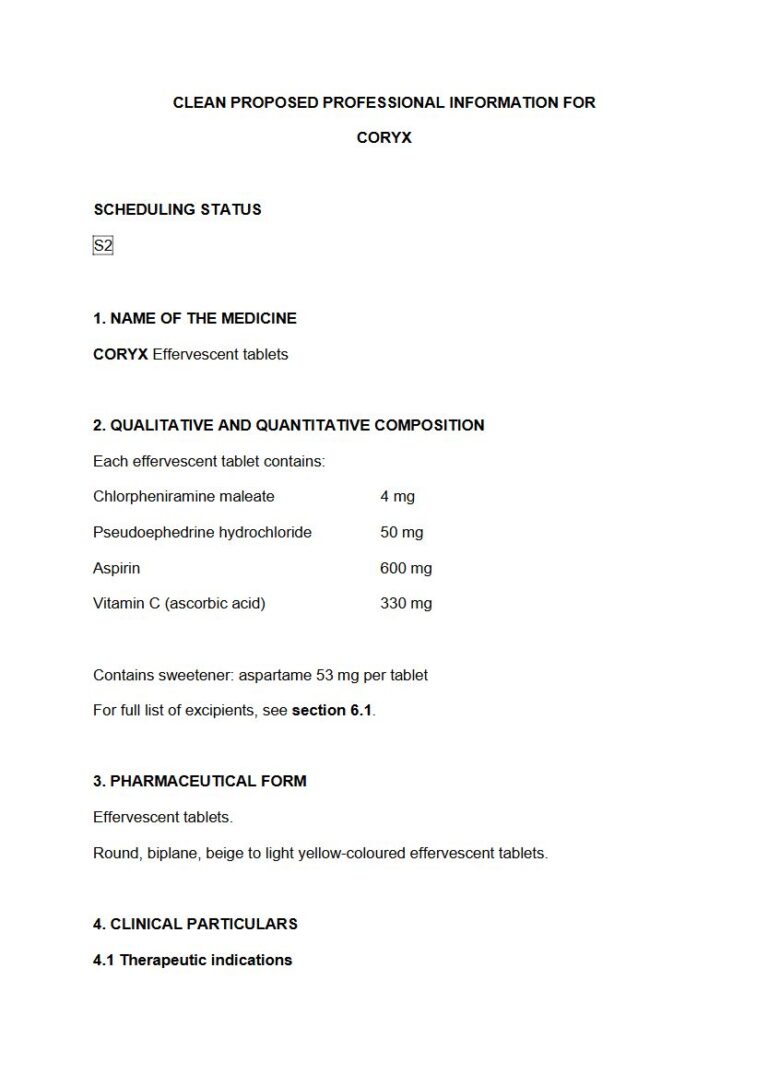
Coryx Effervescent 53 mg Effervescent Tablets
PDF Leaflet Revision Date: 06 November 2024
Clinical Summary
Quick overview from the medicine insert
Indication
Treatment of symptoms associated with colds and influenza in adults and children over 16 years.
Dosage (summary)
One tablet every 8 hours as needed for adults and children over 16 years.
Special Populations
- Elderly
- Renal impairment
- Hepatic impairment
Pregnancy & Breastfeeding
Contraindicated in pregnancy and breastfeeding.
Key Drug Interactions
- MAOIs
- CNS depressants
- NSAIDs
Contraindications
- Hypersensitivity to ingredients
- Coronary disease
- Hypertension
- Pregnancy
- Breastfeeding
- Children under 16
Common side effects
- Drowsiness
- Gastrointestinal disturbances
- Nausea
Counselling Points
- Avoid alcohol
- Do not exceed 10 days of use
- May cause drowsiness
Serious warnings
- Risk of cardiovascular events
- Gastrointestinal bleeding
- Reye's syndrome
Important Disclaimer
The Coryx Effervescent 53 mg Effervescent Tablets professional information leaflet below is the property of Cipla Medpro and is provided on Medinsert exactly as issued, with no.. alterations or editorial changes. We make every effort to keep content current by updating documents as soon as new versions become available. Medinsert serves as a trusted access point for healthcare professionals, but does not replace official sources or clinical judgement. For more details, please read our full disclaimer. read more>>
 Healthcare Professionals Only
This content is for registered healthcare professionals
Sign in or create a free account to read the full package insert.
Free for HPCSA-registered professionals. Powered by Medinsert.
Clinical Particulars
Section 4 of the official insert — extracted exactly as issued, no alterations
4.1 Therapeutic indications
CORYX is indicated in adults and children over 16 years for the treatment of symptoms associated with colds and influenza.
4.2 Posology and method of administration
Posology
Use the lowest effective dose for the shortest possible duration of treatment.
Adults and children over 16 years
One tablet every 8 hours if necessary. Gastric irritation may be reduced by taking doses after food.
Children under 16 years
CORYX is contraindicated in children under the age of 16 years (see section 4.3).
Method of administration
Place one tablet in a glass of warm (or cold if so wished) water and allow to dissolve. Drink all the contents immediately once the whole tablet has dissolved (see section 6.6).
4.3 Contraindications
CORYX is contraindicated in:
u2022 patients with known hypersensitivity to chlorpheniramine, pseudoephedrine, aspirin (or any other NSAID) or vitamin C (ascorbic acid), or to any of the excipients in CORYX (see section 6.1).
u2022 patients with coronary disease, hypertension, cardiovascular disease, heart failure, hyperthyroidism, epilepsy.
u2022 pregnancy and breastfeeding (see section 4.6).
u2022 patients being treated with monoamine oxidase inhibitors (MAOIs) or within 14 days of stopping such treatment (see section 4.5).
u2022 patients with a history of gastrointestinal perforation, ulceration or bleeding (PUBs) related to previous nonsteroidal anti-inflammatory medicines (NSAIDs) including aspirin, as contained in CORYX.
u2022 patients with haemophilia, severe renal impairment and patients receiving oral anticoagulant therapy (see section 4.5).
u2022 patients with active or history of recurrent ulcer / haemorrhage / perforations.
u2022 patients with phenylketonuria (see section 4.4).
u2022 children under the age of 16 years (see section 4.4).
u2022 patients with severe hypertension or uncontrolled hypertension.
u2022 patients with severe acute or chronic kidney disease/renal failure.
4.4 Special warnings and precautions for use
CORYX may predispose to cardiovascular events, gastrointestinal events, or cutaneous reactions which may be fatal. Do not use for more than 10 days without consulting your doctor. Prolonged use of high doses may lead to anaemia, blood dyscrasias, gastrointestinal haemorrhage, peptic ulceration and renal papillary necrosis.
Kidney or liver impairment
Patients suffering from kidney or liver disease should take CORYX under medical supervision. Care should be taken in patients with urinary retention. CORYX is contraindicated in patients with severe acute or chronic kidney disease/renal failure (see section 4.3).
Sensitivity to aspirin
CORYX contains aspirin, therefore it should be used with caution in patients with asthma or allergic disorders. It should not be given to patients with a history of nasal polyps associated with aspirin or sensitivity reactions to aspirin or other NSAIDs (see section 4.3).
Drowsiness
The use of this medicine may lead to drowsiness and impaired concentration, which may be aggravated by the simultaneous intake of alcohol or other central nervous system depressants. Patients should be advised, particularly at the initiation of therapy, against taking charge of vehicles or machinery or performing potentially hazardous tasks where loss of concentration could lead to accidents (see section 4.7).
Reyeu2019s syndrome
Aspirin has been implicated in Reyeu2019s syndrome, a rare but serious illness in children and teenagers who have or are recovering from chicken pox and influenza. A medical practitioner should be consulted before giving CORYX to children under 16 years of age; therefore CORYX is contraindicated in children under 16 years of age and in teenagers with chickenpox and influenza. A doctor should be consulted before CORYX is used in such patients (see section 4.3).
Cardiovascular disease
There appears to be a higher risk of cardiovascular events with higher doses and longer duration of treatment. Due to inhibition of prostaglandin synthesis, fluid retention and oedema have been observed in patients taking aspirin, which is contained in CORYX; therefore CORYX should be used with caution in patients with compromised cardiac function and other conditions predisposing to, or worsened by, fluid retention. Patients with pre-existing congestive heart failure or hypertension should not take CORYX (see section 4.3). CORYX should be used with caution in patients with cardiovascular disease such as ischaemic heart disease, dysrhythmia or tachycardia, and occlusive vascular disorders, including arteriosclerosis or aneurysms. Anginal pains may be precipitated in patients with angina pectoris.
Other
CORYX should be used with caution in patients with diabetes mellitus, closed-angle glaucoma and prostatic hyperplasia.
Elderly
The elderly have an increased frequency of adverse reactions to NSAIDs, such as aspirin in CORYX, especially gastrointestinal perforation, ulceration and bleeding (PUBs) which may be fatal.
Gastrointestinal disease
The risk of gastrointestinal perforation, ulceration or bleeding (PUBs) is higher with increasing doses of CORYX, in patients with a history of ulcers, and the elderly. When gastrointestinal bleeding or ulceration occurs in patients receiving CORYX, treatment with CORYX should be stopped. CORYX should be given with caution to patients with a history of gastrointestinal disease (e.g. ulcerative colitis, Crohnu2019s disease, hiatus hernia, gastro-oesophageal reflux disease, angiodysplasia) as the condition may be exacerbated (see section 4.3). Care should be taken in patients with pyloroduodenal obstruction.
Surgery
CORYX contains aspirin that may increase blood loss during surgery. A neuraxial regional anaesthetic technique is not recommended for a patient taking CORYX in combination with other medicines with anti-coagulant effects.
Skin reactions
Serious skin reactions, some of them fatal, including exfoliative dermatitis, Stevens-Johnson syndrome and toxic epidermal necrolysis have been reported. CORYX should be discontinued at the first appearance of skin rash, mucosal lesions, or any other sign of hypersensitivity.
Pregnancy
Regular use of NSAIDs, such as aspirin in CORYX, during the third trimester of pregnancy, may result in premature closure of the foetal ductus arteriosus in utero, and in persistent pulmonary hypertension of the new-born. The onset of labour may be delayed and its duration increased. CORYX is contraindicated in pregnancy (see section 4.3).
Laboratory tests
CORYX contains aspirin, therefore it can interfere with thyroid function tests.
Skin testing
CORYX may suppress the cutaneous histamine response to allergen extracts and should be stopped several days before skin testing (see section 4.5).
Hyperoxaluria
CORYX should be given with care to patients with hyperoxaluria. Tolerance may be induced with prolonged use of large doses of vitamin C (ascorbic acid).
Hypokalaemia and renal tubular acidosis (RTA)
Severe hypokalaemia and renal tubular acidosis (RTA) have been reported due to prolonged use of NSAIDs at higher than recommended doses. CORYX-induced renal tubular acidosis should therefore be considered in patients with unexplained hypokalaemia and metabolic acidosis.
Posterior reversible encephalopathy syndrome (PRES) and reversible cerebral vasoconstriction syndrome (RCVS)
Cases of PRES and RCVS have been reported with the use of pseudoephedrine-containing products (see section 4.8). The risk is increased in patients with severe or uncontrolled hypertension, or with severe acute or chronic kidney disease/renal failure (see section 4.3). Pseudoephedrine should be discontinued and immediate medical assistance sought if the following symptoms occur: sudden severe headache or thunderclap headache, nausea, vomiting, confusion, seizures and/or visual disturbances. Most reported cases of PRES and RCVS resolved following discontinuation and appropriate treatment.
Aspartame
CORYX contains 53 mg aspartame in each tablet. Aspartame is a source of phenylalanine. CORYX is contraindicated in patients with phenylketonuria (see section 4.3).
4.5 Interactions with other medicines and other forms of interaction
CORYX may enhance the sedative effects of central nervous system (CNS) depressants including alcohol, barbiturates, hypnotics, opioid / narcotic analgesics, anxiolytic sedatives, tranquillisers and antipsychotics. CORYX has an additive antimuscarinic action with other antimuscarinic medicines, such as atropine and some antidepressants (both tricyclics and MAOIs). Care should therefore be observed when tricyclic antidepressants, reserpine, methyldopa or atropine are taken concomitantly. CORYX may cause a hypertensive crisis in patients receiving a MAOI [including a reversible monoamine oxidase inhibitor (RIMA)] (see section 4.3). CORYX should be avoided or used with care in patients undergoing anaesthesia with volatile or halogenated anaesthetics as they may induce ventricular fibrillation. An increased risk of dysrhythmias may occur if given to patients receiving digoxin, quinidine or tricyclic antidepressants and there is an increased risk of vasoconstrictor or pressor effects in patients receiving ergot alkaloids or oxytocin. Use of two or more NSAIDs, including aspirin as in CORYX, concomitantly could result in an increase in side effects. Use of corticosteroids concomitantly may result in an increased risk of gastrointestinal perforation, ulceration or bleeding (PUBs). Some of the effects of aspirin on the gastrointestinal tract are enhanced by alcohol. CORYX may enhance the activity of warfarin and oral antidiabetic preparations and sulphonamides. Use of anti-platelet medicines and selective serotonin reuptake inhibitors (SSRIs) concomitantly may result in increased risk of gastrointestinal bleeding. CORYX diminishes the effects of anti-gout preparations such as probenecid and sulphinpyrazone. Barbiturates and other sedatives may mask the respiratory symptoms of aspirin overdosage and have been reported to enhance its toxicity. CORYX could mask the warning signs of damage caused by ototoxic medicines such as aminoglycoside antibiotics. CORYX may suppress the cutaneous histamine response to allergen extracts and should be stopped several days before skin testing (see section 4.4). CORYX should be used with caution with dipyridamole, metoclopramide, metoprolol, carbonic anhydrase inhibitors, corticosteroids, antacids and adsorbents (including aluminium hydroxide and kaolin), gold compounds, sulfonylurea hypoglycaemic medicines, zafirlukast, methotrexate, phenytoin, valproate, mifepristone, calcium channel blockers, such as verapamil, and spironolactone.
4.6 Fertility, pregnancy and lactation
Pregnancy
CORYX is contraindicated in pregnancy (see sections 4.3 and 4.4). Use of NSAIDs, such as CORYX, around 20 weeks of gestation or later in pregnancy may cause a rare but serious foetal renal dysfunction leading to oligohydramnios and, in some cases, neonatal renal impairment. Complications of prolonged oligohydramnios include limb contractures and delayed lung maturation, which may require invasive procedures such as exchange transfusion or dialysis, in some cases.
Breastfeeding
CORYX is contraindicated in breastfeeding (see section 4.3). CORYX contains pseudoephedrine, which is excreted in breast milk.
4.7 Effects on ability to drive and use machines
CORYX may cause drowsiness or sleepiness which may interfere with the patientu2019s ability to drive or operate machines. Because CORYX may produce sedation, patients should not operate machinery, drive cars, climb dangerous heights or perform potentially dangerous tasks where impaired decision making could lead to accidents.
4.8 Undesirable effects
Tabulated summary of adverse reactions
Blood and the lymphatic system disorders
Less frequent: Agranulocytosis, thrombocytopenia, pancytopenia, aplastic anaemia, iron-deficiency anaemia (during long-term salicylate therapy), leukopenia, haemolytic anaemia. Frequency unknown: Increased bleeding time, decreased platelet adhesiveness, hypoprothrombinaemia, haemolysis (in patients with G6PD deficiency).
Immune system disorders
Frequency unknown: Hypersensitivity reactions, including urticaria, skin eruptions, angioedema, rhinitis and severe, even fatal, paroxysmal bronchospasm and dyspnoea (especially in asthmatics, chronic urticaria or rhinitis), anaphylaxis.
Metabolism and nutrition disorders
Frequency unknown: Altered metabolism, including disturbances of glucose metabolism, hypokalaemia (reported post-marketing following prolonged use of NSAIDs at higher than recommended doses).
Psychiatric disorders
Frequent: Anxiety, restlessness, insomnia. Less frequent: Hallucinations (particularly in children). Frequency unknown: Sleep disturbances, confusion, fear, irritability, psychotic states, euphoria, nervousness.
Nervous system disorders
Frequent: Central nervous system depression, ranging from slight drowsiness to deep sleep, including lassitude, dizziness, or incoordination, headache, psychomotor impairment, antimuscarinic effects, such as dry mouth, thickened respiratory tract secretions, blurred vision, urinary difficulty or retention, constipation and increased gastric reflux. Less frequent: Paradoxical stimulation (especially at high doses, in children and the elderly). Frequency unknown: Facial dyskinesia, adverse mental effects (particularly in children), convulsions, paraesthesias, extrapyramidal effects, tremor, depression, tingling, heaviness and weakness of the hands, posterior reversible encephalopathy syndrome (PRES) (see section 4.4), Reversible cerebral vasoconstriction syndrome (RCVS) (see section 4.4).
Eye disorders
Frequency unknown: Blurred vision, diplopia.
Ear and labyrinth disorders
Frequency unknown: Tinnitus, hearing loss.
Cardiac disorders
Frequent: Tachycardia. Less frequent: Palpitations, cardiac dysrhythmias. Frequency unknown: Bradycardia, anginal pain, cardiac arrest, oedema, cardiac failure.
Vascular disorders
Frequency unknown: Hypotension, with dizziness, fainting and flushing, vasoconstriction, hypertension, cerebral haemorrhage, pulmonary oedema.
Respiratory, thoracic and mediastinal disorders
Frequency unknown: Impaired sense of smell, dryness of the respiratory passages, tightness of the chest, dyspnoea.
Gastrointestinal disorders
Frequent: Gastrointestinal disturbances, nausea, dyspepsia, vomiting. Less frequent: Major upper gastrointestinal bleeding, diarrhoea, epigastric pain. Frequency unknown: Irritation of the gastric mucosa with erosion, ulceration, haematemesis and melaena, impaired sense of taste, ischaemic colitis, loss of appetite, epigastric distress, constipation, dryness of the mouth and throat, hypersalivation, peptic ulcers, perforation or gastrointestinal bleeding, sometimes fatal, flatulence, abdominal pain, ulcerative stomatitis, exacerbation of colitis and Crohnu2019s disease, gastritis.
Hepatobiliary disorders
Frequency unknown: Hepatotoxicity, hepatic injury, elevation of aminotransferase values.
Skin and subcutaneous tissue disorders
Less frequent: Skin rashes, fixed medicine eruptions. Frequency unknown: Exfoliative dermatitis, sweating, hair loss, bullous reactions, including Stevens-Johnson syndrome and toxic epidermal necrolysis.
Musculoskeletal, connective tissue and bone disorders
Frequency unknown: Myalgia.
Renal and urinary disorders
Less frequent: Urinary retention, analgesic nephropathy. Frequency unknown: Hyperoxaluria, renal calcium oxalate calculi, renal impairment, difficulty in micturition, urinary frequency and dysuria, renal tubular acidosis (reported post-marketing following prolonged use of NSAIDs at higher than recommended doses).
General disorders and administrative site conditions
Frequency unknown: Weakness, fatigue.
Reporting of suspected adverse reactions
Reporting suspected adverse reactions after authorisation of the medicine is important. It allows continued monitoring of the benefit/risk balance of the medicine. Health care providers are asked to report any suspected adverse drug reactions to SAHPRA via the Med Safety APP (Medsafety X SAHPRA) and eReporting platform (who-umc.org) found on SAHPRA website or to Cipla Medpro (Pty) Ltd by email: [email protected] or telephone: 080 222 6662 (toll free).
4.9 Overdose
CORYX overdosage may result in convulsions and hypertension in susceptible patients. Overdosage may also cause tachycardia, dysrhythmias and anginal pain, nausea, dizziness, hyperventilation, respiratory alkalosis, metabolic acidosis, hypoglycaemia, vomiting, irritation of gastric mucosa with dyspepsia, haematemesis and melaena. Overdosage with sedating antihistamines, such as chlorpheniramine in CORYX, is associated with antimuscarinic, extrapyramidal and CNS effects. When CNS stimulation predominates over CNS depression, which is more likely in children or the elderly, it causes ataxia, excitement, tremors, psychoses, hallucinations and convulsions; hyperpyrexia may also occur. Deepening coma and cardiorespiratory collapse may follow. In adults, CNS depression is more common with drowsiness, coma and convulsions, progressing to respiratory failure and cardiovascular collapse. Prolonged use at higher than recommended doses may result in severe hypokalaemia and renal tubular acidosis. Symptoms may include reduced level of consciousness and generalised weakness (see section 4.4 and section 4.8). The patient must be taken to a doctor or hospital immediately as specialised treatment may be necessary. Treatment is supportive and symptomatic, the serum salicylate levels should be closely monitored and forced alkaline diuresis instituted if appropriate.
