
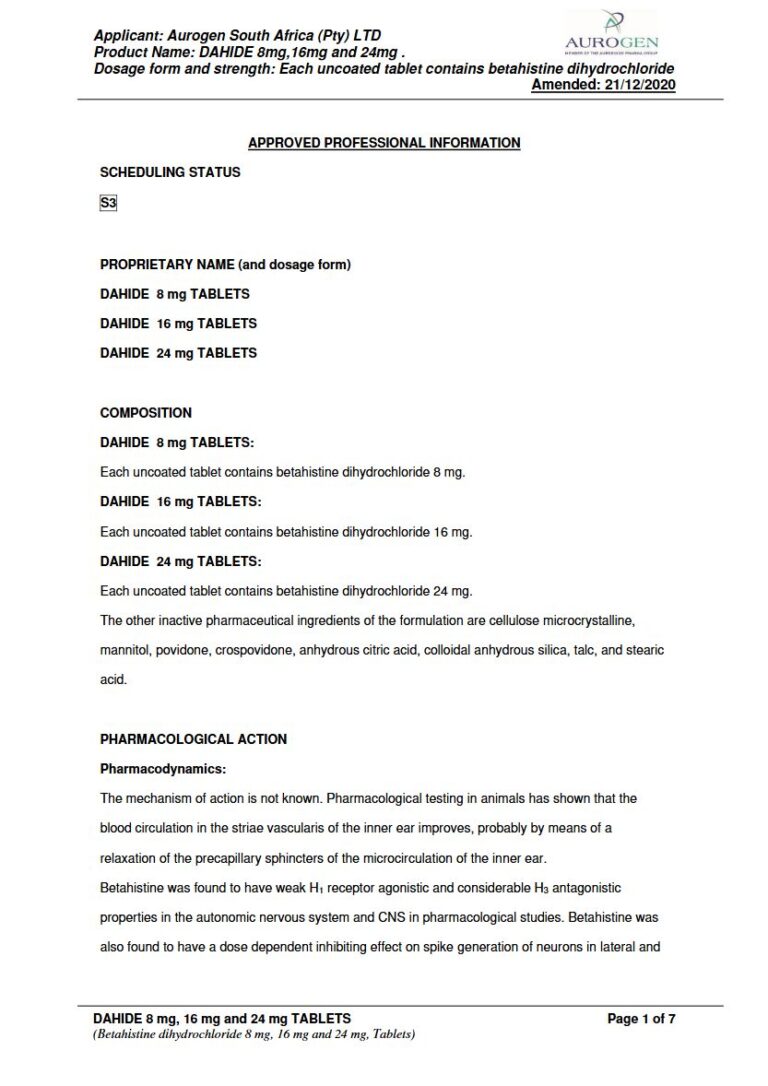
Dahide 8mg,16mg and 24mg TABLETS
PDF Leaflet Revision Date: 13 March 2023
Clinical Summary
Quick overview from the medicine insert
Indication
Symptomatic treatment of vertigo associated with Mu00e9n iu00e8reu2019s syndrome.
Dosage (summary)
Initially 16 mg three times daily; maintenance 24-48 mg daily in divided doses.
Special Populations
- Elderly
- Patients with bronchial asthma
- Patients with a history of peptic ulcers
Pregnancy & Breastfeeding
Not recommended during pregnancy and lactation due to insufficient data.
Key Drug Interactions
- Avoid concomitant use with antihistamines
Contraindications
- Hypersensitivity to ingredients
- Active peptic ulcer
- Phaeochromocytoma
Common side effects
- Gastro-intestinal disturbances
- Headache
- Hypersensitivity reactions
Counselling Points
- Take with meals to reduce gastrointestinal disturbances
- Report any hypersensitivity reactions
Serious warnings
- Caution in asthmatic patients
- Caution in patients with peptic ulcer history
Important Disclaimer
The Dahide 8mg,16mg and 24mg TABLETS professional information leaflet below is the property of Aurogen South Africa and is provided on Medinsert exactly as issued, with no.. alterations or editorial changes. We make every effort to keep content current by updating documents as soon as new versions become available. Medinsert serves as a trusted access point for healthcare professionals, but does not replace official sources or clinical judgement. For more details, please read our full disclaimer. read more>>
 Healthcare Professionals Only
This content is for registered healthcare professionals
Sign in or create a free account to read the full package insert.
Free for HPCSA-registered professionals. Powered by Medinsert.
Clinical Particulars
Section 4 of the official insert — extracted exactly as issued, no alterations
4.1 Therapeutic indications
DAHIDE TABLETS are indicated for the symptomatic treatment of the vertigo associated with Mu00e9niu00e8reu2019s syndrome.
4.2 Posology and method of administration
Adults (including the elderly): Initially 16 mg three times daily taken preferably with meals. Maintenance doses are generally in the range of 24 to 48 mg daily, in divided doses.
DAHIDE 8 mg TABLETS 1 u2013 2 tablets 3 times/day
DAHIDE 16 mg TABLETS 1 / 2 u2013 1 tablet 3 times/day 1 tablet 2 times/day
The dosage should be individually adapted according to the response.
Children: No dosage recommendations are made for children.
4.3 Contraindications
Hypersensitivity to any of the ingredients.
Patients with active peptic ulcer.
Patients with phaeochromocytoma.
4.4 Special warnings and precautions for use
Warnings: DAHIDE TABLETS should be administered with caution to patients with bronchial asthma as clinical intolerance has been shown in relatively few patients. Caution is advised in patients with a history of peptic ulcers.
Special precautions: Caution should be taken in the treatment of asthmatic patients and patients with a history of peptic ulcer. Concomitant use with anti-histamines should be avoided (see u201cINTERACTIONSu201d).
4.7 Effects on ability to drive and use machines
On the basis of the pharmacodynamics profile and reported adverse reactions (see u201cSIDE EFFECTSu201d), DAHIDE TABLETS have no or negligible effects on the ability to drive and use machines.
4.5 Interactions with other medicines
Concomitant use with antihistamines should be avoided (See u201cSpecial Precautionsu201d).
4.6 Fertility, pregnancy and lactation
There is insufficient data on the use of this medicine during pregnancy and lactation. Therefore DAHIDE TABLETS should not be used during pregnancy and lactation.
4.8 Undesirable effects
DAHIDE TABLETS may cause the following side effects:
Immune System Disorders: Less frequent: Hypersensitivity reactions e.g. anaphylaxis
Nervous system disorders: Less frequent: Headache.
Gastrointestinal disorders: Frequent: Gastro-intestinal disturbances. These can normally be dealt with by lowering the dose or by taking the dose during meals.
Skin and subcutaneous tissue disorders: Less frequent: Cutaneous hypersensitivity reactions have been reported, in particular rash, pruritis and urticaria.
4.9 Overdose
See SIDE EFFECTS and WARNINGS AND SPECIAL PRECAUTIONS. The most common symptoms are nausea, vomiting and headache. Hypotension may occur. There is no specific antidote. Treatment may include stomach emptying by inducing emesis or by lavage. Further treatment is symptomatic and supportive.
