
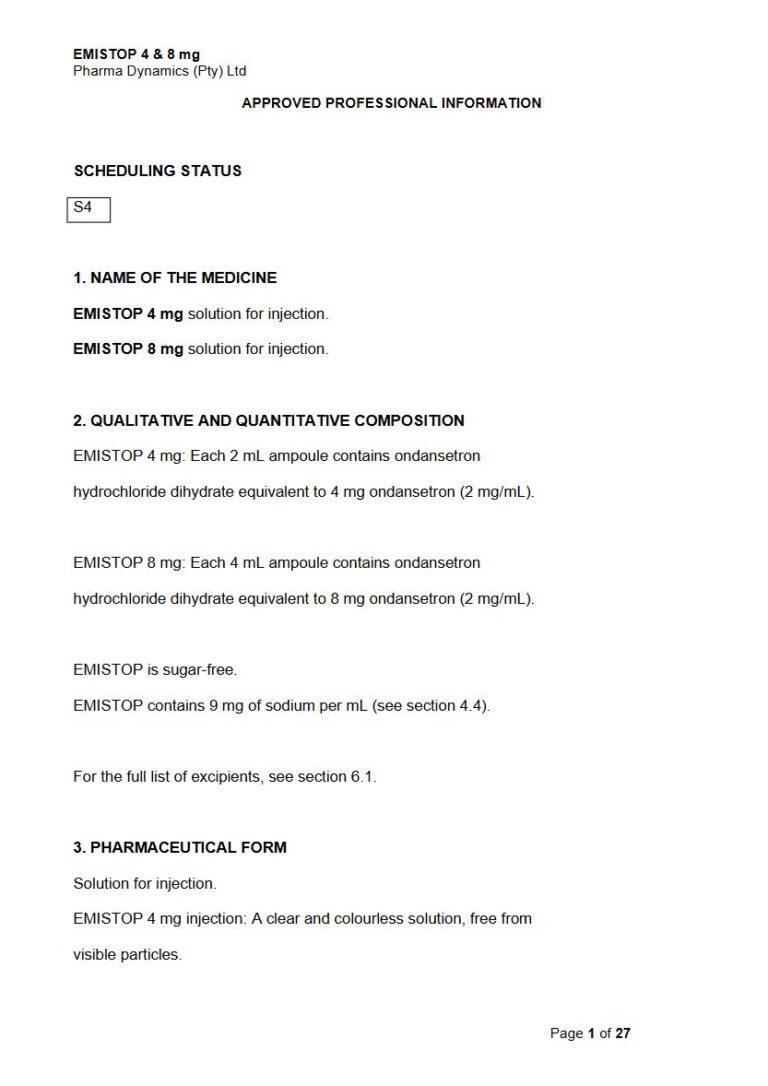
Emistop 4mg & 8 mg Injection (aqueous solution).
PDF Leaflet Revision Date: 16 February 2026
Clinical Summary
Quick overview from the medicine insert
Indication
Management of nausea and vomiting induced by chemotherapy, radiotherapy, and post-operative.
Dosage (summary)
Adults: 8 mg IV/IM before treatment, then 8 mg orally every 12 hours.
Onset of Action / Duration
Onset: 30 mins, Duration: Up to 24 hours
Special Populations
- Elderly
- Renal impairment
- Hepatic impairment
Pregnancy & Breastfeeding
Contraindicated in first 12 weeks of pregnancy; avoid breastfeeding.
Key Drug Interactions
- Apomorphine
- CYP3A4 inducers
- QT prolonging agents
Contraindications
- Hypersensitivity to ondansetron
- Pregnancy
- Congenital long QT syndrome
Common side effects
- Headache
- Dizziness
- Constipation
- Hypotension
Counselling Points
- Monitor for signs of QT prolongation.
- Avoid use in early pregnancy.
- Report any severe allergic reactions.
Serious warnings
- QT prolongation
- Myocardial ischemia
- Serotonin syndrome
Important Disclaimer
The Emistop 4mg & 8 mg Injection (aqueous solution). professional information leaflet below is the property of Pharma Dynamics and is provided on Medinsert exactly as issued, with no.. alterations or editorial changes. We make every effort to keep content current by updating documents as soon as new versions become available. Medinsert serves as a trusted access point for healthcare professionals, but does not replace official sources or clinical judgement. For more details, please read our full disclaimer. read more>>
 Healthcare Professionals Only
This content is for registered healthcare professionals
Sign in or create a free account to read the full package insert.
Free for HPCSA-registered professionals. Powered by Medinsert.
Clinical Particulars
Section 4 of the official insert — extracted exactly as issued, no alterations
4.1 Therapeutic indications
EMISTOP is indicated for the management of nausea and vomiting induced by chemotherapy and radiotherapy. EMISTOP is also indicated for the prevention and treatment of post-operative nausea and vomiting. Routine prophylaxis is not recommended for patients in whom there is little expectation that nausea and vomiting will occur.
4.2 Posology and method of administration
Chemotherapy and radiotherapy induced nausea and vomiting: The emetogenic potential of cancer treatment varies according to the doses and combinations of chemotherapy and radiotherapy regimens used.
Adults: Emetogenic chemotherapy and radiotherapy: For most patients receiving emetogenic chemotherapy and radiotherapy, EMISTOP 8 mg should be administered as a slow IV infusion (not less than 2-3 minutes) or IM injection, in not less than 30 seconds, immediately before treatment, followed by 8 mg orally twelve-hourly. In circumstances where delayed or prolonged emesis is expected after 24 hours, ondansetron may be continued orally, 8 mg twice daily for up to 5 days after a course of treatment.
Highly emetogenic chemotherapy: A single dose of EMISTOP 8 mg by slow IV infusion (not less than 2-3 minutes) or IM injection, in not less than 30 seconds, immediately before chemotherapy has been shown to be effective in many patients. Higher doses may be required in some patients, particularly those on high dose cisplatin and the doses should be adjusted according to the severity of the emetogenic challenge. In these patients the following dose schedules have been shown to be effective:
- a dose of 8 mg by slow IV or IM injection immediately before chemotherapy, followed by two further IV or IM doses of 8 mg two to four hours apart, or by a constant infusion of 1 mg/hour for up to 24 hours
- a single dose of 16 mg diluted in 50 u2013 100 mL of saline or other compatible infusion fluid, infused over not less than 15 minutes immediately before chemotherapy. A single dose greater than 16 mg should not be given due to dose-dependent increased risk of QT prolongation (see section 4.4).
The efficacy of EMISTOP in highly emetogenic chemotherapy may be enhanced by the addition of a single intravenous dose of dexamethasone phosphate 20 mg administered 30 u2013 45 minutes prior to the first EMISTOP dose prior to chemotherapy. To protect against delayed or prolonged emesis after the first 24 hours, ondansetron may be continued orally, 8 mg twice daily for up to 5 days after a course of treatment.
Special populations
Elderly: Based on more recent ondansetron plasma concentrations and exposure-response modelling, a greater effect on QTcF is predicted in patients u2265 75 years of age compared to young adults. Specific dosing information for intravenous dosing is provided below for patients over 65 years of age and over 75 years of age.
- In patients 75 years of age or older, the initial intravenous dose of EMISTOP, given for the prevention of chemotherapy-induced nausea and vomiting (CINV) should not exceed 8 mg, (infused over at least 15 minutes).
- In patients aged less than 75 years, a single dose of intravenous EMISTOP given for the prevention of CINV in adults (aged less than 75 years) must not exceed 16 mg (infused over at least 5 minutes).
Elderly patients aged 65 years or older: All intravenous doses should be diluted in 50-100 mL of saline or other compatible infusion fluid (see section 6.6) and infused over 15 minutes. The initial dose of 8 mg may be followed by two further intravenous doses of 8 mg, infused over 15 minutes and given no less than four hours apart. (see section 5.2).
Paediatric population: Experience is currently limited, but EMISTOP was effective and well tolerated in children over the age of 4 years, when given intravenously at a dose of 5 mg/m2 over 15 minutes, immediately before chemotherapy, followed by oral therapy of doses of ondansetron 4 mg every 12 hours for up to 5 days.
Patients with Renal Impairment: No alteration of daily dosage or frequency of dosing, or route of administration are required.
Patients with Hepatic Impairment: Clearance of EMISTOP is significantly reduced and serum half-life significantly prolonged in subjects with moderate or severe impairment of hepatic function. In such patients a total daily dose of 8 mg should not be exceeded and therefore parenteral or oral administration is recommended.
Prevention and treatment of post-operative nausea and vomiting: Adults: Immediately before induction of anaesthesia, or post-operatively if the patient experiences nausea and/or vomiting occurring shortly after surgery, administer EMISTOP 4 mg undiluted intramuscularly or intravenously. If given intravenously, it must be administered by IV infusion over not less than 2 u2013 5 minutes or longer. Alternatively, for the prevention of post-operative nausea and vomiting, ondansetron may be given orally one hour prior to induction of anaesthesia. Repeat dosing for patients who continue to experience nausea and/or vomiting post-operatively has not been studied. While recommended as a fixed dose for all, few patients above 80 kg or below 40 kg have been studied.
Special populations: Elderly: Based on more recent ondansetron plasma concentrations and exposure-response modelling, a greater effect on QTcF is predicted in patients u226575 years of age compared to young adults. Specific dosing information for intravenous dosing is provided for patients over 65 years of age and over 75 years of age.
A slight age-related decrease in clearance, and an increase in the half-life of ondansetron is predicted, presenting as slight, clinically insignificant age-related increases in both oral bioavailability (65 %) and a prolonged elimination half-life (5 hours) of ondansetron.
Paediatric population: For prevention of post-operative nausea and vomiting in paediatric patients two years and older having surgery performed under general anaesthesia, EMISTOP may be administered by slow intravenous infusion over 2 to 5 minutes or longer at a dose of 0,1 mg/kg up to a maximum of 4 mg either prior to, at, or after induction of anaesthesia. For the treatment of established post-operative nausea and vomiting in patients two years and older, EMISTOP may be administered by slow intravenous injection at a dose of 0,1 mg/kg up to maximum of 4 mg over not less than 2-5 minutes or preferably longer. Repeat dosing for patients who continue to experience nausea and/or vomiting post-operatively has not been studied and thus should not be given.
Patients with renal/hepatic impairment: Patients with renal impairment: No alteration of daily dosage or frequency of dosing, or route of administration is required. There is limited information for daily dosage or frequency of dosing, or route of administration for severe renal impairment. Patients with hepatic impairment: Clearance of EMISTOP is significantly reduced and serum half-life significantly prolonged in patients with moderate or severe impairment of hepatic function. In such patients, a total daily dose of 8 mg should not be exceeded.
4.3 Contraindications
- hypersensitivity to ondansetron or to any of the ingredients of EMISTOP (see section 6.1)
- pregnancy
- ondansetron use is contraindicated during the first 12 weeks of pregnancy irrespective of the indication (see sections 4.4 and 4.6)
- congenital long QT syndrome
- concomitant use with apomorphine (see section 4.5).
4.4 Special warnings and precautions for use
Myocardial Ischaemia: Cases of myocardial ischemia have been reported in patients treated with ondansetron. In some patients, especially in the case of intravenous administration, symptoms appeared immediately after administration of ondansetron.
Patients with hepatic impairment: In patients with moderate or severe impairment of hepatic function, clearance of EMISTOP is significantly reduced and serum half-life significantly prolonged. In such patients, a total daily dose of 8 mg should not be exceeded. EMISTOP prolongs QT interval in a dose-dependent manner. In addition, cases of Torsade de Pointes have been reported. Avoid EMISTOP in patients with congenital long QT syndrome (see section 4.3). EMISTOP should be administered with caution in patients who have or may develop prolongation of QTc, including patients with electrolyte abnormalities, congestive heart failure, bradydysrhythmias or patients taking other medicines that lead to QT prolongation or electrolyte abnormalities. Hypokalaemia and hypomagnesaemia should be corrected prior to EMISTOP administration. Hypersensitivity reactions have been reported in patients who have exhibited hypersensitivity to other selective 5-HTu2083 receptor antagonists. Respiratory events should be treated symptomatically and clinicians should pay particular attention to them as precursors of hypersensitivity reactions.
Patients with signs of sub-acute intestinal obstructions should be monitored following administration, as EMISTOP is known to increase large bowel transit time. Serotonin syndrome (including altered mental status, autonomic instability and neuromuscular abnormalities) been reported following the concomitant use of EMISTOP and other serotonergic medicines [including selective serotonin reuptake inhibitors (SSRI) and serotonin noradrenaline reuptake inhibitors (SNRIs)]. Appropriate observation of the patient is advised if the concomitant treatment with EMISTOP and other serotonergic medicines is warranted.
Prevention of nausea and vomiting with EMISTOP may mask occult bleeding in patients with adenotonsillar surgery. Therefore, such patients should be followed carefully after EMISTOP administration.
The use of ondansetron during the first 12 weeks of pregnancy increases the risk of developing oral cleft palate and/or lip to the foetus.
Sodium: EMISTOP contains 3,6 mg, 14,4 mg and 57,6 mg sodium per 1 mL, 4 mL and 16 mL, respectively, equivalent to 0,18 %, 0,72 % and 2,88 % of the WHO recommended maximum daily intake of 2 g sodium for an adult.
Paediatric population: Close monitoring is required for paediatric patients receiving EMISTOP with hepatotoxic chemotherapeutic medicines as concomitant use may cause impaired hepatic function.
CINV: When calculating the dose on a mg/kg basis and administering three doses at 4-hour intervals, the total daily dose will be higher than if one single dose of 5 mg/m2 followed by an oral dose is given. The comparative efficacy of these two different dosing regimens has not been investigated in clinical trials. Cross-trial comparison indicates similar efficacy for both regimens.
4.5 Interaction with other medicines and other forms of interaction
Cases of profound hypotension and loss of consciousness have been reported with the concomitant use of apomorphine and EMISTOP. Concomitant use with apomorphine is therefore contraindicated (see section 4.3). Concomitant use of apomorphine and EMISTOP may intensify QT prolongation (see sections 4.3 and 4.4).
Potent inducers of isoenzyme CYP3A4, such as phenytoin, carbamazepine and rifampicin have been reported to increase ondansetron clearance and reduce ondansetron plasma concentrations. Efficacy of tramadol is reduced in patients using EMISTOP. Co-administration of EMISTOP with hepatic cytochrome P-450 enzymes such as CYP3A4, CYP2D6 and CYP1A2 metabolise EMISTOP. Due to the multiplicity of metabolic enzymes capable of metabolising ondansetron, enzyme inhibition or reduced activity of one enzyme (e.g. CYP2D6 genetic deficiency) is normally compensated by other enzymes, and should result in little or no significant change in overall ondansetron clearance or dose requirement. Caution should be exercised when EMISTOP is co-administered with medicines that prolong the QT interval and/or cause electrolyte abnormalities (see section 4.4). Use of EMISTOP with QT prolonging medicines may result in additional QT prolongation. The risk of arrythmias may be increased with concomitant use of EMISTOP with cardiotoxic medicines (e.g. anthracyclines such as doxorubicin, daunorubicin or trastuzumab), antibiotics such as erythromycin, antifungals such as ketoconazole, antiarrhythmics (such as amiodarone) and beta blockers (such as atenolol or timolol) (see section 4.4).
Serotonergic Medicines (SSRI and SNRIs) Serotonin syndrome (including altered mental status, autonomic instability and neuromuscular abnormalities) has been reported with concomitant use of EMISTOP with other serotonergic medicines (including SSRIs and SNRIs). Specific studies have shown that there are no interactions when EMISTOP is administered with alcohol, temazepam, furosemide, alfentanil, tramadol, morphine, lidocaine, thiopental, or propofol. There is no evidence that EMISTOP either induces or inhibits the metabolism of other medicines commonly co-administered with it.
4.6 Fertility, pregnancy and lactation
Women of childbearing potential / Contraception in males and females: Women of childbearing potential being treated with EMISTOP should not become pregnant as EMISTOP is contraindicated in the first 12 weeks of pregnancy, irrespective of the cause of the nausea and vomiting (see section 4.3). Women of childbearing potential to use contraception while taking EMISTOP and for 2 days after stopping treatment.
Pregnancy: EMISTOP is contraindicated for post-operative nausea and vomiting during pregnancy, as well as during the first 12 weeks of pregnancy irrespective of the indication due to the risk (see section 4.3). During the first 12 weeks of pregnancy can be associated with an increased risk of developing oral cleft palate and/or lip to the foetus.
Breastfeeding: Tests have shown that ondansetron passes into the milk of lactating animals. It is therefore recommended that mothers receiving EMISTOP should not breastfeed their babies.
Fertility: There is not information on the effects of EMISTOP on human fertility.
4.7 Effects on ability to drive and use machines
EMISTOP has no or negligible influence on the ability to drive and use machines. No signs of sedation or impairment of performance, when using machinery during psychomotor testing, were observed for EMISTOP, however, impaired vision and dizziness are possible side effects therefore patients should not drive or use machines until the effects of EPISTOP treatment are known (see section 4.8).
4.8 Undesirable effects
Summary of the safety profile: The following frequencies are estimated at the standard recommended doses of ondansetron. The adverse event profiles in children and adolescents were comparable to that seen in adults.
Tabulated list of adverse effects:
| System Organ Class | Frequency | Side effects |
|---|---|---|
| Immune system disorders | Less frequent | Severe hypersensitivity reactions (e.g. anaphylaxis, bronchospasm, shortness of breath, hypotension, shock, angioedema) |
| Nervous system disorders | Frequent | Headache |
| Less frequent | Seizures, dizziness, movement disorders (including extrapyramidal reactions such as oculogyric crisis, dystonic reactions and dyskinesia) | |
| Eye disorders | Less frequent | Transient visual disturbances (e.g. blurred vision), transient blindness (during intravenous administration), oculogyric crisis |
| Cardiac disorders | Less frequent | Dysrhythmias, tachycardia, bradycardia and chest pain with or without ST segment depression, QTc prolongation (including Torsade de Pointes), dysrhythmias, cardiopulmonary arrest, atrial fibrillation, Myocardial ischaemia |
| Vascular disorders | Frequent | Sensation of warmth or flushing |
| Less frequent | Hypotension | |
| Respiratory, thoracic and mediastinal disorders | Less frequent | Hiccups, laryngeal oedema and laryngospasm |
| Gastrointestinal disorders | Frequent | Constipation, diarrhoea, abdominal pain or stomach cramps, increased bowel transit time |
| Hepatobiliary disorders | Less frequent | Transient asymptomatic increases in aminotransferases and in liver function tests |
| General disorders and administrative site conditions | Frequent | Pain, redness and burning at site of injection, rash, urticaria, syncope |
Reporting of suspected adverse reactions: Reporting suspected adverse reactions after authorisation of the medicine is important. It allows continued monitoring of the benefit/risk balance of the medicine. Healthcare professionals are requested to report any suspected adverse drug reactions to SAHPRA via the Med Safety APP (Medsafety X SAHPRA) and eReporting platform (who-umc.org) found on the SAHPRA website. An email can be sent directly to the company, [email protected], to ensure safety of the product.
4.9 Overdose
Signs and symptoms: Manifestations that have been reported include severe constipation, visual disturbances, hypotension and vasovagal episode with transient second-degree AV block.
Management of overdose: In case of suspected overdose, symptomatic and supportive therapy should be given as appropriate, as there is no specific antidote for ondansetron. Ondansetron prolongs QT interval in a dose-dependent manner. ECG monitoring is recommended in case of overdosage.
Paediatric population: Paediatric cases consistent with serotonin syndrome have been reported after inadvertent oral overdoses of EMISTOP (exceeded estimated ingestion of estimated ingestion of 4 mg/kg) in infants and children aged 12 months to 2 years. The use of ipecacuanha to treat overdose with EMISTOP is not recommended, as patients are unlikely to respond due to anti-emetic action of EMISTOP.
