
Engerix-B, Engerix-B Paediatric 1 ml Suspension
PDF Leaflet Revision Date: 05 May 2023
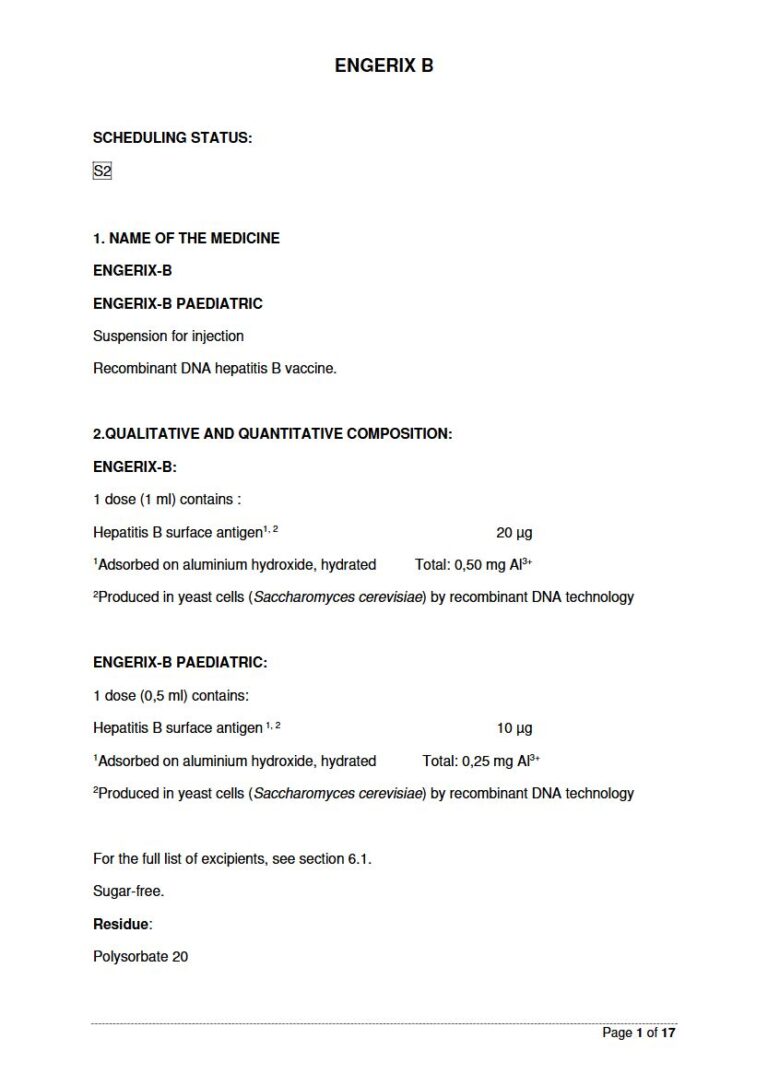
Clinical Summary
Quick overview from the medicine insert
Indication
Active immunisation against hepatitis B virus infection.
Dosage (summary)
Adults: 20 u03bcg in 1 ml; Children: 10 u03bcg in 0.5 ml at 6, 10, 14 weeks.
Special Populations
- Renal impairment
- HIV infection
- Immunocompromised patients
Pregnancy & Breastfeeding
Use in pregnancy not recommended unless high-risk; unknown effects during lactation.
Key Drug Interactions
- Do not mix with other vaccines
- Can be given with BCG, DTP, polio, measles-mumps-rubella, Haemophilus b, and HPV vaccines
Contraindications
- Hypersensitivity to vaccine components
- Acute severe febrile infections
Common side effects
- Pain at injection site
- Fatigue
- Irritability
- Headache
- Gastrointestinal symptoms
Counselling Points
- Shake well before use
- Do not administer if appearance is abnormal
- Report any adverse reactions
Serious warnings
- Risk of syncope
- May not prevent hepatitis B if infection is present at vaccination
- Monitor for apnoea in premature infants
Important Disclaimer
The Engerix-B, Engerix-B Paediatric 1 ml Suspension professional information leaflet below is the property of Glaxosmithkline South Africa and is provided on Medinsert exactly as issued, with no.. alterations or editorial changes. We make every effort to keep content current by updating documents as soon as new versions become available. Medinsert serves as a trusted access point for healthcare professionals, but does not replace official sources or clinical judgement. For more details, please read our full disclaimer. read more>>
 Healthcare Professionals Only
This content is for registered healthcare professionals
Sign in or create a free account to read the full package insert.
Free for HPCSA-registered professionals. Powered by Medinsert.
Clinical Particulars
Section 4 of the official insert — extracted exactly as issued, no alterations
4.1 Therapeutic indications
ENGERIX-B is indicated for active immunisation against hepatitis B virus infection. The vaccine is of no value in the treatment of established hepatitis B virus infection. The vaccine will not protect against infection caused by hepatitis A and non-A, non-B hepatitis viruses. As hepatitis D (caused by the delta agent) does not occur in the absence of hepatitis B infection, it can be expected that hepatitis D will also be prevented by vaccination with ENGERIX-B. The vaccine can be administered at any age from birth onwards. It may be used to start a primary course of vaccination or as a booster dose. It may also be used to complete a primary course of vaccination started with plasma-derived vaccines or as a booster dose in subjects who have previously received a primary course of vaccination with plasma-derived vaccines.
In areas of low prevalence of hepatitis B, vaccination is specially recommended in subjects who are at increased risk of infection. These include:
- Health care personnel: Oral surgeons, dentists, physicians and surgeons; nurses, dental nurses, dental hygienists; paramedical personnel in close contact with patients; staff in haemodialysis, haematology, and oncology units; laboratory personnel handling blood and other clinical specimens; pathologists; morticians and embalmers, blood bank and plasma fractionation workers; chiropodists; cleaning staff in hospitals who handle waste; emergency and first aid workers; ambulance staff.
- Patients: Patients receiving frequent blood transfusions or clotting factor concentrates such as patients in haemodialysis and oncology units, thalassaemics, sickle-cell anaemics; cirrhotics and haemophiliacs, etc.
- Personnel and residents of institutions: Persons with frequent and/or close contacts with high-risk groups; prisoners and prison staff; residents and staff of institutions for the mentally handicapped.
- Persons at increased risk due to their sexual practices: Sexually promiscuous persons, persons who repeatedly contract sexually transmitted disease, homosexually active males, prostitutes.
- Illicit users of addictive injectable drugs.
- Travellers to high endemicity areas and their close contacts.
- Household contacts of any of the above groups and of patients with acute or chronic hepatitis B infection.
- Infants born to mothers who are carriers.
- Others: Police personnel, fire brigade personnel, Armed Forces personnel and anybody who through their work or personal lifestyle may be exposed to the hepatitis B virus.
- Subjects with chronic liver disease (CLD) or at risk of developing CLD (e.g., Hepatitis C virus carriers, persons who abuse alcohol).
In areas of intermediate or high prevalence, vaccination should be offered to all young children and neonates as well as to adult high-risk groups because most of the population is at risk of acquiring hepatitis B. Vaccination against hepatitis B is expected in the long term to reduce not only the overall incidence of hepatitis B but also chronic complications such as chronic active hepatitis and cirrhosis. It may also decrease the incidence of primary hepatocellular carcinoma.
4.2 Posology and method of administration
Posology:
Adults and older children: A dose of 20 u03bcg of antigen protein in 1 ml suspension is recommended for adults and children over 16 years of age.
Neonates, infants and younger children: Three doses of 10 u03bcg of antigen protein in 0,5 ml suspension at 6, 10 and 14 weeks of age is recommended for neonates, infants and children up to and including 15 years of age. However, the 20 u03bcg vaccine can also be used in subjects from 11 years up to and including 15 years of age as a 2-dose schedule in situations when there is a low risk of hepatitis B infection during the vaccination course and when compliance with the complete vaccination course can be assured (see section 5.1).
Method of administration: ENGERIX-B should be injected intramuscularly. In adults the injection should be given in the deltoid region, but it may be preferable to inject ENGERIX-B in the anterolateral thigh in neonates and infants because of the small size of their deltoid muscle. Exceptionally the vaccine may be administered subcutaneously in patients with thrombocytopenia or bleeding disorders. ENGERIX-B should not be administered in the buttock or intradermally since this may result in a lower immune response. ENGERIX-B SHOULD UNDER NO CIRCUMSTANCES BE ADMINISTERED INTRAVASCULARLY. The vaccine should be inspected visually for any foreign particulate matter and/or colouration prior to administration. Before use, ENGERIX-B should be well shaken to obtain a slightly opaque, white suspension. Do not administer if the content appears otherwise. As with other vaccines, a dose of ENGERIX-B should be withdrawn under strict aseptic conditions and precautions taken to avoid contamination of the contents. Use different needles to pierce the rubber stopper and to inject the vaccine.
Primary Immunisation schedule:
- All subjects: A 0-, 1- and 6-months schedule gives optimal protection at month 7 and produces high antibody titres. An accelerated schedule, with immunisation at 0, 1 and 2 months, will confer protection more quickly and is expected to provide better patient compliance. With this schedule, a booster should be administered at 12 months as titres after the third dose are lower than those obtained after the 0, 1, 6 months schedule. In infants this schedule will allow for simultaneous administration of hepatitis B with other childhood vaccines.
- Subjects from 11 years up to and including 15 years of age: The 20-u03bcg vaccine may be administered in subjects from 11 years up to and including 15 years of age according to a 0, 6 months schedule. However, in this case, protection against hepatitis B infections may not be obtained until after the second dose (see section 5.1). Therefore, this schedule should be used only when there is a low risk of hepatitis B infection during the vaccination course and when completion of the two-dose vaccination course can be assured. If both conditions cannot be assured (for instance patients undergoing haemodialysis, travellers to endemic regions and close contacts of infected subjects), the three-dose or the accelerated schedule of the 10-u03bcg vaccine should be used.
- Subjects 18 years of age and above: In exceptional circumstances in adults, where a more rapid induction of protection is required, e.g., persons travelling to areas of high endemicity and who commence a course of vaccination against hepatitis B within one month prior to departure, a schedule of three intramuscular injections given at 0, 7 and 21 days may be used. When this schedule is applied, a booster dose is recommended 12 months after the first dose (see section 5.1 for seroconversion rates).
Booster dose: For haemodialysis and other immunocompromised patients, booster doses are recommended. The need for a booster dose in healthy individuals who have received a full primary vaccination course has not been established. Thus, a booster dose is not recommended in these circumstances. The booster dose is as well tolerated as the primary vaccination course.
Special dosage recommendations:
Neonates born of mothers who are HBV carriers: The immunisation with ENGERIX-B PAEDIATRIC of these neonates should start at birth, and one of the two immunisation schedules have to be followed. Either the 0, 1 and 2 months or the 0-, 1- and 6-months schedule can be used; however, the former schedule provides a more rapid immune response. When available, hepatitis B immune globulins (HBIg) should be given simultaneously with ENGERIX-B PAEDIATRIC at a separate injection site as this may increase the protective efficacy.
Dosage recommendation for known or presumed exposure to HBV: In circumstances where exposure to hepatitis B virus has recently occurred (e.g., needlestick with contaminated needle) the first dose of ENGERIX-B may be administered simultaneously with hepatitis B immunoglobulin which however must be given at a separate injection site. The accelerated immunisation schedule should be advised.
Patients with renal insufficiency including patients undergoing haemodialysis 16 years of age and above: The primary immunisation schedule for patients with renal insufficiency including patients undergoing haemodialysis is four double doses (2 x 20 u03bcg) at elected date, 1 month, 2 months and 6 months from the date of the first dose. The immunisation schedule should be adapted in order to ensure that the anti-HBs antibody titre remains equal to or higher than the accepted protective level of 10 mIU/mL.
Patients with renal insufficiency including patients undergoing haemodialysis up to and including 15 years of age, including neonates: Patients with renal insufficiency, including patients undergoing haemodialysis, have a reduced immune response to hepatitis B vaccines. Either the 0, 1, 2 and 12 months or the 0, 1, 6 months schedule of ENGERIX-B 10 u03bcg can be used. Based on adult experience, vaccination with a higher dosage of antigen may improve the immune response. Consideration should be given to serological testing following vaccination. Additional doses of vaccine may be needed to ensure a protective anti-HBs level u2265 10 mIU/mL.
4.3 Contra-indications
Hypersensitivity to any component of the vaccine or to patients having shown signs of hypersensitivity after previous ENGERIX-B administration. ENGERIX-B should be postponed in subjects suffering from acute severe febrile infections. However, the presence of a minor infection does not contra-indicate vaccination. HIV infection is not considered as a contra-indication for hepatitis B vaccination.
4.4 Special warnings and precautions
Syncope (fainting) can occur following, or even before, any vaccination as a psychogenic response to the needle injection. It is important to have procedures in place to avoid injuries from faints. Because of the long incubation period of hepatitis B it is possible for unrecognised infection to be present at the time of vaccination. The vaccine may not prevent hepatitis B in such cases.
ENGERIX-B should not be administered in the gluteal region or intradermally since these routes of administration may not result in an optimum immune response. ENGERIX-B should under no circumstances be administered intravascularly. In patients with renal insufficiency including patients undergoing haemodialysis, HIV infected patients and persons with an impaired immune system, adequate HBs antibody titres may not be obtained after the usual primary vaccination course and such patients may therefore require administration of additional doses of the vaccine. The vaccine will not prevent infection caused by other pathogens known to infect the liver such as hepatitis A, hepatitis C and hepatitis E virus.
The potential risk of apnoea and the need for respiratory monitoring for 48-72 hours should be considered when administering the primary immunization series to very premature infants (born u2264 28 weeks of gestation) and particularly for those with a previous history of respiratory immaturity. As the benefit of vaccination is high in this group of infants, vaccination should not be withheld or delayed.
A solution of 1 in 1 000 adrenaline should always be readily available for immediate use in case of a rare anaphylactic reaction.
4.5 Interactions with other medicinal products and other forms of interaction
ENGERIX-B should not be mixed with other vaccines. ENGERIX-B can be given concomitantly with BCG, DTP, DT, polio, measles-mumps-rubella, Haemophilus b and hepatitis A vaccine, but different injectable vaccines should always be administered at different injection sites. ENGERIX B can be given concomitantly with Human Papillomavirus (HPV) vaccine. Administration of ENGERIX B at the same time as HPV vaccine has shown no clinically relevant interference in the antibody response to the HPV antigens. Anti-HBs geometric mean antibody concentrations were lower on co-administration, but the clinical significance of this observation is not known since the seroprotection rates remain unaffected. The proportion of subjects reaching anti-HBs u2265 10 mIU/mL was 97.9 % for concomitant vaccination and 100 % for ENGERIX B alone.
ENGERIX-B may be used to complete a primary immunisation course started either with plasma-derived or with other genetically engineered hepatitis B vaccines, or, if it is desired to administer a booster dose, it may be administered to subjects who have previously received a primary immunisation course with plasma-derived or with other genetically engineered hepatitis B vaccines.
4.6 Fertility, pregnancy and lactation
Pregnancy: Adequate human data on use during pregnancy and adequate animal reproduction studies are not available. The effect of the antigen on foetal development is unknown and therefore general vaccination of pregnant women cannot be recommended. However, vaccination of a pregnant woman may be considered in order to prevent hepatitis B in high-risk situations.
Lactation: Adequate human data on use during lactation and adequate animal reproduction studies are not available.
4.7 Effects on ability to drive and use machines
ENGERIX-B has moderate influence on the ability to drive and use machine. Some of the undesirable effects mentioned under section 4.8 may affect the ability to drive or use machines.
4.8 Undesirable effects
Tabulated list of adverse reactions:
Clinical Trial Data: Frequencies are reported as: Very common: ( u2265 1/10) Common: ( u2265 /100 to < 1/10) Uncommon: ( u2265 1/1 000 to <1/100) Rare: ( u2265 1/10 000 to < 1/1 000) Very rare: ( u2264 1/10 000).
Within each frequency grouping, undesirable effects are presented in order of decreasing seriousness.
| Body system category | Frequency | Adverse reactions |
|---|---|---|
| Blood and lymphatic system disorders | Rare | lymphadenopathy |
| Metabolism and nutrition disorders | Common | appetite lost |
| Psychiatric disorders | Very common | irritability |
| Nervous system disorders | Common | headache (very common with 10 u03bcg formulation), drowsiness |
| Uncommon | dizziness | |
| Rare | paresthesia | |
| Gastrointestinal disorders | Common | gastrointestinal symptoms (such as nausea, vomiting, diarrhoea, abdominal pain) |
| Musculoskeletal and connective tissue disorders | Uncommon | myalgia |
| Rare | arthralgia | |
| Skin and subcutaneous tissue disorders: | Rare | rash, pruritus, urticaria |
| General disorders and administration site conditions | Very common | pain and redness at injection site, fatigue |
| Common | swelling at injection site, malaise, injection site reaction (such as induration), fever ( u2265 37,5 u00b0C) | |
| Uncommon | influenza-like illness |
In a comparative trial in subjects from 11 years up to and including 15 years of age, the incidence of local and general solicited symptoms reported after a two-dose regimen of ENGERIX-B 20 u03bcg was similar overall to that reported after the standard three-dose regimen of ENGERIX-B 10 u03bcg.
Post-marketing Data: Infections and infestations: meningitis Blood and lymphatic system disorders: thrombocytopenia Immune system disorders: anaphylaxis, allergic reactions including anaphylactoid reactions and mimicking serum sickness Nervous system disorders: paralysis, convulsions, hypoaesthesia, encephalitis, encephalopathy, neuropathy, neuritis Vascular disorders: hypotension, vasculitis Skin and subcutaneous tissue disorders: angioneurotic oedema, lichen planus, erythema multiforme Musculoskeletal and connective tissue disorders: arthritis, muscular weakness.
Reporting of suspected adverse reactions: Reporting suspected adverse reactions after authorisation of the medicinal product is important. It allows continued monitoring of the benefit/risk balance of the medicine. Healthcare professionals are asked to report any suspected adverse reactions to SAHPRA via the u20186.04 Adverse Drug Reactions Reporting Formu2019, found online under SAHPRAu2019s publications: https://www.sahpra.org.za/Publications/Index/8
4.9 Overdose
Cases of overdose have been reported during post-marketing surveillance. Adverse events reported following overdosage were similar to those reported with normal vaccine administration.
