
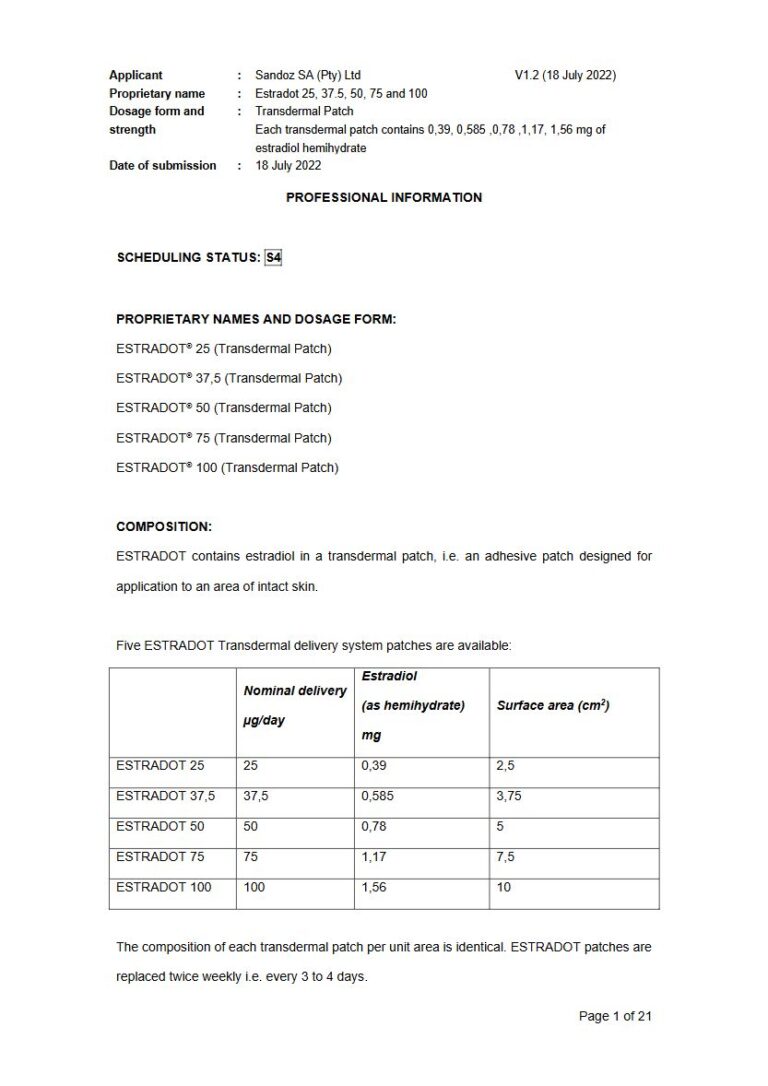
Estradot 25 mg/37.5 mg/50 mg/75 mg/100 mg Patch
PDF Leaflet Revision Date: 18 July 2022
Clinical Summary
Quick overview from the medicine insert
Indication
Estrogen replacement therapy for menopause symptoms.
Dosage (summary)
Apply ESTRADOT patch every 3 to 4 days; start with ESTRADOT 50.
Special Populations
- Elderly
- Women with intact uterus
Pregnancy & Breastfeeding
Contraindicated in pregnancy and breastfeeding.
Key Drug Interactions
- Anticonvulsants
- Rifampicin
- St. John's wort
Contraindications
- Hypersensitivity to estrogens
- Pregnancy
- Breastfeeding
- Undiagnosed abnormal vaginal bleeding
- Breast cancer
- Severe hepatic disease
- Venous thromboembolism
- Thrombophilic disorders
Common side effects
- Mood changes
- Headache
- Breast tenderness
- Nausea
- Application site reaction
Counselling Points
- Report any mood changes
- Avoid tight clothing over the patch
- Rotate application sites
- Not a contraceptive
Serious warnings
- Increased risk of breast cancer
- Risk of venous thromboembolism
- Monitor for depression
Important Disclaimer
The Estradot 25 mg/37.5 mg/50 mg/75 mg/100 mg Patch professional information leaflet below is the property of Sandoz Sa and is provided on Medinsert exactly as issued, with no.. alterations or editorial changes. We make every effort to keep content current by updating documents as soon as new versions become available. Medinsert serves as a trusted access point for healthcare professionals, but does not replace official sources or clinical judgement. For more details, please read our full disclaimer. read more>>
 Healthcare Professionals Only
This content is for registered healthcare professionals
Sign in or create a free account to read the full package insert.
Free for HPCSA-registered professionals. Powered by Medinsert.
Clinical Particulars
Section 4 of the official insert — extracted exactly as issued, no alterations
4.1 Therapeutic indications
u2022 Estrogen replacement therapy for the treatment of the symptoms of natural or surgically induced menopause.
u2022 To reduce the risk of postmenopausal osteoporosis (see sections u201cDOSAGE AND DIRECTIONS FOR USEu201d, u201cWARNINGSu201d and u201cSpecial precautionsu201d). In women with an intact uterus, estrogens should always be supplemented by administration of a progestogen.
4.2 Posology and method of administration
Adults and elderly: Dosage: Hormone Replacement Therapy (HRT) involving either estrogen-only or estrogen-progestogen combined therapy should only be continued as long as the benefits outweigh the risks for the individual. ESTRADOT should be applied every 3 to 4 days (i.e. twice weekly).
Climacteric symptoms: ESTRADOT is available in five strengths: 25, 37, 5, 50, 75 and 100 microgram/day. Treatment is usually initiated with an ESTRADOT 50 patch. Depending on the clinical response the dose should then be adjusted to the womanu2019s individual needs. If, after three months, there is an insufficient response in the form of alleviated symptoms, the dose should be increased. If symptoms of overdose arise (e.g. tender breasts) the dose must be decreased. Maintenance therapy must always be at the lowest effective dose.
Prevention of postmenopausal osteoporosis: Treatment should be initiated with an ESTRADOT 50 patch. Dose adjustments can be made by using other strengths of ESTRADOT. The lowest effective dose should be used for maintenance therapy.
General instructions: ESTRADOT is administered as continuous therapy (uninterrupted application twice weekly). In women with an intact uterus, ESTRADOT should be combined with a progestogen approved for addition to estrogen treatment as follows: The progestogen is added either for the last 12 to 14 days of every 4-week cycle (continuous-sequential) or every day without interruption (continuous-combined). In women not currently taking oral estrogens or in women switching from another estradiol transdermal therapy, treatment with ESTRADOT may be initiated at any convenient time. In women who are currently taking oral estrogens, treatment with ESTRADOT should be initiated one week after withdrawal of oral hormone replacement therapy, or sooner if menopausal symptoms reappear within one week.
Method of administration: The adhesive side of ESTRADOT should be placed on a clean, dry area of the abdomen. ESTRADOT should not be applied to the breasts. ESTRADOT should be replaced twice weekly. The site of application must be rotated, with an interval of at least 1 week allowed between applications to a particular site. The area selected should not be oily, damaged, or irritated. The waistline should be avoided, since tight clothing may dislodge the patch. The patch should be applied immediately after opening the sachet and removing the protective liner. The patch should be pressed firmly in place with the palm of the hand for about 10 seconds, making sure there is good contact, especially around the edges. In the event that a patch should fall off, the same patch may be reapplied. If necessary, a new patch may be applied. In either case, the original treatment schedule should be continued. If a woman has forgotten to apply a patch, she should apply a new patch as soon as possible. The subsequent patch should be applied according to the original treatment schedule. The interruption of treatment might increase the likelihood of recurrence of symptoms.
Children: ESTRADOT should not be used in children.
4.3 Contraindications
ESTRADOT should not be used by women with any of the following conditions:
- Known hypersensitivity to estrogens or to any of the excipients.
- Known or suspected pregnancy.
- Breast feeding.
- Undiagnosed abnormal vaginal bleeding.
- Known or suspected breast cancer.
- History of breast cancer.
- Known or suspected cancer of the endometrium or other estrogen-dependent neoplasia.
- Existing or previous severe hepatic disease.
- History of or current venous thromboembolism (e.g. deep vein thrombosis, pulmonary embolism).
- Known thrombophilic disorders or thrombophlebitis.
- History of or current arterial thromboembolic disease (e.g. coronary heart disease, stroke).
- Porphyria.
- Depression not well controlled with treatment.
- A history of depression with the use of hormonal containing medicines irrespective of indication, dosage formulation and route of administration.
4.4 Special warnings and precautions for use
Osteoporosis: When initiating HRT for the prevention of osteoporosis, careful consideration should be given to the benefits versus the risks for the individual. Potential alternative therapies should be considered if the risks outweigh the benefits. Periodic re-evaluation for continuing treatment is recommended.
Contact sensitisation: Contact sensitisation is known to occur with all topical applications. Although it is extremely rare, women who develop contact sensitisation to any of the components of the patch should be warned that a severe hypersensitivity reaction may occur with continuing exposure to the causative agent.
Cardiovascular disease: HRT should not be used to prevent cardiovascular disease. Large clinical trials (Womenu2019s Health Initiative and Heart and Estrogen/Progestin Replacement study) evaluated the risk of cardiovascular events with the HRT products used in these studies. The Womenu2019s Health Initiative (WHI) studies were randomised clinical trials conducted with either continuous combined oral conjugated equine estrogens (CEO) and medroxyprogesterone acetate (MPA) for an average follow-up of 5.2 years, or with oral conjugated equine estrogen (CEE) for an average follow-up of 6.8 years. In the WHI continuous combined oral HRT trial, the absolute excess risk of coronary heart disease was 7 additional cases per 10,000 person-years (37 versus 30) in HRT-treated women and the relative risk was 1.29. In the WHI estrogen-only HRT trial, the use of CEE alone did not affect coronary heart disease incidence in postmenopausal women. In addition, both WHI studies showed an increased incidence of stroke. In the trial of continuous combined oral conjugated equine estrogens (CEE) and medroxyprogesterone acetate (MPA), the absolute excess risk was 8 additional cases per 10,000 person-years (29 versus 21) in HRT-treated women and the relative risk was 1.41.
Breast cancer: Randomised controlled trials and epidemiological studies have reported an increased risk of breast cancer in women taking HRT. Women using estrogen-progestogen combined HRT had a possibly higher risk as compared with women who used unopposed estrogens. The excess risk of breast cancer increases with the duration of intake of estrogen-only and estrogen-progestogen combined HRT. There is evidence arising from the WHI continuous combined study (see subsection Cardiovascular disease) which shows an absolute excess risk of invasive breast cancer of 8 additional cases per 10,000 person-years (38 versus 30) in the HRT-treated women and a relative risk of 1.26.
A meta-analysis reanalysed 51 epidemiological studies conducted between the 1970s and the early 1990s. The cumulative incidence of breast cancer between the ages of 50 and 70 in non-users of HRT is about 45 per 1,000 women. The cumulative excess numbers of breast cancers diagnosed between these ages per 1,000 women who began use of HRT at age 50 to 70 and used it for 5, 10, and 15 years, are estimated to be 2, 6, and 12, respectively. The number of additional cases of breast cancer is broadly similar for women who start HRT regardless of age at start of treatment (between ages of 45 and 65). The excess risk seems to return to baseline in the course of about five years after stopping treatment. For transdermal estrogen-only and estrogen-progestogen combined HRT products, no large randomised clinical trials to date have assessed the HRT-associated risk of breast cancer. Therefore, there are no data to support the conclusion that the frequency of breast cancer is different with ESTRADOT.
Ovarian cancer: In some epidemiological studies, the long-term use of opposed and unopposed estrogens in hysterectomised and non-hysterectomised women has been associated with an increased risk of being diagnosed with ovarian cancer. It is uncertain whether long-term use of combined HRT (estrogens and progestogens) confers a different risk than estrogen-only HRT products.
Endometrial cancer: The risk of endometrial cancer in users of unopposed estrogens who have an intact uterus is greater than in non-users and appears to depend on the duration of treatment and the estrogen dose. The greatest risk appears to be associated with prolonged use. It has been shown that adequate concomitant progestogen therapy lowers the incidence of endometrial hyperplasia and therefore the potential risk of endometrial carcinoma associated with prolonged use of estrogen therapy.
Dementia: In a randomised placebo-controlled ancillary study of the WHI, the Women's Health Initiative Memory Study (WHIMS), women aged 65 and older (average age 71) treated with oral CEO and MPA for an average follow-up of 4 years were reported to have a two-fold increase in the risk of developing probable dementia. The absolute excess risk of probable dementia was 23 additional cases per 10,000 person-years (45 versus 22) in CEO/MPA treated women and the relative risk was 2.05. In a randomised, placebo-controlled, estrogen alone ancillary study of the WHI (WHIMS), the absolute excess risk of probable dementia after an average follow-up of 5.2 years was 12 additional cases per 10,000 person-years (37 versus 25) in CEE treated women and the relative risk was 1.49, which did not reach statistical significance (p = 0.18) compared to placebo. Since both sub-studies were conducted in women aged 65 to 79 years, it is unknown whether these findings apply to younger postmenopausal women. For transdermal estrogen-only or estrogen-progestogen combined products, no large randomised clinical trials have assessed the HRT-associated risk of probable dementia to date. Therefore, there are no data to support the conclusion that the frequency of probable dementia is different with ESTRADOT.
Venous thromboembolism: Estrogen-only and estrogen-progestogen combined HRT are associated with a higher risk of developing venous thromboembolism (VTE), i.e. deep vein thrombosis or pulmonary embolism. Three randomised controlled trials (WHI estrogen-alone, WHI combined HRT and HERS) and epidemiological studies have found a two- to threefold higher risk for users compared with non-users. The WHI continuous combined study (see subsection u201cCardiovascular diseaseu201d) showed an increased incidence of pulmonary embolism. The absolute excess risk was 8 additional cases per 10,000 person-years (15 versus 7) in HRT-treated women and the relative risk was 2.13. The increase in risk was found only in current users and did not persist in former users. The risk appeared to be higher in the first years of use compared to later years. For non-users, it is estimated that the number of cases of VTE that would occur over a 5-year period is about 3 per 1,000 women aged 50 to 59 years and 8 per 1,000 women aged 60 to 69 years. It is estimated that in healthy women who use HRT for 5 years, the number of additional cases of VTE would be between 2 and 6 per 1,000 women aged 50 to 59 years and between 5 and 15 per 1,000 women aged 60 to 69 years. Risk/benefit should therefore be carefully weighed in consultation with the individual when prescribing HRT to women with a risk factor for the occurrence of VTE that is not already mentioned under u201cCONTRAINDICATIONSu201d. Generally recognised risk factors for VTE include a personal history or positive family history (the occurrence of VTE in a direct relative at a relatively early age may indicate genetic predisposition) of thromboembolic disease, severe obesity (Body Mass Index > 30 kg/m2) and systemic lupus erythematosus (SLE). The risk of VTE also increases with age. There is no consensus about the possible role of varicose veins in VTE. A history of recurrent spontaneous abortion should be investigated to exclude thrombophilic predisposition. In women in whom this diagnosis is confirmed, the use of HRT is viewed as contraindicated. The risk of VTE may be temporarily increased with prolonged immobilisation, major elective or posttraumatic surgery, or major trauma. In women on HRT, scrupulous attention should be given to prophylactic measures to prevent VTE following surgery. Depending on the nature of the event and the duration of the immobilisation, consideration should be given to temporarily stopping HRT several weeks (four to six weeks) earlier, if possible. The treatment should not be restarted until the woman is completely mobile. Women should be told to contact their doctor immediately if they become aware of a potential thromboembolic symptom (e.g. painful swelling of a leg, sudden pain in the chest, dyspnoea). If venous thromboembolism (VTE) develops after initiating therapy, the medicine should be discontinued.
Depression: Women with a history of depression who use hormonal containing products should be carefully observed and the medicinal product discontinued if depression recurs to a serious degree. Patients becoming significantly depressed while taking hormonal containing products should stop the medication and use an alternate method of contraception in an attempt to determine whether the symptom is drug-related.
4.5 Interactions with other medicines
The metabolism of estrogens and progestogens may be increased by concomitant use of substances known to induce drug-metabolising enzymes, specifically cytochrome P-450 enzymes, such as anticonvulsants (e.g. phenobarbital, phenytoin, carbamazepine), meprobamate, phenylbutazone and anti-infectives (e.g. rifampicin, rifabutin, nevirapine, efavirenz). Caution should be used if the woman is receiving protease inhibitors (e.g. ritonavir and nelfinavir), which are known as strong inhibitors of cytochrome P-450 enzymes, and by contrast exhibit inducing properties when used concomitantly with steroid hormones. Herbal preparations containing St. Johnu2019s wort (Hypericum perforatum) may induce the metabolism of estrogens and progestogens. Clinically, increased metabolism of estrogens and progestogens may lead to decreased effects and changes in the uterine bleeding profile. With transdermal HRT administration, the first-pass effect in the liver is avoided and, thus transdermally applied estrogens may be less affected by enzyme inducers than oral hormones.
4.6 Fertility, pregnancy and lactation
Pregnancy: ESTRADOT must not be used during pregnancy.
Lactation: ESTRADOT must not be used while breast-feeding. Both estrogens and progestogens cause fetal harm when administered to a pregnant woman.
4.7 Effects on ability to drive and use machines
No known adverse effects on the ability to drive or operate machines have been reported.
4.8 Undesirable effects
Adverse reactions (Table 1) are ranked under heading of frequency, the most frequent first, using the following convention: very common (u2265 1/10); common (u2265 1/100, < 1/10); uncommon (u2265 1/1,000, < 1/100); rare (u2265 1/10,000, < 1/1,000) very rare (<1/10,000), including isolated reports.
Table 1: Neoplasms benign, malignant and unspecified (including cysts and polyps)
- Uncommon: Breast cancer.
Immune system disorders
- Not known (1): Hypersensitivity.
Psychiatric disorders
- Common: Mood changes, including depression.
Nervous system disorders
- Common: Headache, migraine, dizziness.
Gastro-intestinal disorders
- Common: Nausea, abdominal pain, abdominal cramps.
- Uncommon: Vomiting.
Skin and subcutaneous tissue disorders
- Uncommon: Alopecia, hirsutism.
- Not known (1): Erythema multiforme, erythema nodosum.
Reproductive system and breast disorders
- Very common: Breast tenderness.
- Common: Menstrual disorders, (changes in vaginal bleeding pattern and abnormal withdrawal bleeding or flow), metrorrhagia, cervical discharge breast enlargement.
- Uncommon: Genital candidiasis, uterine leiomyoma.
General disorders and administration site conditions
- Very common: Application site reaction (at the patch application site, observed after removing the patch by peeling from the skin).
- Common: Weight change, oedema, pruritus and rash (around the application site).
- Uncommon: Libido increased or decreased.
- Not known (1): Suicidal thoughts/behaviour and suicide.
(1) Frequency, not known. Other adverse reactions have been reported in association with some estrogen-progestogen treatments:
- Estrogen-dependent neoplasms, benign and malignant, e.g. endometrial cancer.
- Venous thromboembolism, e.g. deep leg or pelvic venous thrombosis and pulmonary embolism.
- Stroke.
- Myocardial infarction.
- Cholestatic jaundice.
- Gallbladder disease.
- Aggravation of porphyria.
- Dementia.
- Chorea.
- Contact lens intolerance.
- Purpura.
- Chloasma.
- Carbohydrate tolerance decreased.
4.9 Overdose
Acute overdosage is unlikely due to the mode of administration. The most common symptoms of overdosage in clinical use are breast tenderness and/or vaginal bleeding. If such symptoms occur, a reduction in dosage should be considered. The effects of overdosage can be rapidly reversed by removal of the patch.
