
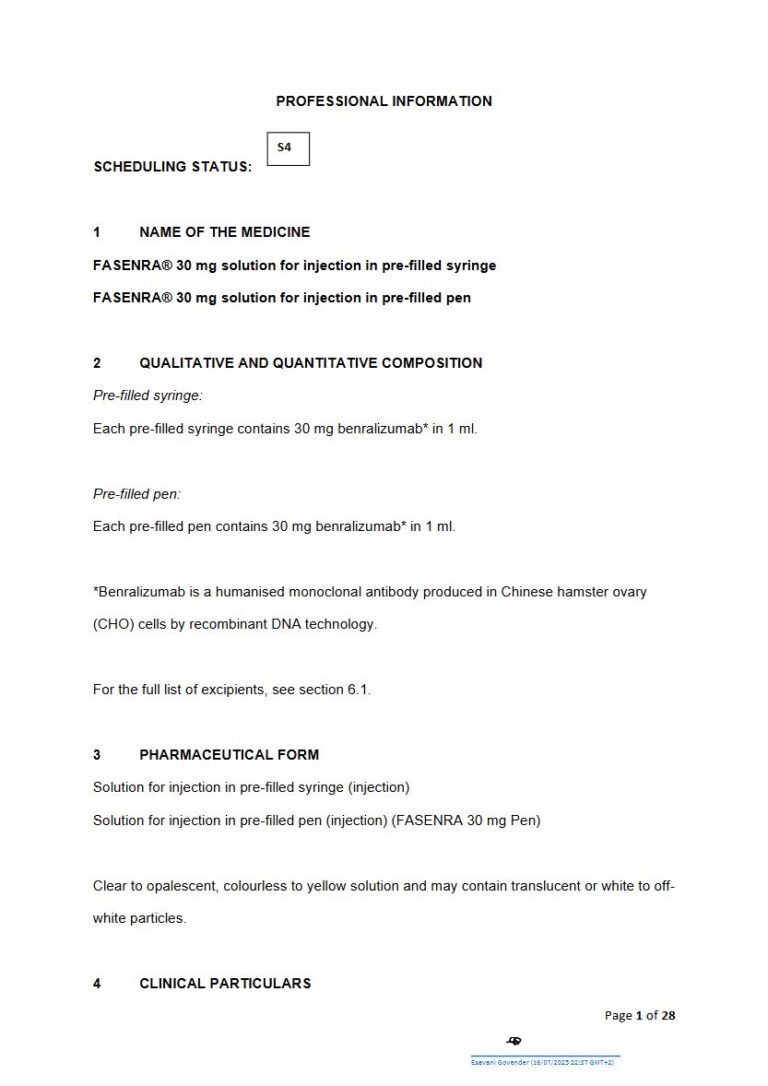
Fasenra 30 mg Solution
PDF Leaflet Revision Date: 10 July 2025
Clinical Summary
Quick overview from the medicine insert
Indication
Add-on maintenance treatment for severe eosinophilic asthma.
Dosage (summary)
30 mg subcutaneously every 4 weeks for 3 doses, then every 8 weeks.
Special Populations
- Elderly
- Renal impairment
- Hepatic impairment
Pregnancy & Breastfeeding
Not established; use only if benefits outweigh risks in pregnancy; avoid breastfeeding.
Key Drug Interactions
- No significant interactions expected with common medications.
Contraindications
- Hypersensitivity to benralizumab or excipients.
Common side effects
- Headache
- Pharyngitis
- Injection site reactions
Counselling Points
- Seek medical advice if asthma worsens
- Do not abruptly discontinue corticosteroids
Serious warnings
- Not for acute asthma exacerbations
- Monitor for hypersensitivity reactions
Important Disclaimer
The Fasenra 30 mg Solution professional information leaflet below is the property of Astrazeneca Pharmaceuticals and is provided on Medinsert exactly as issued, with no.. alterations or editorial changes. We make every effort to keep content current by updating documents as soon as new versions become available. Medinsert serves as a trusted access point for healthcare professionals, but does not replace official sources or clinical judgement. For more details, please read our full disclaimer. read more>>
 Healthcare Professionals Only
This content is for registered healthcare professionals
Sign in or create a free account to read the full package insert.
Free for HPCSA-registered professionals. Powered by Medinsert.
Clinical Particulars
Section 4 of the official insert — extracted exactly as issued, no alterations
4.1 Therapeutic indications
FASENRA 30 mg is indicated as an add - on maintenance treatment in adult patients with severe eosinophilic asthma inadequately controlled despite high - dose inhaled corticosteroids plus long - acting u03b2 - agonists (see section 5.1).
4.2 Posology and method of administration
FASENRA 30 mg treatment should be initiated by a medical practitioner experienced in the diagnosis and treatment of severe asthma. After proper training in the subcutaneous injection technique and education about signs and symptoms of hypersensitivity reactions (see section 4.4), patients with no known history of anaphylaxis or their caregivers may administer FASENRA 30 mg if their medical practitioner determines that it is appropriate, with medical follow - up as necessary. Self - administration should only be considered in patients already experienced with FASENRA 30 mg treatment.
Posology
The recommended dose of benralizumab is 30 mg by subcutaneous injection every 4 weeks for the first 3 doses, and then every 8 weeks thereafter. If an injection is missed on the planned date, dosing should resume as soon as possible on the indicated regimen; a double dose must not be administered. FASENRA 30 mg is intended for long - term treatment. A decision to continue the therapy should be made at least annually based on disease severity, level of exacerbation control and blood eosinophil counts.
Elderly
No dose adjustment is required for elderly patients (see section 5.2).
Renal and hepatic impairment
No dose adjustment is required for patients with renal or hepatic impairment (see section 5.2).
Paediatric population
The safety and efficacy of FASENRA 30 mg in children aged 6 to 18 years have not been established. No data are available for children aged 6 to 11 years old. Currently available data in children 12 to less than 18 years old are described in sections 4.8, 5.1 and 5.2 but no recommendation on a posology can be made.
Method of administration
FASENRA 30 mg is administered as a subcutaneous injection. It should be injected into the thigh or abdomen. If the healthcare professional or caregiver administers the injection, the upper arm can also be used. It should not be injected into areas where the skin is tender, bruised, erythematous, or hardened. Comprehensive instructions for administration using the pre - filled syringe/pre - filled pen (FASENRA 30 mg Pen) are provided in the u2018Instructions for Useu2019.
4.3 Contraindications
Hypersensitivity to the active substance or to any of the excipients listed in section 6.1.
4.4 Special warnings and precautions for use
FASENRA 30 mg should not be used to treat acute asthma exacerbations. Patients should be instructed to seek medical advice if their asthma remains uncontrolled or worsens after initiation of treatment. Abrupt discontinuation of corticosteroids after initiation of FASENRA 30 mg therapy is not recommended. Reduction in corticosteroid doses, if appropriate, should be gradual and performed under the supervision of a medical practitioner.
Hypersensitivity reactions: Acute systemic reactions including anaphylactic reactions and hypersensitivity reactions (e.g. urticaria, papular urticaria, rash) have occurred following administration of benralizumab (see section 4.8). These reactions may occur within hours of administration, but in some instances have a delayed onset (i.e. days). A history of anaphylaxis unrelated to benralizumab may be a risk factor for anaphylaxis following FASENRA 30 mg administration (see section 4.3). In line with clinical practice, patients should be monitored for an appropriate time after administration of FASENRA 30 mg. In the event of a hypersensitivity reaction, FASENRA 30 mg should be discontinued permanently and appropriate therapy initiated.
Parasitic (Helminth) Infection Eosinophils may be involved in the immunological response to some helminth infections. Patients with known helminth infections were excluded from participation in clinical trials. It is unknown if FASENRA 30 mg may influence a patientu2019s response against helminth infections. Patients with pre - existing helminth infections should be treated before initiating therapy with FASENRA 30 mg. If patients become infected, while receiving treatment with FASENRA 30 mg and do not respond to anti - helminth treatment, treatment with FASENRA 30 mg should be discontinued until infection resolves.
4.5 Interaction with other medicines and other forms of interaction
In a randomized, double - blind parallel - group study of 103 patients aged between 12 and 21 years with severe asthma, the humoral antibody responses induced by seasonal influenza virus vaccination do not appear to be affected by benralizumab treatment. An effect of benralizumab on the pharmacokinetics of co - administered medicinal products is not expected (see section 5.2). Cytochrome P450 enzymes, efflux pumps and protein - binding mechanisms are not involved in the clearance of benralizumab. There is no evidence of IL - 5Ru03b1 expression on hepatocytes. Eosinophil depletion does not produce chronic systemic alterations of proinflammatory cytokines.
4.6 Fertility, pregnancy and lactation
Pregnancy: There is a limited amount of data (less than 300 pregnancy outcomes) from the use of benralizumab in pregnant women. Animal studies do not indicate direct or indirect harmful effects with respect to reproductive toxicity (see section 5.3). Monoclonal antibodies, such as benralizumab, are transported across the placenta linearly as pregnancy progresses; therefore, potential exposure to a foetus is likely to be greater during the second and third trimester of pregnancy. Safety in pregnancy has not been established, hence, FASENRA 30 mg should not be used in pregnancy. Its administration to pregnant women should only be considered if the expected benefit to the mother is greater than any possible risk to the foetus.
Breast - feeding: Safety in lactation has not been established, hence, the patient should not breastfeed while on FASENRA 30 mg, unless the benefit of therapy to the woman outweighs the risk to the child.
Fertility: Safety has not been established in fertile patients, hence FASENRA 30 mg should not be administered to fertile women not practicing effective contraception.
4.7 Effects on ability to drive and use machines
FASENRA 30 mg has no or negligible influence on the ability to drive and use machines.
4.8 Undesirable effects
Summary of the safety profile: The most commonly reported adverse reactions during treatment are headache (8 %) and pharyngitis (3 %). Anaphylactic reactions have been reported.
Tabulated list of adverse reactions: A total of 2 514 patients, out of whom 1 663 patients had severe uncontrolled eosinophilic asthma, received benralizumab during clinical studies of 48 to 56 weeks duration. The frequency of adverse reactions is defined using the following convention: very common (u22651/10); common (u22651/100 to <1/10); uncommon (u22651/1 000 to <1/100); rare (u22651/10 000 to <1/1 000); very rare (<1/10 000); and not known (cannot be estimated from available data). Within each frequency grouping, adverse reactions are presented in order of decreasing seriousness.
Table 1. Tabulated list of adverse reactions
System organ class Adverse reaction Frequency
Infections & infestations Pharyngitis* Common
Immune system disorders Hypersensitivity reactions** Anaphylactic reaction Common Not known
Nervous system disorders Headache Common
General disorders and administration site conditions Pyrexia Injection site reaction Common
* Pharyngitis was defined by the following grouped preferred terms: u2018Pharyngitisu2019, u2018Pharyngitis bacterialu2019, u2018Viral pharyngitisu2019, u2018Pharyngitis streptococcalu2019.
** Hypersensitivity reactions were defined by the following grouped preferred terms: u2018Urticariau2019, u2018Papular urticariau2019, and u2018Rashu2019. For examples of the associated manifestations reported and a description of the time to onset, (see section 4.4).
Description of selected adverse reaction
Injection site reactions: In placebo - controlled studies, injection site reactions (e.g. pain, erythema, pruritus, papule) occurred at a rate of 2,2 % in patients treated with the recommended benralizumab dose compared with 1,9 % in patients treated with placebo.
Long - term safety
In a 56 - week extension trial (Trial 4) in patients with asthma from Trials 1, 2 and 3, 842 patients were treated with FASENRA 30 mg at the recommended dose and remained in the trial. The overall adverse event profile was similar to the asthma trials described above. Additionally, in an open - label safety extension trial (Trial 5) in patients with asthma from previous trials, 226 patients were treated with FASENRA 30 mg at the recommended dose for up to 43 months. Combined with the treatment period in previous studies, this corresponds to median follow - up of 3,4 years (range 8,5 months u2013 5,3 years). The safety profile during this follow - up period was consistent with the known safety profile of FASENRA 30 mg.
Paediatric population: There are limited data in paediatric patients (see section 5.1). The frequency, type and severity of adverse reactions in the adolescent population were observed to be similar to those seen in adults.
Reporting of suspected adverse reactions: Reporting suspected adverse reactions after authorisation of the medicine is important. It allows continued monitoring of the benefit/risk balance of the medicine. Health care providers are asked to report any suspected adverse reactions to SAHPRA via the u201c6.04 Adverse Drug Reactions Reporting Formu201d, found online under SAHPRAu2019s publications: https://www.sahpra.org.za/Publications/Index/8
4.9 Overdose
Doses of up to 200 mg were administered subcutaneously in clinical trials to patients with eosinophilic asthma without evidence of dose - related toxicities. There is no specific treatment for an overdose with benralizumab. If overdose occurs, the patient should be treated supportively with appropriate monitoring as necessary.
