
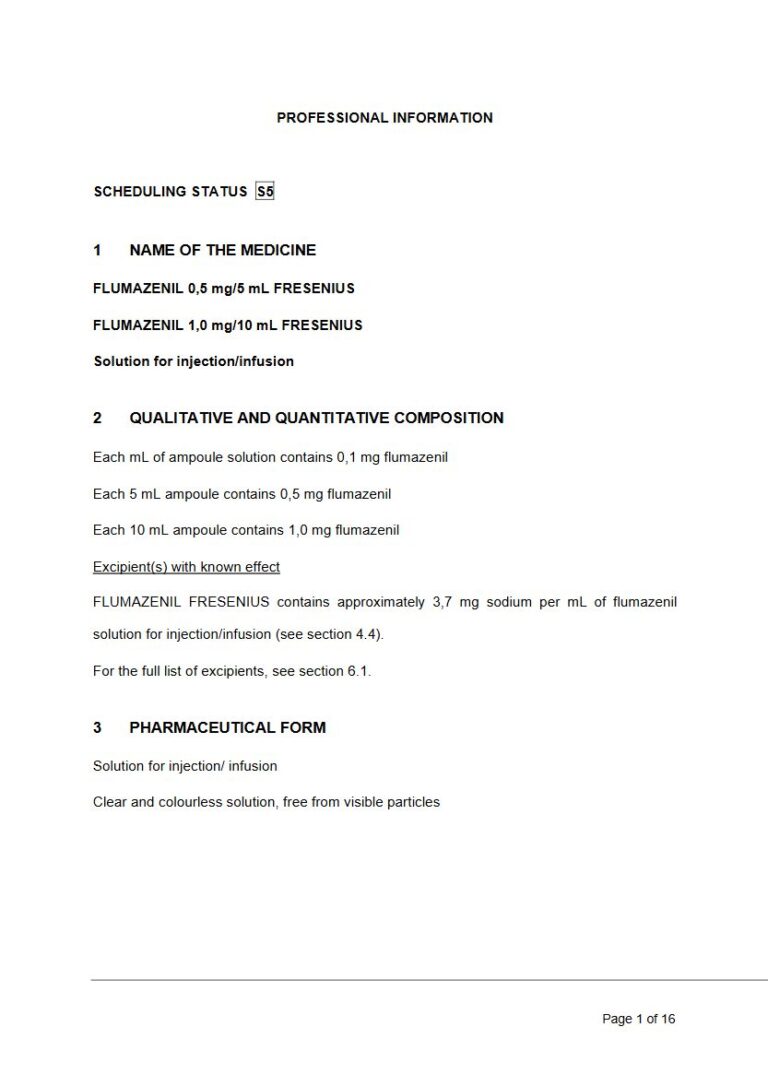
Flumazenil 0,5 Mg/5 Ml/1,0 Mg/10 Ml Solution
PDF Leaflet Revision Date: 12 July 2022
Clinical Summary
Quick overview from the medicine insert
Indication
Reversal of benzodiazepine sedation and overdose.
Dosage (summary)
Initial dose: 0.2 mg IV over 15 seconds; max total dose: 1 mg.
Onset of Action / Duration
Onset: 1-2 mins, Duration: variable.
Special Populations
- Hepatic impairment
Pregnancy & Breastfeeding
Safety not established; breastfeeding should be interrupted for 24 hours.
Key Drug Interactions
- Benzodiazepines
- Tricyclic antidepressants
Contraindications
- Hypersensitivity to flumazenil
- Benzodiazepines for life-threatening conditions
Common side effects
- Anxiety
- Palpitations
- Nausea
- Headache
Counselling Points
- Monitor for re-sedation
- Avoid hazardous activities for 24 hours
- Report any adverse reactions
Serious warnings
- Risk of re-sedation
- Seizures in epileptic patients
- Monitor for respiratory depression
Important Disclaimer
The Flumazenil 0,5 Mg/5 Ml/1,0 Mg/10 Ml Solution professional information leaflet below is the property of Fresenius Kabi South Africa and is provided on Medinsert exactly as issued, with no.. alterations or editorial changes. We make every effort to keep content current by updating documents as soon as new versions become available. Medinsert serves as a trusted access point for healthcare professionals, but does not replace official sources or clinical judgement. For more details, please read our full disclaimer. read more>>
 Healthcare Professionals Only
This content is for registered healthcare professionals
Sign in or create a free account to read the full package insert.
Free for HPCSA-registered professionals. Powered by Medinsert.
Clinical Particulars
Section 4 of the official insert — extracted exactly as issued, no alterations
4.1 Therapeutic indications
Adult patients FLUMAZENIL FRESENIUS is indicated for the reversal of the sedative effects of benzodiazepines in cases where general anaesthesia has been induced and/or maintained with benzodiazepines, where sedation has been produced with benzodiazepines for diagnostic and therapeutic procedures, and for the management of benzodiazepine overdose.
4.2 Posology and method of administration
Posology
Reversal of general anaesthesia in adult patients For the reversal of the sedative effects of benzodiazepines administered for general anaesthesia, the recommended initial dose of FLUMAZENIL FRESENIUS is 0,2 mg (2 mL) administered intravenously over 15 seconds. If the desired level of consciousness is not obtained after waiting an additional 45 seconds, a further dose of 0,2 mg (2 mL) can be injected and repeated at 60-second intervals where necessary (up to a maximum of 4 additional times) to a maximum total dose of 1 mg (10 mL). The dosage should be individualised based on the patientu2019s response, with most patients responding to doses of 0,6 mg to 1 mg. In the event of re-sedation, repeated doses may be administered at 20-minute intervals as needed. For repeat treatment, no more than 1 mg (given as 0,2 mg/min) should be administered at any one time, and no more than 3 mg should be given in any one hour. It is recommended that FLUMAZENIL FRESENIUS be administered as the series of small injections described (not as a single bolus injection) to allow the practitioner to control the reversal of sedation to the approximate endpoint desired and to minimise the possibility of adverse effects. See section 4.4.
Method of administration
FLUMAZENIL FRESENIUS is recommended for intravenously administration only. To minimise the likelihood of pain at the injection site, FLUMAZENIL FRESENIUS should be administered through a freely running intravenous infusion into a large vein. For instructions on dilution of the medicine before administration, see section 6.6. If FLUMAZENIL FRESENIUS is drawn into a syringe or mixed with any of the solutions, it should be discarded after 24 hours. It may be used concomitantly with other resuscitative measures. FLUMAZENIL FRESENIUS should be inspected visually for particulate matter and discolouration prior to administration, whenever solution and container permit.
4.3 Contraindications
- Hypersensitivity to flumazenil or to any of the excipients of FLUMAZENIL FRESENIUS listed in section 6.1.
- Patients receiving benzodiazepines for control of a potentially life-threatening condition (e.g. control of intracranial pressure or status epilepticus). Safety of FLUMAZENIL FRESENIUS during pregnancy and lactation has not been established. See section 4.6.
4.4 Special warnings and precautions for use
Patients who have received FLUMAZENIL FRESENIUS for the reversal of benzodiazepine effects (after conscious sedation or general anaesthesia) should be monitored for re-sedation, respiratory depression, or other residual benzodiazepine effects for an appropriate period (up to 120 minutes) based on the dose and duration of effect of the benzodiazepine employed. Because patients with hepatic impairment may experience delayed effects as described above, an extended observation period may be required.
u2022 Seizures have been reported, especially in patients known to suffer from epilepsy or severe hepatic impairment, particularly after long-term treatment with benzodiazepines or in the cases of mixed-medicine overdose. The use of FLUMAZENIL FRESENIUS is not recommended in epileptic patients who have been on benzodiazepine treatment for a prolonged period. Although FLUMAZENIL FRESENIUS exerts a slight intrinsic anticonvulsant effect, its abrupt suppression of the protective effect of a benzodiazepine agonist can give rise to convulsions in epileptic patients. Particular caution is necessary when using FLUMAZENIL FRESENIUS in cases of mixed-medicine overdose. In particular in the case of an intoxication with benzodiazepines and cyclic antidepressants, certain toxic effects such as convulsions and cardiac dysrhythmias, which are caused by these antidepressants, but which emerge less readily on concomitant administration with benzodiazepines, are exacerbated on administration of FLUMAZENIL FRESENIUS. Practitioners should individualise the dosage of FLUMENAZIL FRESENIUS and be prepared to manage seizures.
u2022 Rapid injection of FLUMAZENIL FRESENIUS should be avoided. In patients with high dose and/or long-term exposure to benzodiazepines ending at any time within the weeks preceding FLUMAZENIL FRESENIUS administration, rapid injection of doses equal to or higher than 1 000 micrograms has led to withdrawal symptoms, including palpitations, agitation, anxiety, emotional lability as well as mild confusion and sensory distortions.
u2022 Panic attacks have been reported after the use of flumazenil as in FLUMAZENIL FRESENIUS in patients with a history of panic disorder.
u2022 FLUMAZENIL FRESENIUS may not fully reverse postoperative airway problems or ventilatory insufficiency induced by benzodiazepines. In addition, even if FLUMAZENIL FRESENIUS is initially effective, such problems may recur because the effects of FLUMAZENIL FRESENIUS wear off before the effects of many benzodiazepines.
u2022 FLUMAZENIL FRESENIUS should be used with caution in patients with head injury as it may be capable of precipitating convulsions or altering blood flow in patients receiving benzodiazepines.
u2022 In patients with severe brain injury (and/or instable intracranial pressure), receiving flumazenil as in FLUMAZENIL FRESENIUS (to reverse the effects of benzodiazepines), an increased intracranial pressure may develop.
u2022 FLUMAZENIL FRESENIUS is not recommended either as a treatment for benzodiazepine dependence or for the management of protracted benzodiazepine abstinence syndromes, as such use has not been studied.
u2022 Elimination may be delayed in patients with hepatic impairment.
u2022 The patient should be monitored for an adequate period of time based on the dose and duration of effect of the benzodiazepine employed (ECG, pulse, oximetry, patient alertness and other vital signs such as heart rate, respiratory rate and blood pressure).
u2022 The antagonistic effect of flumazenil as in FLUMAZENIL FRESENIUS is specific to benzodiazepines; an effect is therefore not to be expected if the 'non-awakening' is caused by other substances.
u2022 When used in anaesthesiology at the end of surgery, FLUMAZENIL FRESENIUS should not be given until the effects of peripheral muscle relaxants have been fully reversed.
u2022 As the action of flumazenil as in FLUMAZENIL FRESENIUS is usually shorter than that of benzodiazepines and sedation may possibly recur, the patient should remain closely monitored, preferably in the intensive care unit, until the effect of flumazenil has presumably worn off.
u2022 In high-risk patients, the benefits of benzodiazepine-induced sedation should be weighed against the risks of rapid awakening. In patients (e.g. with cardiac problems) maintenance of a certain level of sedation may be preferable to being fully awake.
u2022 In patients suffering from pre-operative anxiety or having a history of chronic or episodic anxiety the dosage of FLUMAZENIL FRESENIUS should be adjusted carefully.
u2022 After major surgery, postoperative pain must be considered and it may be preferable to keep the patient lightly sedated.
u2022 In patients treated for long periods with high doses of benzodiazepines, the advantages of the use of flumazenil as in FLUMAZENIL FRESENIUS should be weighed against the risk of withdrawal symptoms. If withdrawal symptoms occur despite careful dosing, individually titrated low doses of benzodiazepines (diazepam or midazolam) should be given by slow intravenous injection.
u2022 Due to the increased frequency of benzodiazepines tolerance and dependence in patients with alcoholism and other medicine dependencies, flumazenil should be used with caution in its population.
4.5 Interaction with other medicines and other forms of interaction
Flumazenil as in FLUMAZENIL FRESENIUS blocks the central effects of benzodiazepines by means of competitive interaction at receptor level. The effects of non-benzodiazepine agonists acting via the benzodiazepine receptor, such as zopiclone, triazolopyridazine and others, are also blocked by FLUMAZENIL FRESENIUS. However, FLUMAZENIL FRESENIUS does not block the effect of medicines that do not operate via this route. Interaction with other central nervous system depressants has not been observed. Caution is necessary when using FLUMAZENIL FRESENIUS in cases of accidental overdose since the toxic effects of other psychotropic medicines (especially tricyclic antidepressants) taken concurrently may increase with the subsidence of the benzodiazepine effect. The pharmacokinetics of flumazenil as in FLUMAZENIL FRESENIUS are unaltered in combination with the benzodiazepines midazolam, flunitrazepam and lormetazepam. The pharmacokinetics of benzodiazepines are unaltered in the presence of the antagonist FLUMAZENIL FRESENIUS. There is no pharmacokinetic interaction between ethanol and FLUMAZENIL FRESENIUS.
4.6 Fertility, pregnancy and lactation
Pregnancy
Safety of FLUMAZENIL FRESENIUS during pregnancy has not been established.
Breastfeeding
Safety of FLUMAZENIL FRESENIUS during breastfeeding has not been established. It is not known whether flumazenil is excreted in human milk. Therefore, breastfeeding should be interrupted for 24 hours when FLUMAZENIL FRESENIUS is used during lactation.
4.7 Effects on ability to drive and use machines
Patients should be warned against engaging in hazardous activities requiring complete mental alertness (such as operating dangerous machinery or driving a motor vehicle) during the first 24 hours after administration since the effect of the originally ingested or administered benzodiazepine (for example, sedation) may occur.
4.8 Undesirable effects
Tabulated summary of adverse reactions
Immune systems disorders
Frequent: Allergic reactions
Less frequent: Severe hypersensitivity reactions, including anaphylaxis.
Psychiatric disorders
Frequent: Anxiety following rapid injection, emotional lability, insomnia, somnolence
Less frequent: Fear
Frequency unknown: Withdrawal symptoms (e.g., agitation, anxiety, confusion, sensory distortions, tachycardia, dizziness, sweating), following rapid injection of doses of 1 mg or more in patients with high dose and/or long-term exposure to benzodiazepines ending at any time within the weeks preceding FLUMAZENIL FRESENIUS administration (see section 4.4), panic attacks (in patients with a history of panic reactions), abnormal crying, agitation, aggressive reactions.
Nervous system disorders
Frequent: Vertigo, headache, agitation following rapid injection, tremor, dry mouth, hyperventilation, speech disorder, paraesthesia
Less frequent: Convulsions in patients suffering epilepsy or severe hepatic insufficiency, mainly after long-term treatment with benzodiazepines or multiple medicines abuse u2013 see section 4.4).
Eye disorders
Frequent: Abnormal vision (diplopia, visual field defects), strabismus, increased lacrimation
Ear and labyrinth disorders
Less frequent: Abnormal hearing (transient hearing impairment, hyperacusis, tinnitus)
Cardiac disorders
Frequent: Palpitations following rapid injection.
Less frequent: Tachycardia, bradycardia, dysrhythmia (atrial, nodal, ventricular, extrasystoles), chest pain
Vascular disorders
Frequent: Flushing, hypotension, orthostatic hypotension, transient increased blood pressure (on awakening)
Less frequent: Hypertension
Respiratory, thoracic and mediastinal disorders
Less frequent: Dyspnoea, cough, nasal congestion, chest pain
Gastrointestinal disorders
Frequent: Nausea (during anaesthesia), vomiting (during anaesthesia), hiccup
Skin and subcutaneous tissue disorders
Frequent: Sweating
General disorders and administration site conditions
Frequent: Injection site pain
Less frequent: Shivering, rigors
Frequency unknown: Fatigue (asthenia, malaise), injection site pain, injection site reaction (thrombophlebitis, skin abnormality, rash)
Reporting of suspected adverse reactions
Reporting suspected adverse reactions after authorisation of the medicine is important. It allows continued monitoring of the benefit/risk balance of the medicine. Healthcare providers are requested to report any suspected adverse drug reactions to SAHPRA via the Med Safety APP (Medsafety X SAHPRA) and eReporting platform (who-umc.org) found on SAHPRA website. Healthcare providers are asked to report any suspected adverse drug reactions to the Holder of the Certificate of Registration at the following email address: [email protected] and to the relevant medicineu2019s regulatory authority in the country where the product is marketed.
4.9 Overdose
There is very limited experience of acute overdose in humans with FLUMAZENIL FRESENIUS. For withdrawal symptoms attributable to agonists, the intravenous use of other benzodiazepines is indicated. There is no specific antidote for overdose with FLUMAZENIL FRESENIUS. Treatment of an overdose is symptomatic and supportive. Reversal with an excessively high dose of FLUMAZENIL FRESENIUS may produce anxiety, agitation, increased muscle tone, hyperesthesia and possibly convulsions. Convulsions have been treated with barbiturates, benzodiazepines and phenytoin, generally with prompt resolution of the seizures.
