
Fml-Neo Liquifilm Ophthalmic 1,0 mg Suspension
PDF Leaflet Revision Date: 03 September 2024
Clinical Summary
Quick overview from the medicine insert
Indication
Treatment of infectious conjunctivitis and anterior segment inflammatory disorders.
Dosage (summary)
1-2 drops in the conjunctival sac 2-4 times daily; may increase to 1 drop hourly for the first 24-48 hours.
Special Populations
- Elderly
- Children under 2 years
Pregnancy & Breastfeeding
Contraindicated in pregnancy and lactation; potential reproductive toxicity.
Key Drug Interactions
- CYP3A inhibitors may increase systemic corticosteroid effects
Contraindications
- Hypersensitivity to ingredients
- Acute untreated purulent infections
- Herpes simplex keratitis
- Fungal ocular diseases
- Ocular tuberculosis
- Glaucoma
Common side effects
- Increased intraocular pressure
- Eye irritation
- Blurred vision
- Eye pain
- Hypersensitivity
Counselling Points
- Complete the full course of treatment.
- Avoid touching the bottle tip to any surface.
- Remove contact lenses before use and wait 15 minutes to reinsert.
Serious warnings
- Prolonged use may increase intraocular pressure and risk of glaucoma.
- Use under strict supervision if longer than one week.
Important Disclaimer
The Fml-Neo Liquifilm Ophthalmic 1,0 mg Suspension professional information leaflet below is the property of AbbVie and is provided on Medinsert exactly as issued, with no.. alterations or editorial changes. We make every effort to keep content current by updating documents as soon as new versions become available. Medinsert serves as a trusted access point for healthcare professionals, but does not replace official sources or clinical judgement. For more details, please read our full disclaimer. read more>>
 Healthcare Professionals Only
This content is for registered healthcare professionals
Sign in or create a free account to read the full package insert.
Free for HPCSA-registered professionals. Powered by Medinsert.
Clinical Particulars
Section 4 of the official insert — extracted exactly as issued, no alterations
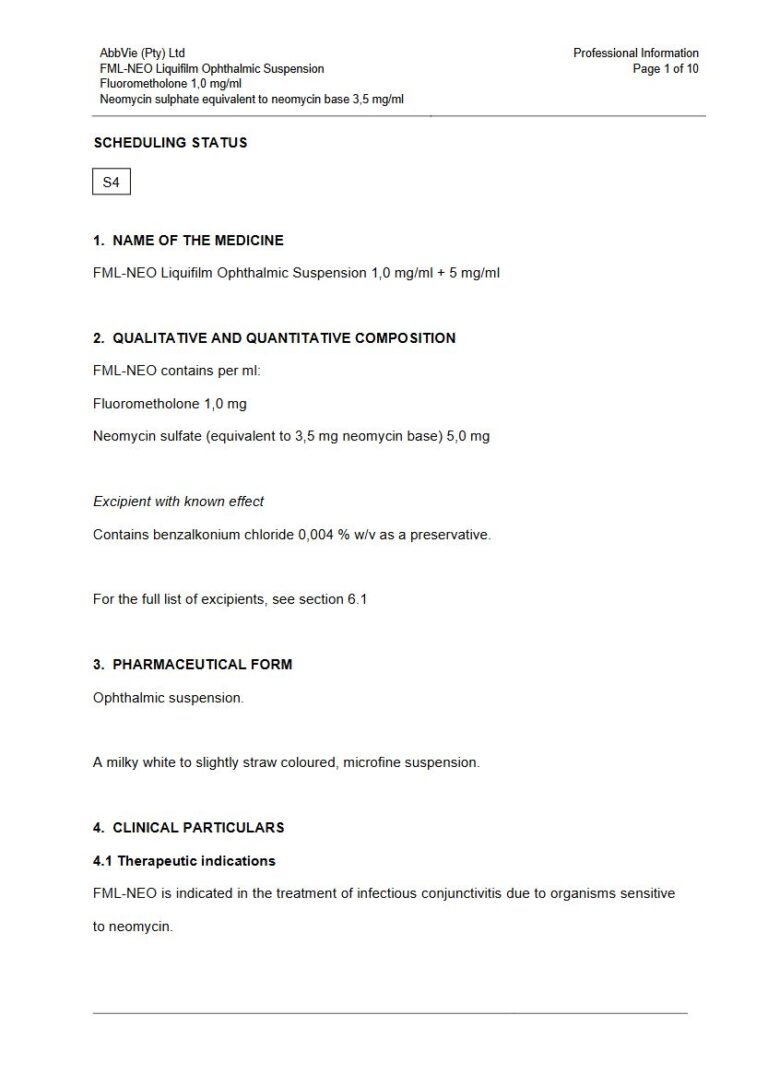
4.1 Therapeutic indications
FML-NEO is indicated in the treatment of infectious conjunctivitis due to organisms sensitive to neomycin. FML-NEO may be used for the treatment of anterior segment inflammatory disorders complicated by bacteria sensitive to neomycin. FML-NEO may be used following removal of foreign bodies as well as before and after surgery, where there is a possibility of infection with susceptible organisms.
4.2 Posology and method of administration
Posology
Recommended dosage in adults (including the elderly) is 1 to 2 drops of FML-NEO in the conjunctival sac two to four times daily. During the initial 24-48 hours, the dosage may be safely increased to 1 drop every hour. Patients should be advised to complete the course of treatment.
Paediatric population
The safety and efficacy in children aged 2 years or younger has not been established.
Method of administration
Shake well before using. Do not freeze. To reduce possible systemic absorption, it may be recommended that the lacrimal sac be compressed at the medial canthus (punctal occlusion) for a few minutes immediately after instillation of each drop. To prevent contamination, care should be taken to avoid touching the bottle tip to the eye or to any other surface. The use of the bottle by more than one person may spread infection.
In the case of simultaneous treatment with other eye drops, a period of 15 minutes between installations should be allowed.
4.3 Contraindications
- Hypersensitivity to fluorometholone or neomycin sulfate or to any of the excipients.
- Acute untreated purulent ocular infections caused by micro-organisms not sensitive to neomycin.
- Acute superficial keratitis and conjunctivitis due to herpes simplex (dendritic keratitis).
- Fungal diseases of ocular structures.
- Vaccinia, varicella, and most other viral diseases of the conjunctiva and cornea.
- Ocular tuberculosis.
- Mycobacterial ocular infections.
- Glaucoma.
- Pregnancy and lactation.
4.4 Special warnings and precautions for use
Eye drops containing corticosteroids such as in FML-NEO, should not be used for more than one week except under strict medical supervision with regular checks for intraocular pressure. Prolonged use of FML-NEO may increase intraocular pressure (IOP) with possible development of glaucoma and damage to the optic nerve, defects in visual acuity and fields of vision, and delayed wound healing. Reports in the literature indicate that posterior subcapsular lenticular opacities have occurred after heavy or protracted use of topical ophthalmic corticosteroids such as contained in FML-NEO.
Acute ocular infection with secretion may be masked, or its activity enhanced by the presence of fluorometholone as in FML-NEO. There have been occurrences of systemic hypercorticoidism after use of topical corticosteroids, as in FML-NEO. Prolonged use may also suppress the host immune response and thus increase the risk of secondary ocular infections. In these cases, it may cause corneal ulceration or thinning of the cornea, with risk of keratic perforation.
Use of FML-NEO in the treatment of patients with a history of herpes simplex requires great caution; frequent slit-lamp microscopy is required. As fungal infections of the cornea have been reported coincidentally with long-term local steroid applications, fungal invasion may be suspected in any persistent corneal ulceration where FML-NEO has been used, or is in use, over a prolonged period of time.
Because of the possibility of inducing corneal abscess, fungal keratopathy or glaucoma, the patient should be referred to an ophthalmologist if the eye has not responded within 48 hours. In diseases due to micro-organisms resistant to neomycin, infection may be masked, enhanced or activated by the steroid in FML-NEO. Prolonged use may result in overgrowth of non-susceptible organisms.
Recent information indicates an increase in the prevalence of persons hypersensitive to neomycin. The possibility of such a reaction should be considered. If sensitivity or other untoward reactions occur, discontinue use of FML-NEO.
Visual disturbance may be reported with systemic and topical corticosteroid use. If a patient presents with symptoms such as blurred vision or other visual disturbances, consider evaluating for possible causes which may include cataract, glaucoma or rare diseases such as central serous chorioretinopathy (CSCR) which have been reported after use of systemic and topical corticosteroids.
Excipients FML-NEO contains the preservative benzalkonium chloride, which may be absorbed by soft contact lenses. Eye irritation and discolouration of the soft contact lenses may also occur due to the presence of benzalkonium chloride. Contact lenses should be removed prior to instillation of FML-NEO and may be reinserted 15 minutes following administration.
As the possibility of adverse effects on the corneal permeability and the danger of disruption of the corneal epithelium with prolonged or repeated usage of benzalkonium chloride preserved ophthalmologic preparations cannot be excluded, regular ophthalmologic examination is required. Caution should be exercised in the use of benzalkonium chloride preserved topical medication over an extended period in patients with extensive ocular surface disease. FML-NEO also contains sodium phosphate. Cases of corneal calcification have been reported in association with the use of phosphate-containing eye drops in patients with damaged corneas.
4.5 Interaction with other medicines and other forms of interaction
Interactions studies for FML-NEO with other medicines were not conducted. Although the systemic exposure is expected to be low with topical ophthalmic corticosteroid administration, co-treatment with CYP3A inhibitors may increase the risk of systemic corticosteroid-related side effects.
4.6 Fertility, pregnancy and lactation
FML-NEO is contraindicated in pregnancy and lactation.
Pregnancy
Studies in animals have shown reproductive toxicity. FML-NEO should not be used in pregnant women.
Breastfeeding
It is unknown whether FML-NEO is excreted in human breast milk. FML-NEO is not recommended for women breastfeeding their infants.
4.7 Effects on ability to drive and use machines
FML-NEO may influence the ability to drive and use machines. If blurred vision occurs, the patient should wait until the vision clears before driving or using machines.
4.8 Undesirable effects
The following side effects were reported during the post-marketing period with FML-NEO. Because post-marketing reporting is voluntary and from a population of unknown size, it is not possible to reliably estimate the frequency of these reactions.
System organ class Adverse reaction
Eye disorders Increased intraocular pressure, eye irritation, conjunctival/ocular hyperaemia, eye pain, visual disturbance, foreign body sensation, eyelid oedema, blurred vision, eye discharge, eye pruritus, increased lacrimation, eye oedema, eye swelling, mydriasis, cataract (including subcapsular), ulcerative keratitis or conjunctival ulcer, corneal ulcer specially if there is a concomitant bacterial, fungal or viral infection, ocular infection (including bacterial, fungal and viral infections) visual field defects, punctate keratitis, eyelid ptosis
Skin and subcutaneous tissue disorders Rash
Immune system disorders Hypersensitivity
Gastro-intestinal disorders Dysgeusia
Reporting of suspected adverse reactions
Reporting of suspected adverse reactions after authorisation of the medicine is important. It allows continued monitoring of the benefit/risk balance of the medicine. Health care providers are requested to report any suspected adverse drug reactions to SAHPRA via the Med Safety APP (Medsafety X SAHPRA) and eReporting platform (who-umc.org) found on the SAHPRA website.
In case of a side effect, please contact [email protected]
4.9 Overdose
If accidental overdosage occurs in the eye, flush the eye with water or normal saline. If accidentally ingested, drink fluids to dilute.
