
Fulvestrant Mylan 250 mg Solution for injection.
PDF Leaflet Revision Date: 03 July 2024
Clinical Summary
Quick overview from the medicine insert
Indication
Treatment of oestrogen receptor positive, locally advanced or metastatic breast cancer in postmenopausal women.
Dosage (summary)
500 mg intramuscularly as two 5 ml injections, one in each buttock, at 1-month intervals with an additional 500 mg dose 2 weeks after the initial dose.
Special Populations
- Renal impairment
- Hepatic impairment
Pregnancy & Breastfeeding
Contraindicated in pregnancy and breastfeeding; use effective contraception during treatment and for 2 years after.
Key Drug Interactions
- No significant drug interactions requiring dose adjustments
Contraindications
- Hypersensitivity to fulvestrant or excipients
- Severe hepatic impairment
- Pregnancy
- Breastfeeding
Common side effects
- Injection site reactions
- Asthenia
- Nausea
- Increased hepatic enzymes
Counselling Points
- Administer slowly (1-2 mins/injection)
- Monitor for hypersensitivity reactions
- Avoid use in children and adolescents
Serious warnings
- Caution in hepatic impairment
- Risk of thromboembolic events
- Potential risk of osteoporosis
Important Disclaimer
The Fulvestrant Mylan 250 mg Solution for injection. professional information leaflet below is the property of Mylan and is provided on Medinsert exactly as issued, with no.. alterations or editorial changes. We make every effort to keep content current by updating documents as soon as new versions become available. Medinsert serves as a trusted access point for healthcare professionals, but does not replace official sources or clinical judgement. For more details, please read our full disclaimer. read more>>
 Healthcare Professionals Only
This content is for registered healthcare professionals
Sign in or create a free account to read the full package insert.
Free for HPCSA-registered professionals. Powered by Medinsert.
Clinical Particulars
Section 4 of the official insert — extracted exactly as issued, no alterations
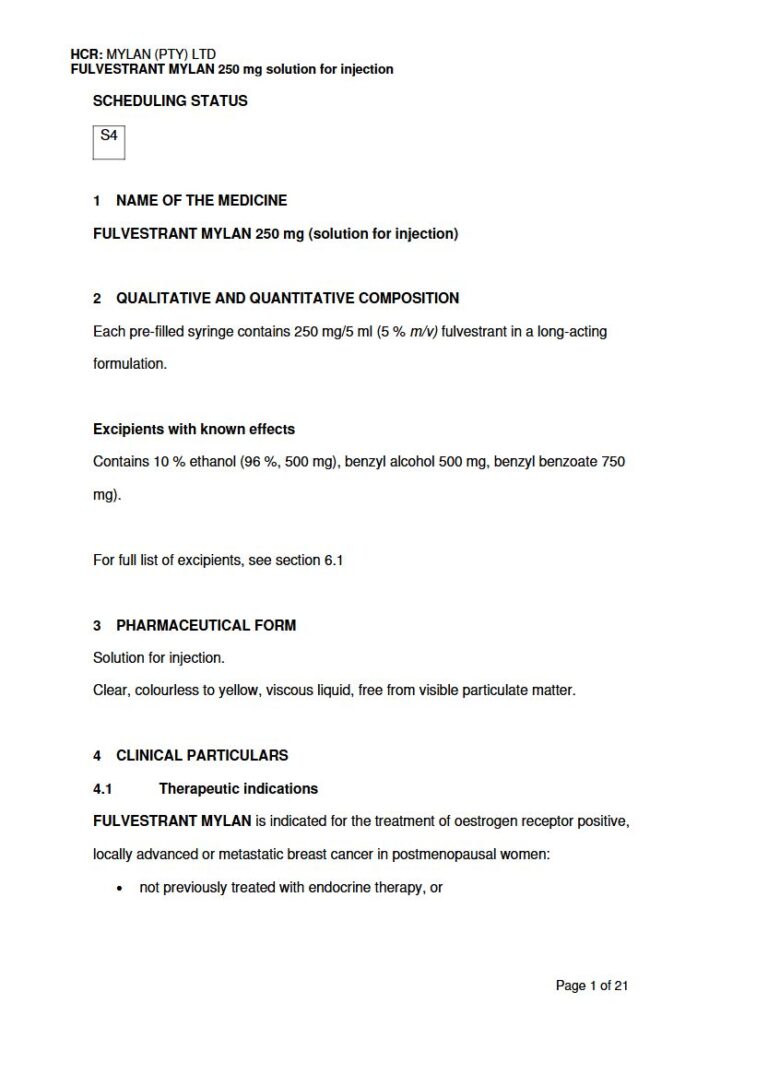
4.1 Therapeutic indications
FULVESTRANT MYLAN is indicated for the treatment of oestrogen receptor positive, locally advanced or metastatic breast cancer in postmenopausal women:
- not previously treated with endocrine therapy, or
- with disease relapse on or after adjuvant anti-oestrogen therapy, or disease progression with an anti-oestrogen.
4.2 Posology and method of administration
Posology:
Adult females (including the elderly): The recommended dose is 500 mg to be administered intramuscularly as two 5 ml injections, one in each buttock (gluteal area), at intervals of 1 month with an additional 500 mg dose given 2 weeks after the initial dose.
Special Population
Patients with renal insufficiency: No dose adjustments are recommended for patients with creatinine clearance greater than 30 ml/min. Safety and efficacy have not been further evaluated in patients with creatinine clearance less than 30 ml/min (see section 4.4).
Patients with hepatic insufficiency: No dose adjustments are recommended for patients with mild to moderate hepatic impairment. However, as fulvestrant exposure may be increased two-fold, FULVESTRANT MYLAN should be used with caution in these patients. Safety and efficacy have not been evaluated in patients with severe hepatic impairment (see section 4.3).
Elderly: No dose adjustment is required for elderly patients.
Paediatric population: Not recommended for use in children or adolescents, as safety and effectiveness have not been established in this age group (see section 5.1).
Interactions requiring dose adjustments: There are no known interactions requiring dose adjustment.
Method of Administration
It is recommended that the injection be administered slowly (1 u2013 2 minutes/injection). Caution should be taken if injecting FULVESTRANT MYLAN at the dorsogluteal site due to the proximity of the underlying sciatic nerve. Refer to section 6.6 for detailed instructions on administration.
4.3 Contraindications
FULVESTRANT MYLAN is contraindicated in:
- patients with known hypersensitivity to fulvestrant or any of the excipients (see section 6.1).
- patients with severe hepatic impairment.
- pregnancy and breastfeeding (see section 4.6).
4.4 Special warnings and precautions for use
FULVESTRANT MYLAN should be used with caution in patients with mild to moderate hepatic impairment (see section 5.2 and 4.2). Caution should be used before treating patients with severe renal impairment (creatinine clearance less than 30 ml/min). See section 4.2. Caution should be used before treating patients with bleeding diatheses or thrombocytopenia or patients on anticoagulants due to the route of administration. Thromboembolic events are observed in women with advanced breast cancer and have been observed in clinical trials with fulvestrant, as in FULVESTRANT MYLAN. This should be taken into consideration when prescribing FULVESTRANT MYLAN to patients at risk. There are no long-term data on the effect of fulvestrant on bone. Due to the mechanism of action of fulvestrant, there is a potential risk of osteoporosis.
Hypersensitivity Reactions
Hypersensitivity reactions such as angioedema and urticaria have been commonly reported (incidence of 1-10 %) and may be serious (see section 4.8). Injection site related events including sciatica, neuralgia, neuropathic pain and peripheral neuropathy have been reported with fulvestrant. Caution should be taken while administering FULVESTRANT MYLAN at the dorsogluteal injection site due to the proximity of the underlying sciatic nerve (see sections 4.2 and 4.8).
The efficacy and safety of fulvestrant have not been studied in patients with critical visceral disease.
Interference with estradiol antibody assays
Due to the structural similarity of fulvestrant and estradiol, fulvestrant may interfere with antibody based-estradiol assays and may result in falsely increased levels of estradiol (see section 4.5).
Ethanol
FULVESTRANT MYLAN contains 10 % w/v ethanol (alcohol) as an excipient, i.e. up to 500 mg per injection, equivalent to 10 ml beer or 4 ml wine. This may be harmful for those suffering from alcoholism and should be taken into account in high risk groups such as patients with liver disease and epilepsy.
Benzyl alcohol
FULVESTRANT MYLAN contains benzyl alcohol as an excipient which may cause allergic reactions. Benzoate salt may increase jaundice (yellowing of the skin and eyes) in newborn babies (up to 4 weeks old).
Paediatric population
FULVESTRANT MYLAN is not recommended for use in children and adolescents as safety and efficacy have not been established in this group of patients (see section 5.1).
4.5 Interaction with other medicines and other forms of interaction
Fulvestrant does not significantly inhibit any of the major cytochrome P450 (CYP) isoenzymes in vitro, and results from a clinical pharmacokinetic trial involving co-administration of fulvestrant with midazolam also suggest that therapeutic doses of fulvestrant will have no inhibitory effects on CYP3A4. In addition, although fulvestrant can be metabolised by CYP3A4 in vitro, a clinical study with rifampicin showed no change in fulvestrant clearance as a result of the induction of CYP3A4, and indirectly suggests that fulvestrant clearance would not be affected by CYP3A4 inhibitors. Results from a clinical study with ketoconazole, a potent inhibitor of CYP3A4, also indicated that there is no clinically relevant change in fulvestrant clearance. Dosage adjustment is not necessary in patients co-prescribed CYP3A4 inhibitors or inducers. Due to the structural similarity of fulvestrant and oestradiol, fulvestrant may interfere with antibody-based oestradiol assays and may result in falsely increased levels of oestradiol (see section 4.4).
4.6 Fertility, pregnancy and lactation
Women of childbearing potential
Patients of childbearing potential should be advised to use effective contraception while on treatment and for two years after last dose.
Pregnancy
FULVESTRANT MYLAN is contraindicated in pregnancy (see section 4.3). Fulvestrant has been shown to cross the placenta after single intramuscular doses in rat and rabbit. Studies in animals have shown reproductive toxicity including an increased incidence of foetal abnormalities and deaths (see section 5.3). If pregnancy occurs while taking FULVESTRANT MYLAN, the patient must be informed of the potential hazard to the foetus and potential risk for loss of pregnancy.
Breast-feeding
Breast-feeding must be discontinued during treatment with FULVESTRANT MYLAN. Fulvestrant is excreted in milk in lactating rats. It is not known whether fulvestrant is excreted in human milk. Considering the potential for serious adverse reactions due to fulvestrant in breast-fed infants, use during lactation is contraindicated (see section 4.3).
Fertility
The effects of fulvestrant on fertility in humans have not been studied.
4.7 Effects on ability to drive and use machines
Fulvestrant has no or negligible influence on the ability to drive or use machines. However, since asthenia has been reported frequently with fulvestrant, caution should be observed by those patients who experience this adverse reaction when driving or operating machinery (see section 4.8).
4.8 Undesirable effects
a) Summary of the safety profile
This section provides information based on all adverse reactions from clinical studies, post-marketing studies or spontaneous reports. In the pooled dataset of fulvestrant monotherapy, the most frequently reported adverse reactions were injection site reactions, asthenia, nausea, and increased hepatic enzymes (ALT, AST, ALP).
b) Tabulated list of adverse reactions
Adverse reactions listed below are classified according to frequency and System Organ Class (SOC). Frequency groupings are defined as Frequent, Less frequent and Frequency unknown. Within each frequency grouping adverse reactions are reported in order of decreasing seriousness.
MedDRA system organ class
Frequency
Adverse reactions
Infections and infestations
Frequent
Urinary tract infections
Blood and lymphatic system disorders
Frequent
Reduced platelet count
Immune system disorders
Frequent
Hypersensitivity reactions, (angioedema, uticaria)
Less frequent
Anaphylactic reactions
Metabolism and nutrition disorders
Frequent
Anorexia
Nervous system disorders
Frequent
Headache
Vascular disorders
Frequent
Hot flushes
Venous thromboembolism
Gastrointestinal disorders
Frequent
Nausea
Vomiting, diarrhoea
Hepato-biliary disorders
Frequent
Elevated hepatic enzymes (ALT, AST, ALP)
Elevated bilirubin
Less frequent
Hepatic failure, hepatitis, elevated gamma-GT
Skin and subcutaneous tissue disorders
Frequent
Rash
Musculoskeletal and connective tissue disorders
Frequent
Joint and musculoskeletal pain (e.g. arthralgia, myalgia)
Back pain
Reproductive system and breast disorders
Frequent
Vaginal haemorrhage
Less frequent
Vaginal moniliasis, leukorrhea
General disorders and administration site conditions
Frequent
Asthenia, injection site reactions
Neuropathy peripheral, sciatica
Less frequent
Injection site haemorrhage, injection site haematoma, neuralgia
c. Description of selected adverse reactions
Joint and musculoskeletal pain
In the FALCON study, of the 65 patients in the fulvestrant arm who reported joint and musculoskeletal pain, 40 % (26/65) of patients reported this within the first month of treatment, and 66,2 % (43/65) of patients within the first 3 months of treatment. No patients reported events that were CTCAE Grade u2265 3 or that required a dose reduction, dose interruption, or discontinued treatment due to these adverse reactions.
Reporting of suspected adverse reactions
Reporting suspected adverse reactions after authorisation of the medicine is important. It allows continued monitoring of the benefit/risk balance of the medicine. Health care providers are asked to report any suspected adverse reactions to SAHPRA on the SAHPRA website at: https://medsafety.sahpra.org.za/#download1, via email at: [email protected] or via telephone at: 0125010311
4.9 Overdose
There is no human experience of overdosage. Animal studies suggest that no effects other than those related directly or indirectly to anti-oestrogenic activity were evident with higher doses of fulvestrant. If overdose occurs, this should be managed symptomatically.
