
Fungistop Topical 10 mg Cream
PDF Leaflet Revision Date: 29 September 2023
Clinical Summary
Quick overview from the medicine insert
Indication
Treatment of dermatomycoses due to fungi.
Dosage (summary)
Apply thinly 2-3 times daily; duration varies by condition.
Pregnancy & Breastfeeding
Safety in pregnancy and breastfeeding not established.
Key Drug Interactions
- May damage latex contraceptives.
Contraindications
- Hypersensitivity to clotrimazole or excipients.
Common side effects
- Allergic reactions
- Contact dermatitis
- Skin irritation
Counselling Points
- Apply correctly and for sufficient duration
- Avoid contact with eyes
- Use alternative contraceptives for 5 days after application.
Serious warnings
- For external use only
- Risk of severe burns near flames.
Important Disclaimer
The Fungistop Topical 10 mg Cream professional information leaflet below is the property of Biotech Laboratories and is provided on Medinsert exactly as issued, with no.. alterations or editorial changes. We make every effort to keep content current by updating documents as soon as new versions become available. Medinsert serves as a trusted access point for healthcare professionals, but does not replace official sources or clinical judgement. For more details, please read our full disclaimer. read more>>
 Healthcare Professionals Only
This content is for registered healthcare professionals
Sign in or create a free account to read the full package insert.
Free for HPCSA-registered professionals. Powered by Medinsert.
Clinical Particulars
Section 4 of the official insert — extracted exactly as issued, no alterations
4.1 Therapeutic indications
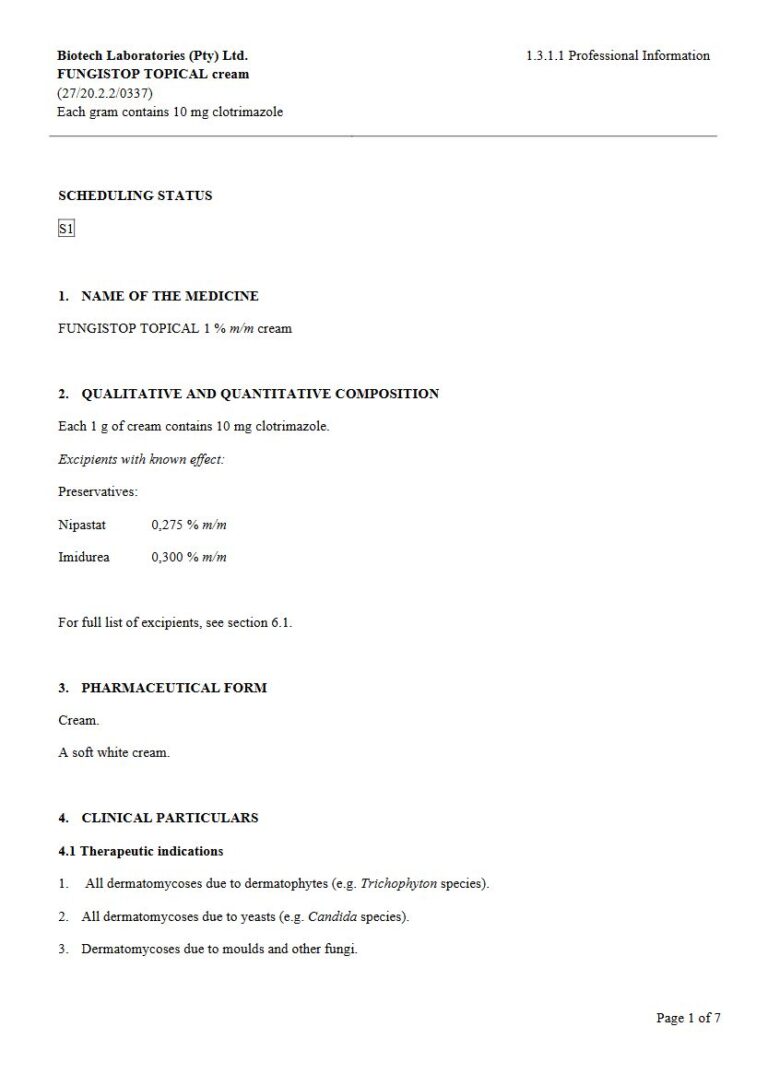
1. All dermatomycoses due to dermatophytes (e.g. Trichophyton species).
2. All dermatomycoses due to yeasts (e.g. Candida species).
3. Dermatomycoses due to moulds and other fungi.
4. Skin disease with secondary infection by these fungi. The dermatomycoses mentioned under 1 u2013 4 include among others:
- Mycoses of the skin and skin folds (e.g. fungal infections of the groin, perineum, axillae, Dhobiesu2019 or jock itch and barberu2019s itch.)
- Ringworm.
- Interdigital mycoses e.g. athleteu2019s foot.
- Candida vulvitis (vulval thrush).
- Candida balanitis (thrush of the glans penis).
- Pityriasis (Tinea) versicolor.
- Erythrasma.
- Paronychia (associated with nail mycoses).
4.2 Posology and method of administration
Posology
Apply thinly to the affected areas 2 - 3 times daily and rub in. A small amount of cream is sufficient for an area about the size of the palm.
Successful treatment demands that FUNGISTOP TOPICAL cream be applied correctly and over a sufficiently long period of time. The duration of treatment varies. In general, it is 3 - 4 weeks in the case of dermatomycoses due to dermatophytes and yeasts; in Candida vulvitis and Candida balanitis, 1 - 2 weeks; and approximately 2 - 4 weeks in erythrasma and 1 - 3 weeks in pityriasis versicolor.
Treatment of fungal infection should be continued for approximately 2 weeks after the disappearance of all symptoms despite a rapid subjective improvement, in order to prevent relapse.
Athletes foot: Always dry the feet carefully, especially between the toes.
FUNGISTOP TOPICAL cream is odourless, can be washed off and does not stain.
Method of administration
For topical use.
4.3 Contraindications
Hypersensitivity to clotrimazole or any of the excipients of FUNGISTOP TOPICAL (see section 6.1).
4.4 Special warnings and precautions for use
For external use only. Not for ophthalmic use.
Do not smoke or go near naked flames - risk of severe burns. Fabric (clothing, bedding, dressings etc) that has been in contact with FUNGISTOP TOPICAL burns more easily and is a serious fire hazard. Washing clothing and bedding may reduce product build-up but not totally remove it.
Excipients FUNGISTOP TOPICAL contains cetostearyl alcohol which may cause local skin reactions (e.g. contact dermatitis).
4.5 Interaction with other medicines and other forms of interaction
FUNGISTOP TOPICAL may cause damage to latex contraceptives. Consequently the effectiveness of such contraceptives may be reduced. Patients should be advised to use alternative precautions for at least five days after using FUNGISTOP TOPICAL.
4.6 Fertility, pregnancy and lactation
Pregnancy
Safety and efficacy of FUNGISTOP TOPICAL in pregnancy has not been established.
Breastfeeding
Safety and efficacy of FUNGISTOP TOPICAL in breastfeeding has not been established.
Fertility
No human studies of the effects of FUNGISTOP TOPICAL on fertility have been performed; however, animal studies have not demonstrated any effects of FUNGISTOP TOPICAL on fertility.
4.7 Effects on ability to drive and use machines
FUNGISTOP TOPICAL cream has no or negligible influence on the ability to drive or use machines.
4.8 Undesirable effects
As the listed undesirable effects are based on spontaneous reports, assigning an accurate frequency of occurrence for each is not possible.
Tabulated list of adverse reactions
MedDRA System Organ Class Frequency Description
Immune system disorders Frequency unknown Allergic reaction, anaphylactic reaction, angioedema, hypersensitivity.
Vascular disorders Frequency unknown Syncope, hypotension.
Respiratory, thoracic and mediastinal disorders Frequency unknown Dyspnoea.
Skin and subcutaneous tissue disorders Frequency unknown Blisters, contact allergic dermatitis 1, erythema, paraesthesia, skin peeling/ exfoliation, pruritis, rash, urticaria stinging skin/ burning sensation skin.
General disorders and administration site conditions Frequency unknown Application site irritation, oedema, discomfort/ pain.
1 If this occurs, treatment should be discontinued
Reporting of suspected adverse reactions
Reporting suspected adverse reactions after authorisation of the medicine is important. It allows continued monitoring of the benefit/risk balance of the medicine. Healthcare providers are asked to report any suspected adverse reactions to SAHPRA via the u201c6.04 Adverse Drug Reactions Reporting Formu201d, found online under SAHPRAu2019s publications: https://www.sahpra.org.za/Publications/Index/8.
4.9 Overdose
See section 4.8. In case of accidental ingestion, gastrointestinal disturbances and central nervous system depression may occur. Treatment is symptomatic and supportive.
