
Fungistop Vaginal 10 mg Cream
PDF Leaflet Revision Date: 29 September 2023
Clinical Summary
Quick overview from the medicine insert
Indication
Treatment of vaginal candidiasis.
Dosage (summary)
Insert 5 g nightly for 6 days; apply externally 2-3 times daily for vulvitis.
Special Populations
- Paediatric use (12 years and older)
Pregnancy & Breastfeeding
Use in pregnancy not established; avoid in first trimester. Discontinue breastfeeding during treatment.
Key Drug Interactions
- May reduce effectiveness of latex contraceptives
- Increased tacrolimus plasma levels
Contraindications
- Hypersensitivity to clotrimazole or excipients
Common side effects
- Allergic reactions
- Skin rash
- Abdominal pain
- Vulvovaginal discomfort
Counselling Points
- Insert cream deeply at night
- Avoid sexual intercourse during treatment
- Use alternative contraception for 5 days post-treatment
Serious warnings
- Consult doctor if no improvement in 3 days
- Avoid during menstruation
- Discontinue if irritation occurs
Important Disclaimer
The Fungistop Vaginal 10 mg Cream professional information leaflet below is the property of Biotech Laboratories and is provided on Medinsert exactly as issued, with no.. alterations or editorial changes. We make every effort to keep content current by updating documents as soon as new versions become available. Medinsert serves as a trusted access point for healthcare professionals, but does not replace official sources or clinical judgement. For more details, please read our full disclaimer. read more>>
 Healthcare Professionals Only
This content is for registered healthcare professionals
Sign in or create a free account to read the full package insert.
Free for HPCSA-registered professionals. Powered by Medinsert.
Clinical Particulars
Section 4 of the official insert — extracted exactly as issued, no alterations
4.1 Therapeutic indications
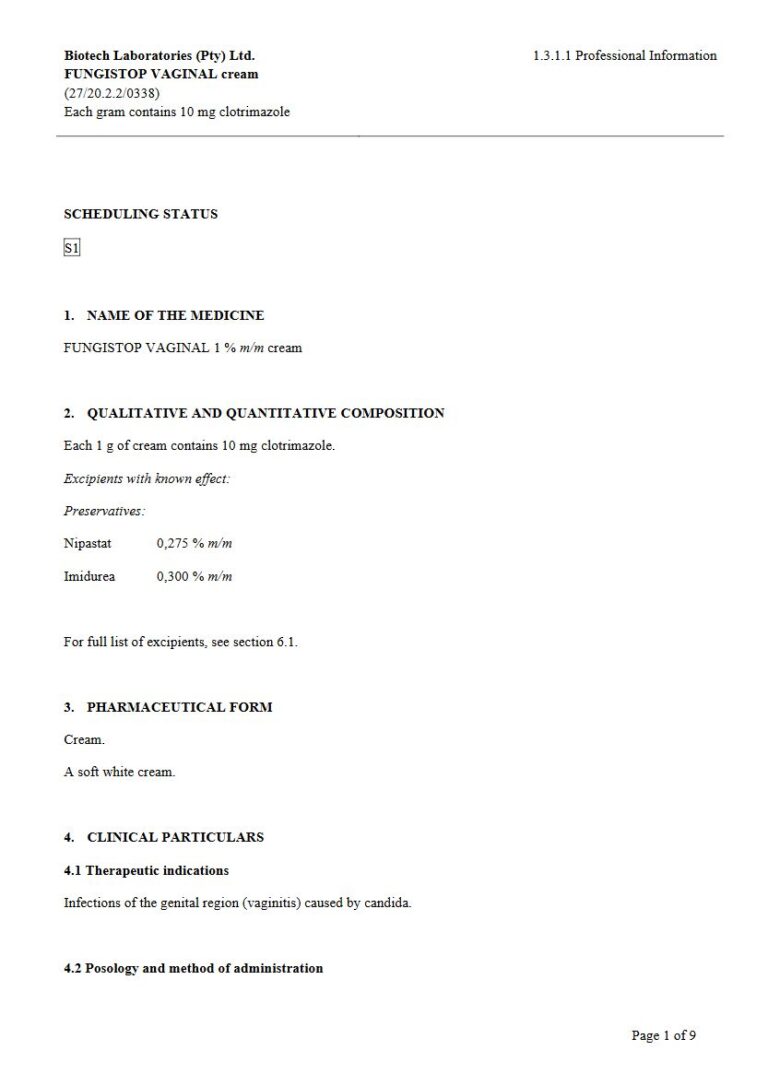
Infections of the genital region (vaginitis) caused by candida.
4.2 Posology and method of administration
FUNGISTOP VAGINAL should be inserted as deeply as possible into the vagina in the evening before going to bed. Insertion is best achieved when lying back with the legs slightly drawn up. The content of 1 applicator of FUNGISTOP VAGINAL (about 5 g) should be inserted each evening on 6 successive days. For candida vulvitis or vulvo-vaginitis the vaginal cream should be applied thinly to the external genitalia 2 - 3 times a day for 1 - 2 weeks. For the prevention of re-infection, the partner should be treated locally with clotrimazole cream at the same time. This preparation does not stain the underwear.
Method of administration
Preparation of the applicator:
- Wash hands thoroughly.
- Screw the open end of one of the applicators over the opening of the tube of cream.
- Gently squeeze the bottom of the tube so that the cream fills the applicator to the top, pushing the plunger out to almost its full extent.
- Unscrew the tube of cream and replace its cap.
Inserting the applicator:
- Carefully insert the end of the applicator as deeply as possible into the vagina. (Making sure the plunger does not fall out). This is best achieved when lying on the back with the legs pulled in a little towards the body.
- Slowly push the plunger with the forefinger until it stops.
- Remove the applicator from the vagina and discard it. Each applicator is for single use only: The surplus cream may be used to treat any inflammation of the vulva (outer vaginal area) and nearby areas. The cream should be applied thinly and rubbed in gently two to three times a day.
4.3 Contraindications
Hypersensitivity to clotrimazole or any of the excipients of FUNGISTOP VAGINAL (see section 6.1).
4.4 Special warnings and precautions for use
Use only if you have already had a vaginal yeast infection diagnosed by a medical practitioner and you have the same symptoms now, otherwise consult your doctor. These symptoms include itching and burning of the vagina and sometimes a white discharge. Patients should be advised to consult their medical practitioner if there is no improvement within 3 days or if the symptoms have not disappeared within one week of using FUNGISTOP VAGINAL.
Patients should be advised to consult a medical practitioner in the event of abdominal pain, fever or a foul-smelling vaginal discharge before or during the use of FUNGISTOP VAGINAL. Recurrent infections may indicate an underlying medical cause. Patients should seek medical advice if symptoms return within 2 months. Treatment during the menstrual period should not be performed. The treatment should be completed before the onset of menstruation. Tampons, intravaginal douches, spermicides or other vaginal preparations should not be used while using FUNGISTOP VAGINAL. Avoidance of vaginal intercourse is recommended in case of vaginal infection and while using FUNGISTOP VAGINAL. As FUNGISTOP VAGINAL may reduce the effectiveness of condoms and diaphragms, patients should be advised to refrain from sexual intercourse to prevent transmission of HIV and sexually transmitted diseases (STDu2019s) during treatment until the symptoms of candidiasis infection have resolved (see section 4.5). If skin rash or new irritation occurs, discontinue use. Contact with eyes should be avoided. Excipients FUNGISTOP VAGINAL contains cetostearyl alcohol which may cause local skin reactions (e.g. contact dermatitis).
Paediatric population
FUNGISTOP VAGINAL is intended for use by adults and children 12 years of age and older.
4.5 Interaction with other medicines and other forms of interaction
FUNGISTOP VAGINAL may cause damage to latex contraceptives, such as condoms and diaphragms, when applied on the genital area (women: intravaginally, labia and adjacent area of the vulva; men: prepuce and glans of the penis). Consequently, the effectiveness and safety of such contraceptives may be reduced. Patients should be advised to use alternative precautions for at least five days after using FUNGISTOP VAGINAL.
Concomitant use of FUNGISTOP VAGINAL with oral tacrolimus (FK-506; immunosuppressant) might lead to increased tacrolimus plasma levels and similarly with sirolimus. Patients should thus be closely monitored for signs and symptoms of tacrolimus or sirolimus overdosage, if necessary, by determination of the respective plasma levels.
4.6 Fertility, pregnancy and lactation
Pregnancy
Safety and efficacy of FUNGISTOP VAGINAL in pregnancy has not been established. There is limited amount of data from the use of FUNGISTOP VAGINAL in pregnant women. Animal studies do not indicate direct or indirect harmful effects with respect to reproductive toxicity. As a precautionary measure, it is preferable to avoid the use of FUNGISTOP VAGINAL during the first trimester of pregnancy.
Breastfeeding
Available pharmacodynamic/toxicological data in animals have shown excretion of clotrimazole and its metabolites in milk. Breastfeeding should be discontinued during treatment with FUNGISTOP VAGINAL.
Fertility
No human studies of the effects of clotrimazole on fertility have been performed, however, animal studies have not demonstrated any effects of clotrimazole on fertility.
4.7 Effects on ability to drive and use machines
FUNGISTOP VAGINAL has no or negligible influence on the ability to drive a vehicle or use machinery.
4.8 Undesirable effects
The following adverse reactions have been identified during post-approval use. Because these reactions are reported voluntarily from a population of uncertain size, it is not possible to estimate their frequency.
Tabulated list of adverse reactions
| MedDRA System Organ Class | Frequency | Description |
|---|---|---|
| Immune system disorders | Frequency unknown | Allergic reaction, anaphylactic reaction, angioedema, hypersensitivity. |
| Vascular disorders | Frequency unknown | Syncope, hypotension. |
| Respiratory, thoracic and mediastinal disorders | Frequency unknown | Dyspnoea. |
| Gastrointestinal disorders | Frequency unknown | Abdominal pain, lower abdominal cramps, nausea. |
| Skin and subcutaneous tissue disorders | Frequency unknown | Skin rash, urticaria, pruritus, contact allergic dermatitis. |
| Renal and urinary disorders | Frequency unknown | Increase in urinary frequency. |
| Reproductive system and breast disorders | Frequency unknown | Genital peeling*, vulvovaginal pruritus, rash, vulvovaginal erythema, vulvovaginal discomfort, vulvovaginal burning sensation, pelvic pain, vaginal haemorrhage, vaginal exfoliation, vaginal discharge, vulvovaginal pain. |
| General disorders and administration site conditions | Frequency unknown | Application site irritation, oedema, pain. |
* This is a result of the natural exfoliation process of removing damaged vaginal epithelium.
Reporting of suspected adverse reactions
Reporting suspected adverse reactions after authorisation of the medicine is important. It allows continued monitoring of the benefit/risk balance of the medicine. Health care providers are asked to report any suspected adverse reactions to SAHPRA via the u201c6.04 Adverse Drug Reactions Reporting Formu201d, found online under SAHPRAu2019s publications: https://www.sahpra.org.za/Publications/Index/8.
4.9 Overdose
See section 4.8. In case of accidental ingestion, gastrointestinal disturbances and central nervous system depression may occur. Treatment is symptomatic and supportive.
